
Zhong Guo Qi Che Bao Wang

Search documents
以创新装备彰显中国智造力量 中国国际消防展在京开幕
Zhong Guo Qi Che Bao Wang· 2025-10-14 07:46
Group 1 - The 21st China International Fire Equipment Technology Exchange Exhibition was held in Beijing, showcasing a record number of exhibitors and products from both domestic and international sources [1][3] - Over 1,200 exhibitors from more than 40 countries and regions participated, with a significant increase in international guests and buyer groups [3] - The exhibition covered the entire fire rescue industry chain, featuring the latest technologies in fire monitoring, firefighting, emergency rescue, and smart fire safety management, including innovative equipment like drones and robots developed in China [5][10] Group 2 - Shanghai Greman Systems showcased a "5+1" product matrix, highlighting innovations in firefighting, rescue, and emergency command scenarios [6] - Notable products included the M180GD four-wheel drive firefighting robot, high-altitude drone firefighting vehicles, and multifunctional fire trucks, all designed to address specific challenges in high-risk environments [8][10] - The exhibition served as a platform for industry experts to exchange ideas and promote the integration of innovative equipment into practical rescue operations, enhancing China's emergency response capabilities [10][12]


占比50%以上 中国重汽实力登陆第二十一届中国国际消防展
Zhong Guo Qi Che Bao Wang· 2025-10-14 07:11
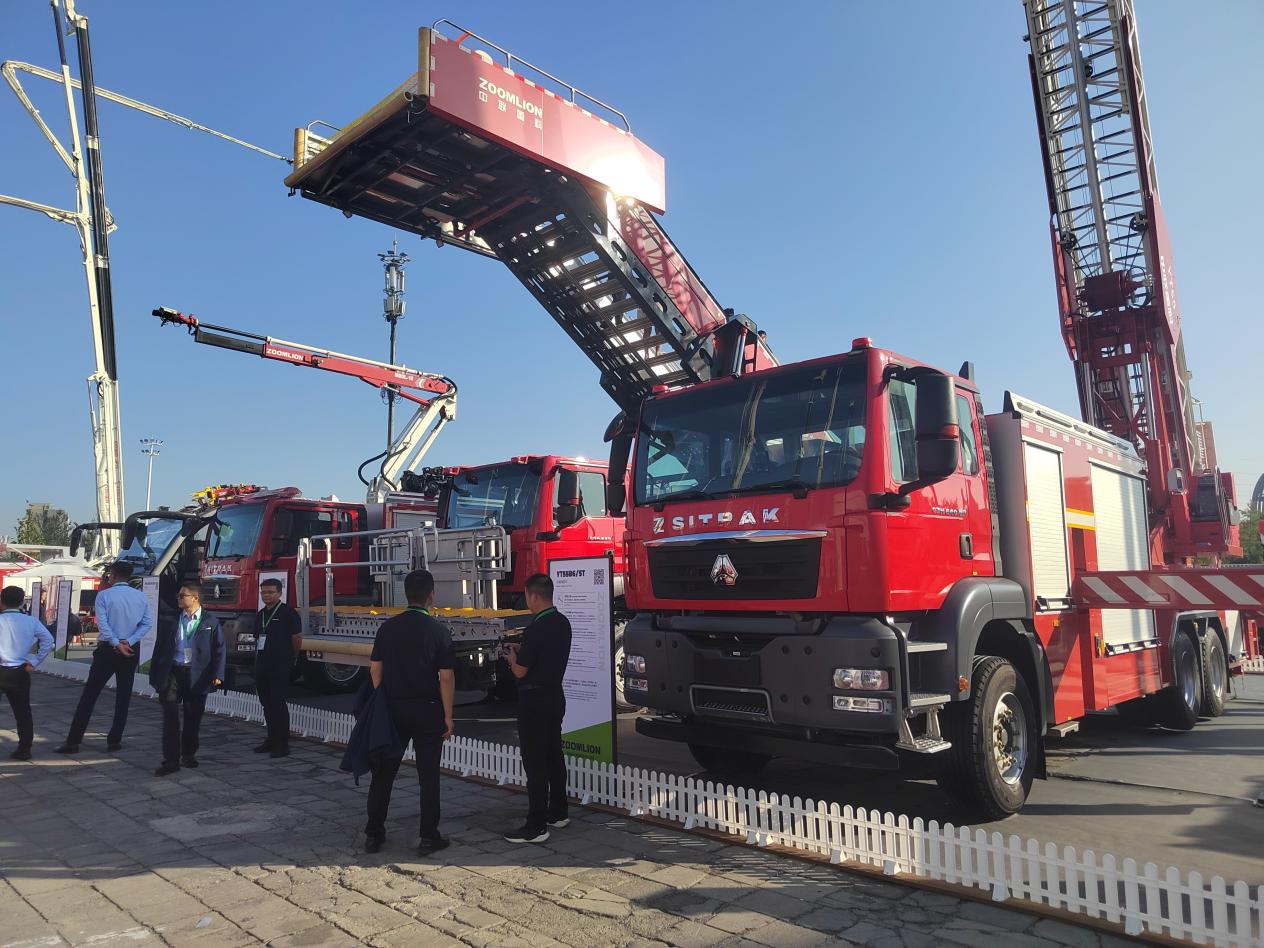
Core Viewpoint - The 21st China International Fire Equipment Technology Exchange Exhibition showcases China's leading position in the fire emergency equipment sector, with China National Heavy Duty Truck Group (CNHTC) prominently featuring its products, particularly the SITRAK series, which dominates the exhibition with over 50% of the showcased vehicles [1][10]. Group 1: Exhibition Highlights - The exhibition, held in Beijing, is a significant event in Asia's fire safety industry, attracting global cutting-edge technologies and innovative solutions [1]. - CNHTC's specialized vehicles, particularly those based on the SITRAK chassis, accounted for more than 90 vehicles out of approximately 170 fire protection heavy trucks displayed, representing over 50% of the total [3][5]. Group 2: Product Features and Innovations - The SITRAK series includes various fire emergency vehicles such as water tankers, foam fire trucks, aerial fire trucks, airport fire trucks, and rescue vehicles, designed to meet diverse emergency scenarios [5][7]. - The SITRAK chassis has undergone significant upgrades, including the transition from EGR to Hi-SCR technology for engines, enhancing reliability, economy, and lightweight design [7]. - The interior of the SITRAK vehicles has been fully upgraded, featuring a 12.3-inch central control LCD screen, safety airbags, and various advanced safety and comfort features [7]. Group 3: Market Position and Brand Influence - SITRAK, a high-end heavy truck brand created in collaboration with Germany's MAN in 2009, has established a strong market presence in over 50 countries and regions [5]. - The brand has achieved a market share of over 250,000 units in the past decade, leading the high-end heavy truck industry in China [5][10]. - CNHTC's commitment to high-end fire emergency equipment is evident in its extensive R&D capabilities and market competitiveness, aiming to elevate China's fire safety equipment to international standards [10]. Group 4: After-Sales Support - SITRAK offers comprehensive after-sales services, including unconditional on-site service, exclusive binding services, extended warranties, regular inspections, and lifetime technical support to meet user operational needs [8].

沈方俊加盟极氪出任公关总监
Zhong Guo Qi Che Bao Wang· 2025-10-14 06:52
10月13日消息,前阿里系的沈方俊已加盟极氪,担任极氪公关总监一职。沈方俊今年5月离开淘宝 公关部,此前去向未明。在加入阿里之前,他曾担任海尔集团新媒体总监,还是中国企业蓝V联盟发起 人。在阿里任职期间,他主导策划了"中国锦鲤""淘宝直播间卖火箭卫星"等多个知名案例。此次沈方俊 加盟极氪,有望凭借其丰富的经验,为极氪的公关工作带来新的思路和活力,助力极氪在市场竞争中取 得更好的成绩。 ...
经典车回归,汽车消费迎来又一增长极
Zhong Guo Qi Che Bao Wang· 2025-10-14 06:24
Core Viewpoint - The 2025 China Classic Car Rally and New Energy Vehicle Gathering aims to revive classic cars in the public eye, showcasing over 50 classic vehicles and promoting the integration of classic and new energy vehicles as part of a broader cultural and economic initiative [1][3]. Group 1: Event Overview - The event is scheduled for November 7-12, 2025, in Hainan, featuring a public tour of classic cars and new energy vehicles, along with technical exhibitions and a classic car industry summit [1]. - The rally will cover major cities in Hainan, connecting various cultural and tourism landmarks, and aims to create a "mobile museum" of classic cars [3][4]. Group 2: Industry Context - The classic car market in China has been historically marginalized due to regulatory constraints, including import restrictions and unclear definitions of classic vehicles [5][6]. - Recent policy changes from the Ministry of Commerce and other departments are aimed at developing the classic car industry, including the establishment of standards for classic car recognition [6][7]. Group 3: Economic Potential - The classic car sector is viewed as a "sunshine industry" with significant consumer potential, especially as policies evolve to support its growth [1][4]. - The integration of classic cars with new energy vehicles is seen as a way to enhance cultural heritage while promoting green technology [3][4]. Group 4: International Comparisons - Global classic car markets, particularly in Europe and the U.S., have established robust ecosystems that combine events, restoration, and trading, serving as models for China's developing market [10][11]. - Japan and Singapore have implemented effective policies to support classic car ownership and trade, contrasting with China's nascent industry [11][12]. Group 5: Future Directions - The establishment of associations and forums is underway to promote the classic car industry, focusing on standardization and resource integration [7][14]. - The classic car sector is expected to become a significant driver of automotive service consumption, with potential growth in areas like restoration, parts reproduction, and event-driven economic activities [14][15].

海外华人汽车工程师全球连线2025将于11月1日举行
Zhong Guo Qi Che Bao Wang· 2025-10-14 02:48
海外华人汽车工程师全球连线2025线上论坛活动将于2025年11月1日(周六)和11月2日(周日)举行。 本次活动议程暂定如下。更多嘉宾信息和议程安排将陆续更新,敬请大家关注。 海外华人汽车工程师全球连线2025开幕式 (19:00 - 19:20) | Claire Urry | 致辞(暂定) Chief Commercial Officer, 英中贸易协会(CBBC) | | --- | --- | | Chris Mason 先生 | 世界汽车工程学会联合会首席执行官 FISITA致辞 FISITA CEO | | 徐宏明 | 海外华人汽车工程师协会全球联盟主席。 | | 我们得 | 英国伯明翰大学先进汽车研究与教育中心主任 | | | 特邀报告主旨演讲 (19:20 - 20:20) | | lan Plummer | Commercial Director of UK Automotive Trends and | | | Chinese New Entrants Autotrader | | 居民营 | 盖世汽车总裁 中国新能源汽车产业竞争力分析 | 观众问答 (20:20 – 20:30) 全球 ...

为“她时代”幸福感助跑!女性汽车为何屡屡成为市场热点?
Zhong Guo Qi Che Bao Wang· 2025-10-14 02:48
Core Viewpoint - The automotive industry is increasingly focusing on designing vehicles specifically for women, reflecting the ideals of enhancing women's sense of gain, happiness, and safety as highlighted in the Global Women's Summit Chair's Statement [3] Group 1: Historical Context - The concept of designing cars for women dates back to the 1950s, exemplified by Chrysler's Dodge LaFemme, which featured a whimsical design and interior tailored for female consumers, although it ultimately did not achieve commercial success [4] - Nissan also targeted practical innovations for women during the same period, introducing features like umbrella holders and slope assist systems to address specific driving challenges faced by female drivers [5] Group 2: Technological Advancements - Significant technological advancements in the automotive industry have been driven by the need to accommodate female drivers, such as Cadillac's introduction of the electric starter in 1912, which made it easier for women to drive [7] - General Motors' development of the automatic transmission in the 1940s further simplified driving, making it more accessible for women [7] - The introduction of power steering by Chrysler in 1951 and subsequent advancements in steering technology have made driving more user-friendly, particularly for women [8] Group 3: Market Dynamics - Women are becoming a significant economic force, with their purchasing decisions influencing 62% of car purchases in the U.S. and over 65% in some European regions [10] - The rise of "her economy" is creating a multi-billion dollar market segment in the automotive industry, prompting manufacturers to innovate and tailor products to meet the diverse needs of female consumers [10] Group 4: Future Directions - Successful automotive design for women should evolve from superficial aesthetics to functional and experiential enhancements that address real driving challenges [11] - The future of women's automotive design should focus on emotional value and personal expression, transforming vehicles into personalized spaces that resonate with women's lifestyles and preferences [11]

共促产业跃升 2025武汉汽车制博会圆满收官
Zhong Guo Qi Che Bao Wang· 2025-10-14 02:25
Core Insights - The 2025 China International Electromechanical Products Expo and Wuhan International Industrial Expo is set to take place from October 11 to 13, 2025, in Wuhan, attracting global attention in high-end equipment and intelligent manufacturing sectors [1] - The expo covers an area of 80,000 square meters and features 1,200 exhibitors, showcasing advancements in various fields including electromechanical industry, automotive manufacturing, intelligent equipment, new energy technology, industrial automation, robotics, and green shipping [3] Group 1: Forums and Discussions - The "2025 World-Class Automotive Industry Cluster Innovation Development Conference" focuses on the latest trends in the automotive industry, emphasizing new technologies, products, scenarios, and models for transformation [5] - The "Wuhan International Embodied Intelligence Automotive Forum" discusses the application of embodied intelligence in the automotive sector, providing guidance for digital transformation [7] - The "Wuhan International New Energy and Charging Industry Development Conference" addresses innovation paths for new energy and charging industries, featuring discussions on various technical routes for commercial vehicle electrification [9] Group 2: Technological Innovations - The "Wuhan International Automotive Body Systems and Lightweight Forum" highlights the latest technologies and trends in automotive lightweighting, including new materials and high-strength steel applications [11] - The "2025 Wuhan New Energy Three Electric Technology Innovation Development Conference" focuses on advancements in three electric technologies and battery technology, promoting upgrades in the automotive and new energy sectors [13] Group 3: Industry Collaboration - The event facilitates deep collaboration among major manufacturers and component suppliers, aiming for advancements in smart driving algorithms, human-machine interaction, and performance enhancements in intelligent chassis and unmanned vehicles [7] - The expo serves as a platform for showcasing China's manufacturing capabilities and driving high-quality development in the global industrial economy [13]

评论 || “车二代”IPO热潮折射传统车企电动化突围决心
Zhong Guo Qi Che Bao Wang· 2025-10-14 02:16
Core Insights - The recent IPO wave among traditional automakers signifies a strategic shift towards capitalizing on the electric vehicle (EV) market, moving away from reliance on internal combustion engine vehicles [1][5] - The successful IPOs of companies like Lantu and Chery reflect a broader trend of traditional car manufacturers seeking to redefine their competitive positioning in the evolving automotive landscape [1][3] Group 1: IPO Trends - Lantu's introduction to the Hong Kong stock market with a market capitalization of HKD 197.2 billion marks a significant entry for traditional automakers into capital markets [1] - The IPO rush is not merely a financing activity but a strategic maneuver to break free from the constraints of the past fuel vehicle era [1][5] - The capital market's reception of traditional automakers' IPOs indicates a shift in investor sentiment, favoring companies that can demonstrate a clear transition to EVs [2][3] Group 2: Financial Performance - Zeekr's projected total revenue for 2024 is CNY 75.9 billion, representing a 47% year-on-year increase, with a gross margin of 15.6% for the fiscal year [2] - Lantu achieved profitability before its IPO, challenging the notion that traditional automakers must incur losses when entering the EV market [2] - The rapid timeline from Lantu's IPO announcement to its formal application, completed in less than 40 days, highlights the agility of traditional automakers in capital operations [2][4] Group 3: Industry Dynamics - The current timing of IPOs reflects traditional automakers' adeptness at navigating industry cycles, with a shift in focus from subsidies to infrastructure development and overseas market expansion [3][5] - The successful listing of Chery and the stock price surge of Seres indicate a positive market response to the evolving dynamics of the EV sector [3] - The transition to high-quality competition in the automotive industry is expected, moving away from mere scale and volume competition towards technology and profitability [5] Group 4: Strategic Models - Lantu's approach of introducing its shares while its parent company delisted offers a new model for traditional automakers to transition effectively [4] - The separation of EV businesses from traditional fuel vehicle operations allows companies to focus resources on core competitive areas, potentially serving as a replicable model for other automakers facing similar challenges [4] - The capitalization wave initiated by "second-generation" automakers is anticipated to reshape the competitive landscape of the Chinese automotive industry [5]
三部门明确2026年起新能源汽车购置税减免技术要求
Zhong Guo Qi Che Bao Wang· 2025-10-14 02:16
Core Points - The Ministry of Industry and Information Technology, the Ministry of Finance, and the State Taxation Administration have jointly announced a vehicle purchase tax exemption for new energy vehicles from 2026 to 2027 [1][2] - New technical requirements for pure electric passenger vehicles and plug-in hybrid vehicles (including range-extended hybrids) have been established, including specific energy consumption limits [1] Group 1: Technical Requirements for Pure Electric Vehicles - Pure electric passenger vehicles must not exceed the energy consumption limit specified in GB 36980.1—2025 for corresponding models [1] - For passenger vehicles with a maximum design total mass exceeding 3500 kg, the energy consumption limit will follow the same standard as that for 3500 kg vehicles [1] Group 2: Technical Requirements for Plug-in Hybrid Vehicles - Plug-in hybrid vehicles must have an all-electric range of at least 100 km under certain conditions [1] - Fuel consumption limits for plug-in hybrids are set at less than 70% for vehicles with a curb weight below 2510 kg and less than 75% for those at or above 2510 kg [1] - Energy consumption limits for plug-in hybrids must be less than 140% for vehicles under 2510 kg and less than 145% for those at or above 2510 kg [1] Group 3: Implementation Timeline - From January 1, 2026, vehicles listed in the "Directory of New Energy Vehicles Eligible for Vehicle Purchase Tax Exemption" must comply with the new requirements [2] - Vehicles purchased from the directory after its publication will be eligible for the tax exemption policy [2]
俄罗斯又拖全球车市后腿了
Zhong Guo Qi Che Bao Wang· 2025-10-14 02:09
Group 1 - Global automotive markets, except for Russia, showed growth in September and the first three quarters of the year, driven by various factors such as electric vehicle (EV) subsidies in the US and tax reforms in India [2] - In the US, electric vehicle sales surged before the expiration of a $7,500 subsidy, with Q3 sales exceeding 438,000 units, marking a record quarter and a market share of 10.5% [3][4] - Major automakers in the US reported increased sales, with Ford's sales up 8.2%, General Motors up 8%, and Hyundai up 13%, largely driven by electric vehicle demand [4] Group 2 - In Europe, the automotive market saw a slight increase in passenger car sales, with a total of 8.69 million units sold from January to August, a 0.4% year-on-year growth [6] - Chinese automakers, particularly BYD and SAIC, have become significant players in the European market, with BYD's sales skyrocketing by 280% [7] - The UK experienced its highest new car sales in September since 2015, driven by strong electric vehicle performance and government subsidies [8] Group 3 - India's automotive market showed resilience with a total of 3.8 million new vehicles sold in the first three quarters, a 2.3% increase year-on-year, supported by tax reforms [9][10] - The new GST 2.0 tax structure in India has significantly improved the affordability of small cars, boosting consumer confidence and sales [10] - In Japan, new car sales reached 3.465 million units in the first nine months, a 5% increase, although the market faced challenges in the latter part of the year [11][12] Group 4 - Brazil's automotive market reported a 2.9% increase in September sales, with a total of 1.91 million vehicles sold in the first nine months, driven by strong export performance [13][14] - The Brazilian government plans to reintroduce tariffs on electric and hybrid vehicles starting in 2024, aiming to stimulate local production [15] - Russian automotive sales plummeted by 23% in the first nine months, with a significant decline in new car sales due to geopolitical factors and rising costs [16][17]




