
Zhong Guo Qi Che Bao Wang

Search documents
浩思动力重构全球动力格局,多元技术路径助力汽车产业平稳过渡至净零时代
Zhong Guo Qi Che Bao Wang· 2025-09-22 03:30
Core Insights - Horse Powertrain, a new powertrain giant formed by Aurobay and Renault's Horse Technology, aims to provide a practical and efficient transition path for the automotive industry towards carbon neutrality [1] Group 1: Company Overview - Horse Powertrain inherits 125 years of powertrain R&D from Renault and Geely, with 17 production bases and 5 R&D centers globally, employing 19,000 people [2] - The company generates annual revenue of €15 billion and produces over 8 million powertrain products, serving over 130 countries and regions, making it one of the top three powertrain companies worldwide [2] Group 2: Technology and Product Offerings - Horse Powertrain's product line includes hybrid systems, alternative fuel solutions (methanol, ethanol, hydrogen, and synthetic fuels), and range extender systems [3] - The integration of technologies from Renault, Volvo, and Geely allows Horse Powertrain to cover 80% of global market demand, providing complete power solutions for various vehicle sizes [3] Group 3: Strategic Goals and Market Position - The company aims to become a global leader in efficient internal combustion and hybrid powertrains by 2035, focusing on innovation, financial excellence, market share, corporate culture, and customer collaboration [4] - Horse Powertrain's global scale advantages in procurement, R&D, manufacturing, and sales enable it to offer large-scale production solutions and system integration services to OEMs [4]
跨国车企近期纷纷聚焦这一技术路线,增程式“第二次黄金时代”开启?
Zhong Guo Qi Che Bao Wang· 2025-09-22 03:15
Core Viewpoint - The rise of range-extended electric vehicles (REEVs) marks a "second golden age" for this technology, as major automakers like Hyundai, Ford, and Stellantis are increasingly investing in REEVs to meet diverse consumer demands and overcome challenges in the electric vehicle market [2][6][10] Industry Trends - The global automotive industry is shifting towards renewable energy, with REEV technology moving from a controversial position to a central focus for multinational automakers [3][10] - Major companies are recognizing REEVs as a key technology for overcoming market challenges and achieving electrification goals, driven by a combination of market demand, technological advancements, and supportive policies [3][6] Market Demand - The rise of REEVs aligns with consumer needs for versatile vehicle usage and long-range capabilities, particularly in markets like North America where consumers prefer trucks and SUVs with extended range [3][4] - REEVs are particularly advantageous in regions with inadequate charging infrastructure, allowing for long-distance travel without range anxiety [8][10] Technological Advancements - The evolution of REEVs from "small battery, large fuel tank" to "large battery, small fuel tank" has significantly improved their range and reduced emissions [4][5] - Recent advancements in battery technology have lowered costs and allowed for larger battery capacities, enhancing the electric range of REEVs and reducing reliance on fuel generators [5][6] User Experience - REEVs are providing a superior user experience by reducing the frequency of charging and offering a quieter, more comfortable ride compared to traditional hybrid vehicles [6][7] - High customer satisfaction is reflected in a 65% repurchase rate for REEVs, compared to 42% for pure electric vehicles, indicating growing consumer loyalty [7] Future Outlook - The International Energy Agency (IEA) predicts that by 2030, REEVs will account for 18% of the global new energy vehicle market, highlighting their emerging importance alongside pure electric and hybrid vehicles [7] - Despite the promising outlook, REEVs will face competition from pure electric and hybrid technologies, necessitating ongoing innovation and adaptation [8][9] Industry Transformation - The shift towards REEVs is prompting automakers to adopt a "scene-oriented" development approach, focusing on real user needs and practical applications [9][10] - The development of REEVs is fostering a new paradigm in the automotive industry characterized by the coexistence of multiple technologies, contributing to sustainable growth [10]


中欧班列骤停:汽车供应链危机加速“重构战”
Zhong Guo Qi Che Bao Wang· 2025-09-22 02:37
Core Viewpoint - The sudden closure of the Polish border has led to significant disruptions in the supply chain for automotive parts between China and Europe, prompting Chinese car manufacturers to urgently restructure their operations to mitigate the impact [1][2]. Group 1: Impact on Supply Chain - The Central European Railway is a critical channel for transporting precision automotive parts from China to Europe, accounting for approximately 35% of the transport share. The abrupt border closure has caused a "shock" to this vital artery, leading to a deep crisis in supply chain security for the global automotive industry [2]. - The automotive industry's reliance on cross-border transport and precise timing for key components such as control systems, sensors, and battery modules makes it highly vulnerable to disruptions. If transport issues persist, major production bases in Germany, France, Czech Republic, and Slovakia may face production cuts or delays in new product launches [2]. Group 2: Chinese Automotive Companies' Response - In response to the supply crisis, Chinese automotive companies have activated emergency plans focusing on localizing production, diversifying logistics, and enhancing technological independence. BYD's local supply capabilities in Hungary now cover 80% of the Central European market, reducing transportation costs by approximately 25% [3]. - Companies are exploring new logistics patterns, such as utilizing the "China-Southeast Asia-Mediterranean" shipping route to mitigate risks associated with the Central European Railway. This includes leveraging roll-on/roll-off shipping through Vietnam and Thailand to reduce reliance on a single transport channel [3]. Group 3: Long-term Strategic Considerations - The logistics crisis serves as a warning for the entire industry, emphasizing the need for supply chain designs that balance efficiency with security in the context of geopolitical risks. Future supply chains are likely to favor "multi-point distribution" to reduce transcontinental dependencies [4]. - The incident highlights the importance of incorporating historical geopolitical factors into risk assessment mechanisms, as events like military exercises and elections can trigger supply chain disruptions [4]. Group 4: Global Automotive Market Implications - The current situation, while a challenge, also presents an opportunity for Chinese automotive companies to drive industry upgrades and strategic adjustments. The crisis underscores the necessity for supply chains to be resilient against geopolitical risks while adapting to market demand changes [6]. - The experience and strategies of Chinese companies in navigating this crisis may provide valuable insights for global automotive firms, emphasizing the need to find a precise balance between efficiency and security in an uncertain international environment [5].



工信部公开征求组合驾驶辅助标准意见,小米大批量召回SU7标准版
Zhong Guo Qi Che Bao Wang· 2025-09-22 01:44
Group 1: Industry Developments - Jingu Co. established a wholly-owned subsidiary, "Hangzhou Jingu Embodied Intelligence Technology Co., Ltd.," to enter the embodied intelligence sector, focusing on humanoid, quadruped, service, and specialized application robots, leveraging its material technology for cost-effective solutions [2] - The U.S. Department of Transportation plans to propose three new federal motor vehicle safety standards in Spring 2026, aimed at updating regulations for autonomous vehicles without manual controls, reflecting a commitment to reshape the regulatory framework for autonomous driving [2] - Tesla's Robotaxi service is now open to the public in the U.S., following a pilot program in Texas, which could accelerate the adoption of autonomous driving technology and reshape the global transportation landscape [3] Group 2: Strategic Partnerships and Collaborations - Pony.ai announced a partnership with Qatar's national transport company Mowasalat to advance autonomous driving technology in Qatar, adapting its technology to local conditions [4] - Changan Automobile launched the "Tianshu Intelligent" brand, planning to explore applications for industrial robots and family service robots by 2030, marking a shift from vehicle manufacturing to smart living services [5][6] - Uber and Momenta are set to test a joint Robotaxi project in Munich, Germany, with plans for a full launch in 2026, indicating a significant step for Chinese autonomous driving technology in international markets [9][10] Group 3: Regulatory and Safety Initiatives - The China Automotive Engineering Research Institute introduced a "smart driving pyramid grading evaluation system," providing a structured assessment of autonomous driving capabilities to guide industry development and consumer choices [7][8] - The Ministry of Industry and Information Technology is soliciting public opinions on mandatory national standards for intelligent connected vehicles, aiming to strengthen safety measures in the industry [19] - Xiaomi announced a recall of over 116,000 SU7 electric vehicles due to safety concerns with the L2 highway navigation assistance feature, demonstrating a commitment to consumer safety and industry standards [22] Group 4: Market Movements and Financial Activities - Hesai Technology completed a dual listing on the Hong Kong Stock Exchange, raising over 4.16 billion HKD, marking the largest IPO in the global lidar industry [17] - Alibaba Group made a strategic investment in Hello's Robotaxi business, enhancing collaboration in autonomous driving and accelerating the commercialization of Robotaxi services [20][21] - Horizon Robotics established its European headquarters in Munich, enhancing its operational capabilities for the global market and supporting Chinese automotive companies in Europe [11]



造大车 赚大钱
Zhong Guo Qi Che Bao Wang· 2025-09-22 01:37
Group 1 - The automotive market is currently experiencing a surge in demand for large SUVs, with models like NIO ES8, Li Auto i8, and Ledo L90 capturing significant attention due to their size and features [2][3] - More large vehicles are set to launch next year, indicating a sustained trend towards larger models in the market [2][3] - The profitability of large SUVs is highlighted by NIO's CEO, who notes that these vehicles can be produced with minimal additional costs while yielding higher margins [2][5] Group 2 - The success of large SUVs is attributed to their spaciousness, strong performance, advanced technology, and competitive pricing, making them appealing to consumers [3][4] - The increase in family sizes due to relaxed birth policies has made 6-7 seat SUVs a preferred choice for family travel, enhancing comfort and reducing travel costs [4][6] - The current market for large SUVs is less competitive, allowing manufacturers to maintain higher profit margins [6][7] Group 3 - The competition in the large SUV segment is intensifying, with potential price wars looming as more models enter the market [7][8] - Traditional luxury brands are facing pressure from large electric SUVs, which are attracting consumers who might have otherwise chosen premium brands [8][9] - The future of the large SUV market will likely see increased competition, necessitating manufacturers to enhance product quality and brand service to meet evolving consumer expectations [9]

全新凌渡L GT不熄 凌感全开
Zhong Guo Qi Che Bao Wang· 2025-09-22 01:37
全新凌渡 | GT不熄 凌感全开 | 1.5T 限时价 11.99% 13.99% ()动力总成终身质保 SAT 全版波版L GTS = 上汽大众 " 落动对网 : 即日配至2025年1月 30日 " 原 首任 非常 范年 车业 , 并报情定在上汽大众 便权经销商处进行保养及事故装修 " 具 林权益及 使用短时 请商 当地级前 高 了解详情 立創自码 ...

以创新智造引领产业升级新篇章,江淮汽车闪耀2025世界制造业大会
Zhong Guo Qi Che Bao Wang· 2025-09-22 01:32
Core Insights - The 2025 World Manufacturing Conference, themed "Intelligent Manufacturing, Creating a Better Future," was held in Hefei, Anhui, showcasing China's manufacturing achievements [1] - JAC Motors participated significantly, presenting its luxury electric flagship model, the ZunJie S800, and the hybrid MPV, the RuiFeng RF8, highlighting innovations in smart manufacturing, green travel, and supply chain collaboration [1] Group 1: ZunJie S800 - The ZunJie S800, developed in collaboration with Huawei, is produced at the ZunJie Super Factory, which is the first 5G full-link automotive manufacturing base in Anhui, utilizing over 1800 intelligent robots for fully automated and digital production [4] - The factory has been recognized as a national-level intelligent manufacturing benchmark enterprise, setting a new standard for high-end automotive smart manufacturing in China [4] - The ZunJie S800 features advanced technologies such as the HUAWEI ADS 4.0 driver assistance system and an 800V high-voltage architecture, redefining luxury standards in safety, comfort, and performance [4][6] Group 2: RuiFeng RF8 - The RuiFeng RF8, a plug-in hybrid MPV, was showcased as the official vehicle for the conference, emphasizing its spacious design and advanced comfort features [8] - It offers a comprehensive range of 1250 km and a fuel consumption of 5.4L per 100 km, balancing efficiency and stability [8] - The vehicle includes over 20 driver assistance functions and a robust safety structure, catering to high-standard travel needs during the conference [8] Group 3: Industry Collaboration and Achievements - Since its inception in 2018, JAC Motors has provided over 300 vehicles for the World Manufacturing Conference, achieving a "zero accident, zero error" service record [10] - The company has formed a "Quality Alliance" with 235 global supply chain partners, enhancing its competitive edge in the high-end smart electric vehicle market [6] - JAC Motors aims to continue its strategic partnerships and accelerate the development of intelligent new energy vehicles, contributing to China's transition from a major automotive nation to a strong automotive nation [13]


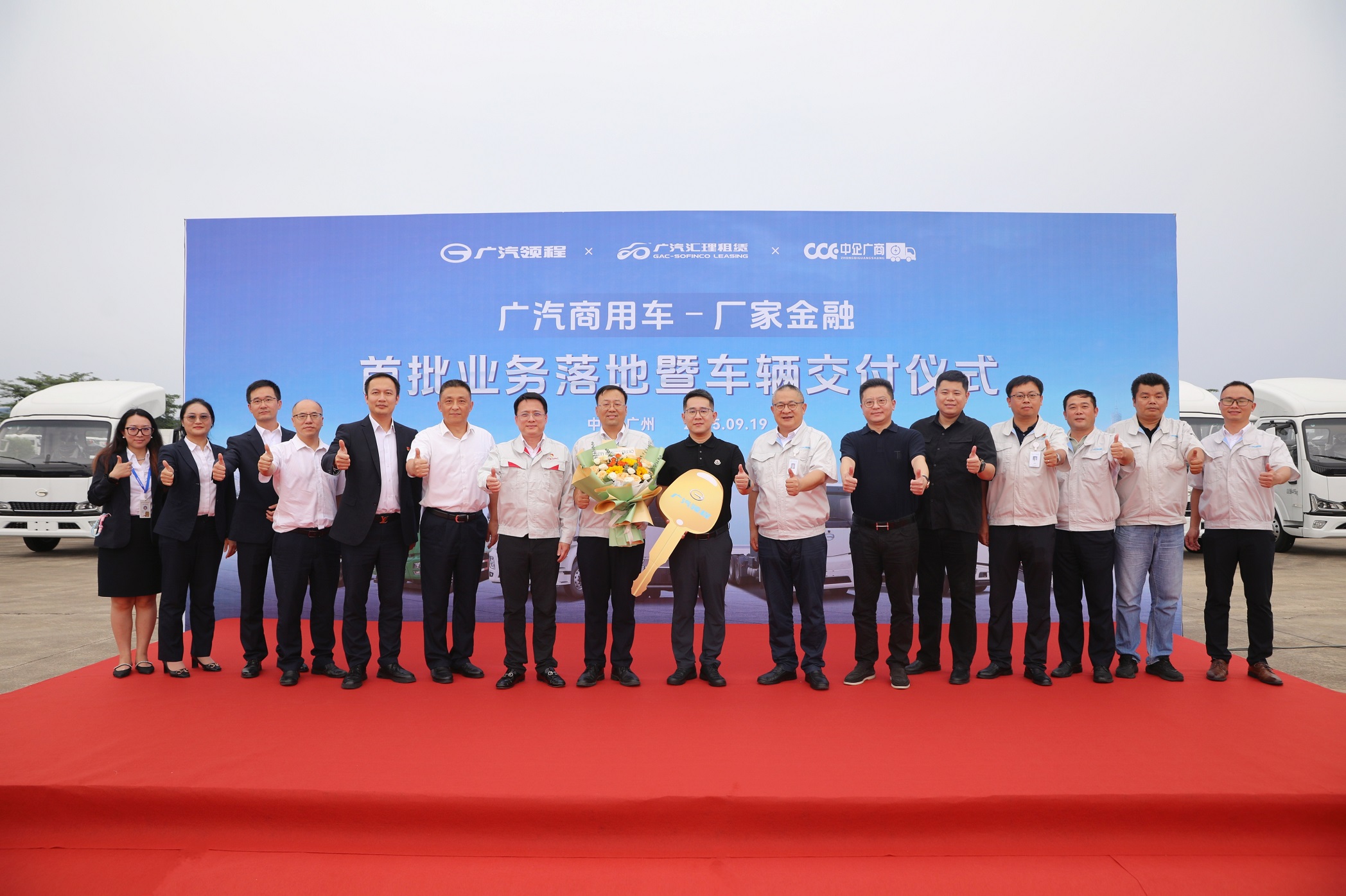
广汽商用车厂家金融首批业务成功落地,46台广汽领程轻卡圆满交付
Zhong Guo Qi Che Bao Wang· 2025-09-22 01:18
Core Insights - The launch of GAC Commercial Vehicle's financial services marks a significant advancement in the company's operations, with the delivery of 46 GAC light trucks [1][10] Group 1: Financial Services Launch - GAC Commercial Vehicle's financial service, "Green Cheng Zhi Rong," has been officially launched, facilitating the delivery of 46 light trucks [1] - This initiative represents a breakthrough in the implementation of a manufacturer financial model within GAC's commercial vehicle sector, aimed at providing flexible and efficient financing solutions for customers [3][6] Group 2: Strategic Collaboration - The collaboration between GAC Lingcheng and GAC Huiri Leasing exemplifies the integration of finance and industry, offering customized financing solutions to support vehicle upgrades and operational efficiency [6] - GAC Lingcheng's General Manager emphasized the importance of this financial service in responding to market demands and enhancing the ecosystem for new energy commercial vehicles [4] Group 3: Market Impact and Future Plans - The introduction of the financial model lowers the barriers for customers to purchase vehicles, thereby enhancing the market competitiveness of GAC Lingcheng's products [10] - Future plans include strengthening internal and external collaborations to build a comprehensive support network for commercial vehicle energy replenishment and accelerate international expansion [4][10]
第九届人单合一模式引领论坛举行,构建AI时代的智能交互生态
Zhong Guo Qi Che Bao Wang· 2025-09-22 01:15
Core Insights - The forum focused on "Organizational Intelligence: Building an Intelligent Interaction Ecosystem in the AI Era" and attracted over 400 global experts and representatives from multinational companies [3] - Zhang Ruimin, founder of Haier Group, emphasized the importance of the "Ren Dan He Yi" model in organizational innovation, highlighting the shift from passive roles to proactive creators [3][5] Group 1: Evolution of the "Ren Dan He Yi" Model - The "Ren Dan He Yi" model has evolved over 20 years, transitioning through four stages: incubation, germination, rooting, and flowering [5] - The model aims to maximize human value and has led to the elimination of over 12,000 middle management positions, disrupting traditional hierarchical structures [5][7] - The model's essence is centered on maximizing human value, allowing individuals to become autonomous innovators, which has been a continuous process of self-evolution [7][8] Group 2: Global Recognition and Application - The model has gained global recognition, with top business schools incorporating it into their curricula, including Harvard Business School, which has included 35 cases related to Haier [10] - The "Ren Dan He Yi" model has been successfully applied in Haier's acquisitions, leading to significant improvements in performance and profitability for acquired companies [9] - By 2025, the model is expected to be recognized as an international management standard, with a proposal for ISO 56012 based on it receiving a 98% approval vote [10] Group 3: Cross-Industry Applications - The second "Zero Distance Excellence Award" attracted 95 organizations from 28 countries, showcasing the model's applicability across various industries [15] - Bayer Group has adopted the model to address organizational inefficiencies, aiming for a cost-saving of €2 billion by 2025 through a new operational model [15] - The model has been implemented in various sectors, including healthcare and digital economy, demonstrating its versatility and effectiveness in enhancing organizational performance [17][18] Group 4: Future Directions - The establishment of the "Zero Distance Excellence Alliance" aims to promote the global application and innovation of the "Ren Dan He Yi" model [20] - The model is seen as a management revolution that enhances organizational vitality by maximizing individual creativity and reconstructing ecological value networks [20]


2025世界智能安全大会解析智能网联汽车测试难点与解题思路
Zhong Guo Qi Che Bao Wang· 2025-09-22 01:15
Core Insights - The 2025 FISITA Intelligent Safety Conference aims to promote global collaboration in autonomous driving safety technology, focusing on key themes such as functional safety, testing evaluation, connected cooperative driving, information security, and artificial intelligence [1] Group 1: Functional Safety and Risk Assessment - The introduction of the SOTIF (Safety of the Intended Functionality) Index 1.0 aims to address the rising number of autonomous driving accidents by establishing a comprehensive risk and capability evaluation system [3] - The SOTIF Index is designed to create a multidimensional, quantifiable measurement system to assess the maturity and confidence level of autonomous driving systems in handling expected functional safety [3] - The need for a scientific and quantifiable evaluation paradigm is emphasized to ultimately reduce the accident rate to zero [3] Group 2: Challenges in Autonomous Driving - Various factors such as different road and weather conditions increase the accident rate of autonomous vehicles, posing higher reliability challenges for Advanced Driver Assistance Systems (ADAS) [4] - The necessity to establish mechanisms for identifying unknown risks and quantifying uncertainties in AI systems is highlighted [4] - Strict adherence to traffic regulations is essential, as violations contribute significantly to accident rates [4] Group 3: Industry Development and Collaboration - The penetration rate of L2-level assisted driving in passenger vehicles reached 62.1% in the first half of the year, with steady progress in L3/L4 autonomous driving testing [5] - The importance of top-level design and policy development is stressed to address new safety challenges and enhance global and industrial collaboration [5] - The establishment of a safety assurance system is crucial for promoting healthy industry development [5] Group 4: Integrated Safety Mechanisms - The need for an integrated safety approach that combines functional safety and cybersecurity is emphasized, moving beyond traditional protective mechanisms [8] - The concept of a "traffic immune system" is proposed, inspired by the human immune system, to achieve a vision of "zero deaths" in traffic [10] - Principles derived from urban immunology can guide the deep collaboration between people, vehicles, and cities to enhance the resilience and sustainability of transportation systems [10] Group 5: Testing and Standardization Challenges - The lack of unified safety standards, liability frameworks, and testing protocols for autonomous vehicles hinders cross-regional deployment and investment [9] - Existing infrastructure, such as road and communication networks, is insufficient to support large-scale autonomous vehicle operations, particularly in rural areas [9] - The need for real-time interaction between autonomous vehicles and urban traffic management systems is highlighted, along with the current immaturity of V2X communication protocols [9]
