
Zhong Guo Huan Jing Bao

Search documents
“美丽中国 科技先行”——生态环境科技活动周主场开放活动侧记
Zhong Guo Huan Jing Bao· 2025-05-27 09:06
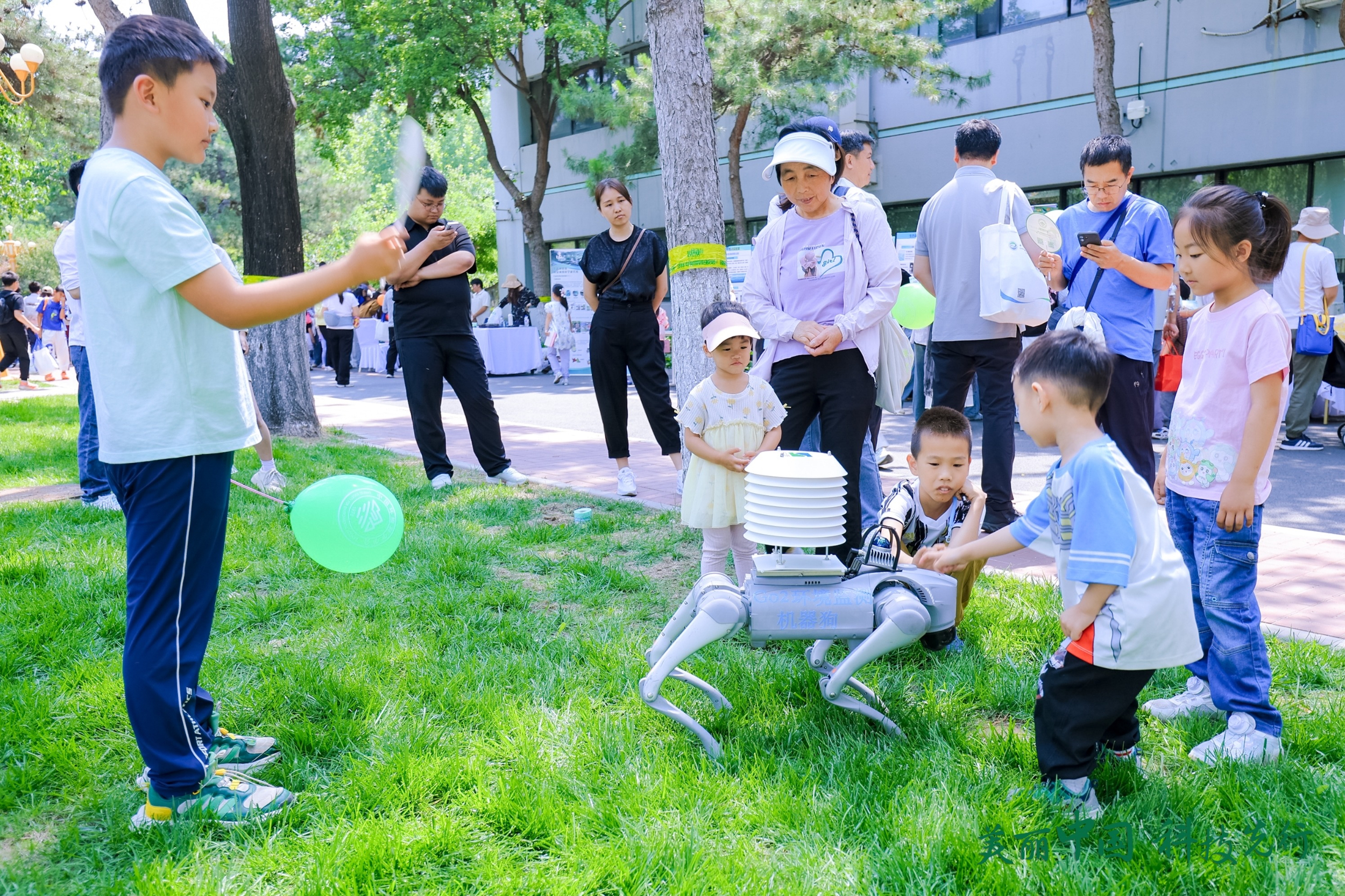
Core Viewpoint - The "Go2 Ecological Environment Monitoring Robot Dog" represents a significant advancement in environmental monitoring technology, showcasing the integration of robotics and environmental science to enhance ecological monitoring capabilities [1][2][5]. Group 1: Technological Innovation - The Go2 robot is equipped with multi-parameter sensors that allow it to monitor air quality, humidity, temperature, noise levels, and more in complex terrains [2][5]. - It can operate independently in environments without internet connectivity, demonstrating high endurance and edge computing capabilities [5]. - Future plans include collaboration with drones and unmanned boats for integrated ecological monitoring across land, sea, and air [5]. Group 2: Public Engagement and Education - The event attracted students and the public, providing hands-on experiences with the Go2 robot and other monitoring technologies, fostering interest in environmental science [1][9]. - Interactive exhibits and educational sessions were designed to enhance public understanding of ecological monitoring and the importance of environmental protection [10][14]. - Activities such as quizzes and interactive displays encouraged participants to engage with environmental issues and express their commitment to ecological conservation [16]. Group 3: Comprehensive Monitoring System - The ecological monitoring network integrates various technologies, including satellite remote sensing, drones, and automatic monitoring stations, creating a multi-dimensional monitoring framework [6][9]. - This system supports pollution prevention, ecological restoration, and emergency responses to severe weather events, providing a scientific basis for environmental management [9][10]. - Recent case studies from key regions highlight the effectiveness of this monitoring system in addressing environmental challenges [9].

发展生态循环农业,先弄懂有机肥的门道
Zhong Guo Huan Jing Bao· 2025-05-27 03:10
Core Viewpoint - The article emphasizes the importance of accelerating the green transformation of agriculture through the development of ecological circular agriculture, which integrates agricultural production with environmental protection and efficient resource utilization [1] Group 1: Organic Fertilizer Quality - The variety of organic fertilizers includes manure, compost, green manure, cake fertilizer, and peat, with both commercial and homemade options available [2] - Commercial organic fertilizers must meet national standards and be registered with agricultural authorities, with labels indicating organic matter, nutrient content, moisture, and pH [2] - Farmers should assess the quality of organic fertilizers based on color, texture, and ensure they are free from harmful residues before application [2] Group 2: Application Quantity of Organic Fertilizer - Organic fertilizers are rich in organic matter but have lower nutrient content, requiring larger application amounts; for instance, organic fertilizers made from livestock manure typically contain 2%-4% nitrogen [3] - Proper dosage is crucial; insufficient application can lead to poor crop yield and health, while excessive application can harm soil structure and microbial activity [3] - A balanced approach to application is necessary to avoid soil compaction and ensure optimal nutrient supply [3] Group 3: Combined Application of Organic Fertilizer - The integration of organic and chemical fertilizers is encouraged to enhance nutrient efficiency and crop quality, particularly in ecological and circular agriculture [4] - Mixing different types of organic fertilizers can improve yield and protein content in crops, as demonstrated in trials with broccoli [4] - Timely application of liquid organic fertilizers during critical growth stages is essential to meet immediate nutrient needs of crops [4] Group 4: Conclusion - The development of ecological circular agriculture relies on the scientific application of organic fertilizers, with a focus on understanding their properties and adjusting application methods based on local conditions and crop needs [5] - This approach aims to improve soil quality, ensure crop yield and product quality, while minimizing environmental risks associated with over-application [5]
恢复官厅水库饮用水水源功能,清淤为何关键?
Zhong Guo Huan Jing Bao· 2025-05-27 02:01
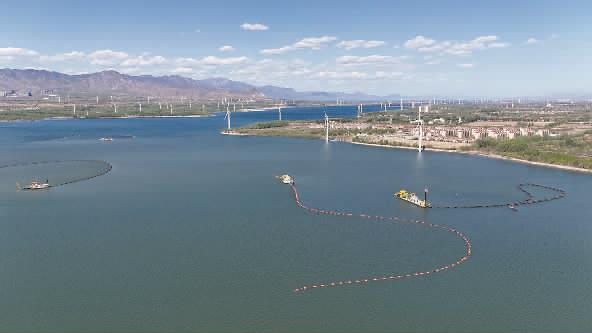
春日的官厅水库,绿如宝石般镶嵌在京冀两地交界处。一艘名为"浚澜"的环保型绞吸式挖泥船伫立于波 光粼粼的水面。 在水下,"浚澜"配备的环保绞刀正在高速飞转,水库底部的淤泥被绞打成泥水混合物,通过水下泵和舱 内泵"串联接力",一口气被"快递"到5公里以外的相变式真空预压脱水施工现场进行无害化处置。 官厅水库要恢复饮用水水源功能,清淤是关键。 国务院批复的《全国重要江河湖泊水功能区(2011—2030)》将官厅水库水功能区类型定位为北京市水 源地保护区,水质标准为地表水Ⅱ类,规划于2030年达标。 《北京城市总体规划(2016年—2035年)》计划到2035年,恢复官厅水库饮用水源功能。 据了解,官厅水库清淤试点工程已于2024年4月20日正式启动。项目将用730天完成近3.09平方公里水库 区内约1153.87万立方米的底泥清淤任务。清淤船"浚澜"日前投用到这一试点,将完成接下来的清淤任 务。 不过,此次清淤面积广、淤泥量大,如何在清淤过程中既不扰动环境、不破坏水质,又能环保高效如期 完成试点任务? 重点治理——聚焦淤积"重灾区"和坝前漏斗区等地清淤 官厅水库总库容41.6亿立方米,建成至今已有71年的历史。由于 ...
推动机动车环境监管提质增效,要抓好这三方面
Zhong Guo Huan Jing Bao· 2025-05-27 01:46
Group 1 - The core viewpoint of the news is the issuance of guidelines by nine departments, including the Ministry of Ecology and Environment, to enhance vehicle pollution control and environmental supervision, emphasizing the need for local governments to identify and address existing issues in vehicle environmental regulation [1] Group 2 - The establishment of a collaborative and efficient governance system is crucial, with clear task division and responsibility boundaries among local environmental, public security, and transportation departments to ensure accountability and prevent shirking of duties [2] - Strengthening capacity building is necessary, including the development of a scientific training system for enforcement personnel and equipping them with advanced detection devices to enhance regulatory capabilities [2] - The performance of vehicle pollution control should be integrated into annual assessments of local governments, with specific quantitative indicators set to motivate effective governance [2] Group 3 - Institutional innovation is needed to improve overall regulatory efficiency, including the implementation of "one-stop" joint law enforcement to streamline processes and enhance collaboration among various departments [3] - Innovative service models should be developed to facilitate public access to vehicle inspections and maintenance, particularly for small transport enterprises, ensuring that regulatory measures are both effective and considerate [3] - A mechanism for public participation in supervision should be established, including a platform for real-time disclosure of enforcement results and a reward system for reporting violations [3] Group 4 - Technological empowerment is essential for creating a smart and precise regulatory model, with the provision of intelligent handheld detection devices and mobile monitoring equipment to enhance enforcement accuracy [4] - The establishment of a grid-based regulatory platform at the county level can facilitate targeted governance by integrating various data sources and creating an electronic environmental record for each vehicle [4] - The application of data analytics, including artificial intelligence, can help identify high-emission vehicle areas and optimize enforcement resource allocation based on pollution patterns [4]
以奋斗姿态,向美丽上海建设目标迈进
Zhong Guo Huan Jing Bao· 2025-05-27 01:23
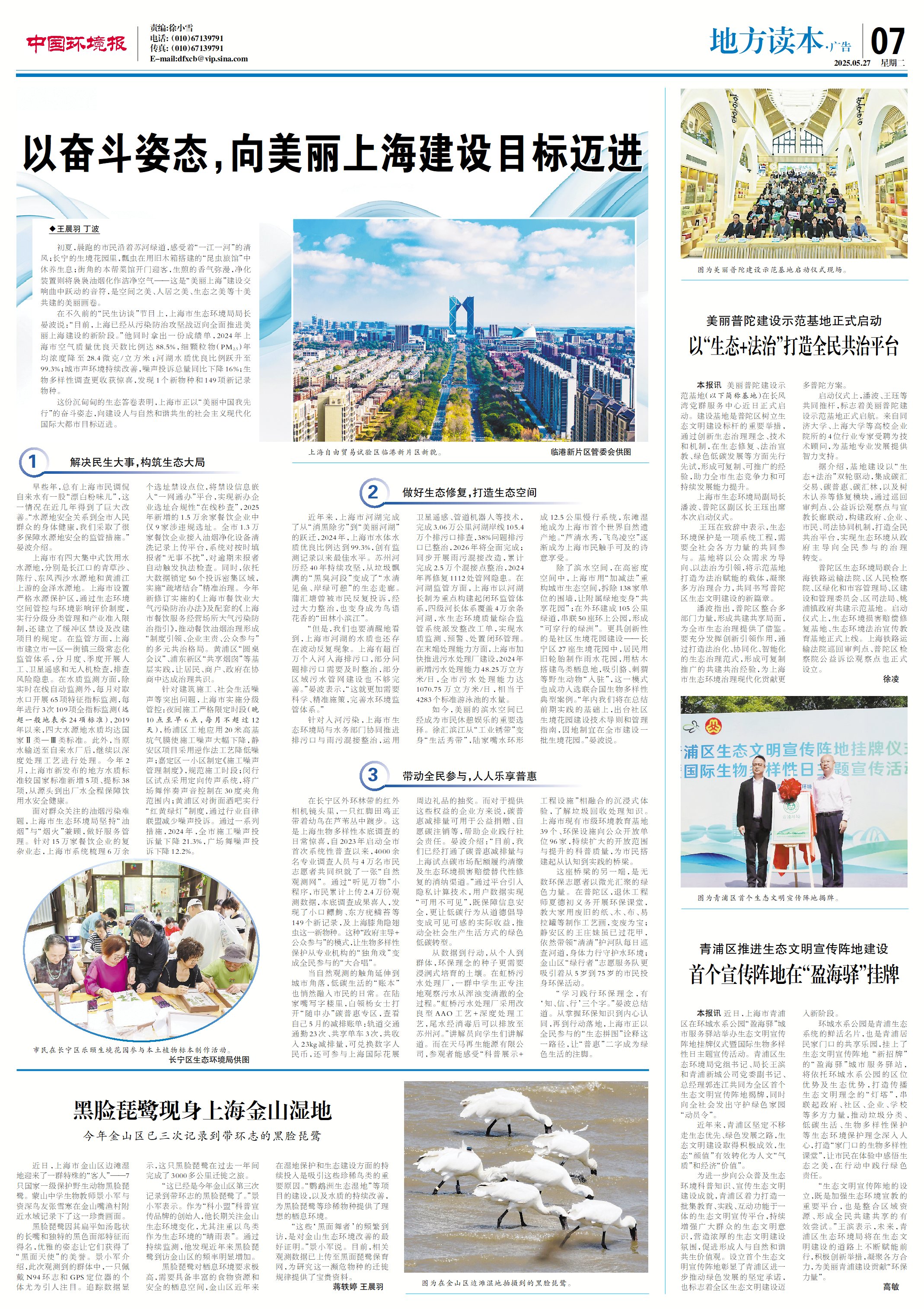
责编:徐小雪 电话:(010)67139791 传真:(010)67139791 E-mail:dfxcb@vip.sina.com 以奋斗姿态,向美丽上海建议 上海自由贸易试验区临港新片区新貌。 解决民生大事,构筑生态大局 早些年,总有上海市民调侃 自来水有一股"漂白粉味儿",这 一情况在近几年得到了巨大改 善。"水源地安全关系到全市人民 群众的身体健康,我们采取了很 多保障水源地安全的监管措施。" 晏波介绍。 上海市有四大集中式饮用水 水源地,分别是长江口的青草沙、 陈行、东风西沙水源地和黄浦江 上游的金泽水源地。上海市设置 严格水源保护区,通过生态环境 空间管控与环境影响评价制度, 实行分级分类管理和产业准入限 制,还建立了缓冲区禁设及改建 项目的规定。在监管方面,上海 市建立市一区一街镇三级常态化 监管体系,分月度、季度开展人 工、卫星遥感和无人机检查,排查 风险隐患。在水质监测方面,除 ◆王晨羽 丁波 初夏,晨跑的市民浩着苏河绿道,感受着"一江一河"的清 风;长宁的生境花园里,瓢虫在用旧木箱搭建的"昆虫旅馆"中 休养生息;街角的本帮菜馆开门迎客,生煎的香气弥漫,净化 装置则将袅袅油烟化作洁净空气 - ...
数字技术如何更好赋能长江流域综合治理?
Zhong Guo Huan Jing Bao· 2025-05-27 00:10
Core Insights - The article emphasizes the importance of digital empowerment in the comprehensive governance of the Yangtze River Basin, highlighting the need for modern information technology to transform governance concepts and methods [1] Digital Technology Application Achievements - Significant progress has been made in the construction of digital twin projects such as the Digital Twin Three Gorges, Digital Twin Danjiangkou, and Digital Twin Han River, which have completed their initial construction tasks [2] - A comprehensive water monitoring system has been established, integrating aerial, terrestrial, and satellite data to support the digital twin of the Yangtze River [2] - Enhanced monitoring capabilities have been achieved through the deployment of hydrological stations and the use of drones and 3D laser scanning systems, improving data collection on hydrology, water quality, and ecology [2] Disaster Prevention and Control - The integration of multi-source data fusion algorithms has improved disaster prevention capabilities, creating a comprehensive forecasting and warning system for the entire river basin [2] Green Transformation and Industrial Upgrade - Digital technology is providing new pathways for green development in the Yangtze Economic Belt, with smart shipping systems utilizing 5G, Beidou navigation, and AI to enhance efficiency and reduce emissions [3] Challenges in Digital Technology Application - Data sharing obstacles exist due to diverse data sources and formats, leading to difficulties in forming unified data standards and hindering deep analysis [4] - The depth of digital technology application is insufficient, with many core technologies relying on foreign imports and lacking integration across various technologies [4] - There is a shortage of composite digital talent required for effective governance, as existing educational and training systems do not meet the practical needs of the industry [5] Recommendations for Improvement - Establish a cross-departmental data sharing system and create a national-level regulatory framework to facilitate data sharing among relevant departments [7] - Focus on core technology development and promote domestic technology products to enhance the application of digital technologies in governance [7] - Accelerate the construction of digital infrastructure, including expanding network coverage and optimizing data center locations to support real-time data processing [8] - Develop a comprehensive talent cultivation system to support the digital governance of the river basin, integrating education with industry needs [8]
北京师范大学张立:建立碳普惠市场,激活消费端巨大减排潜力
Zhong Guo Huan Jing Bao· 2025-05-26 23:22
Core Viewpoint - The establishment of a carbon-inclusive market is essential to address the structural gap in China's carbon market, which currently focuses on production-side emissions reduction while neglecting the consumption-side [1] Group 1: Carbon Inclusive Market Overview - The carbon-inclusive market targets individuals, families, communities, and small enterprises, effectively activating the significant emissions reduction potential on the consumption side [1] - It employs a voluntary participation model based on "behavior-quantification-incentive," transforming everyday low-carbon actions into standardized carbon reduction metrics with economic value [1][2] Group 2: Public Engagement and Behavioral Change - The carbon-inclusive market aims to bridge the "willingness-behavior" gap by quantifying and visualizing low-carbon actions, making emissions reductions measurable and traceable [2] - Diverse incentive measures are implemented to motivate public participation, integrating economic value, social recognition, and service benefits tailored to different demographics [2][3] Group 3: Institutional Channels for Public Participation - The market provides institutional channels for public involvement in environmental governance, creating a positive feedback loop of "public behavior-market signal-policy adjustment" [3] - It addresses data silos through a government-led public platform that connects multi-source data, simplifying public participation in emissions reduction [3] Group 4: Support for Small and Medium Enterprises (SMEs) - The carbon-inclusive market lowers participation barriers for SMEs, which often struggle to engage in existing carbon markets due to their size and capabilities [4] - It opens up diversified revenue channels for SMEs, allowing them to earn from emissions trading and benefit from policy incentives like government green procurement [4][5] Group 5: Policy Recommendations and Implementation Path - Systematic institutional and strategic support is necessary for building a robust carbon-inclusive market, including top-level design and regulatory frameworks [6] - Technological infrastructure should be developed using big data, blockchain, and IoT to create a unified carbon-inclusive platform for data integration [6][7] - A multi-faceted incentive mechanism is recommended, combining economic, policy, and social incentives to enhance participation effectiveness [6][7] Group 6: Regional Collaboration and Capacity Building - Regional collaboration should follow a "pilot first, gradient promotion, regional linkage" principle, focusing on areas like Beijing-Tianjin-Hebei and the Yangtze River Delta [7] - Capacity-building initiatives are essential to enhance government oversight, corporate emissions management, and public engagement [7]
构建“横向到边、纵向到底”责任体系!陕西优化排污许可审批联审联查
Zhong Guo Huan Jing Bao· 2025-05-26 04:04
Core Viewpoint - The recent notification from the Shaanxi Provincial Ecological Environment Department aims to enhance the approval and inspection mechanism for pollutant discharge permits, ensuring accurate issuance and effective management of these permits [1][2]. Group 1: Notification Details - The notification outlines the responsibilities of the Shaanxi Provincial Ecological Environment Department in approving key management pollutant discharge permits for new, modified, or expanded projects [1]. - A comprehensive responsibility system is established to eliminate "sick approvals," with a focus on collaboration between enforcement and approval departments [1]. - The approval process is optimized, with a commitment to complete material reviews within 3 days, joint reviews within 5 working days, and a total processing time of 45 working days from application to permit issuance [1]. Group 2: Accountability and Information Sharing - Department heads are designated as the primary responsible individuals for the permit issuance process, ensuring quality and efficiency [2]. - An information-sharing mechanism is established, requiring departments to report issues encountered during the review process and propose solutions [2]. - Enforcement departments are tasked with providing timely feedback on issues related to the implementation of pollutant discharge permits, aiding in the optimization of environmental control requirements [2].
陕西佛坪县委书记王晴:坚持生态立县、林药兴县、旅游强县,助推高质量发展
Zhong Guo Huan Jing Bao· 2025-05-26 03:25
Core Viewpoint - Foping County in Hanzhong City, Shaanxi Province, is focusing on ecological protection, tourism development, and industrial transformation to achieve high-quality economic growth while enhancing environmental sustainability [1] Group 1: Ecological Protection Initiatives - Foping County is implementing integrated protection and systematic governance of mountains, waters, forests, fields, lakes, grasslands, and deserts, aiming to create a model for beautiful China [2] - The county has established a comprehensive management mechanism for ecological protection, addressing 32 issues identified by ecological environment inspections [2] - The forest coverage rate in the county has increased to 91.2%, with all historical mining sites undergoing ecological restoration [2][3] Group 2: Water and Air Quality Management - Foping County is advancing a three-year action plan for water management, achieving stable water quality at Class II or above [2] - The county aims for an air quality improvement rate of 98.6% by 2024 through pollution prevention measures and monitoring [2] Group 3: Biodiversity Conservation - A collaborative mechanism for biodiversity protection has been established, focusing on the conservation of species such as the giant panda, with successful breeding and rescue programs [3] Group 4: Economic Transformation and Development - Foping County is leveraging its natural resources to develop new productive forces and explore five pathways for realizing the value of ecological products [4] - The tourism sector is being enhanced through new business models, with an annual growth rate of over 22% in comprehensive tourism revenue [4] - The county is developing green energy projects, including pumped storage and photovoltaic power generation, to create a new energy system [4][5] Group 5: Aquaculture and Digital Economy - Foping County is expanding its cold-water fish farming industry, becoming the largest cold-water fish export county in Northwest China [5] - The county is enhancing its digital infrastructure and e-commerce capabilities, with a projected 16.57% increase in e-commerce transaction volume in 2024 [6]
行业观察丨碳约束下的水泥业变局:落后产能加速淘汰,绿色转型成新赛道
Zhong Guo Huan Jing Bao· 2025-05-26 02:45
Core Viewpoint - The inclusion of the cement industry in the national carbon emissions trading market signifies a profound transformation in cost, technology, and competitive landscape, presenting both challenges and opportunities for industry transformation [1] Group 1: Industry Challenges - The Chinese cement industry is experiencing its most severe downturn in nearly a decade, with a projected reduction of 550 million tons in national cement production by 2024 compared to 2021, leading to pressure on the market capitalization of listed companies [1] - The decline in real estate investment and infrastructure growth has resulted in a "cliff-like" drop in cement demand, exacerbated by overcapacity and intense competition among companies [2] - The industry faces challenges such as reduced mutual trust among enterprises and chaotic competition, making effective collaboration difficult and intensifying market confusion [2] Group 2: Opportunities from Carbon Market Inclusion - The implementation of the carbon emissions trading market is expected to drive the cement industry from a high-carbon path to a low-carbon competitive landscape, accelerating innovation and application of low-carbon technologies [3] - The carbon market will encourage companies to adopt advanced production processes, improve energy efficiency, and reduce carbon emissions, enhancing their market competitiveness and promoting a positive green brand image [3][4] - Companies can generate new revenue streams by selling surplus carbon allowances, attracting investments from green funds and financial institutions, thereby broadening financing channels and reducing costs [4] Group 3: Long-term Implications - The carbon market will necessitate increased investments in energy-saving renovations, low-carbon technologies, and materials to lower carbon emission intensity, which is essential for reducing costs associated with purchasing shortfall allowances [5] - The initial phase of the carbon market implementation (2024-2026) provides a transition period for the cement industry, allowing it to adapt without losing price advantages compared to non-participating companies [6] - Despite current market demand decline, the cement industry is expected to remain a crucial raw material in the construction sector due to the large economic scale of the country [6]