
Zhong Guo Huan Jing Bao

Search documents
山东以法治之笔绘就美丽新画卷
Zhong Guo Huan Jing Bao· 2025-12-18 02:00
Core Viewpoint - Shandong Province is advancing its ecological environment legal system through training and reforms, focusing on enhancing legal awareness and practical skills among officials and stakeholders in the environmental sector [2][3][13]. Group 1: Training and Capacity Building - High-level training sessions have been conducted in Shandong to address ecological environment damage compensation, focusing on policy ambiguities and practical challenges [2][11]. - The training integrates Xi Jinping's legal and ecological civilization thoughts, aiming to improve legal literacy and practical skills among participants [11][13]. Group 2: Legal Framework and Administrative Norms - The Shandong Provincial Ecological Environment Department emphasizes the establishment of a robust legal framework and standardized administrative practices to enhance governance [3][14]. - A total of 155 documents have undergone legality and fair competition reviews to prevent illegal administrative actions [14][15]. Group 3: Regulatory Oversight and Compliance - The department has developed a checklist for ecological environment administrative inspections and established a 2025 inspection plan to standardize procedures [4][15]. - Special supervision has been conducted in five cities, identifying and correcting 66 non-compliance issues in administrative inspections [4][15]. Group 4: Standards Development and Implementation - Shandong is advancing its environmental standards, including the revision of key pollution discharge standards and the introduction of new regulations for wastewater treatment [5][16]. - The province is conducting systematic reviews of local environmental standards, ensuring they remain relevant and effective [17]. Group 5: Legal Services and Support for Enterprises - The "Law + Service" approach is being implemented to address legal concerns of enterprises, with over 7000 companies receiving assistance through various initiatives [18][19]. - Specific efforts are being made to revise emission standards in response to industry feedback, particularly in the rubber products sector [18][19]. Group 6: Public Awareness and Education - Shandong is actively promoting legal awareness through various outreach programs, including community and school initiatives to educate the public on environmental laws [20].

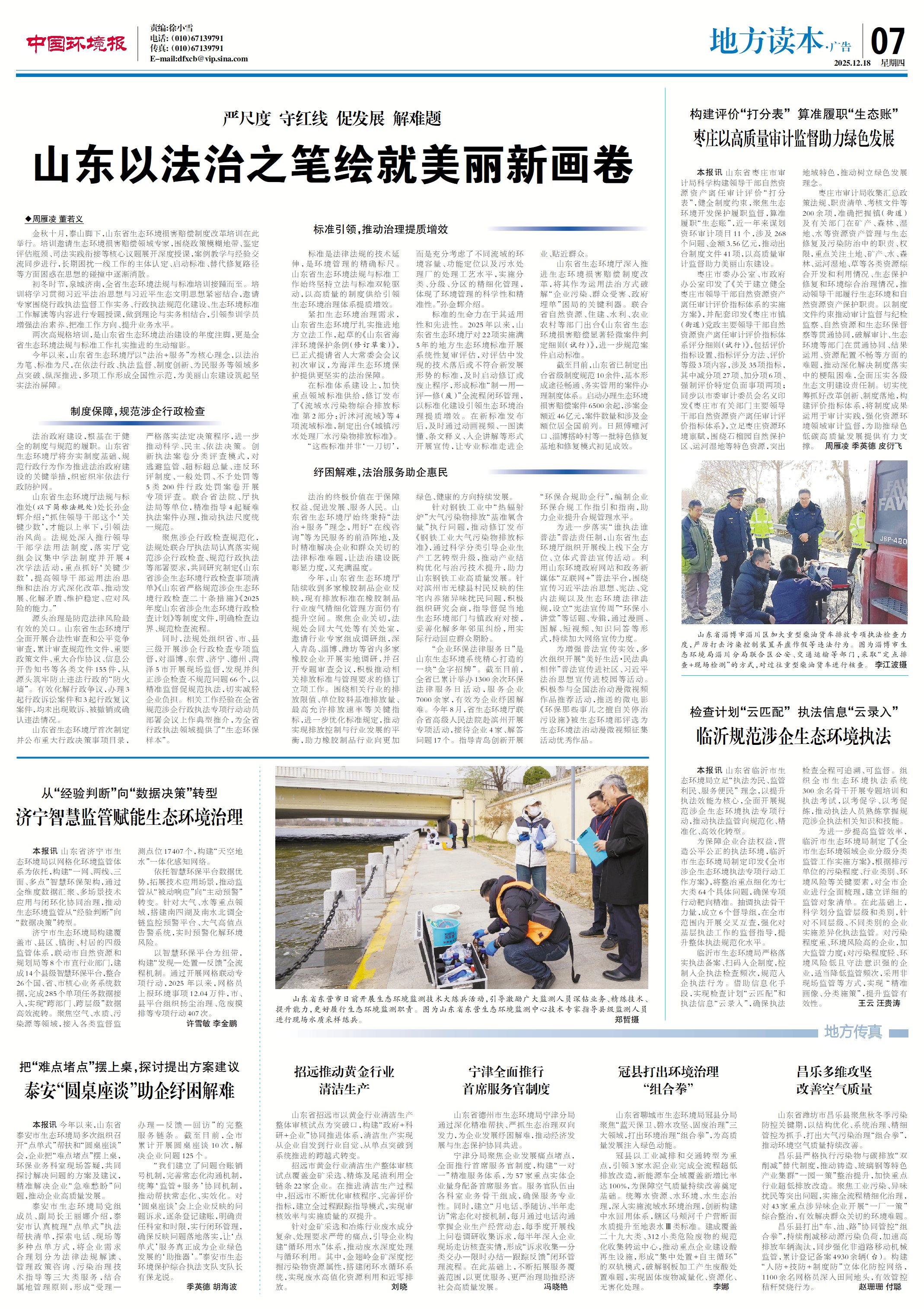
武汉“无废”答卷书写超大城市绿色嬗变
Zhong Guo Huan Jing Bao· 2025-12-18 02:00
Core Viewpoint - Wuhan is advancing its "waste-free city" initiative, integrating solid waste management with ecological protection and urban development, contributing a replicable model for solid waste governance in large cities since its inclusion in the national "waste-free city" list in April 2022 [1] Group 1: Strategic Framework - Solid waste management is identified as a critical bottleneck for sustainable urban development and a key test of governance capabilities in mega cities [2] - Wuhan has established a comprehensive regulatory framework, including the "Implementation Plan for Waste-Free City Construction" and the "Environmental Protection Measures for Solid Waste Pollution," to support its waste management efforts [2] - The city has developed a robust legal and policy system covering five major solid waste areas, ensuring that waste management is legally compliant and systematically organized [2] Group 2: Organizational Support - A leadership group for the "waste-free city" initiative has been formed, led by the city's main government officials, to ensure coordinated efforts across 16 districts and 28 departments [3] - The city has implemented a multi-faceted governance model that includes government leadership, departmental collaboration, and community participation [3] - Wuhan has established the largest circular economy benchmark in Central China, the Qianzi Mountain Circular Economy Industrial Park, with an investment of approximately 5.6 billion yuan, capable of processing 2 million tons of solid waste annually [3] Group 3: Technological and Regulatory Advancements - The city is enhancing its digital regulatory capabilities by creating a comprehensive information management platform for solid waste, ensuring traceability and accountability in waste generation and disposal [4] - A closed-loop management model for hazardous waste has been developed, incorporating early warning systems and lifecycle risk management [4] Group 4: Sector-Specific Initiatives - In the industrial sector, Wuhan has established 204 municipal "waste-free factories" and 82 national-level green factories, reducing industrial solid waste generation intensity from 0.31 tons per 10,000 yuan in 2020 to 0.27 tons per 10,000 yuan by 2024 [5] - The agricultural sector has achieved a comprehensive utilization rate of 95.9% for crop straw, with a resource utilization system that includes over 40 resource utilization entities [6] - The city has built a recycling network for waste resources, achieving a recycling rate of 86.12% through a system of community recycling stations and sorting centers [7] - For construction waste, Wuhan has developed a comprehensive disposal system with a resource utilization rate projected to reach 70% by 2024 [8] - Hazardous waste management has been strengthened, with a 100% safe disposal rate and an increase in comprehensive utilization from 36% in 2020 to 60.24% by 2024 [9] Group 5: Community Engagement and Awareness - Wuhan has created 1,640 "waste-free cells" across various community settings, promoting the "waste-free" concept in daily life [10] - The city encourages the development of unique local brands for waste management, enhancing the effectiveness of the "waste-free city" initiative [11] - A comprehensive public awareness campaign has been launched, utilizing various media and community engagement strategies to promote the "waste-free" philosophy [11] Group 6: Future Goals - Wuhan aims to continue its "waste-free city" construction as a key support for high-quality urban development, focusing on collaborative efforts in waste reduction, resource utilization, and harmless disposal [12]
深圳:一张“绿色名片”如何影响企业真金白银
Zhong Guo Huan Jing Bao· 2025-12-18 02:00
Core Viewpoint - Shenzhen's environmental credit system is evolving to redefine corporate environmental responsibility, emphasizing both regulation and service, as well as punishment and incentives [1] Group 1: Environmental Credit Evaluation System - Shenzhen's environmental credit evaluation began in 2011 and has become a leading system in China, with a comprehensive upgrade in 2023 to include all pollution permit management and key regulatory units [2] - The evaluation process has been automated, improving accuracy and efficiency by integrating data from administrative penalties and other business systems [2] Group 2: Evaluation Indicators - The revised evaluation indicators include 20 penalty items and 14 reward items, reflecting a balance of strict regulation and encouragement for self-improvement [3] - Penalty items now include non-compliance with administrative penalties, allowing for correction opportunities for minor violations, while reward items incorporate "dual carbon," environmental compliance, and ESG-related criteria [3] Group 3: Dynamic Evaluation Mechanism - The evaluation is conducted quarterly, allowing for timely reflection of a company's environmental credit status [4] - The evaluation uses a 100-point system to categorize companies into four levels: Environmental Integrity, Good Environmental Performance, Environmental Warning, and Poor Environmental Performance [5] Group 4: Credit Repair Mechanism - Companies can apply for credit repair after penalties through timely rectification and payment of fines, with around 80 companies successfully completing the repair process [6] - A "buffer period" is established to prevent abuse of the repair mechanism, restricting companies with poor ratings from achieving high credit ratings in subsequent evaluations [6] Group 5: Training and Communication - The Shenzhen Environmental Protection Bureau has established regular training and communication mechanisms to ensure effective policy transmission and timely feedback [7] Group 6: Application of Evaluation Results - The evaluation results are linked to regulatory intensity, with compliant companies enjoying reduced inspection frequencies and access to environmental subsidies, while non-compliant companies face increased scrutiny [8] - Since 2022, Shenzhen has implemented differentiated sewage treatment fees based on environmental credit ratings, with significant fee reductions for compliant companies [8] Group 7: Financial and Market Implications - Environmental credit ratings are becoming crucial for companies in securing financial support and participating in market competition, with poor ratings leading to loan restrictions and impacts on subsidies and procurement qualifications [9] - The evaluation serves as a regulatory tool to promote compliance and will continue to evolve to integrate with various regulatory and financial systems [9]

我国推动气候适应型社会建设有哪些经验?对破解全球气候治理困境带来哪些启示?
Zhong Guo Huan Jing Bao· 2025-12-18 00:29
Core Viewpoint - The article emphasizes the urgent need for enhancing climate resilience as global warming approaches critical thresholds, highlighting the necessity for a strategic shift towards a climate-adaptive society while balancing mitigation efforts [1] Group 1: Global Climate Adaptation Challenges - Climate adaptation is increasingly included in national policies, yet faces systemic inadequacies, slow implementation, and fairness issues, indicating the need for comprehensive reform in development concepts and governance mechanisms [2] - Adaptation actions are fragmented despite international consensus, with developing countries facing structural shortcomings in funding, technology, and capacity building, which hinders their adaptation capabilities [2] - The governance system struggles to balance global public goods supply with national interests, necessitating a fair and cooperative global climate governance framework to address adaptation coordination challenges [2] Group 2: Urban Resilience and Infrastructure - Cities are critical for adaptation, yet many still rely on traditional engineering approaches, failing to recognize the long-term and complex nature of climate risks, leading to insufficient resilience against compound climate shocks [3] - A shift from a focus on "hard engineering" to a systems-thinking approach is essential for effective climate risk management, integrating adaptation into urban development and ecological civilization [3] Group 3: Equity and Technology Gaps - The distribution of climate adaptation technologies is highly imbalanced, with vulnerable countries remaining on the periphery of technological supply, exacerbating the "adaptation gap" and "technology gap" [4] - The current global governance system has institutional barriers in resource allocation, reinforcing the concentration of capital and technology in advantaged regions, which limits the overall global adaptation capacity [4] Group 4: China's Path to a Climate-Resilient Society - China is guided by Xi Jinping's ecological civilization thought, promoting profound changes in development concepts, governance models, and cooperation paradigms to address climate crises and global governance deficits [5] - The "National Strategy for Climate Change Adaptation 2035" marks a new phase of systematic and institutional adaptation efforts, emphasizing the integration of adaptation into long-term national development planning [6] - China adopts a systematic approach to adaptation, recognizing the interconnectedness of ecosystems and promoting ecological protection, disaster risk management, and green space development [6] Group 5: Pilot Projects and International Cooperation - China implements a strategy of classified guidance and pilot projects for climate-resilient urban development, creating a network of demonstration cities that integrate adaptation goals into urban planning and management [7] - Through initiatives like the Belt and Road and South-South cooperation, China shares adaptation knowledge and technology with developing countries, enhancing their capacity to respond to climate risks [7] Group 6: Global Insights from China's Practices - China's approach to building a climate-adaptive society reflects a deep transformation in development paradigms, enhancing national climate resilience and providing insights for addressing structural and mechanistic challenges in global climate governance [8] - The fundamental shift in development logic towards ecological harmony is essential for overcoming the inadequacies in global public goods supply [8] - A comprehensive governance system that integrates planning, spatial security, engineering support, and institutional collaboration is crucial for effective climate adaptation [9] - Fair and cooperative global climate governance must address the urgent needs of developing countries in terms of funding, technology, and capacity building [9]
为什么要修订《环境空气质量标准》?|《环境空气质量标准》与配套技术规范修订系列解读①
Zhong Guo Huan Jing Bao· 2025-12-17 23:18
Core Viewpoint - The Ministry of Ecology and Environment is seeking public opinion on the revised "Ambient Air Quality Standards" (GB 3095—2012) and its accompanying technical specifications, highlighting the need for updates to improve public health and align with international standards [1][3][5] Group 1: Achievements of Current Standards - The implementation of the current "Ambient Air Quality Standards" has significantly improved air quality in China, reducing the annual average concentration of PM2.5 from 46 micrograms per cubic meter to 29.3 micrograms per cubic meter, a decrease of 36% [2] - Major pollutants such as PM10, SO2, NO2, and CO have also seen reductions exceeding 25%, with SO2 dropping by 65% from 23 micrograms per cubic meter to 8 micrograms per cubic meter [2] - By 2024, 222 cities, or 65.5% of all cities, will meet air quality standards, marking a historical high [2] Group 2: Reasons for Revising Standards - The revision aims to further protect public health, as studies indicate significant health risks associated with PM2.5 and other pollutants, necessitating updated standards to mitigate these risks [3] - The revision supports the goals of the "Beautiful China" initiative, which aims to reduce the national average PM2.5 concentration to below 28 micrograms per cubic meter by 2027 and below 25 micrograms per cubic meter by 2035 [3] - The current PM2.5 secondary limit of 35 micrograms per cubic meter is relatively lenient compared to international standards, indicating a need for alignment with global air quality benchmarks [4]
吉林省生态警务联动办公室利剑出鞘
Zhong Guo Huan Jing Bao· 2025-12-17 06:39
警务联动办公室扮演着高效的"联络大平台"与"联合指挥部"角色。在打击环境违法犯罪工作中,生态环 境部门相关数据与公安机关大数据直接互联互通。结合大数据分析和信息共享,常态化进行协调会商和 案件定期移交,在广泛发现违法问题、适时开展线索研判、深入分析案情、及时查处违法犯罪等方面提 供了很大帮助。 吉林省生态环境保护综合行政执法局副局长李忠波介绍,成立警务联动办公室这一举措,旨在深度融合 两部门职能优势,破解以往执法中存在的"信息沟通不及时、同步打击合力不强"等难题,特别是在重大 案件办理中,有效解决了生态环境部门在先期线索挖掘、证据固定等方面的实际困难。 面对生态环境违法犯罪"手段升级、方式隐蔽、隐形变异"等新特点,2023年,吉林省生态环境厅与吉林 省公安厅联合,在吉林省生态环境保护综合行政执法局正式挂牌设立"生态环境保护警务联动办公 室"(以下简称警务联动办公室)。两年来,警务联动办公室组织协调全省各级生态环境执法部门和公 安机关,查处15起生态环境刑事犯罪案件。 李忠波表示,下一步,吉林省将以警务联动办公室为依托,持续强化刑事打击、加强主动预防、推动综 合治理。通过不断健全行刑衔接机制,深化联合执法与专项 ...
吉林“接诉即办”解民忧
Zhong Guo Huan Jing Bao· 2025-12-17 06:39
Group 1 - The core viewpoint of the article emphasizes the efficient handling of public ecological and environmental demands in Jilin City, achieving a 100% resolution rate for 2,801 cases by 2025, with increasing public satisfaction [1] - Jilin City has established a center for handling ecological and environmental issues, implementing a "7×24 hours" response mechanism to ensure timely resolution of complaints [1] - The city has adopted a "two centers + one linkage" model to manage environmental violations, integrating digital regulatory systems and utilizing advanced technologies for efficient enforcement [1] Group 2 - The next steps for Jilin City include strengthening accountability and transitioning from addressing individual issues to managing broader environmental governance, with a focus on protecting the ecological environment along the Songhua River [2]
长春以“三个聚焦”锻造执法攻坚利剑
Zhong Guo Huan Jing Bao· 2025-12-17 06:39
Core Viewpoint - Changchun City is enhancing its ecological environment law enforcement capabilities through rigorous training and practical exercises, focusing on improving environmental quality and regulatory effectiveness [1][2]. Group 1: Training and Skill Development - The city integrates training into daily operations, ensuring "full participation, year-round, and throughout the process" in law enforcement training [1]. - Emphasis is placed on theoretical training and practical exercises, including on-site inspections and operational training with advanced equipment like drones and portable monitoring devices [1]. - A problem-oriented approach is adopted to evaluate training outcomes, with competitions and rewards to foster a "craftsman spirit" within the enforcement team [1]. Group 2: Regulatory Improvements - The city is optimizing enforcement methods by promoting non-site inspections and smart law enforcement, aiming for comprehensive oversight with minimal disruption to businesses [1]. - There has been a 47.77% decrease in on-site inspections, while the number of penalty cases has increased by 44.13% year-on-year, indicating improved enforcement efficiency [1]. Group 3: Incentives and Technology Integration - Performance in training is linked to personal evaluations and promotions, motivating staff to enhance their skills [2]. - The city is developing an "Internet + Law Enforcement" system to leverage big data for pollution permits and video monitoring of key enterprises, supporting precise law enforcement [2]. - Administrative checks on enterprises are being standardized, with a focus on balancing strict enforcement with business development needs [2].
辽源创新执法模式 筑牢民生“防护墙”
Zhong Guo Huan Jing Bao· 2025-12-17 06:39
Core Viewpoint - Liao Yuan City is intensifying environmental law enforcement and supervision to address prominent environmental issues affecting the public, aiming to promote high-quality economic and social development through high-level ecological protection [1] Group 1: Environmental Law Enforcement - Liao Yuan City prioritizes party leadership in its ecological environment enforcement team, integrating party building with integrity construction to translate theoretical learning into practical actions [1] - The city has innovated enforcement models such as "health check-style" law enforcement and is exploring "city-wide simulated cross-enforcement" methods, utilizing big data and enhancing collaboration with public security departments [1] - This year, 23 special enforcement inspections and risk assessments were conducted, involving over 1,300 ecological enforcement personnel and checking more than 594 enterprises, resulting in 37 administrative penalties and one criminal case referred to public security [1] Group 2: Public Engagement and Complaint Handling - Liao Yuan City adopts a people-centered approach, promptly investigating prominent ecological issues reported by the public, and has processed 522 environmental complaint cases with a 100% resolution rate [1] - The city employs a training model where experienced personnel mentor newcomers, enhancing the professional skills of enforcement officers and solidifying their foundational competencies [1] Group 3: Service-Oriented Enforcement - The city implements a "law enforcement + service" inspection model, creating detailed profiles for enterprises and establishing "health check" records, serving and guiding over 86 enterprises and creating more than 100 "one enterprise, one file" records [1] - Additionally, assistance was provided to over 9 enterprises in completing credit restoration [1]
吉林生态环境执法转型
Zhong Guo Huan Jing Bao· 2025-12-17 06:39
Core Viewpoint - Jilin Province is implementing a flexible regulatory model that emphasizes service over management, aiming for a balance between high-level ecological protection and high-quality economic development [1][2] Group 1: Regulatory Changes - Jilin Province is adopting measures such as "no disturbance without issues" and "no penalties for first-time violations" to create a more inclusive and prudent regulatory environment [1] - The province has established a clear framework for enterprise-related inspections, including a public column on its website detailing inspection qualifications and frequency limits, effectively reducing arbitrary enforcement [1] - There has been a significant reduction in enforcement records, with a 46.8% year-on-year decrease, alleviating the burden on enterprises during inspections [1] Group 2: Supportive Measures for Enterprises - The ecological environment department is shifting from a focus on strict regulation to providing services, implementing a differentiated regulatory approach for compliant enterprises [1] - Initiatives such as "law delivery to enterprises" and "enterprise service month" are being conducted to combine enforcement with support, offering legal policy interpretations and environmental protection technical services [2] - The department is utilizing a "warm enterprise" strategy, which includes providing manuals, training, health checks, and problem-solving to enhance enterprises' compliance motivation [2]