
Guo Jia Tong Ji Ju

Search documents
2025年1—5月份全国房地产市场基本情况
Guo Jia Tong Ji Ju· 2025-06-16 02:00
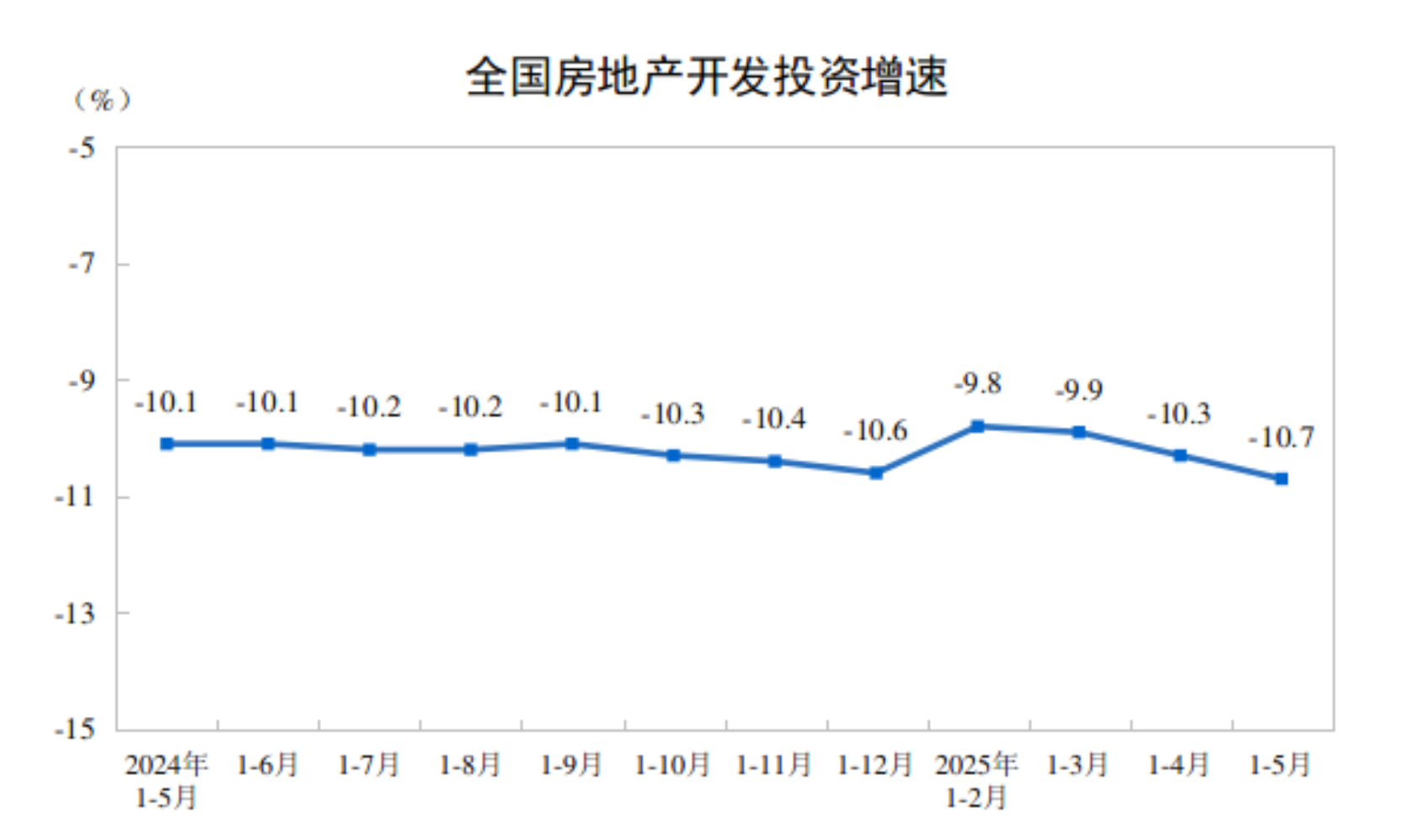
Group 1: Real Estate Development Overview - From January to May, the total construction area of real estate development enterprises reached 625,020 million square meters, a year-on-year decrease of 9.2%. The residential construction area was 435,354 million square meters, down 9.6% [2][13] - The new construction area for buildings was 23,184 million square meters, a decline of 22.8%. The residential new construction area was 17,089 million square meters, down 21.4% [2][13] - The completed construction area was 18,385 million square meters, a decrease of 17.3%. The residential completed area was 13,337 million square meters, down 17.6% [2][13] Group 2: New Housing Sales and Inventory - From January to May, the sales area of new commercial housing was 35,315 million square meters, a year-on-year decrease of 2.9%. The residential sales area decreased by 2.6% [3][16] - The sales revenue from new commercial housing was 34,091 billion yuan, down 3.8%. The residential sales revenue decreased by 2.8% [3][16] - As of the end of May, the inventory of unsold commercial housing was 77,427 million square meters, a reduction of 715 million square meters from the end of April. The residential unsold inventory decreased by 439 million square meters [6][16] Group 3: Funding Situation for Real Estate Development - From January to May, the total funds available for real estate development enterprises amounted to 40,232 billion yuan, a year-on-year decrease of 5.3%. Domestic loans were 6,679 billion yuan, down 1.7% [7][14] - Foreign investment increased by 49.0% to 16 million yuan, while self-raised funds decreased by 7.2% to 13,743 billion yuan [7][14] - Personal mortgage loans were 5,645 billion yuan, down 8.5% [7][14] Group 4: Real Estate Development Prosperity Index - The real estate development prosperity index (National Real Estate Prosperity Index) stood at 93.72 at the end of May, indicating a lower level of prosperity in the sector [9][22]

2025年1—5月份全国固定资产投资增长3.7%
Guo Jia Tong Ji Ju· 2025-06-16 02:00
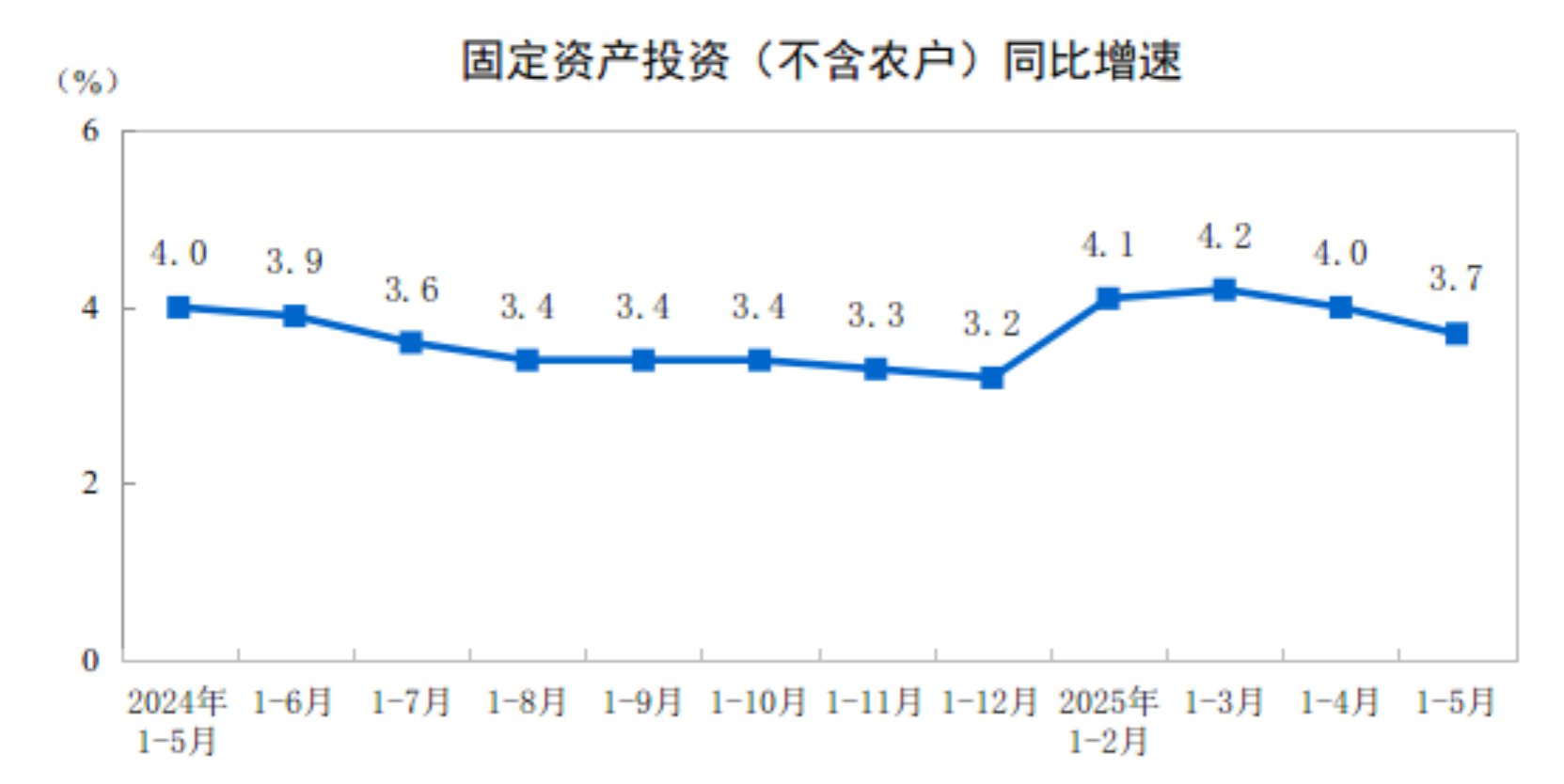
Core Insights - The fixed asset investment (excluding rural households) in China for the first five months of 2025 reached 191,947 billion yuan, showing a year-on-year growth of 3.7% [5] - The investment growth varied across different industries, with the primary industry growing by 8.4%, the secondary industry by 11.4%, and the tertiary industry declining by 0.4% [2][5] Investment by Industry - In the secondary industry, industrial investment increased by 11.6%, with mining investment up by 5.8%, manufacturing investment up by 8.5%, and investment in electricity, heat, gas, and water production and supply rising by 25.4% [3][5] - The tertiary industry saw infrastructure investment (excluding electricity, heat, gas, and water production and supply) grow by 5.6%, with significant increases in water transport (27.2%), water management (26.6%), and air transport (4.7%) [3] Regional Investment Trends - Investment growth varied by region, with the eastern region growing by 0.5%, the central region by 4.5%, the western region by 4.9%, and the northeastern region by 2.1% [3] Investment by Ownership Type - Domestic enterprises saw a fixed asset investment growth of 3.7%, while investment from Hong Kong, Macau, and Taiwan enterprises grew by 6.5%. In contrast, foreign enterprises experienced a decline of 13.4% [4][6]
国家统计局城市司首席统计师王中华解读2025年5月份商品住宅销售价格变动情况统计数据
Guo Jia Tong Ji Ju· 2025-06-16 01:33
Group 1 - In May 2025, the sales prices of new residential properties in first-tier cities decreased by 0.2% month-on-month, with Shanghai increasing by 0.7% while Beijing, Guangzhou, and Shenzhen saw declines of 0.4%, 0.8%, and 0.4% respectively [3] - The sales prices of second-hand residential properties in first-tier cities fell by 0.7% month-on-month, with Beijing, Shanghai, Guangzhou, and Shenzhen experiencing declines of 0.8%, 0.7%, 0.8%, and 0.5% respectively [3] Group 2 - Year-on-year, the sales prices of new residential properties in first-tier cities decreased by 1.7%, a reduction in the decline by 0.4 percentage points compared to the previous month, with Shanghai increasing by 5.9% and declines in Beijing, Guangzhou, and Shenzhen of 4.3%, 5.8%, and 2.6% respectively [4] - The year-on-year sales prices of second-hand residential properties in first-tier cities decreased by 2.7%, with a reduction in the decline by 0.5 percentage points compared to the previous month, where Beijing and Shanghai saw declines of 0.7% and 0.1% respectively [4]
2025年5月份70个大中城市商品住宅销售价格变动情况
Guo Jia Tong Ji Ju· 2025-06-16 01:30
Core Insights - The residential property market in 70 major cities in China shows a mixed trend in new and second-hand housing prices as of May 2025, with some cities experiencing slight declines while others see increases in prices [1][2][3][4][5][6] New Residential Property Prices - In May 2025, the new residential property price index for Beijing is at 99.6 (month-on-month) and 95.7 (year-on-year), indicating a slight decrease compared to the previous month and a significant drop compared to the same month last year [1] - Shanghai's new residential prices increased slightly to 100.7 (month-on-month) and 105.9 (year-on-year), showing resilience in the market [1] - Cities like Shenzhen and Guangzhou show a month-on-month decrease in new residential prices at 99.6 and 99.2 respectively, while year-on-year comparisons also reflect declines [1] Second-Hand Residential Property Prices - The second-hand residential property price index for Beijing stands at 99.2 (month-on-month) and 99.3 (year-on-year), indicating stability but a slight decline from the previous month [3][4] - In contrast, cities like Hangzhou and Nanjing show a month-on-month decrease in second-hand prices at 99.6 and 99.1 respectively, while year-on-year comparisons also reflect declines [3][4] - The overall trend in second-hand residential prices across major cities indicates a more pronounced decline compared to new residential properties, with many cities reporting lower indices [3][4] Price Classification by Size - The price index for new residential properties categorized by size shows that properties under 90m² in Beijing have a month-on-month index of 99.7 and a year-on-year index of 95.8, indicating a decline [5] - For properties between 90-144m², the index in Beijing is at 99.6 (month-on-month) and 95.0 (year-on-year), while properties over 144m² show a similar trend with an index of 99.6 (month-on-month) and 96.0 (year-on-year) [5] - The classification indicates that smaller properties are experiencing a more significant decline compared to larger properties in several cities [5] Regional Variations - Cities like Chengdu and Xi'an show resilience with month-on-month indices of 100.3 and 99.5 respectively, indicating stable or increasing prices [1][5] - Conversely, cities such as Tangshan and Hohhot show declines in both new and second-hand property prices, reflecting regional disparities in the housing market [1][3][5] - The data suggests that while some major cities are stabilizing or increasing in price, others are facing challenges, highlighting the uneven recovery in the residential property market across China [1][3][5]
2025年6月上旬流通领域重要生产资料市场价格变动情况
Guo Jia Tong Ji Ju· 2025-06-14 01:30
Core Viewpoint - The monitoring of market prices for 50 important production materials across nine categories shows a mixed trend, with 11 products experiencing price increases, 35 seeing declines, and 4 remaining stable in early June 2025 compared to late May 2025 [2]. Group 1: Price Changes in Major Categories - In the black metal category, prices for rebar, wire rod, and ordinary plates decreased by 1.0% to 1.7%, with rebar priced at 3111.1 yuan per ton [4]. - In the non-ferrous metal category, electrolytic copper saw a price increase of 0.4% to 78731.7 yuan per ton, while aluminum ingots decreased by 0.6% to 20203.3 yuan per ton [4]. - Chemical products experienced varied changes, with sulfuric acid increasing by 2.3% to 635.8 yuan per ton, while methanol decreased by 2.5% to 2137.0 yuan per ton [4]. Group 2: Energy and Coal Prices - In the petroleum and natural gas sector, liquefied natural gas (LNG) prices fell by 1.1% to 4264.2 yuan per ton, while gasoline prices increased by 1.1% to 8372.1 yuan per ton [4]. - Coal prices showed a decline, with anthracite coal dropping by 3.6% to 914.8 yuan per ton and coke decreasing by 5.6% to 1181.4 yuan per ton [4]. Group 3: Agricultural Products and Inputs - Among agricultural products, rice prices increased slightly by 0.2% to 4036.8 yuan per ton, while wheat prices decreased by 0.6% to 2415.3 yuan per ton [5]. - Fertilizer prices also saw a decline, with urea dropping by 1.4% to 1864.3 yuan per ton [5]. Group 4: Monitoring Methodology - The price monitoring includes data from over 2000 wholesalers, agents, and distributors across more than 300 trading markets in 31 provinces [7]. - The methodology involves various data collection techniques, including on-site price collection and electronic inquiries [8].
国家统计局城市司首席统计师董莉娟解读2025年5月份CPI和PPI数据
Guo Jia Tong Ji Ju· 2025-06-09 01:44
Group 1: CPI Analysis - In May, the Consumer Price Index (CPI) decreased by 0.2% month-on-month and by 0.1% year-on-year, while the core CPI, excluding food and energy, increased by 0.6%, with the growth rate expanding by 0.1 percentage points compared to the previous month [1][2][3] - The month-on-month decline in CPI was primarily driven by a 1.7% decrease in energy prices, which accounted for approximately 70% of the total decline in CPI [2] - Food prices fell by 0.2%, with seasonal vegetables seeing a 5.9% price drop, while prices for eggs, pork, and poultry slightly decreased by 0.3% to 1.0% [2][3] Group 2: PPI Analysis - The Producer Price Index (PPI) decreased by 0.4% month-on-month and by 3.3% year-on-year, with the year-on-year decline expanding by 0.6 percentage points compared to the previous month [1][4][5] - The month-on-month PPI decline was influenced by international factors, including a 5.6% drop in oil and gas extraction prices and a 3.5% decrease in refined oil product manufacturing prices [4] - Some sectors showed marginal price improvements, with consumer demand policies positively impacting prices in certain industries, such as a 12.8% increase in the price of arts and crafts and a 0.8% rise in footwear manufacturing [5]
2025年5月份工业生产者出厂价格同比下降3.3%
Guo Jia Tong Ji Ju· 2025-06-09 01:30
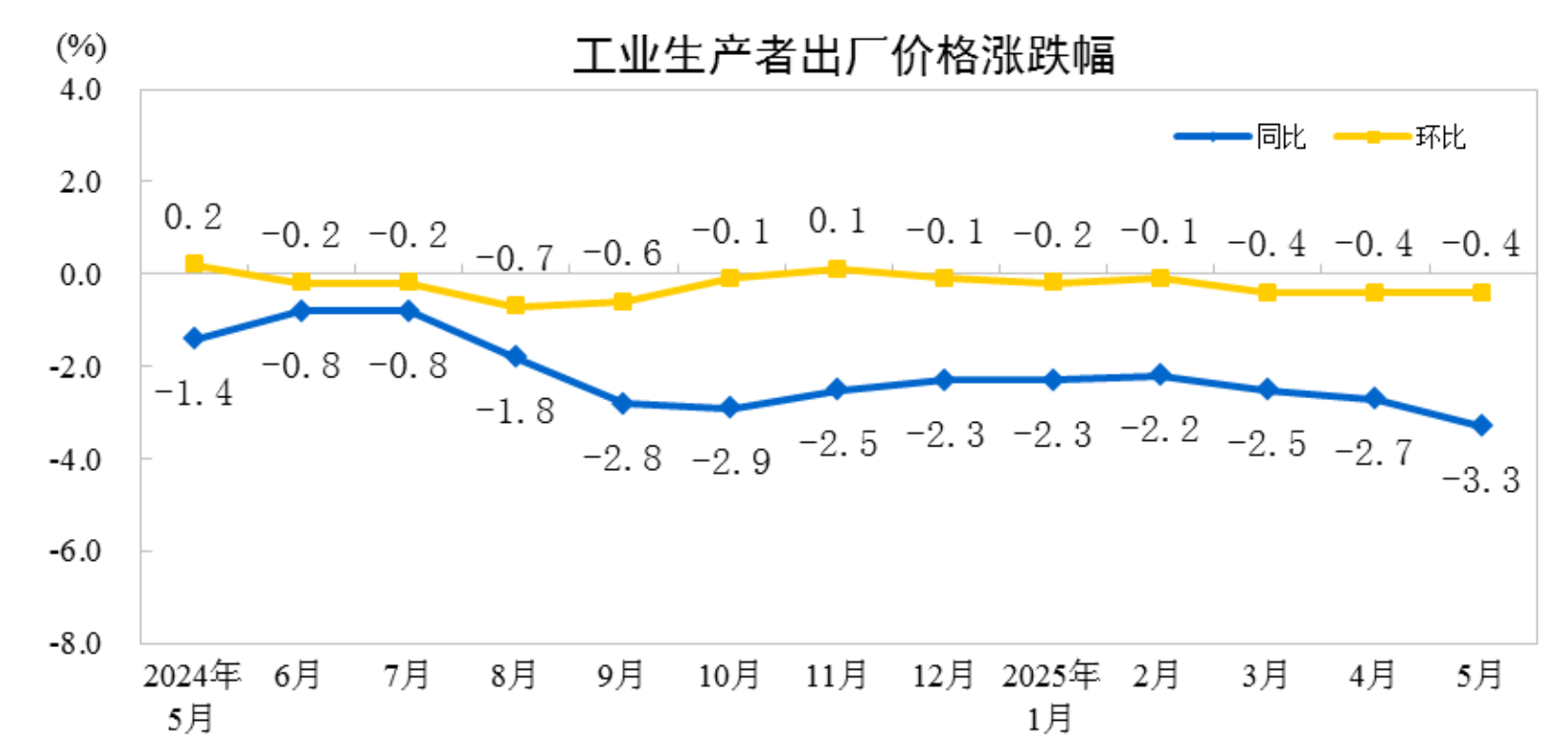
Core Insights - In May 2025, the national industrial producer's ex-factory prices decreased by 3.3% year-on-year and 0.4% month-on-month, while the purchasing prices dropped by 3.6% year-on-year and 0.6% month-on-month [1][4][6] - The average decline for both ex-factory and purchasing prices from January to May was 2.6% compared to the same period last year [1][7] Group 1: Year-on-Year Changes - In May, the prices of production materials fell by 4.0%, contributing approximately 2.98 percentage points to the overall decline in ex-factory prices [3][7] - The mining industry saw a significant price drop of 11.9%, while raw materials and processing industries experienced declines of 5.4% and 2.8%, respectively [3][7] - Consumer goods prices decreased by 1.4%, with food prices also down by 1.4%, while clothing prices remained stable [3][7] Group 2: Month-on-Month Changes - In May, production material prices decreased by 0.6%, impacting the overall ex-factory price level by approximately 0.44 percentage points [6][7] - The mining sector's prices fell by 2.5%, while raw materials and processing industries saw declines of 0.9% and 0.3%, respectively [6][7] - Consumer goods prices remained stable, with food prices down by 0.1% and clothing prices up by 0.2% [6][7] Group 3: Purchasing Prices - The purchasing prices for fuel and power decreased by 2.1%, while chemical raw materials fell by 1.2% and black metal materials by 0.6% [6][9] - Notably, the prices of non-ferrous metal materials and wires increased by 4.6% [9][10] - The average decline in purchasing prices from January to May was 2.6% compared to the same period last year [7][9]
2025年5月份居民消费价格同比下降0.1%
Guo Jia Tong Ji Ju· 2025-06-09 01:30
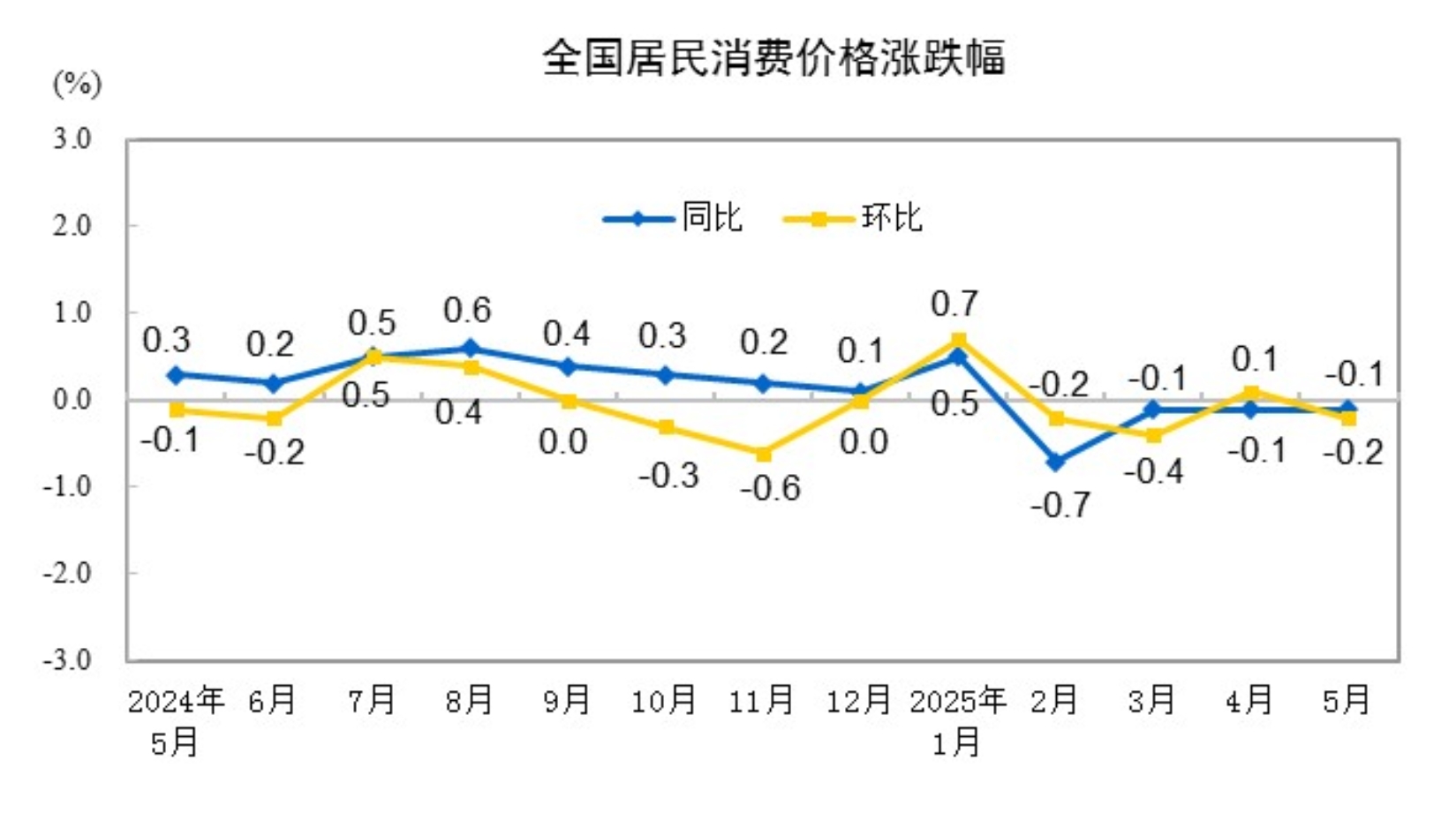
Group 1 - In May 2025, the national consumer price index (CPI) decreased by 0.1% year-on-year, with urban prices remaining stable and rural prices declining by 0.4% [1] - The average CPI from January to May 2025 was down 0.1% compared to the same period last year [1] - Month-on-month, the CPI fell by 0.2% in May, with both urban and rural areas experiencing a decline of 0.2% [1] Group 2 - In May, food and tobacco prices rose by 0.1% year-on-year, contributing approximately 0.02 percentage points to the CPI increase [3] - Fresh fruit prices surged by 5.5%, impacting the CPI by about 0.12 percentage points, while fresh vegetable prices dropped by 8.3%, reducing the CPI by approximately 0.17 percentage points [3] - Among the seven major categories, six saw price increases, with other goods and services, clothing, and education/culture/entertainment rising by 7.3%, 1.5%, and 0.9% respectively [3] Group 3 - Month-on-month, food and tobacco prices decreased by 0.2%, affecting the CPI by approximately 0.05 percentage points [5] - Fresh vegetable prices fell by 5.9%, contributing to a CPI decrease of about 0.12 percentage points, while fresh fruit prices increased by 3.3%, adding approximately 0.07 percentage points to the CPI [5] - Other categories showed mixed results, with clothing prices rising by 0.6% and transportation/communication prices declining by 1.2% [5] Group 4 - The CPI for food and tobacco decreased by 0.2% month-on-month and increased by 0.1% year-on-year [7] - The price of grains fell by 0.2% month-on-month and 1.4% year-on-year, while pork prices increased by 3.1% year-on-year [7] - The transportation and communication category saw a significant year-on-year decline of 4.3% [7]
2025年5月下旬流通领域重要生产资料市场价格变动情况
Guo Jia Tong Ji Ju· 2025-06-04 01:30
Core Viewpoint - The monitoring of market prices for 50 important production materials across nine categories indicates a mixed trend, with 11 products experiencing price increases, 38 seeing declines, and one remaining stable in late May 2025 compared to mid-May 2025 [2]. Group 1: Price Changes in Major Categories - In the black metal category, prices for rebar, wire rod, and ordinary plates decreased by 1.4%, 1.7%, and 1.2% respectively, with rebar priced at 3143.7 yuan per ton [4]. - In the non-ferrous metal category, aluminum ingot saw a price increase of 0.9% to 20330.0 yuan per ton, while electrolytic copper decreased by 0.1% to 78398.6 yuan per ton [4]. - Chemical products showed varied results, with sulfuric acid increasing by 0.7% to 621.8 yuan per ton, while methanol decreased by 4.6% to 2191.9 yuan per ton [4]. Group 2: Energy and Coal Prices - In the petroleum and natural gas sector, liquefied natural gas (LNG) prices fell by 2.1% to 4310.4 yuan per ton, while diesel prices increased by 0.7% to 6968.7 yuan per ton [4]. - Coal prices also experienced declines, with anthracite coal dropping by 1.2% to 948.5 yuan per ton and coking coal decreasing by 3.5% to 1167.9 yuan per ton [4]. Group 3: Agricultural Products and Inputs - Among agricultural products, rice prices increased by 0.8% to 4027.6 yuan per ton, while soybean prices rose by 0.7% to 4321.6 yuan per ton [5]. - Fertilizer prices showed a decline, with urea decreasing by 2.5% to 1890.0 yuan per ton [5]. - The price of pesticides, however, increased by 1.1% to 23771.4 yuan per ton, indicating a rise in agricultural production inputs [5].
国家统计局服务业调查中心高级统计师赵庆河解读2025年5月中国采购经理指数
Guo Jia Tong Ji Ju· 2025-05-31 01:36
Group 1: Manufacturing PMI Insights - In May, the Manufacturing PMI rose to 49.5%, an increase of 0.5 percentage points from the previous month, indicating an improvement in economic conditions [2][3] - The production index reached 50.7%, up by 0.9 percentage points, signaling accelerated manufacturing activity, while the new orders index increased to 49.8%, up by 0.6 percentage points [3] - Large enterprises saw their PMI rise to 50.7%, returning to the expansion zone, with production and new orders indices at 51.5% and 52.5%, respectively [3] Group 2: High-Tech and Export Performance - High-tech manufacturing PMI stood at 50.9%, maintaining expansion for four consecutive months, while equipment manufacturing and consumer goods PMIs were at 51.2% and 50.2%, respectively [4] - New export orders and import indices improved to 47.5% and 47.1%, reflecting a recovery in foreign trade orders, particularly from companies engaged in U.S. trade [4] Group 3: Non-Manufacturing Sector Performance - The Non-Manufacturing Business Activity Index was at 50.3%, slightly down by 0.1 percentage points but still indicating expansion [5] - The service sector's business activity index rose to 50.2%, driven by increased consumer activity in tourism and dining during the May Day holiday [5] - The construction sector maintained expansion with a business activity index of 51.0%, although it showed a slight decline from the previous month [6] Group 4: Composite PMI Overview - The Composite PMI Output Index increased to 50.4%, up by 0.2 percentage points, indicating continued expansion in production and business activities across sectors [7]