
Qi Huo Ri Bao

Search documents
以高质量服务深耕产业沃土,以高水平开放拥抱世界风云→
Qi Huo Ri Bao· 2025-08-24 23:52
Core Viewpoint - The futures market's high-level opening is essential for enhancing international competitiveness and supporting the country's higher-level opening [2] Group 1: Market Development and Internationalization - The domestic futures market has accelerated its internationalization process, with specific futures contracts attracting foreign traders, thereby enhancing global price influence [2] - Futures exchanges are establishing delivery warehouses abroad and building cross-border logistics networks, which expands market depth and positions Chinese futures prices as important references in global trade [2] - The trend of international commodity market risks returning to Chinese market prices highlights the influence and fairness of the Chinese market [2] Group 2: Cross-Border Cooperation and Investor Education - Encouragement for domestic and foreign exchanges to collaborate on contract mutual listing and joint listing to enhance international compatibility of the Chinese futures market [3] - The importance of optimizing cross-border connectivity mechanisms, drawing on successful experiences like the Shanghai-Hong Kong Stock Connect, to explore a "Futures Connect" model [3] - Emphasis on educating foreign investors about Chinese market rules through multilingual platforms and online training tools [3][4] Group 3: Opportunities and Challenges for Futures Companies - Domestic futures companies are increasingly venturing into international markets, providing overseas risk management and financing services for Chinese enterprises [5] - The international business of some futures companies has become a significant growth point, driven by policy support and increasing demand for risk management from domestic enterprises [5] - Challenges include cross-border regulatory differences, high compliance costs, and a shortage of professionals skilled in both derivatives and cross-border communication [6][7] Group 4: Enhancing Service to the Real Economy - The futures market is transitioning from a focus on product and tool innovation to enhancing its functions to better serve the real economy [8][9] - Industry participants face challenges in using futures tools for risk management, including insufficient professional capabilities and data barriers [9][10] - Recommendations for industry enterprises to improve risk management awareness and establish internal risk control systems [10] Group 5: Innovations in Service Tools and Business Models - Futures companies are encouraged to strengthen innovation capabilities and deepen service in key areas to enhance their effectiveness in serving the real economy [14] - Suggestions for service tool innovations include the comprehensive application of OTC options and cross-border risk management tools [14] - The importance of building a professional team that combines industry researchers and futures analysts to understand and address the real pain points of enterprises [15]

明确展业边界,加强全过程监管!《期货公司互联网营销管理暂行规定》解读来了→
Qi Huo Ri Bao· 2025-08-24 23:52
Core Viewpoint - The China Securities Regulatory Commission (CSRC) has officially released the "Interim Regulations on Internet Marketing Management for Futures Companies," which will take effect on October 9, 2025, aiming to enhance the regulation of internet marketing activities by futures companies and protect the legitimate rights and interests of futures traders [1][2]. Summary by Sections Regulatory Framework - The "Interim Regulations" consist of 18 articles focusing on issues and risks associated with internet marketing activities of futures companies, including defining the scope of internet marketing, strengthening content review, clarifying marketing systems, and enhancing customer protection [2][4]. - Internet marketing activities are defined as commercial promotion of futures brokerage or trading consulting services via the internet, including brand promotion and trader education [2][3]. Marketing Management - The regulations specify that branch offices of futures companies must conduct internet marketing under the authorization and unified management of the headquarters, prohibiting independent use of third-party services for marketing [3]. - New requirements mandate that marketing content must prominently display the company name and risk warnings, enhancing the regulation of marketing materials [3]. Third-Party Management - Futures companies utilizing third-party services for internet marketing must sign written agreements outlining rights and obligations, and report to the local CSRC office [3]. - The regulations aim to strengthen the crackdown on illegal activities such as unauthorized brokerage and misleading trading consulting services [3][4]. Customer Protection - The regulations require futures companies to enhance risk warnings and follow-up with clients, ensuring that fees do not exceed publicized standards and addressing unusual trading behaviors promptly [4]. - Fair competition is emphasized, prohibiting the use of false information to discredit competitors and other unfair marketing practices [4]. Supervision and Transparency - The CSRC, along with industry associations, will establish an information-sharing mechanism for monitoring internet marketing activities of futures companies, enhancing transparency and regulatory coordination [5]. - The increasing regulatory scrutiny has led to penalties for futures companies engaging in misleading marketing practices, indicating a trend towards stricter enforcement [5]. Long-term Implications - In the short term, futures companies may face an adjustment period, but clear regulatory guidance is expected to encourage improved service quality and differentiated development paths in the long run [6]. - The regulations are anticipated to standardize internet marketing activities across the industry, providing protection for both traders and futures companies, fostering a stable operational environment [6].
大幅回调,一周跌逾11%!碳酸锂期货连续四日减仓
Qi Huo Ri Bao· 2025-08-24 23:46
Core Viewpoint - Lithium carbonate futures prices experienced a significant decline, with the main contract closing at 78,960 yuan/ton on August 23, marking a cumulative drop of over 11% in the last four trading days [1][3]. Group 1: Market Dynamics - The recent price drop is attributed to weak fundamentals, negative news, and profit-taking by investors [3]. - The core driver of the recent price surge was supply disruptions, but the subsequent price increase has begun to stimulate supply [3]. - Market sentiment has turned bearish, particularly following news of production resumption by Yichun Silver Lithium and a more than 30% month-on-month increase in lithium ore imports in July [4]. Group 2: Supply and Demand Analysis - As of August 21, lithium carbonate production was approximately 19,100 tons, a decrease of 842 tons from the previous week, primarily due to reductions in lithium mica and salt lake production [5]. - Social inventory of lithium carbonate decreased by 713 tons to around 141,500 tons, indicating a significant drawdown, although inventory levels remain high compared to the past year [5]. - Current market contradictions include halted production at key projects and potential license expirations for mining operations, which could lead to further supply constraints [5]. Group 3: Future Outlook - Analysts suggest that the market remains in a loose supply-demand balance, with short-term price pressures likely [6]. - There is an expectation of increased demand as the "golden September and silver October" consumption season approaches, which may support prices despite recent declines [6]. - The sensitivity of the market to supply disruptions remains high, and prices may experience volatility as new information emerges [6].




打通煤炭供应链“最后一公里” 李家寨6号站台配煤基地正式通车
Qi Huo Ri Bao· 2025-08-24 23:26
Core Viewpoint - The successful launch of the Li Jiazai No. 6 station marks a significant step in optimizing the coal logistics system in Henan Province, enhancing the efficiency of the energy supply chain through collaboration between state-owned and private enterprises [1][2]. Group 1: Company Collaboration - The Li Jiazai No. 6 station is a joint effort between Zhongping Supply Chain, Zhengzhou Coal Group, and Zhengzhou Railway Transport Company, aiming to leverage the strengths of both state-owned and private enterprises [1][2]. - The partnership is described as a strategic complement rather than a simple resource overlap, enhancing the entire coal supply chain from production to terminal supply [2][3]. Group 2: Operational Efficiency - The station has a coal collection capacity exceeding 500,000 tons annually, with 11 loading positions and a usage area of nearly 6,000 square meters [3]. - The location of the station provides significant logistical advantages, connecting major coal production areas in Shanxi with consumption markets in Central and Southern China, thus reducing logistics costs by over 30% compared to traditional road transport [3][4]. Group 3: Technological Advancements - The station features an automated blending machine capable of processing 400 tons of coal per hour, significantly improving efficiency and accuracy compared to manual blending [4]. - The blending process is crucial for optimizing coal quality and reducing emissions, aligning with stricter environmental standards [4][5]. Group 4: Brand Development - The operation of the Li Jiazai No. 6 station aims to establish a recognizable brand for high-end coal blending in Henan, combining resources from Pingmei Shenma Group and Zhengzhou Coal Group with the advantages of Shanxi's smokeless coal [5][6]. - Future plans include enhancing collaboration with railway transport and storage management to ensure efficient operations and promote green logistics practices [6]. Group 5: Industry Trends - The initiative aligns with national policies for energy transition and carbon neutrality, emphasizing the importance of sustainable practices in the coal industry [2][6]. - The company has been actively responding to mixed-ownership reform policies, forming joint ventures to enhance the resilience and efficiency of the energy supply chain [6].

中泰期货“保险+期货”创新模式获评省级典型案例
Qi Huo Ri Bao· 2025-08-24 16:06
Core Viewpoint - The Shandong Provincial State-owned Assets Supervision and Administration Commission has recognized the "Insurance + Futures" innovative model for cotton price targeting as a benchmark practice in supporting rural revitalization through financial services [1][2]. Group 1: Background and Context - The cotton planting area and yield in Shandong have been declining due to multiple factors, including falling cotton prices, differences in subsidy policies, and higher returns from alternative crops [1]. - The "Insurance + Futures" pilot project was initiated in 2019 with support from the Shandong Provincial Department of Agriculture and Rural Affairs and the Provincial Department of Finance, making it the first of its kind to be promoted at the provincial level [1]. Group 2: Project Implementation and Impact - As of 2024, the pilot project covers major cotton-producing areas such as Dongying and Jining, insuring a cotton planting area of 637,300 acres, benefiting approximately 150,000 cotton farmers, equivalent to a physical cotton scale of 51,000 tons [2]. - The government has provided a special premium subsidy of 70.11 million yuan, offering price risk protection amounting to 780 million yuan for cotton farmers in the province [2]. - The project has successfully compensated over 73 million yuan due to significant cotton price declines influenced by supply-demand imbalances, international trade tensions, and financial market volatility, effectively mitigating farmers' operational risks and stabilizing their income [2]. Group 3: Recognition and Future Plans - The "Insurance + Futures" model has been recognized as one of the first innovative products in financial support for agriculture in Shandong, contributing to the company's reputation in the sector [2]. - The company plans to continue innovating the "Insurance + Futures" model, aiming to expand the range of covered products, enhance protection amounts, and establish a long-term mechanism involving farmer participation, government subsidies, insurance protection, and futures hedging [2].
上期所招募部分期货、期权品种做市商
Qi Huo Ri Bao· 2025-08-24 16:06
Group 1 - The Shanghai Futures Exchange announced on the 22nd that it aims to enhance market operation quality and better serve the development of the real economy [1] - The exchange is recruiting market makers for aluminum alloy futures, as well as for options on petroleum asphalt, fuel oil, pulp, and offset printing paper [1]
大商所扩大焦炭指定厂库标准仓单最大量
Qi Huo Ri Bao· 2025-08-24 16:06
Core Viewpoint - The Dalian Commodity Exchange has announced an expansion of the maximum quantity for coking coal designated warehouse receipts, which will enhance the delivery capacity for several companies involved in coking coal futures trading [1] Group 1: Company Updates - Mucai Zhongda Metal Group Co., Ltd. (Rizhao Port) has increased the maximum quantity of coking coal futures standard warehouse receipts from 45,000 tons to 75,000 tons, with the delivery speed raised from 3,000 tons per day to 5,000 tons per day [1] - Mucai Zhongda Metal Group Co., Ltd. (Caofeidian Port) has seen its maximum quantity for coking coal futures standard warehouse receipts increase from 30,000 tons to 45,000 tons, and the delivery speed has been raised from 2,000 tons per day to 3,000 tons per day [1] - Tianjin Jinghai Taijin Import and Export Trade Co., Ltd. (Qingdao Port) has had its maximum quantity for coking coal futures standard warehouse receipts expanded from 30,000 tons to 120,000 tons, with the delivery speed increased from 2,000 tons per day to 8,000 tons per day [1] - Zhejiang Huishan Industrial Co., Ltd. (Qingdao Port) has increased its maximum quantity for coking coal futures standard warehouse receipts from 24,000 tons to 90,000 tons, and the delivery speed has been raised from 1,600 tons per day to 6,000 tons per day [1]

【大宗周刊】海南国际清算所:聚焦大宗商品风险管理 促进市场创新融合发展
Qi Huo Ri Bao· 2025-08-24 00:06
Group 1: Forum Overview - The forum on "Risk Management and Market Innovation in the Context of Commodities" was held in Beijing, focusing on the integration of risk management and market innovation [1] - The event was organized by Hainan International Clearing House and attracted representatives from commodity producers, trading companies, and futures firms [1][2] Group 2: Market Dynamics - Since 2025, the global economy has entered a deep adjustment period, with the commodity market facing pressures from geopolitical conflicts, energy transitions, and supply chain resilience [1] - Companies in the commodity sector are focusing on refined cost control and precise risk hedging as essential survival strategies [1] Group 3: Hainan International Clearing House Developments - Hainan International Clearing House has rapidly developed a comprehensive risk management system and has launched an independent clearing system for over-the-counter derivatives [2][3] - Since the launch of its swap clearing business in October 2023, the clearing house has expanded its product offerings to 45 types, covering various commodities [3] - The clearing scale has surpassed 200,000 tons, with a contract value exceeding 4 billion yuan, and a peak customer margin balance of 140 million yuan [3] Group 4: Key Insights from the Forum - The forum provided insights into macroeconomic challenges, including changes in domestic and international interest rates and their impact on monetary policy [4] - It emphasized the importance of understanding the differences between over-the-counter derivatives and other financial instruments for businesses [4] - The forum discussed asset management strategies, highlighting the potential for fixed income products combined with options to enhance returns [4] Group 5: Energy Transition and Supply Chain Efficiency - The transition towards dual carbon goals is reshaping the energy structure and commodity allocation logic [5] - The forum highlighted the importance of integrating futures and spot markets to reduce costs and enhance efficiency for manufacturing enterprises [6] Group 6: Logistics and Supply Chain Innovations - The opening of the Li Jiazai No. 6 coal distribution station marks a significant step in optimizing coal logistics in Henan province [8][9] - The station aims to enhance the efficiency of coal supply chains by integrating production, transportation, and storage [9][10] - The facility is designed to handle over 500,000 tons of coal annually and features advanced coal blending technology for customized supply solutions [10][11] Group 7: Future Directions - The collaboration between Zhongping Supply Chain and Zheng Coal Group aims to create a new brand for coal blending in Henan, focusing on quality control and stable supply [12] - The initiative seeks to establish a green logistics model, promoting sustainable practices in coal transportation and storage [12]
尾盘异动 全线大涨!“双焦价格底部已现”!
Qi Huo Ri Bao· 2025-08-24 00:02
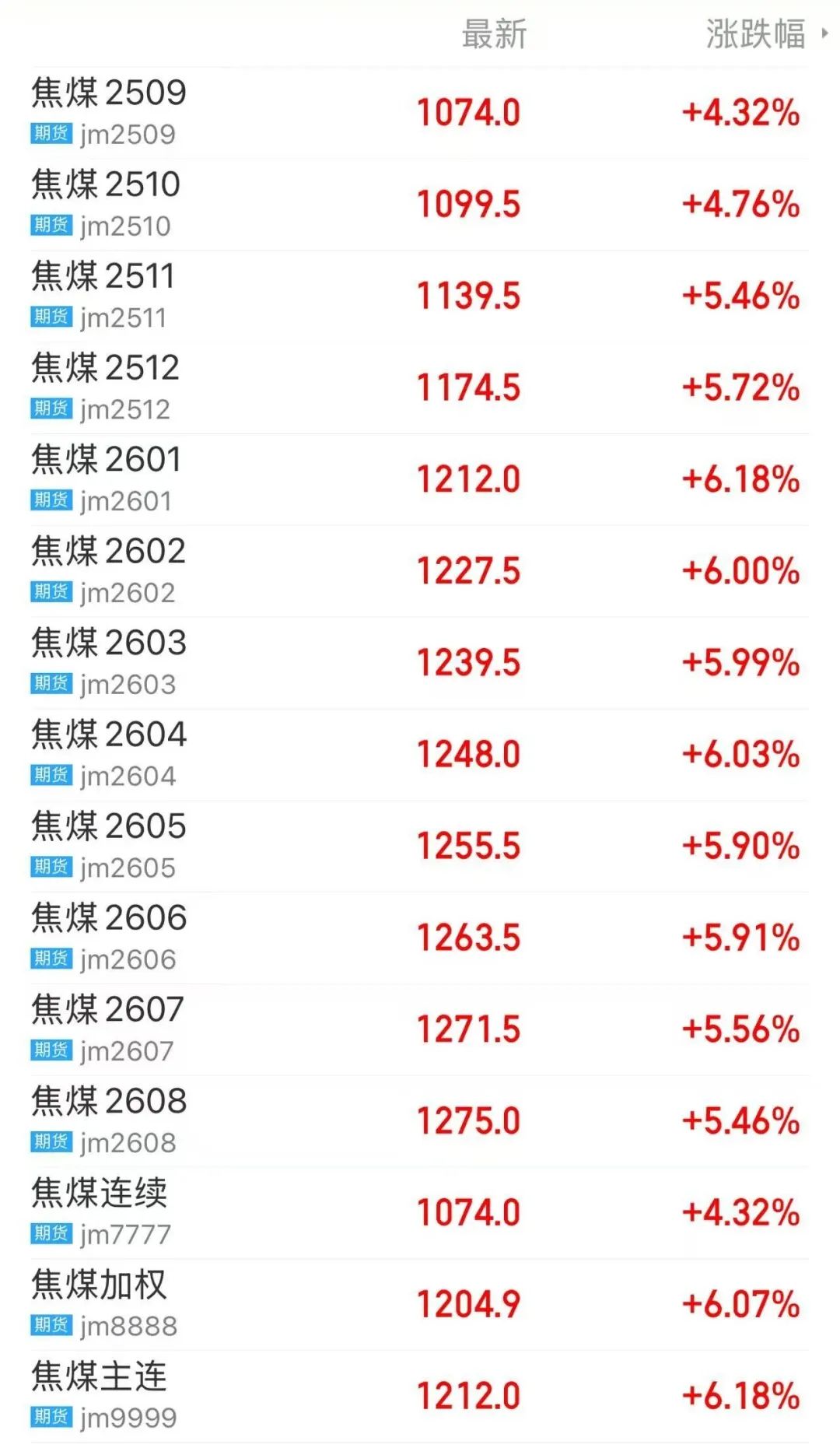
Group 1 - A coal mine accident in Fujian Daitian resulted in 7 fatalities, leading to a significant increase in coking coal futures prices, with the main contract rising by 6.18% to over 1200 yuan/ton [1] - Coking coal futures contracts experienced substantial gains, with various contracts showing increases ranging from 4.32% to 6.18% [2][3] - Analysts suggest that the rebound in coking coal and coke futures is primarily driven by the accident news rather than fundamental market conditions [3] Group 2 - Recent production checks have led to a decline in mining output, but there are signs of recovery in the past two weeks, indicating a reduction in the impact of policies on supply [4] - The import of coal has increased significantly since late July, with Mongolian coal volumes at historically high levels, and expectations for increased arrivals of Australian coal [4] - The overall demand for coking coal remains stable, with steel production maintaining above 2.4 million tons, and coke prices improving, leading to a profit of around 20 yuan per ton for coking enterprises [4] Group 3 - The coking coal and coke fundamentals are currently weak, with a recent shift from a replenishment cycle to a destocking cycle observed in the downstream market [5] - Steel and coking plants' coal inventories have decreased, while upstream coal mine inventories have increased, indicating rising pressure on coking coal stocks [5] - The steel market is experiencing a seasonal decline in demand, with steel inventories rising for four consecutive weeks, suggesting potential further weakness in coking coal demand [5] Group 4 - Market trading logic has shifted from a focus on "anti-involution" policies to a recognition of limited improvements in fundamentals, particularly in the steel sector [6] - The current market is characterized by a struggle between the residual effects of "anti-involution" policies and weak real demand, with expectations of further price declines in the short term [6] - The upcoming significant event on September 3 may lead to increased safety regulations following the coal mine accident, potentially causing a temporary rise in futures prices [6]
尾盘异动,全线大涨!“双焦价格底部已现”!
Qi Huo Ri Bao· 2025-08-23 23:45
Group 1 - A coal mine accident in Fujian Daitian resulted in 7 fatalities, leading to a rapid increase in coking coal futures prices, with the main contract rising by 6.18% to over 1200 yuan/ton [1] - Coking coal futures contracts experienced significant gains, with various contracts showing increases ranging from 4.32% to 6.18% [2][3] - Analysts suggest that the rebound in coking coal and coke futures is primarily influenced by the mine accident news rather than fundamental market conditions [4] Group 2 - Recent "anti-involution" policies have dampened bullish sentiment in the commodity market, with exchanges adjusting fees to reduce market volatility [4] - Basic supply and demand dynamics indicate a recent recovery in mining output, with coal imports increasing significantly since late July, suggesting a potential rise in future coking coal arrivals [4] - Current inventory levels for coking coal are stable, but there is an increase in upstream coal mine inventories, indicating rising pressure on coking coal supply [5] Group 3 - The market is currently experiencing a transition from a replenishment phase to a destocking phase, with coking coal inventories at steel mills decreasing slightly [5] - The demand for coking coal may weaken further due to seasonal factors and potential production cuts in northern steel mills [5][6] - The trading logic in the market reflects a struggle between the residual effects of "anti-involution" policies and weak fundamental realities, with expectations of further price declines in the short term [6]