Jin Shi Shu Ju

Search documents
官方数据“停摆”,私营报告来“救场”!美国就业市场究竟是冷是热?
Jin Shi Shu Ju· 2025-11-07 03:55
Group 1 - In October, the number of layoffs announced by U.S. employers surged to 153,074, nearly doubling from 54,064 in September, with a total of 1,099,500 layoffs reported this year, a 65% increase from the same period last year [2][3] - The layoffs are attributed to cost-cutting measures and the impact of artificial intelligence, marking the highest number of layoffs for this period since the COVID-19 pandemic [2][3] - Despite the layoffs, the unemployment rate remains low at 4.36%, with no significant changes observed in the labor market since the turmoil in September [3][4] Group 2 - The job market is experiencing a slowdown, with hiring data from platforms like Indeed showing a decline in job postings to the lowest level since 2021, particularly in tech-heavy regions [3][4] - ADP reported a rebound in private sector job growth with 42,000 new jobs added in October, contrasting with other reports indicating a reduction in overall employment [4] - Employee confidence is at its lowest since June, reflecting the challenges faced in a stagnant labor market with limited external options [4]
再贵也有人买单?泡泡玛特直播间失言翻车,股价跌超5%
Jin Shi Shu Ju· 2025-11-07 03:48
Core Viewpoint - The controversy surrounding a comment made by staff during a live stream about a 79 yuan blind box has led to significant backlash against Pop Mart, resulting in a stock price drop and concerns over product quality and demand sustainability [2][3]. Group 1: Incident Overview - During a live stream, a staff member commented that selling a blind box for 79 yuan was "a bit excessive," to which another staff member responded that "someone will buy it," sparking outrage among viewers [3]. - Pop Mart's stock price fell over 5% in early trading, marking its largest drop in about two weeks and reaching its lowest level since May [2]. - Since peaking at the end of August, Pop Mart's stock has declined approximately 38%, raising concerns about the sustainability of demand for its products [2]. Group 2: Product Details - The controversial product is the "DIMOO New Diary Series - Blind Box," which includes six regular and one hidden variant, priced at 79 yuan per box and 474 yuan for a full set [3]. - The blind box contains components such as zinc alloy pendants, polyester lanyards, resin figures, and glass/acrylic parts, but the cost of counterfeit versions is as low as 4 yuan, leading to debates about its true value [3]. Group 3: Quality Issues - Pop Mart is facing scrutiny over quality control issues, particularly with the "SKULLPANDA Dining Table Series" blind boxes, which had misprinted brand names [4]. - The affected series has been completely removed from sale, but misprinted items have seen a surge in second-hand market prices, with some items selling for significantly above their original prices [4]. - For instance, the price of the misprinted "Duality of Balance" has risen to 74 yuan, exceeding its original price of 69 yuan, and the average transaction price for a full box has increased from 691 yuan to 717 yuan, with some transactions reaching as high as 1000 yuan [4].

共和党推新方案欲打破停摆僵局,民主党关键要求成“拦路虎”!
Jin Shi Shu Ju· 2025-11-07 03:01
Core Points - The Senate Republican leadership is pushing for a new proposal to end the government shutdown, with a vote expected on Friday [2] - Democrats are demanding that the extension of Affordable Care Act subsidies be included in any legislation, which remains unresolved [2][4] - The proposal combines a short-term spending measure with three full-year appropriations bills, but the duration of the temporary measure is unclear [2][4] Group 1 - Senate Majority Leader John Thune indicated that the Republican leadership aims to create momentum for an agreement [2] - The government shutdown has led to federal employees not receiving paychecks for weeks, and low-income families are facing cuts to food assistance [2] - Some Democrats, particularly progressives, insist on extending the ACA subsidies that benefit 22 million people beyond the end of the year [4] Group 2 - The House of Representatives has complicated the situation by passing its own temporary spending agreement, which would fund the government until November 21 [4] - House Speaker Mike Johnson stated that the Senate must approve the House bill before any negotiations can occur [4] - Senate Democrats are seeking negotiations on extending the ACA subsidies before voting on any Republican proposals to reopen the government [4][5] Group 3 - President Trump has pressured Senate Republicans to eliminate the filibuster rule to bypass Democrats, but Republican senators have largely resisted this request [5] - Senate Democrats held a closed-door meeting to find a breakthrough, with some expressing hope for unity [6] - Senate Republicans are urging their Democratic colleagues to support the revised proposal, which aims to fund three of the twelve annual appropriations bills [6]
美国关键矿产清单重磅更新!铜、白银、铀入选引关注
Jin Shi Shu Ju· 2025-11-07 02:02
Group 1 - The Trump administration has added 10 minerals to its critical minerals list, bringing the total to 60, which includes copper and metallurgical coal, essential for electric vehicles, power grids, and data centers [2] - The updated list will guide federal investment and project permitting decisions, shaping a broader mineral strategy aimed at reducing import dependence and enhancing domestic mining [2][3] - The inclusion of uranium, boron, lead, phosphates, potash, rhenium, silicon, and silver reflects a comprehensive approach to securing materials necessary for defense, manufacturing, and clean energy technologies [3] Group 2 - Strengthening domestic production is seen as a way to mitigate potential supply shocks and export restrictions from competitors, with officials emphasizing the importance of reducing reliance on foreign sources [3] - The agricultural value of potash and phosphates is highlighted, as they are crucial for crop growth, with the U.S. relying heavily on imports for potash [4] - The profitability of U.S. copper mining is under scrutiny, as domestic mines have lower ore grades compared to international operations, leading to higher costs and lower profits [5][6] Group 3 - The inclusion of metallurgical coal aligns with the administration's support for fossil fuels, amidst challenges faced by U.S. metallurgical coal mines due to supply and export dynamics [7] - The National Mining Association is advocating for further expansion of the critical minerals list to ensure access to domestic resources when needed [8]


乌克兰大使确认:战斧等远程武器谈判“非常积极”
Jin Shi Shu Ju· 2025-11-07 00:32
Core Viewpoint - Ukraine is actively negotiating with the U.S. for military equipment procurement, including long-range missiles, despite mixed signals from U.S. President Trump regarding support for Ukraine [2][3] Group 1: Military Procurement Negotiations - Ukraine's Ambassador to the U.S., Olha Stefanishyna, stated that discussions for military procurement are ongoing and involve multiple delegations working to secure funding for more military equipment from the U.S. [2] - The negotiations are not limited to Tomahawk missiles but also include various types of long-range and short-range missiles, with progress described as quite positive [2] Group 2: Diplomatic Relations - Stefanishyna's role includes easing tensions with Trump, who has previously criticized Ukrainian President Zelensky, labeling him as a "dictator" [2] - Following a difficult meeting with Trump, Zelensky has managed to improve relations over the past few months [2] Group 3: Military Strategy and Challenges - Zelensky is pushing for the procurement of Tomahawk and other long-range missiles to target deep Russian positions, although Trump has indicated that these missiles would only be effective if launched from the U.S. [3] - Stefanishyna acknowledged the challenging period for Ukraine due to repeated Russian attacks on energy infrastructure and emphasized the need for enhanced air defense capabilities [3] - She warned that any refusal to pressure Russia would be seen as a green light for them to escalate their military capabilities [3]
金十数据全球财经早餐 | 2025年11月7日
Jin Shi Shu Ju· 2025-11-06 23:03
Economic Indicators - The unemployment rate in the U.S. for October is approximately 4.36%, marking a four-year high [9] - Revelio Labs reported a decrease of 9,100 non-farm jobs in October, with a year-on-year increase of 175% in layoffs [9] - The Chicago Fed President expressed caution regarding interest rate cuts due to unreliable inflation data [9] Market Performance - The WTI crude oil price fell by 0.13% to $59.40 per barrel, while Brent crude oil decreased by 0.18% to $63.21 per barrel, amid concerns of oversupply [3] - Major U.S. stock indices declined, with the Dow Jones down 0.84%, S&P 500 down 1.12%, and Nasdaq down 1.9% [3] - The Hong Kong Hang Seng Index rose by 2.12%, with significant gains in large tech stocks like Alibaba and JD.com [4] Corporate Developments - Tesla shareholders approved a compensation plan for Elon Musk valued at nearly $1 trillion [9] - A restructuring platform for polysilicon is being planned, with acquisition details still under discussion [11] - The World Gold Council reported that global gold ETFs saw net inflows for five consecutive months, with daily trading volumes reaching record highs [11]

机密会议曝光:美国暂无计划打击委内瑞拉,且缺乏法律授权
Jin Shi Shu Ju· 2025-11-06 15:01
但一名美国官员表示,特朗普政府正寻求司法部出具另一份单独的法律意见,以便在不经国会授权动用 武力的情况下,为针对地面目标发动打击提供法律依据。不过,目前尚未就是否在委内瑞拉境内发动袭 击作出任何决定。 "今天的情况很可能明天就变,"该美国官员在谈及当前政策状态时表示,并指出特朗普尚未决定如何处 理委内瑞拉问题。 美国在加勒比海地区大规模集结军事力量——包括即将部署的"福特"号航母打击群——引发外界对美国 是否有意打击委内瑞拉境内目标的质疑。但两名知情人士称,简报员表示,这些军事力量部署仅为支持 反毒行动和开展情报收集。 迄今为止,特朗普政府一直试图避免让国会参与其在拉丁美洲的军事行动。据CNN报道,一名司法部 高级官员上周告知国会,美国军方无需国会批准即可继续对涉嫌贩毒者实施致命打击,且政府不受一项 已有数十年历史的战争权力法约束——该法律要求政府与议员协作。 据CNN援引知情人士报道,美国国务卿马可·鲁比奥(Marco Rubio)、国防部长皮特·赫格塞思(Pete Hegseth)及白宫法律顾问办公室(Office of Legal Counsel)一名官员周三向议员做简报时表示,特朗普 政府目前不计划在 ...
美联储今年票委“放鹰”:通胀数据断供,降息需更谨慎!
Jin Shi Shu Ju· 2025-11-06 14:35
Core Insights - Chicago Fed President Goolsbee expressed concerns about the lack of inflation data during the government shutdown, which may hinder the ability to assess price trends accurately [1] - The unemployment rate in the U.S. is projected to rise slightly to 4.4% in October, marking a potential four-year high, due to a decrease in employment rates among the unemployed and an increase in layoffs [1][2] - Goolsbee noted that while the unemployment and layoff rates are objectively low, there are signs of a slight cooling in the labor market, indicating a gradual rather than sharp slowdown [2] Inflation Concerns - The September inflation rate remains high at 3%, significantly above the Federal Reserve's target of 2%, raising concerns among officials about the timeline for inflation returning to target levels [2] - Core service inflation has increased, with core service prices rising 3.5% year-over-year in September, indicating persistent price pressures even in sectors not directly affected by tariffs [2] Interest Rate Outlook - Goolsbee does not hold a hawkish view on interest rates in the medium term, suggesting that the "stable point" for rates may be significantly lower than current levels, indicating a potential for future rate decreases [2]
每日投行/机构观点梳理(2025-11-06)
Jin Shi Shu Ju· 2025-11-06 14:19
Group 1: Trade and Economic Outlook - Goldman Sachs indicates that even if the U.S. Supreme Court rules Trump's tariffs illegal, the overall impact on trade will be limited, with a predicted decrease in the probability of maintaining tariffs by about 10 percentage points [1] - The Supreme Court's decision is expected between December 2025 and January 2026, and if tariffs are deemed illegal, the government may need months to refund approximately $115 to $145 billion in tariffs [1] - Jefferies maintains a low allocation stance on U.S. Treasuries, noting that the Supreme Court's ruling on tariffs could lead to significant market volatility [3] Group 2: Monetary Policy and Interest Rates - TD Securities forecasts a 25 basis point rate cut by the Bank of England in November, with a close vote expected at 5-4 [4] - Danske Bank also anticipates a 25 basis point rate cut by the Bank of England, highlighting the importance of the votes from the Governor and Deputy Governor [7] - The Bank of England's decision-making is influenced by ongoing inflation and labor market conditions, with a cautious approach to further easing [7] Group 3: Commodity and Sector Analysis - CITIC Securities predicts that gold prices will continue to rise, driven by geopolitical tensions and weak U.S. economic performance [8] - CITIC Securities also notes that the white liquor industry is at a bottom, with a recovery expected in 2026, while the beer sector is anticipated to see stable revenue and profit [9] - CITIC Securities reports that the aluminum sector is experiencing high profit expansion, with demand for electrolytic aluminum exceeding expectations [10] Group 4: Market Trends and Investment Strategies - CITIC Securities highlights that the current market rally is characterized by an increase in total deposits and a need for improvement in total wealth [11] - The firm expects that 2026 will be a critical year for real estate companies to repair their balance sheets, with some firms potentially reaching profitability [12] - The outlook for AI capital expenditures remains optimistic, with significant growth expected in 2025 and 2026, despite uncertainties in 2027 [13]
美股年底涨势无忧?散户大军有望继续“添柴加火”
Jin Shi Shu Ju· 2025-11-06 14:03
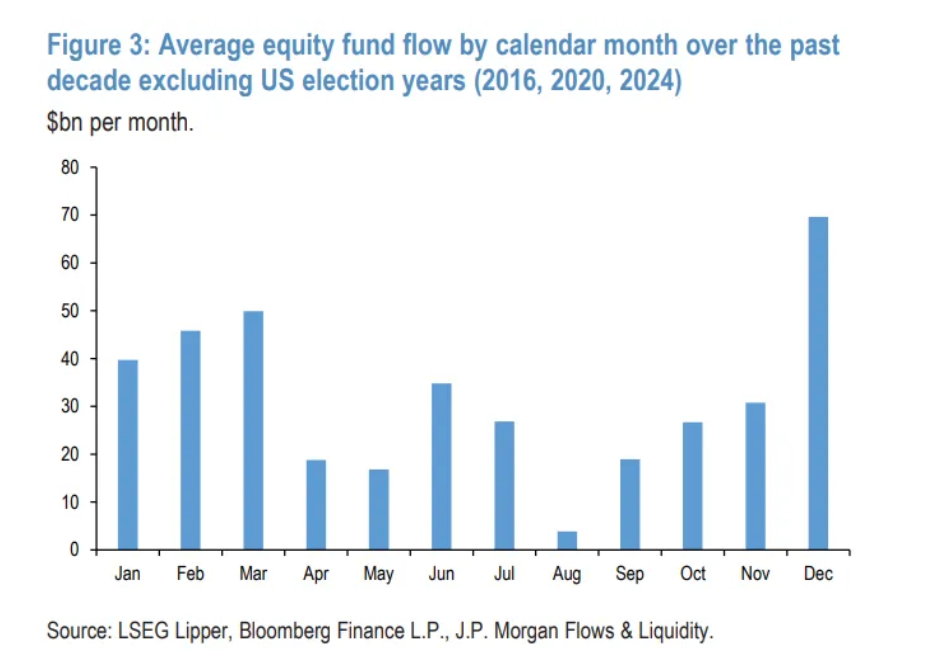
Group 1 - The report led by Nikolaos Panigirtzoglou indicates that stock fund inflows tend to be higher in December and the following first quarter during non-U.S. election years, based on a study of seasonal patterns over the past decade [1] - The S&P 500 index has recently achieved a six-month consecutive increase, the longest streak since August 2021, with a nearly 6% rise in September and October, driven by a surge in large tech stocks due to the AI growth trend [4] - Retail investors have shown strong buying momentum in stocks over the past two months, which is expected to continue into early 2026, as indicated by significant inflows into exchange-traded funds (ETFs) [4] Group 2 - Retail demand for stocks is reflected in the inflows into ETFs, with stock ETFs seeing monthly inflows of $160 billion over the past two months, marking the strongest buying pace since the U.S. elections in November/December 2024 [4] - Recent global stock market gains have faced challenges due to concerns over high valuations in the tech sector, leading some investors to take profits, alongside negative impacts from potential U.S. government shutdowns and conflicting statements from Federal Reserve officials regarding interest rate cuts [4] - Richard Privorotsky from Goldman Sachs suggests that any market pullback is unlikely to last long, emphasizing that the stock market will be a target for buying on dips due to factors like fiscal expansion, corporate earnings, and money supply [5]