
Jin Shi Shu Ju

Search documents
一周热榜精选:非农继续跟随政府停摆,特朗普关税案或败北?
Jin Shi Shu Ju· 2025-11-07 13:56
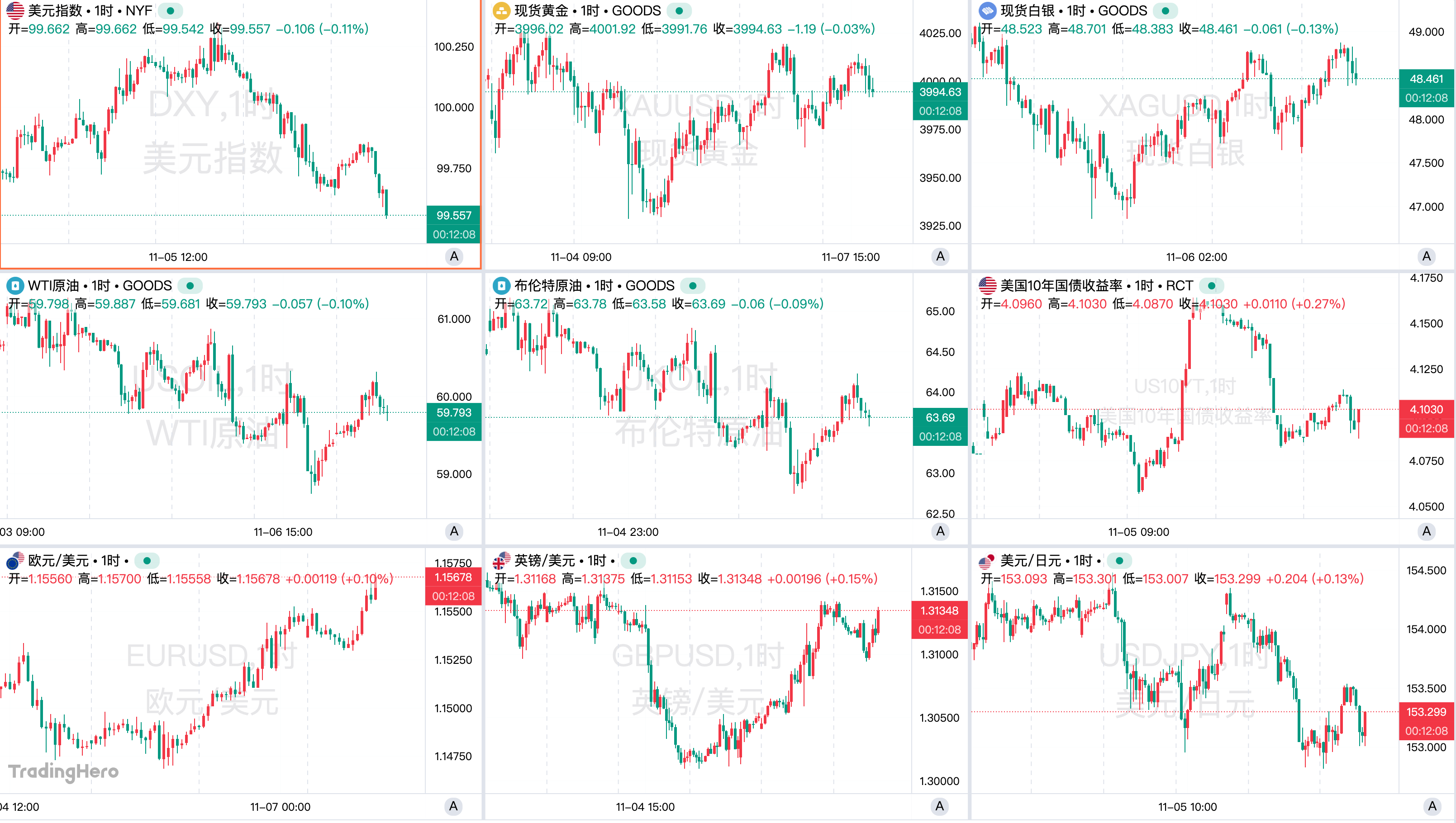
Market Overview - The US dollar index experienced fluctuations this week, initially rising above the 100 mark to reach a three-month high before falling back below 100 on Thursday, currently reported at 99.55 [1] - The precious metals market saw significant volatility, with gold prices dropping to a near one-month low of $3930 per ounce before rebounding, while silver fluctuated between $47 and $49 per ounce [1] - The oil market continued its downward trend, with both crude oil benchmarks declining for four consecutive trading days due to weak factory activity in Asia and rising global inventories [1] Employment and Economic Indicators - The US job market showed mixed signals, with ADP reporting an addition of 42,000 jobs in October, ending a two-month decline, while Challenger reported a record 153,000 layoffs, a 175% year-over-year increase [6] - The Federal Reserve is engaged in heated discussions regarding potential interest rate cuts, with differing opinions on the current economic conditions and inflation risks [7] Political Developments - The US government shutdown continues to impact the economy, with the Congressional Budget Office estimating losses of $11 billion after six weeks and $14 billion after eight weeks, affecting air travel and food assistance programs [8][9] - The Supreme Court is debating the legality of Trump's tariffs, with skepticism from both liberal and conservative justices, potentially impacting future trade policies [10] Corporate Developments - Goldman Sachs predicts limited impact on trade dynamics even if the Supreme Court rules against Trump's tariffs, while also noting potential 30% returns for Chinese stocks by the end of next year [5] - Tesla's shareholders approved a $1 trillion compensation plan for Elon Musk, aiming for a market cap increase from $2 trillion to $8.5 trillion, with ambitious targets set for vehicle deliveries and autonomous driving capabilities [15][16] Industry Insights - The US government updated its critical minerals list, adding ten new minerals including copper and silver, to reduce reliance on foreign sources and promote domestic mining [14] - OpenAI and Amazon Web Services entered a $38 billion computing power agreement, marking a significant collaboration in the AI and cloud computing sectors [18] - Nvidia's CEO expressed confidence in China's potential to win the AI race, criticizing Western regulatory approaches [17]


美股抛售何时休?这些技术点位或成关键!
Jin Shi Shu Ju· 2025-11-07 13:23
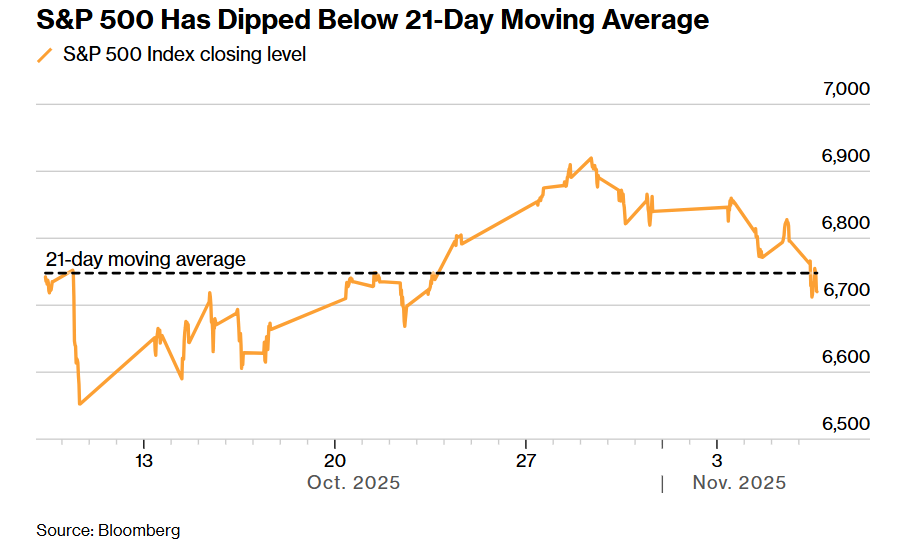
Core Viewpoint - The U.S. stock market is experiencing turbulence, with concerns over the return on investments in the AI sector and high stock valuations leading to a decline in the S&P 500 index, which fell to 6720.32 points, the lowest in two weeks [1] Group 1: Market Analysis - The S&P 500 index has dropped below the 21-day moving average, indicating a potential turning point as investors face uncertainty due to government shutdowns and the Fed's policy path [4] - The index has seen a decline of 2.5% from its previous record high, with the Chicago Board Options Exchange Volatility Index (VIX) rising to around 20 [4] - The Challenger Group reported that announced layoffs in October reached the highest level for this time of year in over 20 years, driven by cost-cutting in AI-related sectors [4] Group 2: Technical Indicators - Key support levels for the S&P 500 index are being closely monitored, with the next significant point being the 6700 mark, where a high volume of options contracts may provide short-term support [5] - Analysts from Morgan Stanley identified the 6740-6800 range as critical technical levels, with a more significant support level at 6640 points [5] - Increased hedging activity has been noted, with the VIX hovering around the critical 20-point mark, indicating rising market vulnerability [5][6] Group 3: Upcoming Catalysts - The upcoming earnings report from NVIDIA on November 19 is anticipated to be a potential market catalyst, especially as the earnings season approaches its end [5]
出口消息扰动,尿素领涨煤化工,后续价格走势如何?
Jin Shi Shu Ju· 2025-11-07 11:02
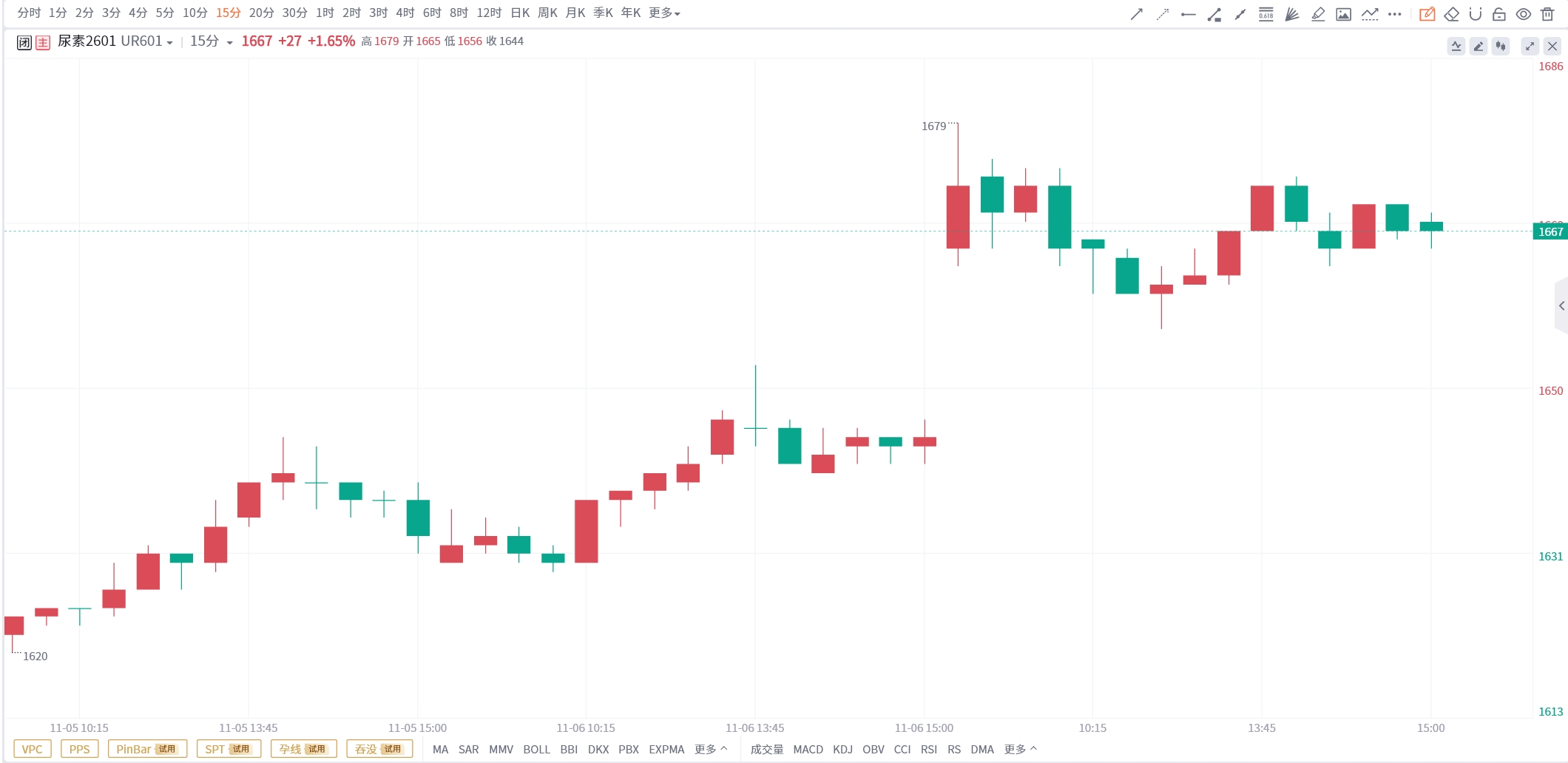
Core Viewpoint - The urea market is experiencing slight price increases due to improved production rates and market sentiment, but overall demand remains cautious with a focus on export quota developments [2][4][6]. Group 1: Market Trends - Urea prices in Shandong have slightly increased, with small granular urea trading at 1540-1590 RMB/ton and large granular urea at 1740-1760 RMB/ton [2]. - The overall market sentiment has been positively influenced by recent export news, although the follow-up market response has been less than expected [2][4]. - The industry’s daily production rate is reported at 19.59 thousand tons, showing a slight decrease of 0.08 thousand tons from the previous day [4]. Group 2: Supply and Demand Dynamics - Urea production rates have improved as previously shut-down facilities are coming back online, leading to an accumulation of inventory [3][7]. - As of November 5, total inventory for Chinese urea enterprises reached 157.81 million tons, an increase of 2.38 million tons week-on-week, reflecting a 1.53% rise [3][8]. - Agricultural demand is tapering off as the wheat planting season concludes, while industrial demand is gradually increasing, particularly from compound fertilizer manufacturers [7][8]. Group 3: Future Outlook - Analysts suggest that the new export quota news could lead to a stronger market performance, but caution is advised as the actual impact remains to be seen [4][5]. - There is speculation that export quotas may be significantly relaxed next year, but the export window for this year is likely to remain closed [5][7]. - The overall expectation is for prices to remain volatile with a tendency towards weakness due to limited increases in future export expectations [8].
德国高级军官警告:俄罗斯随时可能对北约发动有限攻击
Jin Shi Shu Ju· 2025-11-07 10:04
Core Viewpoint - A senior German military official warns that Russia has the capability to launch limited attacks on NATO territory at any time, depending on the stance of Western allies [1] Group 1: Military Capabilities and Intentions - Russia could potentially launch a small-scale attack on NATO territory as early as tomorrow, according to General Alexander Sollfrank, who emphasizes that such an attack would be limited in scale and speed due to Russia's current military commitments in Ukraine [1] - Despite setbacks in Ukraine, Russia's air force remains strong, and its nuclear and missile capabilities have not been affected [1] - Russia aims to increase its total military personnel to 1.5 million and possesses sufficient main battle tanks, supporting the feasibility of a limited attack [2] Group 2: NATO's Response and Defense Strategy - The establishment of the German Joint Operations Command in 2024 marks a strategic shift in Germany's defense policy from overseas missions to the defense of NATO territory [2] - Germany plans to increase its defense spending from nearly €100 billion in 2025 to approximately €160 billion (about $187 billion) by 2029, aligning with NATO's new core military spending target of 3.5% of GDP [3] - The potential for a Russian attack on NATO is influenced by three factors: Russia's military strength, its military record, and leadership decisions, with NATO's deterrence efforts playing a significant role [3] Group 3: Strategic Implications of Russian Actions - Recent incidents, such as Russian drones entering Polish airspace, have heightened Western concerns about Russia escalating conflicts [3] - Russia's mixed warfare tactics, including drone incursions, are part of a broader strategy that encompasses its military actions in Ukraine, referred to as "non-linear warfare" [3] - The intent behind Russian provocations is to test NATO's reactions, create unease, spread fear, and assess the alliance's resilience [4]
越南民间掀起抢金狂潮,政府终结13年垄断后仍难满足需求
Jin Shi Shu Ju· 2025-11-07 09:45
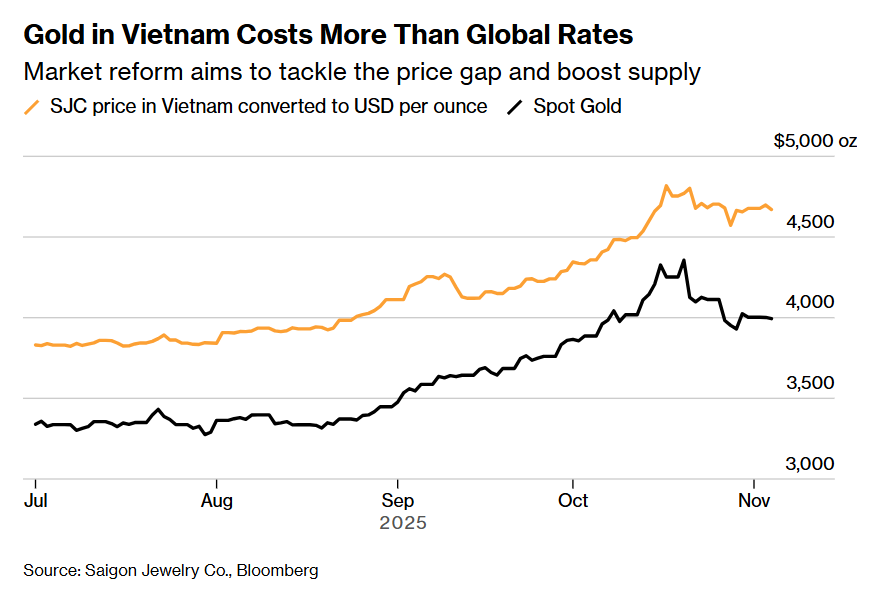
Core Insights - The article highlights a surge in gold demand in Vietnam due to cultural significance and recent price increases, with consumers facing shortages as they prepare for weddings and other events [1][2][5] Group 1: Market Dynamics - Gold prices in Vietnam reached a historical high of $4,380 per ounce, leading to a buying frenzy among consumers [1] - The Vietnamese government is transitioning from a 13-year monopoly on gold imports and production, aiming to open the market and reduce the price gap between local and global gold prices [2][8] - The annual gold demand in Vietnam is approximately 55 tons, the highest in Southeast Asia, but the central bank only imported about 13.5 tons last year [2] Group 2: Cultural Significance - Gold is deeply embedded in Vietnamese culture, often given as gifts during weddings to symbolize prosperity and good fortune [1][5] - The tradition of hoarding gold as a safe asset persists, with many families storing gold at home, reflecting a lack of trust in the banking system [5][7] Group 3: Regulatory Changes - New regulations require gold transactions over 20 million VND (approximately $760) to be conducted via bank transfers, ending the long-standing cash transaction tradition [7] - The government is considering imposing a 10% tax on gold purchases to curb hoarding and encourage other forms of investment, while also planning to establish a national gold exchange [8]
全球降息周期或已见顶!流动性退潮,股市还能继续涨吗?
Jin Shi Shu Ju· 2025-11-07 09:00
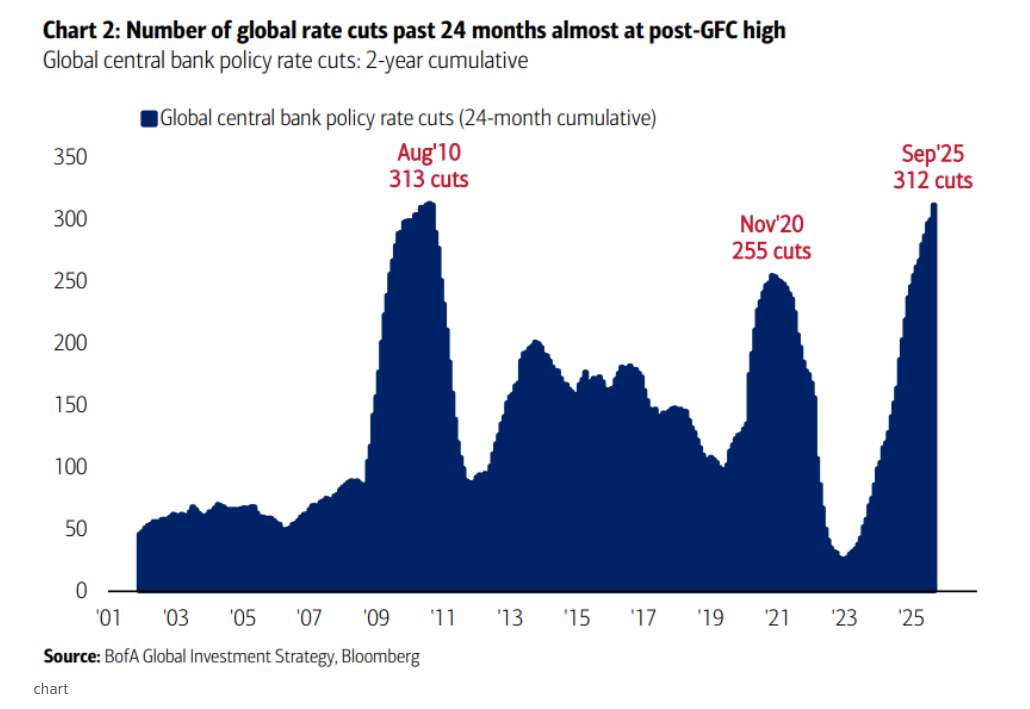
Group 1 - The global interest rate cut cycle may have peaked, raising questions about when or if the currently robust market will begin to feel pressure [1][4] - Over the past 25 months, global central banks have matched the number of interest rate cuts seen during the 2007-09 financial crisis, indicating a significant scale of historical rate hikes implemented to combat inflation in 2022-23 [1][4] - The end of ultra-loose monetary policy suggests that the financial environment will no longer be as accommodating, although major central banks like the Federal Reserve are still expected to cut rates further [4] Group 2 - Analysts from Societe Generale suggest that the peak of the easing cycle could signal a bullish outlook for Wall Street, indicating that profit growth will accelerate and spread across sectors [5] - The peak of the easing cycle traditionally means that the market is confident in accelerating profit growth, as evidenced by strong market performance following previous peaks in August 2020 and September 2009 [5] - Current market valuations are notably different from those periods, as the stock market is at unprecedented highs, raising concerns about potential bubbles [5] Group 3 - Almost all major asset classes have risen this year, driven by various factors, with the AI boom providing a significant boost to Wall Street [6] - Standard Chartered highlights that the common force behind the rise in asset prices is liquidity, which has been abundant [6][7] - The concept of liquidity is influenced by factors beyond monetary policy, including bank reserves, private sector credit availability, and overall risk appetite [7]
全球资产配置大转向持续发酵:投资者仍不愿全仓押注美国
Jin Shi Shu Ju· 2025-11-07 08:21
Core Viewpoint - A significant trend is emerging among investors as they approach 2025, characterized by a reluctance to heavily invest in U.S. assets, a phenomenon referred to as "Sell America" or "Anywhere But the USA" [1] Group 1: Investor Sentiment - Many investors are increasingly discussing the need to withdraw from the U.S. market, as noted by ETF.com’s Dave Nadig [1] - Despite a rebound in major U.S. indices, international investors continue to favor portfolios that are not dominated by U.S. stocks [1][2] - The "Trump sell-off" initiated by trade policy concerns is still evolving, according to AJ Bell's Daniel Coatsworth [1] Group 2: Global Fund Trends - There is a rising interest in global funds that exclude U.S. assets, allowing investors to gain market exposure while avoiding U.S. equities [2] - The MSCI World Ex-U.S. Index has risen by 24% year-to-date, outperforming the S&P 500 Index, which has increased by approximately 15.6% [2] Group 3: Asset Allocation Factors - Investors may limit their U.S. asset allocation due to already significant exposure or dissatisfaction with the current U.S. political climate [3] - Concerns about the extreme concentration of the U.S. stock market, particularly among the "Magnificent 7" tech stocks, are influencing asset allocation decisions [3][4] Group 4: International Demand - Evidence suggests that demand for international assets remains strong, with Brandes Investment Partners reporting significant inflows into international and global strategies [4] - Investors are still allocating funds to U.S. stocks but are increasingly focusing on value stocks or small-cap stocks as part of diversified global portfolios [4] Group 5: Diverging Perspectives - Not all analysts agree on a mass exodus from U.S. assets; some see a trend more aligned with "hedging against the U.S." rather than outright selling [5] - There is a notable difference in experiences between domestic and international investors, with European investors facing lower net returns from U.S. investments due to currency fluctuations [6]
技术刘报告:国际现货黄金涨势不改 欧美留意方向选择
Jin Shi Shu Ju· 2025-11-07 07:53
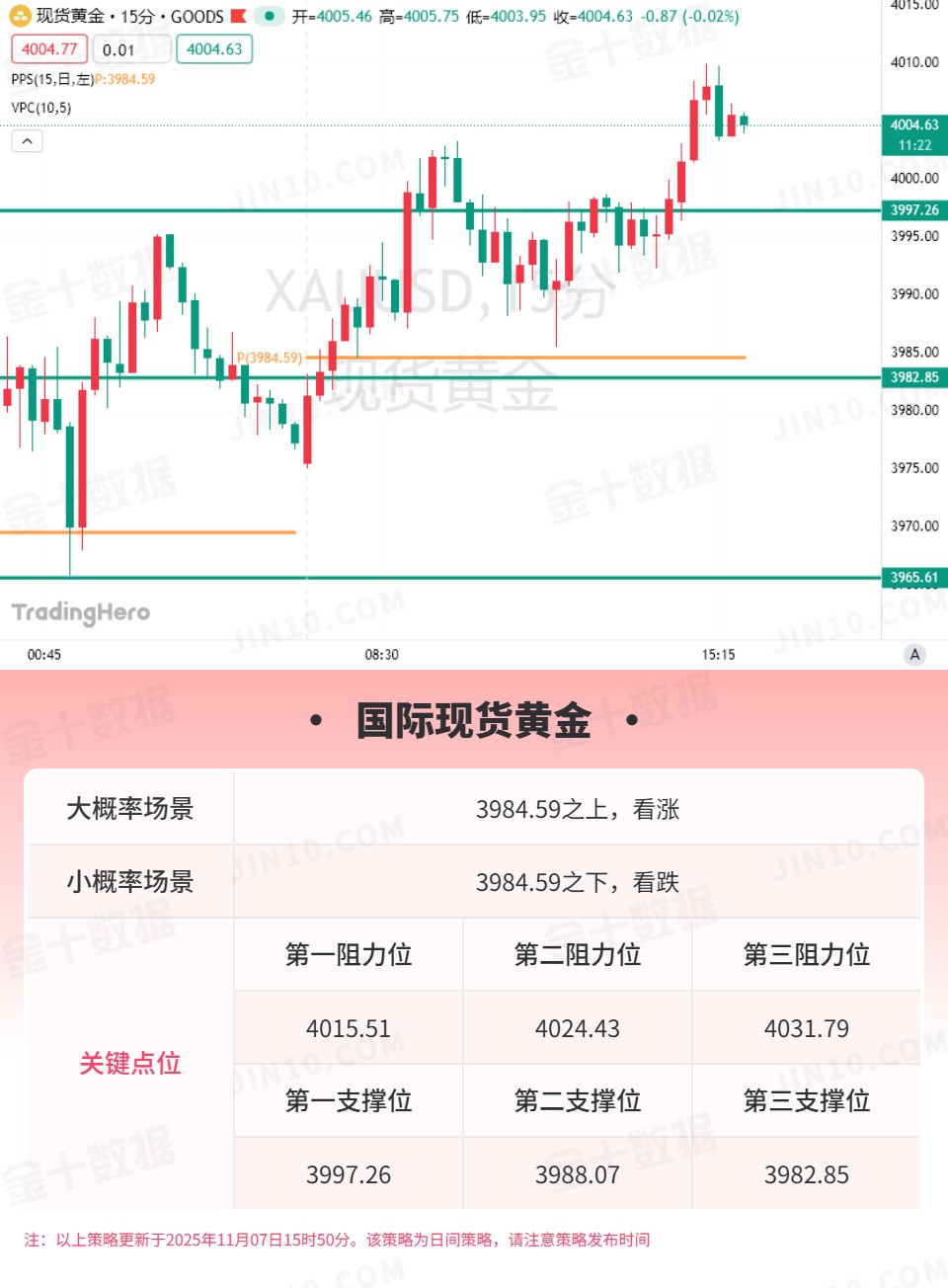
Group 1 - The article discusses the VPC indicator strategy, which is intended for reference and not as investment advice [1] - The strategy update was released on November 7, 2025, at 15:50 Beijing time [1] Group 2 - The article provides a bullish scenario for the price above 48.07 and a bearish scenario below this level [5] - Key resistance levels are identified at 48.73, 49.02, and 49.23, while support levels are at 48.40, 48.17, and 47.80 [5] Group 3 - The article includes information on the Euro/USD currency pair, with a current price of 1.15316, showing a slight decrease of 0.00001 (-0.00%) [9] - The article outlines a bearish scenario below 1.1533 and a bullish scenario above this level [9] - Key support levels are at 1.1521, 1.1509, and 1.1496, while resistance levels are at 1.15550 and 1.15525 [9] Group 4 - The article mentions a bullish scenario for the price above 0.6485 and a bearish scenario below this level [15] - Key support levels are at 0.6470, 0.6442, and 0.6370, while resistance levels are at 0.6496, 0.6512, and 0.6522 [15]
美股风雨飘摇?摩根大通力挺:回调就是上车机会,大胆抄底!
Jin Shi Shu Ju· 2025-11-07 05:36
Core Viewpoint - In uncertain times, the simplest advice may be the best, which can be summarized as "buying the dip." Morgan Stanley sees investment opportunities despite concerns over the sustainability of AI trading, suggesting to capitalize on any sell-off opportunities before the year ends [1] Group 1: Economic Strength - The U.S. economy is expected to maintain strong growth momentum, with positive signals indicating stabilization in hiring activities despite ongoing government shutdowns [1] - In October, the private sector added 42,000 jobs, exceeding economists' expectations of 25,000 and improving from a loss of 32,000 jobs in the previous month [1][2] - The ISM Services PMI recorded 52.4% in October, indicating continued expansion in the services sector, aligning with a GDP growth rate of 2.5% [2] Group 2: Corporate Earnings - U.S. companies reported strong third-quarter earnings, with 83% of S&P 500 companies exceeding analyst expectations, potentially marking the highest proportion of earnings beats since 2021 [3] - The average earnings surprise for the third quarter ranks among the top ten since 1987, highlighting robust corporate performance [3] Group 3: Diminishing Headwinds - Key factors that have pressured the stock market are beginning to weaken, including uncertainties surrounding tariffs and trade policies [4] - The government shutdown, which is the longest in history, may provide new liquidity to the market once resolved, potentially boosting speculative sectors [5] - Analysts view recent market pullbacks as buying opportunities, reinforcing the bullish sentiment [5]

OpenAI一句话再掀美股风暴!融资疑云引爆科技股抛售
Jin Shi Shu Ju· 2025-11-07 04:15
Core Viewpoint - The enthusiasm for AI in the U.S. stock market is rapidly being replaced by skepticism, leading to significant declines in large tech stocks that had previously driven market gains [2]. Group 1: OpenAI's Funding Concerns - OpenAI has committed to investing over $1.4 trillion in AI infrastructure, despite not being profitable [2]. - CFO Sarah Friar suggested that the U.S. government should provide funding guarantees, which raised concerns on Wall Street [2]. - Both Friar and CEO Sam Altman later clarified that OpenAI is not seeking government guarantees for its data centers [2]. Group 2: Market Reactions and Investor Sentiment - Investor anxiety is heightened regarding whether the AI-driven tech stock rally has gone too far, with skepticism about OpenAI's funding needs [3]. - The Nasdaq 100 index fell by 2.1% on Tuesday and 1.9% on Thursday, retreating nearly 4% from its October 29 peak, although it remains up about 20% year-to-date [4]. - Nvidia's stock dropped 3.7% on Thursday, marking a cumulative decline of over 9% over three trading days, the largest drop since April [4]. Group 3: Broader Market Implications - Oracle's stock nearly erased all of its 36% gain since September 10, reflecting a shift in market sentiment [4]. - The recent market pullback occurred despite strong earnings reports from S&P 500 tech companies, with an average earnings growth of 23% reported by 47 companies [5]. - The sell-off is viewed as a reality check, with valuations returning to fundamentals as investors seek to lock in profits [6]. Group 4: Future Outlook and Economic Impact - Key upcoming events include Nvidia's Q3 earnings report on November 19 and Broadcom's quarterly results on December 12, which may be overshadowed by concerns over OpenAI's funding [6]. - The labor market is experiencing disruptions, with U.S. companies announcing 153,074 layoffs in October, attributed in part to AI applications [7]. - Ongoing government shutdown concerns are also contributing to investor unease, with analysts suggesting that recent stock market gains warrant a correction [8].