
Jin Shi Shu Ju

Search documents
美国政府停摆:长期经济增长的“杀手”
Jin Shi Shu Ju· 2025-10-15 05:45
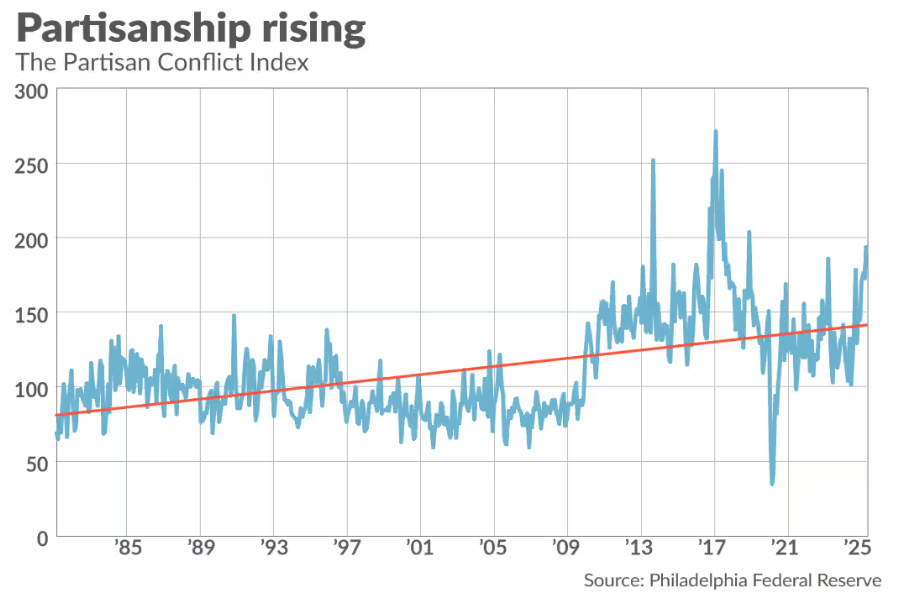
Group 1 - The core argument is that political polarization in the U.S. is leading to a significant reduction in corporate investment, which will adversely affect long-term economic growth [1][2] - A study by Marina Azzimonti found a negative correlation between the partisan conflict index (PCI) and domestic private investment, indicating a causal relationship [2][5] - Azzimonti's research highlights that 27% of the decline in corporate investment from 2007 to 2009 can be attributed to increased partisan conflict [2] Group 2 - The long-term trend of the PCI is steadily increasing, currently more than double the levels seen during the 2007-2009 period, suggesting that corporate investment would be higher without government dysfunction [5] - Political polarization creates greater economic uncertainty, which diminishes the likelihood of returns on capital investments, leading to delays in investment decisions [5] - Political polarization also reduces the likelihood of timely legislative responses to economic crises, negatively impacting expected returns and suppressing corporate investment [5][6] Group 3 - Azzimonti's findings contradict the belief that corporate America prefers political gridlock, as it actually leads to poorer stock market performance [6] - Research indicates that stock market returns are better under unified government control, with annualized returns being 8.7 percentage points higher from 1927 to 2020 during unified government periods [8] - The impact of government dysfunction may not be immediately visible in economic data, but historical trends suggest that future U.S. economic growth rates are likely to be significantly lower [8]

黄金不再恐高!散户入场才刚刚开始
Jin Shi Shu Ju· 2025-10-15 04:20
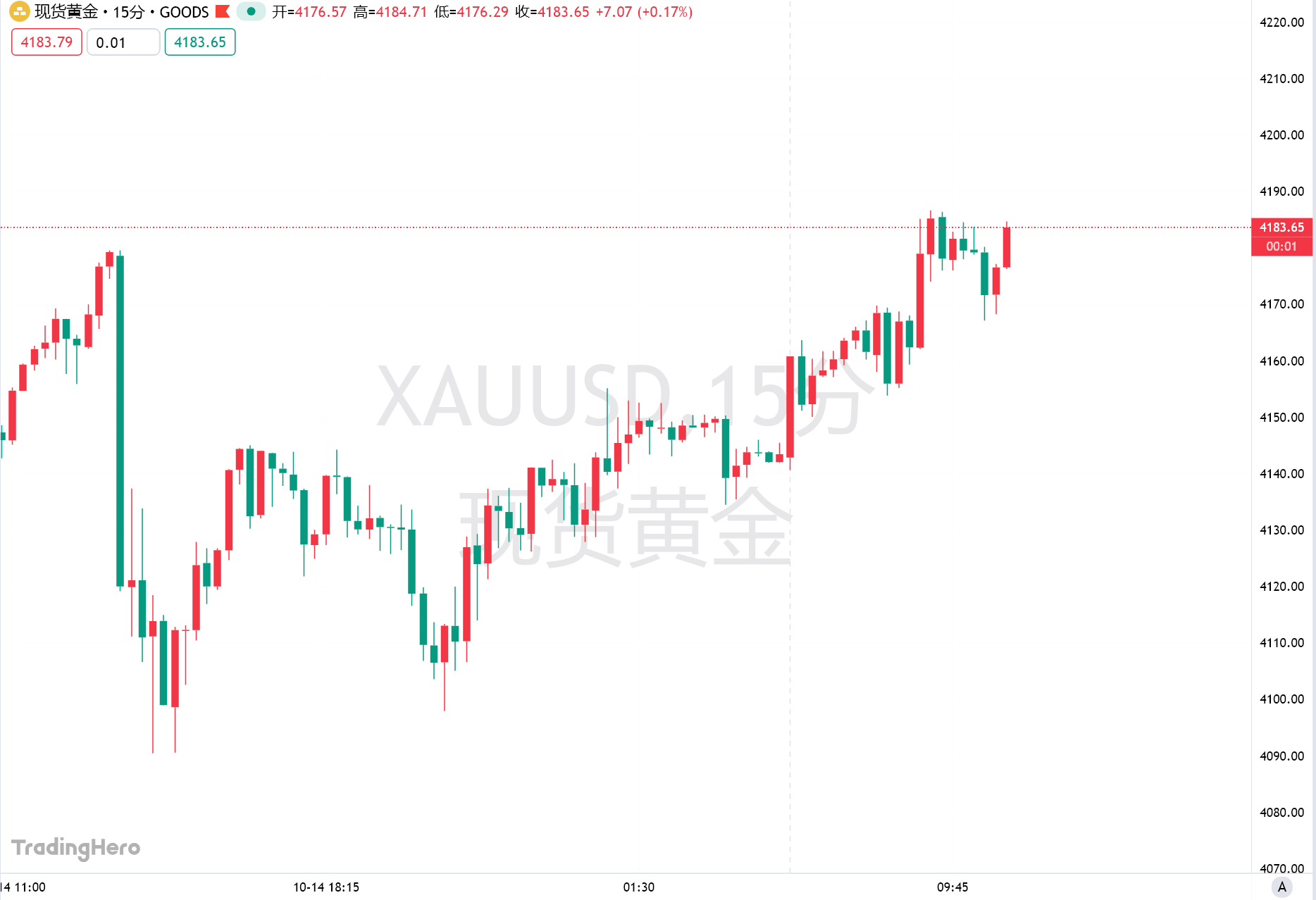
Core Viewpoint - Despite record-high gold prices, Western investors' demand for gold continues to rise, driven by increasing government debt and strong central bank purchases [1][10] Group 1: Market Dynamics - The American Gold Exchange reports that U.S. investors have primarily been net sellers of gold and silver during the ongoing bull market, cashing in profits as prices rise [1] - As of October 9, trading volume for the most active gold futures contracts on the Comex reached 448,407 contracts, the highest since April 12, 2024 [4] - The SPDR Gold Trust ETF saw trading volume rise to nearly 33.7 million shares on October 9, marking the highest level since April 22, 2025 [4] Group 2: Investor Behavior - U.S. retail investors only recently began participating as buyers in the gold and silver markets after the Federal Reserve signaled a dovish shift in late August [3] - The World Gold Council indicates that from June to September, North American gold ETFs experienced higher monthly inflows compared to Asia, despite gold prices reaching historical highs [7] - Tavi Costa from Crescat Capital notes that Western investors have only recently engaged in the current gold rally, influenced by the competitive performance of other asset classes [7] Group 3: Structural Changes - The current ETF infrastructure is more mature than in previous crises, allowing for faster capital inflows into the gold market [6] - The demand for physical gold is being driven by both retail investors and central banks, which are competing for the same physical gold [6] - Will Rhind from GraniteShares highlights that many new investors are more familiar with products like the SPDR Gold Trust ETF, leading to increased purchases [8] Group 4: Economic Context - The rise in gold trading volume reflects the severity of global economic imbalances, with central banks indicating a strong demand for gold to stabilize their currencies [8] - Samuelson from the American Gold Exchange argues that the current gold bull market is driven by unprecedented physical buying, rather than merely being a reaction to currency devaluation [10] - The ongoing inflation is eroding purchasing power, making gold and silver more attractive as stores of value compared to depreciating fiat currencies [10]
又一次致命打击!美军击沉委内瑞拉贩毒船致6人死亡
Jin Shi Shu Ju· 2025-10-15 02:54
Core Points - The article discusses a recent military strike by the U.S. against a drug trafficking vessel near Venezuela, resulting in the death of six individuals associated with drug trafficking [2] - President Trump has emphasized combating drug trafficking, particularly fentanyl, as a key focus since returning to office [2][5] - The U.S. has increased military presence in the Caribbean, deploying advanced weaponry and conducting multiple strikes against drug trafficking organizations [4][6] Summary by Sections Military Action - The U.S. conducted a military strike on a vessel linked to drug trafficking, resulting in six deaths [2] - This action is part of a broader strategy to combat drug trafficking, with the U.S. intelligence confirming the vessel's involvement in drug transport [2][4] - The U.S. has reported at least five similar strikes in recent weeks, leading to a total of 27 deaths [2] Legal and Political Context - The legality of these military actions is under scrutiny, with bipartisan concerns raised in Congress regarding the legal basis for such strikes [3][4] - The Pentagon asserts that these actions comply with U.S. and international law [4] Strategic Implications - The military deployment in the Caribbean is described as the largest in decades, aimed at pressuring Venezuelan leadership, particularly Nicolás Maduro, who is accused of leading a drug trafficking organization [4][6] - The U.S. has doubled the reward for information leading to Maduro's capture from $25 million to $50 million [4] Drug Trafficking Dynamics - Venezuela is not a producer of fentanyl but has historically been a transit point for cocaine, primarily sourced from Colombia [5][6] - The majority of cocaine entering the U.S. is reported to originate from Colombia, with only a small percentage transiting through Venezuela [6]
油市过剩已经到来!顶级石油贸易商:油价会跌但不会崩
Jin Shi Shu Ju· 2025-10-15 02:22
Core Viewpoint - Major commodity traders indicate that signs of an oil surplus are finally emerging, which could lead to lower oil prices. Brent crude oil prices have dropped by 11% since the end of last month due to increased supply from OPEC+ and other countries, leading to a bearish outlook for the U.S. oil market next year [1][2]. Group 1: Market Supply and Demand - The International Energy Agency (IEA) forecasts a surplus of approximately 4 million barrels per day by 2026, an increase of 18% from previous predictions [1]. - Traders from Gunvor Group, Vitol Group, and Trafigura Group expect oil prices to decline in the short term before recovering next year [1]. - The influx of oil into the market is attributed to steady increases in OPEC production and slight increases from non-OPEC countries like Guyana, Norway, and Brazil [3]. Group 2: Price Predictions - Vitol Group predicts that the average oil price next year will be around $60 per barrel, while Gunvor anticipates a drop followed by a recovery to $62 per barrel [2][3]. - Trafigura expects prices to fall to around $50 per barrel by the end of the year before rising to approximately $60 per barrel next year [3]. - Despite these predictions, the decline is not expected to be catastrophic, but it represents a 14% decrease compared to the average price from 2025 to date, which is disappointing for oil-dependent companies [3]. Group 3: Market Dynamics - The current market situation shows an influx of oil without a corresponding increase in demand, compounded by escalating trade tensions [4]. - There are concerns that the market may be overestimating the production capabilities of Venezuela and Iran, both under sanctions, while global refineries are operating at full capacity to meet demand [3].
美联储两大官员发声,为再度降息预热!
Jin Shi Shu Ju· 2025-10-15 00:42
Core Viewpoint - The Federal Reserve should continue to lower interest rates this year to support the labor market while maintaining sufficiently high rates to keep inflation in check [1] Group 1: Interest Rate Outlook - Boston Fed President Susan Collins indicated that further easing, potentially another 25 basis points, may be appropriate, but emphasized the need to avoid premature long-term guidance [2] - The futures market reflects investor expectations for rate cuts at the upcoming Federal Reserve meetings, with a 25 basis point cut anticipated [3] Group 2: Labor Market Insights - Collins noted that it is currently difficult to determine whether the recent slowdown in hiring is due to decreased labor demand or a significant drop in immigration affecting labor supply [1] - To maintain stable unemployment, the economy requires only about 40,000 new jobs per month, compared to approximately 80,000 pre-pandemic [1] Group 3: Economic Projections - Collins expects a slight increase in the unemployment rate this year and early 2026, but anticipates a rebound in hiring as tariffs and economic uncertainties diminish [1] - Fed Governor Michelle Bowman expressed her belief that there will be two more rate cuts by the end of the year, contingent on the labor market and other economic data evolving as expected [3]
金十数据全球财经早餐 | 2025年10月15日
Jin Shi Shu Ju· 2025-10-14 23:10
Group 1 - Federal Reserve Chair Powell indicated that the process of balance sheet reduction may be nearing its end, with rising risks in the job market [9] - The International Energy Agency (IEA) warned of a record oversupply in the oil market next year, predicting a significant surplus in global oil supply by 2026 [3][11] - The IMF has raised its global growth forecast for 2025, citing potential impacts from the ongoing trade war initiated by former President Trump [11] Group 2 - The U.S. dollar index closed at 99.056, down 0.21%, while the yield on the 10-year U.S. Treasury bond reached 4.033% [3][6] - Spot gold hit a record high of $4180 per ounce before a sharp decline, ultimately closing at $4142.15, marking a 0.77% increase [3][6] - The Hang Seng Index fell by 1.73%, with significant declines in the semiconductor sector, where stocks like Hua Hong Semiconductor dropped over 13% [4][5]

鲍威尔最新讲话:就业通胀前景变化不大,或将结束缩表
Jin Shi Shu Ju· 2025-10-14 17:31
Core Viewpoint - Federal Reserve Chairman Jerome Powell discussed the U.S. economic outlook and monetary policy, emphasizing the Fed's ongoing efforts to maintain economic and financial stability while adapting policies based on economic conditions rather than preset paths [1][3]. Economic Outlook - Current data indicates that the employment and inflation outlook has not changed significantly since September, despite some delays in government data due to the shutdown [3][4]. - Economic activity growth may be more robust than previously expected, with the unemployment rate remaining low as of August, although non-farm employment growth has slowed [3][4]. - The labor market shows signs of weakness, with rising risks to employment, as evidenced by low levels of layoffs and hiring, alongside declining perceptions of job opportunities among residents and businesses [3][4]. Inflation and Monetary Policy - The core Personal Consumption Expenditures (PCE) inflation rate was 2.9% year-on-year as of August, slightly up from earlier in the year, primarily due to rising core goods prices [4]. - Short-term inflation expectations have increased this year, while most long-term inflation expectations remain aligned with the Fed's 2% target [4]. - The rising risks in the labor market have influenced the Fed's assessment of risk balance, leading to a more neutral policy stance being deemed appropriate [4]. Federal Reserve Operations - Powell indicated that the balance sheet reduction may conclude in the coming months, with the Fed aiming to ensure sufficient liquidity in the financial system to manage short-term interest rates and market volatility [1][3]. - The tightening liquidity conditions and rising repo rates have led to temporary liquidity pressures, highlighting the need for a flexible approach to the balance sheet based on experiences since 2020 [1][3].
美政府关门“污染”!美国9月CPI报告恐失真?
Jin Shi Shu Ju· 2025-10-14 12:26
Core Insights - The U.S. government shutdown is threatening the quality of key inflation data, particularly the Consumer Price Index (CPI) report scheduled for release next month [1] - The Bureau of Labor Statistics (BLS) has been instructed to recall some employees to prepare the September CPI report, but has been unable to collect new price information since the shutdown began on October 1 [1][2] - The labor-intensive nature of CPI data collection, which involves gathering information on approximately 80,000 items nationwide, is particularly impacted by the funding interruption [1] Data Collection Challenges - The BLS may resort to more estimations due to the inability to collect certain prices, as noted by former BLS officials [2] - If the shutdown continues, the BLS might adjust the weights of various categories based on longer-term price changes [2] - The collection rate of prices has declined, which poses further risks to data quality [3] Impact on Reports - Any issues with the October CPI report could affect the release of other reports, including the PCE price index, which relies on CPI data [3] - The September CPI report, initially scheduled for release, has been delayed to October 24 due to the need to recall staff for Social Security adjustments [2][3] Caution on Data Interpretation - Economists advise against overinterpreting any single data point, especially for the October report [4] - Analysts recommend a cautious approach to any anomalies in the October data [5]
每日数字货币动态汇总(2025-10-14)
Jin Shi Shu Ju· 2025-10-14 10:43
Group 1: Market Sentiment and Trends - Traders are heavily buying put options for Bitcoin and Ethereum, indicating a hedge against potential downside risks following a recent market crash [1] - The cryptocurrency market has seen a total evaporation of $380 billion in value, with approximately $131 billion coming from altcoins, raising concerns about the future of the altcoin ecosystem [2] - The funding rates for cryptocurrencies have dropped to their lowest point since the 2022 crash, marking one of the most severe leverage resets in cryptocurrency history [4] Group 2: Regulatory Developments - The U.S. SEC's cryptocurrency working group chief legal advisor Mike Selig is still the top candidate to replace the CFTC chairman, with a focus on coordinating regulatory efforts between the SEC and CFTC [5] - Kenya's parliament has passed a virtual asset service provider bill aimed at attracting more investment into the sector by providing regulatory clarity [11] - Dubai has announced a new financial strategy that includes virtual assets as a core pillar, aiming to increase the sector's contribution to GDP to 3%, approximately 13 billion AED [12] Group 3: Institutional Involvement - JPMorgan plans to engage in cryptocurrency trading but has no immediate plans for custody services, opting instead to explore partnerships with third-party custodians [6][4] - BlackRock's CEO Larry Fink has acknowledged that cryptocurrencies, like Bitcoin, serve a similar purpose to gold as alternative assets, although he advises against them occupying a large portion of investment portfolios [7][8] - Citibank is planning to launch cryptocurrency custody services by 2026, indicating a significant move by traditional financial institutions into the digital asset space [9] Group 4: Corporate Actions - The Dogecoin Foundation's commercial branch, House of Doge, is set to go public through a merger with Nasdaq-listed Brag House Holdings, expected to be completed in early 2026 [10]


每日期货全景复盘10.14:午后市场情绪明显转弱,贵金属冲高回落!
Jin Shi Shu Ju· 2025-10-14 10:38
Market Overview - The futures market shows a bearish sentiment with 17 contracts rising and 61 contracts falling today, indicating a concentration of trading activity in declining varieties [2][5]. Key Contract Movements - The top gainers include the shipping index (European line) at 2512 (+7.36%), Shanghai gold at 2512 (+2.70%), and Shanghai silver at 2512 (+2.64%), driven significantly by supply and demand factors [6]. - The largest declines were seen in canola at 2511 (-5.32%), glass at 2601 (-3.40%), and methanol at 2601 (-2.61%), likely influenced by increased bearish pressure or negative fundamentals [6]. Capital Flow Analysis - The most significant capital inflows were into the CSI 500 at 2512 (1.478 billion), 30-year treasury bonds at 2512 (588 million), and 10-year treasury bonds at 2512 (454 million), indicating strong interest from major funds [9]. - Conversely, the largest capital outflows were from Shanghai gold at 2512 (-2.266 billion), Shanghai copper at 2511 (-1.347 billion), and Shanghai silver at 2512 (-1.347 billion), suggesting a notable withdrawal of funds from these assets [9]. Position Changes - Significant increases in open interest were observed in peanut at 2601 (+29.12%), cotton yarn at 2601 (+20.39%), and short fiber at 2512 (+19.91%), indicating a high level of trading activity and potential new capital entering these markets [10]. - Conversely, notable decreases in open interest were seen in corn at 2511 (-13.17%), eggs at 2511 (-13.97%), and silicon iron at 2511 (-23.55%), suggesting a withdrawal of major funds and warranting attention for future performance [10]. Key Events and Impacts - Indonesia is considering regulating palm oil exports to meet domestic biodiesel demand, which may lead to a reduction in global edible oil supply as exports decrease [11]. - Silver has outperformed gold this year, with a price increase of over 80% compared to gold's 57%, driven by investor demand and industrial usage [12][13]. - Iron ore inventories at major ports in Australia and Brazil have increased, with total iron ore stock at Chinese ports rising by 171.18 million tons, indicating a trend of increased supply [14]. Industry Insights - A new regulatory document on solar photovoltaic capacity control is expected to be released soon, aiming to balance supply and demand in the industry [15]. - The U.S. may lose 16 million tons of soybean orders if China does not return to the U.S. market by mid-November, highlighting the impact of trade dynamics on agricultural exports [16]. - Indonesia's Freeport may suspend operations at the Manyar smelter due to a shortage of copper concentrate, affecting supply chains in the copper market [16]. Future Focus - Upcoming data releases include China's September CPI and global metal market supply-demand conditions, which are expected to influence market expectations and trading strategies [19][24].
