
Jin Shi Shu Ju

Search documents
特朗普“金卡”价格狂降400万美元,全球富豪疯狂心动
Jin Shi Shu Ju· 2025-09-26 14:45
Core Points - The introduction of the "Golden Card" by President Trump has significantly increased demand among global wealthy individuals, with the price reduced from $5 million to $1 million, making it one of the most popular visa programs worldwide [1][2] - The U.S. government plans to issue 80,000 "Golden Cards," which, along with potential platinum cards and increased H-1B visa fees, could generate $100 billion in revenue [2] Group 1: Advantages of the "Golden Card" - The "Golden Card" offers a much lower price point compared to similar programs in other countries, such as Singapore's $8 million investment visa and New Zealand's nearly $3 million program [2] - Wealthy families see the $1 million investment as a small price to pay for access to the U.S. education, healthcare, banking, and financial markets [2] - The program is expected to attract a significant number of applications, with estimates suggesting at least 5,000 to 10,000 applications annually [3][4] Group 2: Challenges and Concerns - There are currently no official application channels for the "Golden Card," and potential applicants are awaiting further updates [3] - Legal challenges may arise, particularly from those who have been waiting for EB-1 and EB-2 visa approvals, as the "Golden Card" could be seen as allowing wealthy individuals to bypass the queue [5][6] - The non-refundable nature of the $1 million donation contrasts with other countries' investment visa programs, which often allow for potential returns on investment [6] Group 3: Market Context and Future Prospects - The launch of the "Golden Card" coincides with increasing geopolitical uncertainties, prompting wealthy individuals to seek alternative residency options [4] - The U.S. is projected to be a top destination for millionaires, with an estimated 7,500 expected to relocate to the U.S. this year [4] - The potential introduction of a "Platinum Card" may attract a different demographic, particularly those looking to avoid U.S. taxation on global income, although its appeal may be limited due to its higher price and lack of pathways to permanent residency [7][8]
无视油市供应过剩预警!OPEC+或批准11月再度增产
Jin Shi Shu Ju· 2025-09-26 13:56
石油交易商预计, OPEC+或将在11月同意进一步恢复产量,以努力夺回全球市场份额。 周五,布伦特原油价格徘徊在每桶69美元附近,今年以来累计跌幅近7%。这一回落给经历了数年通胀 的消费者带来些许喘息,也有利于美国总统特朗普——他正寻求降息,并向俄罗斯施压以结束俄乌冲 突。 在21位调查受访者中,仅有3人认为8个核心OPEC+成员国不会增产,其余多数预测增产的受访者认 为,增幅约为日均13.7万桶。 不过,沙特能源大臣阿卜杜勒阿齐兹·本·萨勒曼亲王(Prince Abdulaziz bin Salman)向来以"出其不 意"闻名,例如曾通过"超大规模增产"加速推进"日均220万桶"产能的重启。尽管西方制裁与乌克兰袭击 对俄罗斯能源产业构成挑战,但作为OPEC+联合领导人,俄罗斯在增产问题上也基本持配合态度。 彭博社对交易商与分析师的调查显示,沙特及其盟友很可能批准11月再次增产,幅度或与定于10月实施 的"日均13.7万桶"温和增幅持平。8个核心OPEC+成员国将于10月5日召开视频会议。 尽管石油行业普遍警告"油市即将出现过剩",但OPEC+已开始逐月重启新一轮闲置产能(总计日均166 万桶)。 不过,此前 ...
美国8月PCE增速稳定,个人支出增长超出预期!
Jin Shi Shu Ju· 2025-09-26 13:05
Group 1 - The core PCE inflation rate for August recorded at 2.9%, meeting expectations and unchanged from the previous value [1] - Overall PCE inflation rate for August recorded at 2.7%, also meeting expectations but higher than the previous value of 2.60% [1] - Personal spending in August exceeded expectations, reaching the highest level since March 2025, indicating resilience in consumer demand [1] Group 2 - Despite a significant slowdown in the labor market and stagnation in job growth, consumption continues to rise, primarily driven by high-income households benefiting from a strong stock market and elevated housing prices [4] - U.S. household wealth surged to a record $176.3 trillion in Q2, but low-income households face pressure due to rising commodity prices from import tariffs [4] - The risk of consumption growth is concentrated among high-income households, with potential vulnerabilities tied to stock market and housing price fluctuations [4] Group 3 - Richmond Fed President Barkin emphasized the focus on balancing inflation and unemployment, indicating limited risks of further deterioration in both metrics [5] - The Federal Reserve recently voted to lower the benchmark interest rate by 25 basis points in response to growing concerns about labor market slowdown [5] - Discrepancies among Federal Reserve officials regarding future rate cuts exist, with some advocating for continued cuts to mitigate employment risks while others remain concerned about inflation potential [6]

鲍威尔提前剧透PCE料温和上涨,但魔鬼藏在细节里!
Jin Shi Shu Ju· 2025-09-26 11:43
Core Insights - The Personal Consumption Expenditures (PCE) price index, a key inflation indicator favored by the Federal Reserve, is expected to show a moderate increase, with the overall PCE projected to rise by 0.3% month-over-month in August, while the core PCE, which excludes volatile food and energy prices, is anticipated to increase by 0.2% [1] - Federal Reserve Chairman Jerome Powell indicated that the year-over-year overall PCE inflation rate for August is expected to reach 2.7%, slightly up from 2.6% in the previous month, while the core PCE inflation rate is expected to remain stable at 2.9% [1][2] - Despite inflation being above the Fed's long-term target of 2%, Powell and other Fed officials are reassured that inflation has not surged unexpectedly due to increased tariffs [2] Inflation Monitoring - The Federal Reserve is closely monitoring inflation dynamics, particularly focusing on the extent of price increases in goods and whether the recent rise in service costs is a temporary fluctuation [3][4] - Goods prices have been significantly impacted by tariffs, showing only a 0.5% increase over the past year, with expectations of price declines for most of 2023 and 2024 [4] - Service price growth, which had previously slowed, has recently rebounded in June and July, raising concerns among Fed officials [4] Labor Market Concerns - The labor market is showing signs of strain, with a significant drop in new job creation, a gradual rise in unemployment rates, and an increase in the time it takes for individuals to find jobs [2] - The Fed implemented its first interest rate cut of the year, citing "weakness in the labor market" as a primary reason [2] Future Outlook - Most Federal Reserve officials believe that service costs will stabilize again, and they are looking for evidence of this in the upcoming August PCE report [5] - The PCE data is considered a critical economic indicator that will be closely watched by market participants [5]
每日投行/机构观点梳理(2025-09-26)
Jin Shi Shu Ju· 2025-09-26 10:27
Group 1 - Morgan Stanley predicts that the "Genius Act" aims to maintain the dominance of the US dollar, with a long-term bearish outlook on the dollar [2] - The Federal Reserve is expected to lower interest rates by a cumulative 125 basis points by mid-2024, bringing rates down to around 3% [2] - The current economic conditions may lead to a decline in demand for US dollars and US Treasury bonds, resulting in dollar depreciation [2] Group 2 - Citadel's founder anticipates that the Federal Reserve will lower interest rates once or twice more in 2025 due to concerns about the labor market [4] - The number of new jobs is declining, which could hinder the ability to create new employment opportunities without immigration [4] - The Federal Reserve's focus on the labor market may lead to further rate cuts as economic conditions evolve [4] Group 3 - Panmure Liberum warns that rising long-term US Treasury yields could delay the investment boom in artificial intelligence [3] - Higher yields increase debt costs, making some investment projects unprofitable, with a 1% rise in yields potentially reducing IT equipment investment growth by 0.6% [3] - The current high valuations may lead to downward adjustments in earnings forecasts for large tech companies and growth stocks [3] Group 4 - Citic Securities expects the weakness of the US dollar to persist at least through 2025 due to narrowing monetary policy differentials and slowing economic momentum [6] - The domestic dairy industry is entering a high-growth phase driven by deep processing and increased capacity, with a projected demand exceeding 26 billion yuan [6] - The sector is expected to benefit from lower milk prices and a focus on domestic supply chain innovation [6] Group 5 - The gaming industry is experiencing an upswing due to the approval of new game licenses, with 145 domestic and 11 imported licenses issued in September 2025 [8] - The stable supply of licenses is expected to enhance short-term industry sentiment and support long-term product development [8] - Companies focusing on AI and IP commercialization trends are recommended for potential performance improvements [8]
美股15年长牛的背后,有一个关键推手经常被忽视!
Jin Shi Shu Ju· 2025-09-26 09:47
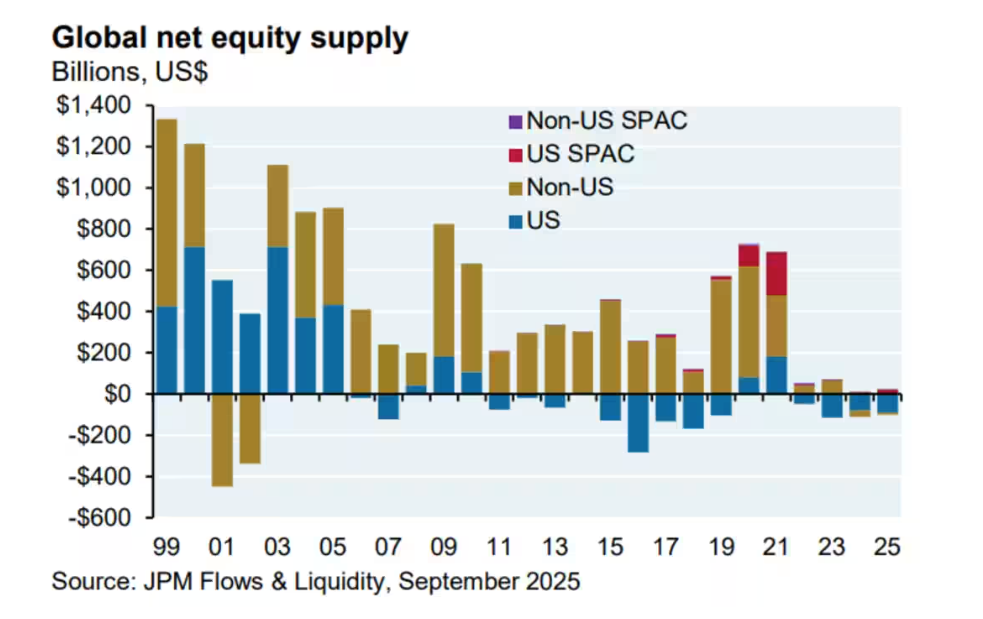
Core Insights - The article discusses the steady rise of the U.S. stock market post-financial crisis, attributing it to various factors including expanding profit margins of large corporations and the significant impact of tech giants like Microsoft and Apple on the global economy [1][3] - A critical point raised is the supply-demand imbalance in the stock market, which is considered a key factor in maintaining market resilience against volatility [1][3] Group 1: Market Dynamics - The supply of U.S. stocks has been on a declining trend since 2011, with a notable exception during the COVID-19 pandemic when IPO activity surged [3] - Corporate stock buybacks have been identified as a significant driver of this declining supply trend [3] - Despite a decrease in the proportion of fixed income pension plan inflows relative to the total market capitalization of the S&P 500, an annual influx of $1.5 trillion still needs to find investment opportunities [3] Group 2: Market Performance - Since 2011, investors have faced multiple stock market sell-offs, but only two have evolved into bear markets: the bear market in 2022, which resulted in the worst annual performance for the S&P 500 since 2008, and the brief sell-off in March 2020 due to the pandemic [3] - The article notes that the U.S. stock market indices, including the S&P 500, Dow Jones, and Nasdaq, experienced a decline, marking the first simultaneous three-day drop since March [3]
美联储决策层洗牌,2%通胀目标会否被废除?
Jin Shi Shu Ju· 2025-09-26 09:22
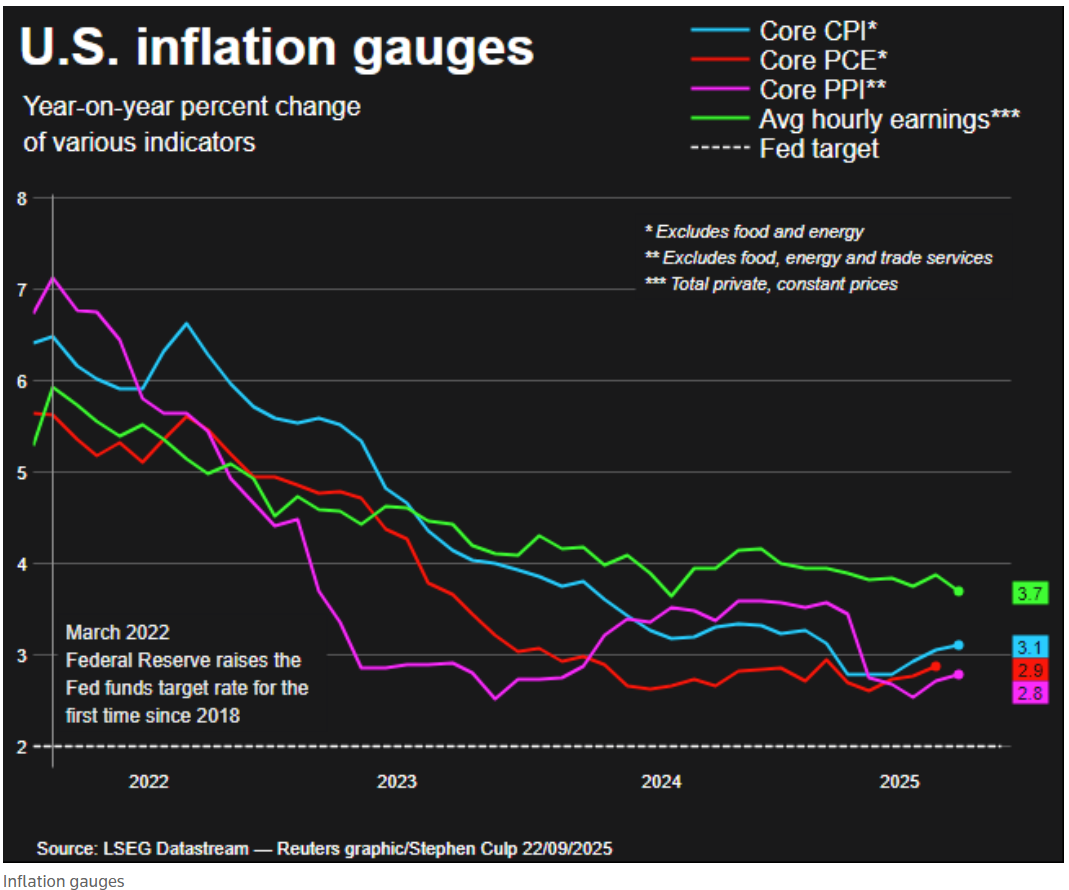
Core Viewpoint - The likelihood of the Federal Reserve changing its 2% inflation target is minimal, but discussions around alternative targets may intensify as the composition of the Federal Reserve Board changes and Powell's term ends in May next year [1][4]. Inflation Performance - The U.S. inflation rate is expected to show that it has exceeded the Federal Reserve's 2% target for 54 consecutive months, which is a rare occurrence for a central bank [1][3]. - The median expectation among Federal Reserve officials indicates that overall Personal Consumption Expenditures (PCE) inflation and core PCE inflation may not return to 2% until 2028, and even this timeline may be difficult to achieve [3]. Employment and Monetary Policy - The dual mandate of the Federal Reserve includes "full employment and price stability," but rising risks in the employment sector have prompted a restart of the rate-cutting cycle [3]. - Current financial conditions are among the most accommodative in years, with economic growth remaining robust, suggesting that rate cuts could further exacerbate inflationary pressures [3]. Trust in Inflation Targeting - The longer the Federal Reserve fails to meet its inflation target, the more likely public trust in the "inflation target itself" and the overall policy-making of the Federal Reserve may be undermined [3]. Potential Shift to Inflation Range - There is a possibility of adopting an "inflation range" as an alternative to the current target, which some Federal Reserve officials, including Atlanta Fed President Bostic, have shown openness to [5]. - Bostic suggested that a range of 1.75% to 2.25% could be a reasonable starting point, emphasizing that this approach would provide greater flexibility for policymakers [5]. Advantages and Disadvantages of Inflation Range - An "inflation range" could allow the Federal Reserve to avoid being technically in violation of its target even if inflation exceeds 2%, as long as it remains within the defined range [5]. - However, a wider range could lead to accumulated pressure if inflation spirals out of control, potentially forcing the Federal Reserve to implement overly aggressive and uncomfortable policy measures [6]. Global Context and Consumer Expectations - While the "inflation range" approach is more common in emerging markets, developed economies like Canada, Australia, and New Zealand have also adopted it, although central banks generally prefer more precise inflation targets [8]. - Consumer expectations for inflation are notably high, with a one-year expectation of 4.8% and a five-year expectation of 3.9%, which could lead to a "wage-price spiral" if not addressed [8].
乌克兰轰炸俄能源设施奏效,但需小心特朗普变脸!
Jin Shi Shu Ju· 2025-09-26 08:50
Core Insights - The ongoing conflict between Ukraine and Russia has seen a significant escalation, with Ukraine launching multiple drone attacks on Russian energy infrastructure, impacting Russia's oil and gas industry, which constitutes a quarter of its GDP [2][4] - In response to these attacks, Russia has announced a partial ban on diesel exports, which is expected to affect its crucial cash flow from energy exports [4][6] - The global diesel market has reacted strongly, with European refining margins reaching their highest levels since February 2024, driven by already tight global diesel inventories [3][6] Group 1: Impact on Russian Energy Exports - Ukraine's drone strikes have targeted key facilities, including those of major companies like Salavat, leading to significant disruptions in Russian oil exports [2][4] - Russia's diesel export ban is projected to reduce daily export volumes significantly, with Kpler estimating an average of 880,000 barrels per day for 2024, accounting for 12% of global diesel maritime exports [2][3] - The ban is primarily aimed at traders, while refiners, who account for three-quarters of total exports, are not directly affected, yet the news has still led to a surge in global diesel prices [2][3] Group 2: Western Sanctions and Responses - Western nations have implemented a series of sanctions aimed at limiting Russia's energy revenue while trying to avoid global oil price shocks [4][5] - The G7 has set price caps on Russian oil and refined products, which has led to a significant portion of Russian oil being transported via "shadow fleets" to circumvent sanctions [5][6] - Recent sanctions by the EU have further tightened the price caps on Russian oil, indicating a strategic approach to limit Russia's financial capabilities without completely cutting off its energy exports [6][7] Group 3: Political Implications - The situation presents a dilemma for Western leaders, particularly for U.S. President Trump, who is balancing the need to penalize Russia while avoiding significant increases in domestic energy prices [7][8] - Ukraine's strategy of targeting Russian energy infrastructure may strain Kremlin finances but could also provoke retaliatory actions that might destabilize energy prices further, complicating Western support for Ukraine [7][8]
比2008金融危机更危险!美联储内部报告戳破银行业平静假象
Jin Shi Shu Ju· 2025-09-26 08:29
一、突破性结论:后危机改革未能增强大型银行韧性 美联储近期发布的一篇研究论文提出了惊人观点:2008年金融危机后针对大型银行的审慎监管改革,并 未显著降低其偿付风险;相反,这些机构的存款融资风险已大幅上升。这一基于美联储自身分析框架的 发现,直接驳斥了"大型银行资本充足、抗危机能力超金融危机前"的主流说法。 AI播客:换个方式听新闻 下载mp3 音频由扣子空间生成 美联储一份内部研究得出了突破性结论:当前美国大型银行体系面临的风险,可能已超过2008年全球金 融危机前夕的水平。基于全新"经济资本"模型的评估显示,此前被吹捧"更安全"的大型银行,其真实偿 付能力正不断下降,存款基础也愈发脆弱。 这一发现从根本上挑战了过去十余年"后金融危机时代监管有效"的主流叙事,为看似平静的市场敲响了 尖锐警钟。 四、美联储频发警示,呼吁个人储户主动行动 过去六个月,美联储持续发布报告,强调商业地产再融资压力、学生贷款高不良率、消费信贷压力上升 等风险——这与银行CEO们的乐观表态形成鲜明对比。研究显示,部分社区银行凭借保守的经营模式与 低风险资产配置,展现出更强的韧性;但并非所有小型银行都安全,储户需通过多重健康指标进行全面 ...
今夜PCE会否撕毁市场全部预期?
Jin Shi Shu Ju· 2025-09-26 07:58
SHMET 网讯:在近期数据显示经济在面对关税时比预期更具韧性之后,将于北京时间周五晚8点 30分公布的关键PCE通胀报告变得尤为重要,尽管市场普遍预计这一美联储最青睐的通胀指标不会显示 非常令人担忧的上升,但投资者想知道细节中是否有任何魔鬼。 预测人士预计,这份报告将显示,以个人消费支出(PCE)衡量的8月份物价年率将录得2.7%,高 于7月份2.6%,月率将录得0.3%,高于上个月的0.2%;剔除了波动的食品和能源行业的核心PCE预计在 过去一年中上涨了2.9%,与7月相同,月率则较上月的0.3%小幅回落至0.2%。 美联储主席鲍威尔周二在一次公开活动中公布了美联储对PCE报告的展望。他说,美联储经济学家 的计算表明,在截至8月的12个月中,PCE物价指数将上涨2.7%,核心PCE年率将录得2.9%,与市场预 测一致。 尽管通胀已经让位于劳动力市场,但美联储官员仍在密切关注通胀,他们特别想看到的是商品价格 继续上涨多少,以及最近服务成本的上涨是否只是昙花一现。 商品受关税影响最大,自年初以来价格不断上涨。在截至7月的12个月中,商品价格仅上涨了 0.5%,但实际上在2023年和2024年的大部分时间里一直 ...