
Xin Lang Ji Jin

Search documents
锂矿股集体调整,盛新锂能等多股跌停!有色龙头ETF(159876)获资金净申购8520万份,近5日狂揽1.75亿元!
Xin Lang Ji Jin· 2025-11-23 11:43
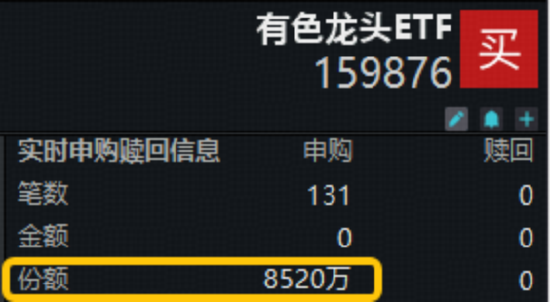
Core Viewpoint - The global market is experiencing volatility due to declining expectations for interest rate cuts by the Federal Reserve and ongoing declines in Japanese government bonds, leading to a sell-off in A-shares, particularly in the non-ferrous metals sector [1][3]. Group 1: Market Performance - On November 21, A-shares saw all three major indices decline, with the non-ferrous metals sector ETF (159876) dropping by 5.62%, with a trading volume exceeding 1 billion yuan [1]. - Despite the market downturn, the non-ferrous metals ETF (159876) attracted a net subscription of 85.2 million units, indicating strong investor interest in the sector [1]. Group 2: Employment Data and Fed Policy - The U.S. Labor Department reported an unexpected increase of 119,000 non-farm jobs in September, significantly above the market expectation of 50,000, which raises the likelihood that the Federal Reserve may not cut interest rates next month [3]. - Even if the Fed pauses a rate cut, as long as it remains in a rate-cutting cycle, there is still upward momentum for non-ferrous metal prices, suggesting that the sector's bullish trend is not over [3]. Group 3: Lithium Market Dynamics - In November, lithium carbonate futures have been on the rise, with prices reaching over 100,000 yuan/ton, marking a 67% increase from the year's low on May 30 [3]. - The market is currently experiencing a supply shortage of approximately 13,000 tons, with demand at 128,000 tons against a supply of 115,000 tons, indicating a continued upward pressure on prices [3]. Group 4: Future Outlook - Institutions generally believe that the non-ferrous metals sector is likely to continue its bullish trend, with various firms expressing optimism about a comprehensive bull market in non-ferrous metals [4]. - Key investment themes include industrial metals like copper and aluminum, energy metals such as lithium and cobalt, and strategic assets like gold and rare earths [4]. - The non-ferrous metals ETF (159876) offers broad exposure across various metals, which can help mitigate risks compared to investing in single metal sectors [4].


创业板人工智能ETF较历史高点回撤超12%,果断布局还是谨慎观望?
Xin Lang Ji Jin· 2025-11-23 11:43
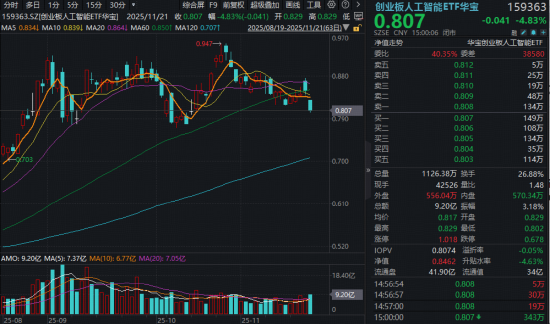
周五(11月21日),创业板人工智能跳空大跌近5%,主要受光模块等算力硬件剧烈回调影响,截至收 盘,新易盛跌超8%创9月份以来新低,天孚通信跌超7%,中际旭创跌逾5%。AI应用方向则逆市活跃, 易点天下20CM涨停,万兴科技、中文在线、蓝色光标等涨超2%。 热门ETF方面,光模块含量超54%的创业板人工智能ETF(159363)场内收跌4.83%,失守所有短期均 线,为10月高点回调以来新低,单日成交9.2亿元。资金进场大举抢筹,全天净申购1.76亿份。 【海内外多事件催化,AI应用或迎补涨行情】 配置上看,中银证券指出,2025年以来,AI产业链内部已经经历了从海外算力-国产算力-存力与电力的 行情轮动,AI应用作为下游对比之下涨幅有限,仍具备较高配置性价比,产业拐点催化之下,AI应用 或将迎来补涨行情。 【算力高景气度持续,光模块有望引领反攻】 英伟达超预期财报印证了全球算力高景气度。机构指出,在全球算力需求持续高企的背景下,1.6T光模 块零售价格上涨,800G及以下速率光模块降价速度减缓,光模块行业一改以往量增价跌的态势,出现 了"量价齐增"的现象。 数量方面,此前据市场测算,明年全球800G光模块有 ...

否极泰来?港股AI逆转5连阴,资金大举低吸
Xin Lang Ji Jin· 2025-11-23 11:43
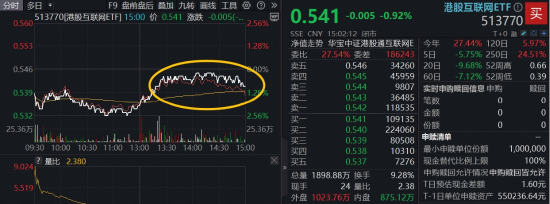
Core Viewpoint - Hong Kong stocks continued to decline, with the Hang Seng Index and Hang Seng Tech Index dropping by 2.38% and 3.21% respectively, influenced by overnight movements in US stocks. However, the Hong Kong Internet ETF (513770) showed signs of stabilization, recovering from earlier losses and closing down only 0.92% after a significant drop of over 2% in the morning session [1][4]. Market Performance - The Hong Kong Internet ETF (513770) experienced a net inflow of 54.14 million CNY over the past five days, with a total of 4.271 billion CNY accumulated over the last 60 days, indicating strong buying interest despite recent declines [2][6]. - The ETF has seen a significant drop over five consecutive days, yet investors have been increasingly buying into the fund, demonstrating confidence in the sector [2][6]. Sector Analysis - The performance of tech giants in the Hong Kong market was mixed, with Xiaomi Group-W rising by nearly 3% at one point, while other major players like Kuaishou-W, Tencent Holdings, and Alibaba-W saw declines of over 1% to 4% [4][6]. - The market's overall weakness was attributed to the lack of clear signals regarding interest rates from the latest US non-farm payroll data, alongside ongoing concerns about the high valuations of AI stocks [4][6]. Valuation Insights - The current price-to-earnings (PE) ratio of the CSI Hong Kong Internet Index stands at 22.47, which is significantly lower than the NASDAQ 100 (34.42) and the ChiNext Index (39.2), indicating a historical low valuation compared to the past decade [4][5]. - According to招商证券, the valuation of the Hong Kong tech sector remains at historically low levels, suggesting substantial room for valuation recovery [5][6]. Future Outlook - Analysts from 中信证券 predict that the Hong Kong market will experience a second round of valuation recovery and performance resurgence by 2026, driven by a rebound in fundamentals and significant valuation discounts [6]. - 广发证券 believes that the foundation for a bull market in Hong Kong remains intact, with a potential for a "volatile upward trend" as liquidity improves, which could attract funds into core assets in the internet sector [6][7]. ETF Composition - The Hong Kong Internet ETF (513770) has a total scale exceeding 11.2 billion CNY, with an average daily trading volume of over 600 million CNY, indicating good liquidity [7]. - The ETF tracks the CSI Hong Kong Internet Index, which is heavily weighted towards major internet companies, with Alibaba-W, Tencent Holdings, and Xiaomi Group-W comprising the top three holdings, accounting for 18.89%, 17.01%, and 10.05% of the index respectively [6][7].
前沿硬科技产品蓄势待发!华泰柏瑞中证科创创业人工智能ETF获批!
Xin Lang Ji Jin· 2025-11-22 08:42
Core Insights - The approval of the Huatai-PB CSI Innovation and Entrepreneurship Artificial Intelligence ETF and six other similar funds marks a significant development in the hard technology sector, providing investors with new opportunities to engage in cutting-edge technology investments [1][4] Group 1: ETF and Index Overview - The Huatai-PB CSI Innovation and Entrepreneurship Artificial Intelligence ETF tracks the CSI Innovation and Entrepreneurship Artificial Intelligence Index, which was launched on May 14, 2025, focusing on the latest technological advancements [1][2] - The index comprises 50 leading companies from the Sci-Tech Innovation Board and the Growth Enterprise Market, emphasizing AI technology research, hardware support, and commercial applications across various sectors [2][3] Group 2: Industry Composition and Performance - The top three weighted industries in the index are communication equipment (37.92%), semiconductors (31.21%), and software development (9.29%), representing the forefront of domestic hard technology and high growth [3] - The index has shown a remarkable year-to-date increase of 72.04% from January 1 to November 21, 2025, outperforming similar indices such as the Sci-Tech Innovation 50 and the Innovation and Entrepreneurship 100, which increased by 45.87% and 23.02%, respectively [4] Group 3: Strategic Importance - The index aligns with national strategic goals, particularly the "Artificial Intelligence+" initiative, which aims for a transition to an intelligent economy by 2035, thus positioning itself to capture the value of the AI industry [4] - The dual attributes of the index, combining the Sci-Tech Innovation Board and the Growth Enterprise Market, provide a unique and representative tool for investors to efficiently allocate resources within the AI industry while mitigating individual stock risks [4]
工银瑞信高管调整:"工行系"杨帆张桦同步履新
Xin Lang Ji Jin· 2025-11-22 06:57
Core Points - The announcement on November 22 revealed the appointment of Yang Fan as the new General Manager and Zhang Zhi as the Deputy General Manager of ICBC Credit Suisse Asset Management, effective November 21, 2025 [1] - The management changes at ICBC Credit Suisse began in May 2025, indicating a significant restructuring phase for the company [4][6] - The new executives, Yang Fan and Zhang Zhi, both have extensive backgrounds within the Industrial and Commercial Bank of China (ICBC) system, suggesting a strategic alignment with the parent company [6][7] Management Changes - The management overhaul started with the departure of several key positions, including the resignation of Vice General Manager Hao Wei and Chief Risk Officer Zhu Bi Yan in May 2025 [4] - The transition included the temporary appointment of Zhao Guicai as acting General Manager, who served for less than three months before the new appointments were made [4][5] - The restructuring reflects a broader trend in the public fund industry, where over 40 fund companies have seen leadership changes in 2025 [7] New Executives' Background - Yang Fan has a diverse career within ICBC, having held various roles from the Financial Markets Department to the Asset Management Department, culminating in his position as Deputy General Manager of Asset Management [3][6] - Zhang Zhi has also progressed through the ranks in ICBC's Financial Markets Department, gaining expertise in fixed income investment and risk management [3][6] - Both new executives are expected to leverage their extensive experience to navigate the company through a new growth phase [7] Company Overview - ICBC Credit Suisse Asset Management was established on June 21, 2005, with ICBC holding an 80% stake and UBS holding 20% [7] - As of September 30, 2025, the company's asset scale reached 862.42 billion yuan, ranking 14th among 162 fund companies in China [7]

重磅!事关十五五规划硬科技主线|华宝上证科创板芯片ETF火线获批
Xin Lang Ji Jin· 2025-11-22 05:40
Core Insights - The approval of multiple hard technology fund products, including the Huabao Shanghai Stock Exchange Science and Technology Innovation Board Chip ETF, is significant for guiding investments in key sectors like chips and artificial intelligence, aligning with national strategies and industrial policies [1][4] - The Huabao Shanghai Stock Exchange Chip ETF tracks the SSE Science and Technology Innovation Board Chip Index, which includes 50 companies involved in semiconductor materials, chip design, manufacturing, packaging, and testing, reflecting the overall performance of representative chip industry companies [4] - The latest "14th Five-Year Plan" emphasizes breakthroughs in critical technologies across various sectors, including integrated circuits and artificial intelligence, positioning China's chip industry for substantial growth [4] Fund Management and Performance - Huabao Fund manages the largest on-market money market ETF, Huabao Tianyi ETF, with an asset management scale of 131.49 billion yuan as of October 2025, ranking it among the top in the industry [5] - Huabao Fund has developed a comprehensive ETF matrix focused on high-tech strategic emerging industries, including various AI-related ETFs and sector-specific funds, enhancing its product offerings [6] - The "High Dividend ETF Family" has gained significant scale, with Huabao Fund holding the largest bank ETF and several other notable dividend-focused ETFs [7] Investment Returns - In the first three quarters of 2025, Huabao Fund's ETFs generated a total profit of 16.895 billion yuan for investors, with equity ETFs contributing 16.261 billion yuan, showcasing strong performance in the index fund and ETF investment space [7]
摩根资产管理A股市场点评:调整是内外因素共振结果 中长期视角下布局三类投资机会
Xin Lang Ji Jin· 2025-11-22 03:35
Market Overview - A-shares experienced a collective decline on November 21, with the Shanghai Composite Index dropping by 2.45% to close at 3835 points, the Shenzhen Component down by 3.41%, and the ChiNext Index falling by 4.02% [1] - Market turnover significantly increased, with a total trading volume of 1.97 trillion yuan, up approximately 257.5 billion yuan from the previous trading day [1] Sector Performance - Defensive sectors such as media, home appliances, food and beverage, banking, and agriculture showed relatively smaller declines, while cyclical and technology sectors like non-ferrous metals, power equipment, basic chemicals, and electronics faced deeper adjustments [1] - The banking sector rebounded during the session, providing stability to the market, and dividend assets demonstrated defensive characteristics amid rising risk aversion [1] Influencing Factors - External liquidity concerns intensified as Federal Reserve officials expressed caution regarding a potential rate cut in December, leading to a rapid cooling of expectations for such a move and putting pressure on technology stocks sensitive to liquidity [1] - Divergence in market logic regarding the AI industry emerged, with investors worried about the sustainability of capital expenditures and eventual returns from U.S. AI giants, despite strong earnings from leading AI companies [1] - Event-driven factors, including stock index futures settlement and geopolitical tensions, amplified market volatility [2] Future Outlook - Morgan Asset Management views the current adjustment as a result of both internal and external factors, suggesting that the external factors acted as a trigger rather than the main issue for the A-share market [2] - The market has largely priced in the liquidity shock, with an 89% probability of the Federal Reserve maintaining interest rates in December, indicating that the negative sentiment around "no rate cut" has been largely absorbed [2] - A-shares are expected to maintain an independent logic, with no excessive capital expenditure issues similar to the U.S. AI sector, and the fundamentals of technological innovation and self-sufficiency remain solid [2] - Investment opportunities may arise in the following areas: undervalued quality companies in the technology sector, industries with policy support and improving fundamentals (such as photovoltaics and chemicals), and defensive dividend assets like banking and coal [2]
失守3900!科技股首当其冲,创业板人工智能阶段新低!资金高切低,吃喝板块、港股AI受青睐
Xin Lang Ji Jin· 2025-11-21 11:41
Market Overview - Global market risk aversion continues to escalate, influenced by significant fluctuations in US stocks, leading to declines in major Asia-Pacific indices [1] - A-shares experienced a substantial adjustment, with over 5,000 stocks in the red, and the Shanghai Composite Index falling 2.45% to 3,834.89 points [1] - The total market turnover reached 1.98 trillion yuan, showing a significant increase compared to the previous period [1] Sector Performance - Technology growth sectors were hit hard, with the hard technology broad-based dual innovation leader ETF (588330) dropping 4.1% [1] - The entrepreneurial board AI ETF (159363) opened lower and fell 4.83%, breaching all short-term moving averages [1] - Cyclical sectors such as non-ferrous metals and chemicals also faced declines, but there was active bottom-fishing capital evident in the market [1] Defensive Stocks - In a broadly declining market, defensive stocks like China Bank rose 0.8%, reaching a new historical high [1] - Consumer stocks outperformed the market, with leading consumer ETFs such as the consumer leader ETF (516130) and food ETF (515710) showing better performance [1] - Analysts from Dongfang Securities predict that the food and beverage sector may experience "easy rises and difficult falls" by 2026 [1] ETF Insights - The consumer leader ETF (516130) reported a slight decline of 0.76% with a trading volume of 602.31 million yuan [2] - The banking ETF (512800) fell 1.06% with a turnover of 14.57 billion yuan, indicating a slight premium [2] - The food ETF (515710) also saw a decline of 1.29% with a trading volume of 619.93 million yuan [2] Future Outlook - Analysts suggest that the market may continue a "weight protection + structural theme" oscillation pattern in the short term, with low-valuation financial stocks offering defensive value [3] - In the medium to long term, a "systematic slow bull" market is expected to continue, with focus areas including large consumption, prosperity, traditional industries, and dividends [3] - The Hong Kong internet ETF (513770) showed resilience, with a net inflow of 54.14 million yuan over the past five days, indicating strong buying interest despite recent declines [4][6] Consumer Sector Dynamics - The food and beverage sector demonstrated resilience, with the food ETF (515710) outperforming the Shanghai Composite Index [10] - Recent data indicated that Moutai 1935's sales have increased significantly in several markets, with some regions seeing over 30% growth [12] - Analysts believe that the food and beverage sector is currently at a historical low valuation, presenting a good opportunity for left-side layout [12][13] AI and Technology Sector - The AI sector showed relative resilience, with the Hong Kong AI ETF (159363) experiencing a significant drop of 4.83% but still attracting bottom-fishing capital [14] - The overall market sentiment is influenced by concerns over high valuations in AI, despite the sector's potential for growth [6] - Institutions expect that the AI application sector may see a rebound, driven by recent advancements and market dynamics [18]

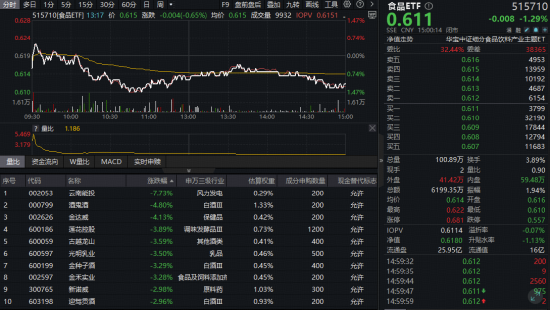
茅台1935动销猛增!吃喝板块韧性彰显,食品ETF(515710)显著跑赢沪指!左侧布局时机浮现?
Xin Lang Ji Jin· 2025-11-21 11:38
Core Viewpoint - The food and beverage sector demonstrates resilience amid market corrections, with the food ETF (515710) showing fluctuations in performance, reflecting the overall market sentiment [1][3]. Group 1: Market Performance - The food and beverage sector ranks among the top three in performance across 30 CITIC primary industries, despite a broader market downturn [1]. - The food ETF (515710) experienced a decline of 1.29% by the end of the trading day, after an initial rise [1][2]. - Key stocks such as Yunnan Energy Investment fell by 7.73%, while others like Jiu Gui Jiu and Jin Da Wei dropped over 4%, negatively impacting the sector's overall performance [1][2]. Group 2: Sales and Demand Insights - Recent research indicates that Moutai 1935 has seen over 20% year-on-year sales growth in several markets since Q3, with some areas reporting growth exceeding 30% [1][3]. - High opening rates and positive feedback from distributors suggest strong recognition of the product in both distribution and consumer channels [3]. Group 3: Valuation and Investment Opportunities - The food and beverage sector is currently at a historical low in terms of valuation, presenting a potential opportunity for left-side positioning [3]. - As of November 20, the food ETF's underlying index had a price-to-earnings ratio of 21, placing it in the lower 10.2% percentile over the past decade, indicating favorable long-term investment potential [3]. - Analysts predict that the food and beverage sector will experience a shift from valuation recovery to performance-driven growth starting in 2026, with expectations of improved earnings across various segments [4]. Group 4: Sector Composition and Focus - The food ETF (515710) tracks the CSI sub-index for the food and beverage industry, with approximately 60% of its holdings in leading high-end and mid-range liquor stocks, and nearly 40% in other segments like beverages and dairy [5]. - Key stocks in the ETF include major brands such as Moutai, Wuliangye, and Yili, indicating a strong focus on established market leaders [5].


算力剧烈回调,新易盛跌超8%创9月份以来新低,资金借道159363悄然“抄底”?AI应用突现20CM涨停
Xin Lang Ji Jin· 2025-11-21 11:34
Core Viewpoint - The recent significant drop in the ChiNext AI sector, primarily driven by a sharp correction in optical module and computing hardware, has led to notable declines in key stocks, while AI application stocks have shown resilience with some experiencing gains [1][3]. Group 1: Market Performance - On November 21, the ChiNext AI sector experienced a nearly 5% drop, with stocks like Xinyisheng falling over 8%, Tianfu Communication down more than 7%, and Zhongji Xuchuang declining over 5% [1]. - The ChiNext AI ETF (159363), which has over 54% exposure to optical modules, closed down 4.83%, marking a new low since the correction began in October, with a daily trading volume of 920 million yuan [1]. - The cumulative decline for the ChiNext AI sector was 1.18% for the week, with a more than 12% drop from the peak at the end of October [3]. Group 2: Optical Module Market Dynamics - Nvidia's better-than-expected earnings report confirms the high demand for global computing power, suggesting that short-term fluctuations will not alter the overall positive trend in computing power demand [3]. - The retail price of 1.6T optical modules has increased from approximately $1200 at launch to over $2000 currently, while the price decline for 800G and lower-speed optical modules has slowed, indicating a shift to a "volume and price increase" scenario in the optical module industry [3][4]. - Projections indicate that global demand for 800G optical modules could reach 40 million units next year, with 1.6T optical modules expected to exceed 7 million units [3]. Group 3: Future Outlook for AI Applications - The launch of Alibaba's "Qianwen APP" signals a new phase in AI applications, moving towards an "ecological integration" model, which may lead to a rebound in AI application stocks [4]. - International developments, such as Google's new multimodal AI model, are accelerating the commercialization of AI, reinforcing the positive industry trend [4]. - The AI application sector, despite its limited recent gains compared to other segments, is expected to experience a rebound due to the ongoing evolution of the AI industry [4]. Group 4: Investment Recommendations - Investors are advised to focus on the first ChiNext AI ETF (159363) and its associated funds, which have a significant allocation to optical module leaders, particularly "Yizhongtian" [5]. - The ETF's portfolio is heavily weighted towards computing power, with over 70% allocated to this sector and more than 20% to AI applications, positioning it to effectively capture AI thematic trends [5].
