Xin Lang Ji Jin

Search documents
芯片反攻!首只聚焦港股芯片产业链的港股信息技术ETF(159131)直线拉涨1%,机构:国产AI芯片迎来高斜率增长期
Xin Lang Ji Jin· 2025-11-17 02:15
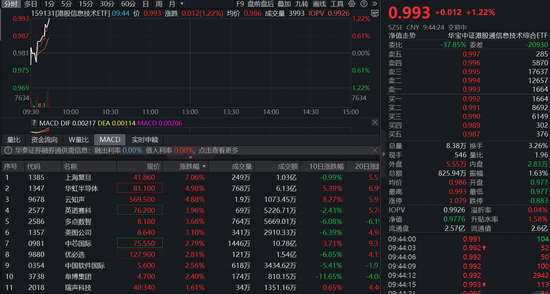
Group 1 - The core viewpoint of the news is the launch of the first Hong Kong ETF focused on the semiconductor industry, which has seen a significant price increase in its components, indicating a bullish trend in the market [1][3] - The ETF (159131) is designed to track the "Hong Kong Semiconductor Industry Chain" and has seen a price increase of 1.22% in early trading, with notable gains in stocks like Shanghai Fudan, Hua Hong Semiconductor, and Yunzhisheng [1][3] - The ETF's index consists of 70% hardware and 30% software, focusing on 42 Hong Kong tech companies, with significant weights in companies like SMIC (20.27%) and Xiaomi (9.11%) [3][4] Group 2 - The semiconductor industry is experiencing a shift towards domestic AI chips due to U.S. sanctions affecting NVIDIA's products, leading to increased demand for local alternatives [2][3] - As domestic chip manufacturing matures, the market share for local AI chips is expected to rise significantly, driven by the growing demand for computing power [3] - The ETF aims to capture the potential of the semiconductor supercycle in Hong Kong, providing investors with exposure to the AI hardware sector [3][4]

化工板块惊魂一跳!化工ETF(516020)冲高回落,估值水平已至低位!券商预判2026年行业或迎上行起点
Xin Lang Ji Jin· 2025-11-17 02:15
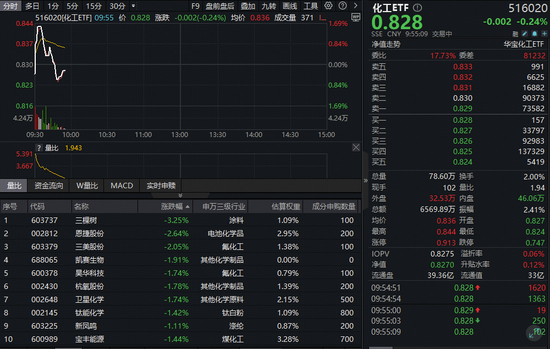
Group 1 - The chemical sector experienced a significant drop on November 17, with the chemical ETF (516020) initially rising by 1.69% before falling to a decrease of 0.24% at the time of reporting [1] - Key stocks in the sector, including coatings, battery chemicals, and fluorochemicals, saw notable declines, with SanKeTree dropping over 3%, and Enjie and Sanmei both falling over 2% [1] - The report indicates that the peak of new capacity additions in the chemical industry has passed, leading to a reduction in capital expenditure, which is expected to improve the supply-demand balance in the sector [1][3] Group 2 - The current PB-LF valuation of the basic chemical industry is close to the bottom levels seen in 2019 and 2024, indicating that the sector is still undervalued [3] - The chemical industry is expected to see a continuous improvement in supply-demand dynamics, with a potential upward trend in industry prosperity [3] - Analysts suggest that the chemical sector may experience a rebound starting in 2026, driven by improved domestic demand and supply-side adjustments [3] Group 3 - The chemical ETF (516020) tracks the CSI segmented chemical industry index, covering various sub-sectors, with nearly 50% of its holdings in large-cap leading stocks [4] - Investors can also access the chemical ETF through linked funds, providing a more efficient way to invest in the chemical sector [4]




华商汇享多元配置3个月持有混合(FOF)11月17日发行
Xin Lang Ji Jin· 2025-11-17 02:15
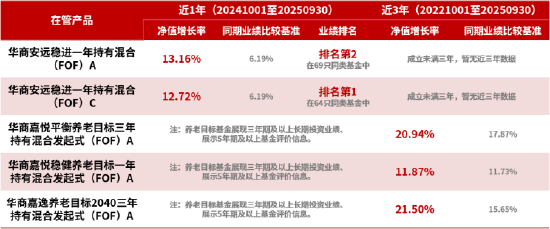
Core Insights - The long-term performance of investment products managed by Sun Zhiyuan at Huashang Fund has significantly outperformed benchmarks, demonstrating the effectiveness of his "steady counterattack" investment strategy [1][2][4] Performance Summary - Huashang Anyuan Stable One-Year Holding Mixed (FOF) A achieved a net value growth rate of 13.16% over the past year, surpassing the benchmark of 6.19%, ranking second among peers [2][3] - Huashang Anyuan Stable One-Year Holding Mixed (FOF) C recorded a net value growth rate of 12.72%, also exceeding the benchmark, and ranked first among its category [2][3] - Huashang Jiayue Balanced Pension Target Three-Year Holding Mixed (FOF) A achieved a net value growth rate of 20.94% over three years, outperforming the benchmark of 17.87% [2][3] - Huashang Jiayi Pension Target 2040 Three-Year Holding Mixed (FOF) A reached a growth rate of 21.50%, significantly higher than the benchmark of 15.65% [2][3] Investment Strategy - Sun Zhiyuan's investment methodology includes a mid-term market trend model to identify asset rotation, a three-dimensional evaluation system for fund managers, and a focus on absolute return strategies to enhance FOF product returns [4][5] - Huashang Fund has a robust research and investment platform, achieving a 5A rating from Tianxiang Investment Advisors for its three-year comprehensive fund management performance [4][9] Upcoming Fund Launch - The Huashang Huixiang Multi-Asset Three-Month Holding Mixed (FOF) is set to launch on November 17, 2025, aiming to provide long-term stable returns based on Huashang Fund's investment capabilities [5][6]
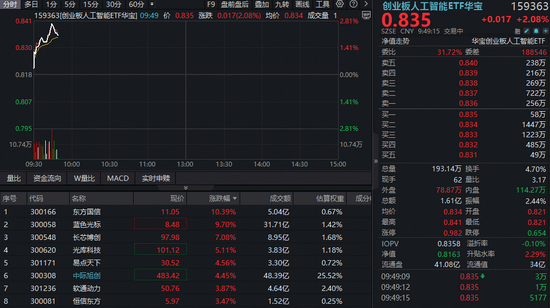
算力重拾涨势!创业板人工智能ETF(159363)反弹超2%!机构:AI带动的算力需求依然非常旺盛
Xin Lang Ji Jin· 2025-11-17 02:11
把握光模块等算力核心机会,建议重点关注全市场首只创业板人工智能ETF(159363)及场外联接(A 类023407、C类023408),标的指数重点布局光模块龙头"易中天",光模块含量超54%。从赛道分布 看,逾七成仓位布局算力,超两成仓位布局AI应用,能够高效捕捉AI主题行情。(截至2025.10.31) 数据来源:沪深交易所等。注:"全市场首只"是指首只跟踪创业板人工智能指数的ETF。 风险提示:创业板人工智能ETF华宝被动跟踪创业板人工智能指数,该指数基日为2018.12.28,发布日 期为2024.7.11。创业板人工智能指数2020-2024年年度涨跌幅分别为:20.1%、17.57%、-34.52%、 47.83%、38.44%,指数成份股构成根据该指数编制规则适时调整,其回测历史业绩不预示指数未来表 现。文中指数成份股仅作展示,个股描述不作为任何形式的投资建议,也不代表管理人旗下任何基金的 持仓信息和交易动向。基金管理人评估的本基金风险等级为R4-中高风险,适宜积极型(C4)及以上的 投资者,适当性匹配意见请以销售机构为准。任何在本文出现的信息(包括但不限于个股、评论、预 测、图表、指标、理论、 ...

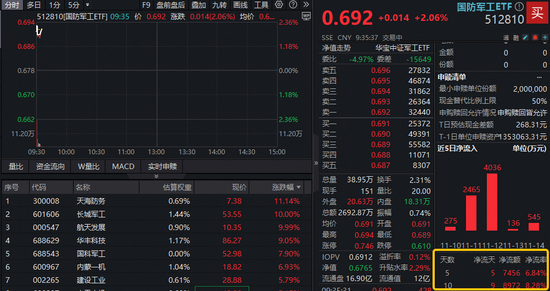
地缘局势不确定性加剧,国防军工ETF跳空高开逾2%!长城军工、航天发展一字涨停!
Xin Lang Ji Jin· 2025-11-17 01:43
【投国防军工,选"512八一0"】代码有"八一"的国防军工ETF(512810)同时是融资融券+互联互通标 的,是一键投资国防军工核心资产的高效工具,覆盖"商业航天 + 低空经济 + 可控核聚变 + 大飞机 + 深 海科技 + 军用AI "等诸多热门主题。 数据来源于沪深交易所、公开资料等。 风险提示:国防军工ETF被动跟踪中证军工指数,该指数基日为2004.12.31,发布于2013.12.26。2020- 2024年分年度历史收益分别为:67.91%、14.28%、-25.74%、-11.02%、8.20%。指数成份股构成根据该 指数编制规则适时调整,其回测历史业绩不预示指数未来表现。以上个股均为标的指数成份股,仅作展 示,个股描述不作为任何形式的投资建议,也不代表管理人旗下任何基金的持仓信息和交易动向。基金 管理人评估的本基金的风险等级为R3-中风险,适宜平衡型(C3)及以上投资者,适当性匹配意见请以 销售机构为准。任何在本文出现的信息(包括但不限于个股、评论、预测、图表、指标、理论、任何形 式的表述等)均只作为参考,投资人须对任何自主决定的投资行为负责。另,本文中的任何观点、分析 及预测不构成对阅读者 ...

石化行业绿色转型加速!化工ETF(516020)大涨1.4%!机构:看好政策驱动下高景气细分领域
Xin Lang Ji Jin· 2025-11-17 01:43
11月17日,截至9时33分,化工ETF(516020)盘中表现稳健,场内价格现涨1.4%,成交额为1660.67万 元,基金最新规模为33.18亿元。 成份股方面,彤程新材、盐湖股份和金发科技表现最为突出,涨幅分别达到6.85%、6.32%和4.36%。另 一方面,三棵树、杭氧股份和宏达股份表现较弱,跌幅分别为1.4%、1.22%和0.37%。 消息面上,2025石油和化工行业高新发展大会于11月16日举行,业界共同谋划石化行业"十五五"高质量 发展路径,聚焦创新驱动与绿色转型。此外,11月12日湖北徽阳新材料年产50万吨磷石膏提纯装置主体 结构封顶,该项目采用磷石膏高值化综合利用技术,助力行业绿色升级。 中银国际指出,基础化工行业受关税政策、原油价格波动影响较大,当前市盈率处于历史74.78%分位 数。建议关注"十五五"规划相关子行业、低估值龙头及电子材料领域。中长期看好政策复苏需求、新兴 材料(半导体/OLED/新能源)及供给侧改革下的氟化工、农化等高景气细分。 化工ETF(516020)及其联接基金(联接A:012537,联接C:012538)被动跟踪细分化工指数,该指 数前十大权重股分别为万华化学、 ...
【早盘三分钟】11月17日ETF早知道
Xin Lang Ji Jin· 2025-11-17 01:33
Core Insights - The market is currently experiencing fluctuations, with a notable adjustment in the AI sector, particularly in the ChiNext AI index, which saw a decline of over 3% in a single day, indicating a broader market correction [3][4] - The banking sector is showing strong performance, with the China Securities Banking Index rising over 9% since October, significantly outperforming the broader market and the ChiNext index by nearly 13% [4][6] - High dividend yields and low valuations in the banking sector are attracting investor interest, especially in a low-interest-rate environment [4][6] Market Temperature - The market temperature gauge indicates a mixed sentiment, with the Shanghai Composite Index at a 99.09% percentile, Shenzhen Component Index at 84.36%, and ChiNext Index at 43% [1] Sector Performance - The top three sectors with net inflows include Defense and Military (846 million), Real Estate (545 million), and Construction Decoration (471 million) [2] - The sectors with the largest net outflows are Electronics (-14.608 billion), Electric Equipment (-8.542 billion), and Chemical Engineering (-5.713 billion) [2] ETF Performance - The banking ETF (512800) has shown a 0.85% increase on the day and a 4.82% increase over the past six months, indicating strong investor confidence [3][6] - The AI-focused ChiNext ETF (159363) has experienced a significant decline, reflecting the broader market's adjustment in technology stocks [3][4] Investment Strategy - The current investment strategy in the banking sector is supported by its high dividend yield and stable operational characteristics, making it attractive for investors seeking safety and income [4][6] - The AI hardware and computing sectors are expected to remain key market drivers in the upcoming year, despite recent volatility [4]

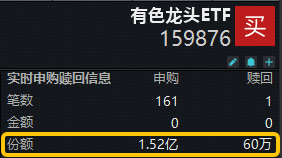
1.39亿资金大手笔埋伏有色龙头ETF(159876)!美联储鹰派言论,难挡资金进场热情!本周热点怎么看?
Xin Lang Ji Jin· 2025-11-17 01:33
Core Viewpoint - The recent surge in investment in the non-ferrous metals sector, particularly through the non-ferrous metal leader ETF (159876), indicates a strong market sentiment anticipating a rebound in this sector. Group 1: Investment Activity - On November 14, the non-ferrous metal leader ETF (159876) saw a net subscription of 150 million shares, amounting to 139 million yuan in a single day, reflecting early capital entry into the non-ferrous sector [1] - The ETF currently holds 152 million shares, with 161 subscription transactions recorded [1] Group 2: Performance Drivers - In the performance aspect, the Q3 2025 report shows that out of 60 constituent stocks in the non-ferrous leader ETF, 56 companies reported profits, with 44 companies experiencing year-on-year net profit growth. Notably, Chujiang New Material's net profit surged 20 times year-on-year, and 10 other companies reported triple-digit net profit increases [2] - The current bull market in non-ferrous resources is characterized as a "new quality productivity bull market," driven by demand from emerging sectors such as new energy, AI, and aerospace, contrasting with the previous market driven by real estate and infrastructure [2] - Supply-side disruptions have intensified supply-demand conflicts, further elevating non-ferrous metal prices and highlighting their scarcity and strategic value [2] Group 3: Policy Support - The joint issuance of the "Non-ferrous Metal Industry Stabilization Growth Work Plan (2025-2026)" by eight departments aims to strengthen strategic resource security and promote digital upgrades in the industry [2] - Policies aimed at optimizing industry supply structures and large-scale infrastructure projects, such as the Yaxi Water Conservancy Project, are expected to create significant demand for non-ferrous metal raw materials [2] Group 4: Market Outlook - Analysts from Dongfang Securities suggest that the non-ferrous metals sector is entering a new cycle driven by supply-demand tightness, with a relatively independent price trend [5] - CITIC Securities anticipates that supply tightness will continue to drive prices of copper and cobalt upward, while lithium prices may benefit from unexpected demand in energy storage [5] - The overall bullish sentiment for precious metals like gold remains unchanged, with attention expected to shift towards underperforming sectors like electrolytic aluminum in the fourth quarter [5] Group 5: Global Economic Factors - The probability of the Federal Reserve maintaining interest rates in December has risen above 50%, which could provide long-term benefits for non-ferrous metals as lower interest rates typically lead to increased demand for physical assets [3] - Geopolitical tensions are expected to drive demand for safe-haven assets like gold, while industrial metals like copper may also see increased investment due to stable demand and supply chain disruptions [4]
红利风向标 | 市场防御性配置需求升温,红利策略四季度或韧性凸显
Xin Lang Ji Jin· 2025-11-17 00:56
Core Viewpoint - The news highlights the performance of various dividend-focused ETFs and indices, showcasing their recent returns and volatility metrics, indicating a mixed performance in the market. Group 1: Dividend ETFs Performance - The latest dividend yield for the S&P Dividend ETF is 4.92% as of November 14, 2025, with a one-year return of 5.32% and an annualized volatility of 11.44% [1] - The Hong Kong Stock Connect Dividend ETF has a recent dividend yield of 5.54%, with a one-year return of 2.00% and an annualized volatility of 11.46% [1] - The A500 Dividend Low Volatility ETF shows a one-year return of 8.53% and an annualized volatility of 9.67% [2] Group 2: Index Performance Comparison - The S&P Hong Kong Stock Connect Low Volatility Dividend Index has a one-year return of 35.5% with an annualized volatility of 12.17% [2] - The performance of the Shanghai Composite Index over the same period shows a return of 18.07% with an annualized volatility of 11.46% [2] - The A800 Dividend Low Volatility Index has a one-year return of 9.59% and a recent weekly return of 0.20% [2]

小红日报|银行股展现缓震实力,标普红利ETF(562060)标的指数收跌0.42%
Xin Lang Ji Jin· 2025-11-17 00:42
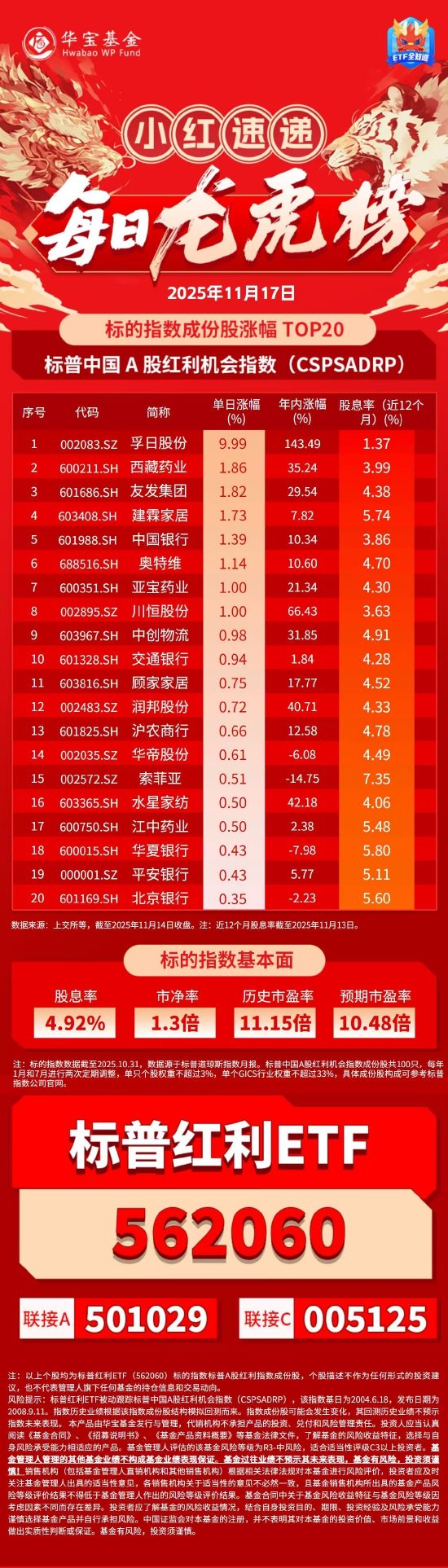
Group 1 - The article highlights the top 20 stocks in the S&P China A-Share Dividend Opportunity Index, showcasing significant daily and year-to-date gains along with their dividend yields [1] - The stock with the highest daily gain is LuRi Co., Ltd. (002083.SZ) with a 9.99% increase and a year-to-date gain of 143.49% [1] - Tibet Pharmaceutical (600211.SH) and Youfa Group (601686.SH) also show strong performance with year-to-date gains of 35.24% and 29.54% respectively, along with dividend yields of 3.99% and 4.38% [1] Group 2 - The index includes companies with varying dividend yields, with JiaFeiYa (002572.SZ) having the highest yield at 7.35%, despite a year-to-date decline of 14.75% [1] - Other notable companies include China Bank (601988.SH) with a year-to-date gain of 10.34% and a dividend yield of 3.86%, and Gujia Home (603816.SH) with a 17.77% gain and a yield of 4.52% [1] - The overall performance of the index reflects a mix of high-growth stocks and those offering attractive dividends, indicating diverse investment opportunities [1]