
Xi Niu Cai Jing

Search documents
从“加价难求”到月销难破5000辆 本田思域不好卖了?
Xi Niu Cai Jing· 2025-11-07 09:31
Core Viewpoint - The Honda Civic, once a dominant player in the automotive market, has seen a significant decline in sales, with September sales dropping to 4,035 units, a year-on-year decrease of 19.57% [2] Group 1: Sales Performance - In January, the Civic sold 9,155 units, but has not surpassed 5,000 units in any month since [2] - The overall market trend shows a rapid decline in fuel vehicle market share, with new energy vehicles (NEVs) achieving a penetration rate of over 58% in September [3] Group 2: Competitive Landscape - The Civic is facing intense competition from domestic new energy vehicles, which offer lower fuel consumption and advanced technology features [2] - For example, the BYD Qin PLUS DM-i has a starting price of 79,800 yuan, with a fuel consumption of only 3.8L/100km, significantly lower than the Civic's 7-8L/100km in urban conditions [2] Group 3: Consumer Preferences - Consumers are increasingly prioritizing vehicles with lower overall costs and better experiences, rather than just brand recognition [4] - The Civic's outdated technology and lack of competitive advantages in terms of electrification and smart features have diminished its appeal [3][4] Group 4: Strategic Response - In an attempt to regain market share, Honda has opted for a price reduction strategy, reportedly lowering prices by 30% [3] - However, this strategy has not resulted in increased sales and has negatively impacted the interests of existing Civic owners [3] Group 5: Industry Implications - The current situation of the Civic serves as a warning for the entire fuel vehicle industry, indicating that merely relying on brand strength is insufficient in today's market [4] - Continuous innovation and responsiveness to consumer needs are essential for survival in the competitive automotive landscape [4]



享道出行冲刺IPO:3年半累亏19.07亿元 押宝Robotaxi
Xi Niu Cai Jing· 2025-11-07 09:31
Core Viewpoint - The company Xiangdao Mobility, a subsidiary of SAIC Group, has officially submitted its prospectus for an IPO, with joint sponsors being CICC and Guotai Junan International [1] Financial Performance - Revenue for Xiangdao Mobility from 2022 to 2024 is projected to be 4.73 billion, 5.72 billion, and 6.39 billion RMB, respectively, with a compound annual growth rate (CAGR) of 16.3% [2] - In the first half of 2025, revenue decreased by 2.8% year-on-year to 3.01 billion RMB due to a decline in ride-hailing service revenue and a reduction in completed orders [2] - The core ride-hailing service is expected to contribute 4.99 billion RMB in 2024, accounting for 78% of total revenue [2] Profitability and Losses - Xiangdao Mobility has been in a long-term loss position, with net losses of 7.81 billion, 6.04 billion, 4.07 billion, and 1.15 billion RMB from 2022 to the first half of 2025, totaling 19.07 billion RMB over three and a half years [3] - The loss rate in the first half of 2025 has reduced by nearly 80% compared to 2022, and operating cash flow has turned positive, but future profitability remains uncertain [3] Cost Management - In response to financial pressures, Xiangdao Mobility has reduced administrative expenses by 25.9% and R&D expenses by 49.6% for 2023-2024 [3] - In the first half of 2025, administrative expenses decreased by 18.0% and R&D expenses by 2.8%, while employee benefits have also been cut [3] Future Outlook - Xiangdao Mobility is positioning itself as the first L4-level Robotaxi operating platform with a car manufacturer background in China, aiming for fully unmanned Robotaxi operations in Shanghai by the end of 2025 and scaled commercial operations in multiple cities by 2027 [4] - Part of the funds raised from the IPO will be allocated to the Robotaxi sector to seize development opportunities [4]

长安福特高层变动 赵非接任董事长
Xi Niu Cai Jing· 2025-11-07 09:31
Core Insights - Changan Ford has undergone a leadership change with Zhu Huarong stepping down as chairman and Zhao Fei taking over, marking a new development phase for the company [2] - Zhu Huarong's resignation is attributed to the establishment of the new central enterprise, China Changan Automobile, which requires him to focus on group strategic planning and core business areas [2] - Zhao Fei has a rich background in technology and management, having previously led significant improvements in sales, revenue, and net profit at Changan Ford since his appointment in 2018 [2] Company Strategy - Changan Ford is actively integrating marketing channels for passenger cars and pickup trucks while focusing on the development of new energy vehicles [3] - Zhao Fei faces the challenge of maintaining traditional business advantages while accelerating the transition to electrification and enhancing local strategies [3] - The company aims to improve its core competitiveness in the new energy and intelligent sectors through technological innovation and product upgrades [3]

丰田加拿大召回99178辆汽车
Xi Niu Cai Jing· 2025-11-07 09:25
Group 1 - Toyota is recalling 99,178 vehicles in Canada due to a software issue affecting the rearview camera display, specifically in models equipped with a panoramic camera system [2] - The company is expected to notify affected customers by the end of December, and dealers will provide free software updates [2] - Despite challenges in certain markets, Toyota has maintained strong global sales growth, with a nearly 3% year-on-year increase in global sales in September, reaching 949,200 units [2] Group 2 - In Japan, Toyota's sales have declined by 5% due to a large-scale recall of the Prius model, impacting production [3] - Conversely, in the U.S. market, Toyota and Lexus brands saw a sales increase of over 14%, driven by strong demand for hybrid vehicles, which accounted for 42% of total sales in the first half of the fiscal year [3] - To adapt to international market changes, Toyota is enhancing its global production strategy, focusing on localization in North America and accelerating its localization strategy in China, including establishing a manufacturing base for electric vehicles and batteries in Shanghai [3]


中美算力,都等电来
Xi Niu Cai Jing· 2025-11-07 08:21
Core Insights - The token economy in both China and the U.S. is heavily reliant on electricity, with each country facing unique challenges in this regard [1][3] - The U.S. is experiencing a power shortage due to outdated generation and grid infrastructure, limiting token production [1][2] - In contrast, China faces high token production costs due to relatively low-efficiency hardware, impacting the overall cost of token generation [1][3] Group 1: U.S. Challenges - Microsoft CEO Satya Nadella emphasized that the real issue is not a shortage of GPUs but a lack of electricity, which restricts token production and monetization [1] - Major U.S. tech companies are in a race for AI infrastructure investment, which has turned into a competition for electricity supply [1][2] - The construction of large-scale data centers in the U.S. is progressing from 1GW to 10GW, with companies like Crusoe targeting significant capacity increases [1][2] Group 2: Infrastructure and Policy - Silicon Valley giants are urging the White House for support in developing infrastructure, particularly the power grid, to match the pace of AI innovation [3] - OpenAI has suggested that the U.S. needs to add 100GW of electricity capacity annually to compete effectively in AI against China [3] - The U.S. added 51GW of power capacity last year, while China added 429GW, highlighting a significant "power gap" [3] Group 3: China's Challenges - China's AI infrastructure is built on domestic chips, which currently have lower efficiency, leading to increased demand for computational power [3][4] - ByteDance's daily token calls have surged from 16.4 trillion in May to 30 trillion in September, indicating a rapid increase in computational needs [3] - The cost of electricity for a major cloud provider in China is estimated at 8-9 billion yuan for 1GW annually, reflecting the high operational costs associated with domestic chip usage [5] Group 4: Efficiency and Cost - The competition in the token economy involves not just hardware but also the software, tools, and the electricity and cooling systems required to operate them [4] - Huawei's CloudMatrix 384 has shown a significant increase in total computational power but at a much higher energy cost compared to NVIDIA's latest offerings [5][6] - The average industrial electricity cost in the U.S. is approximately 9.1 cents per kWh, while certain regions in China have reduced costs to below 4 cents per kWh, indicating a competitive advantage for Chinese data centers [6]



11月7日早间重要公告一览
Xi Niu Cai Jing· 2025-11-07 03:57
Group 1: Company Acquisition - Shanghai Zhiyuan Hengyue Technology Partnership has completed the acquisition of shares in Shangwei New Materials, now holding 58.62% of the company, making it the controlling shareholder [1] - The acquisition price was set at 7.78 yuan per share, with the total number of shares tendered accounting for 33.6332% of the company's total equity [1] Group 2: Revenue Forecast Adjustment - BeiGene has updated its revenue forecast for 2025, now expecting it to be between 36.2 billion and 38.1 billion yuan, an increase from the previous estimate of 35.8 billion to 38.1 billion yuan [3] - The adjustment in revenue expectations is attributed to the leading position of Baiyueze in the U.S. market and its ongoing expansion in Europe and other key global markets [3] Group 3: Shareholder Reduction Plans - Shandong Heda's director plans to reduce holdings by up to 350,000 shares, representing 0.1017% of the total equity [5] - Huawai Technology's shareholder intends to reduce holdings by up to 5.2 million shares, accounting for 1.92% of the total equity [7] - Shenghong Co. plans for specific shareholders and executives to collectively reduce holdings by up to 8.7887 million shares, which is 2.8165% of the total equity [9] - High Alliance New Materials' executives plan to reduce holdings by up to 26,630 shares, representing 0.061% of the total equity [11] - New Light Pharmaceuticals' shareholder intends to reduce holdings by up to 4.8 million shares, which is 3% of the total equity [13] - Mengguli's shareholders plan to reduce holdings by up to 13.7885 million shares, accounting for 3% of the total equity [15] - Wanli Stone's general manager plans to reduce holdings by up to 3.7 million shares, representing 1.63% of the total equity [16] - Hongri Pharmaceuticals' shareholders and executives plan to reduce holdings by up to 47.3373 million shares, which is 1.58% of the total equity [17] - Feilihua's executives plan to reduce holdings by up to 620,000 shares, accounting for 0.1187% of the total equity [19] - Zhou Dazheng's senior management plans to reduce holdings by up to 126,600 shares, representing 0.0117% of the total equity [21] - Dali Cape's shareholder intends to reduce holdings by up to 18 million shares, which is 4.5% of the total equity [22] - Yixin Hall's actual controller plans to reduce holdings by up to 11.7121 million shares, accounting for 2% of the total equity [22] - Online and Offline's vice president plans to reduce holdings by up to 23,500 shares, representing 0.03% of the total equity [22] - Lige Optical's specific shareholder plans to reduce holdings by up to 930,400 shares, which is 0.7692% of the total equity [23] - Zhenhua Co.'s specific shareholder plans to reduce holdings by up to 930,400 shares, representing a significant deviation from the company's fundamentals [25] - Wenke Co.'s specific shareholder plans to reduce holdings by up to 3.5 million shares, accounting for 0.55% of the total equity [26] - Shanghai Hanxun's controlling shareholder plans to transfer 5% of the company's shares, totaling approximately 621 million yuan [27]



投流超10亿元 生态闭环厮杀 大厂与“四小龙”上演AI智能助手之争
Xi Niu Cai Jing· 2025-11-07 03:37
Core Insights - The AI application market is experiencing a clear polarization, with significant shifts in rankings among AI products as highlighted in the "2025 Q3 AI Application Value List" released by Daily Economic News and QuestMobile [1] Market Performance - In Q3, ByteDance's Doubao saw a month-on-month active user growth of 22.2% to 159 million, with an average download of 34.47 million, surpassing the long-time leader DeepSeek for the first time [3] - The performance of the previously prominent "AI Four Little Strong" has shown weakness in Q3, indicating a shift in market dynamics [3][5] User Engagement Trends - The top 20 applications with the largest month-on-month decline in active users include X EVA (-74.3%), Yijian Chengpi (-65.9%), and Lipu (-61.8%), showcasing a significant drop in user engagement for many AI applications [4] - New entrants like AQ and Xiaoyunque are emerging, backed by major companies, indicating a competitive landscape [4] Competitive Landscape - The competition among AI assistants is intensifying, marking a new phase where merely increasing model parameters is no longer sufficient; practical application of AI technology to solve specific business problems is now crucial [5] - Major players like ByteDance and Tencent are leveraging their ecosystems to enhance user retention and engagement, with Doubao benefiting from a strategy that integrates various platforms [9][10] Strategic Moves - Alibaba's Quark has launched a dialogue assistant feature, marking its entry into the AI assistant market, which is seen as part of a broader strategic plan to enhance its C-end market presence [10][11] - The AI assistant market is evolving from single-point breakthroughs to comprehensive competition, with applications increasingly integrating e-commerce and other functionalities [12][14] Future Directions - The market is witnessing a bifurcation in commercialization strategies, with hardware routes (e.g., Quark AI glasses) and software routes (e.g., API calls, advertising) emerging as key trends [13][14] - The ongoing competition is expected to focus on ecosystem integration and user experience, pushing companies to develop differentiated capabilities [14]



“双11”战场突变:即时零售“三国杀”从百亿补贴转向体验之争
Xi Niu Cai Jing· 2025-11-07 03:37
Core Insights - The core focus of the article is the intense competition among major e-commerce platforms in the instant retail sector during this year's "Double 11" shopping festival, shifting from price wars to rapid delivery services [2][4][10] Group 1: Instant Retail Competition - Major platforms like Taobao, Meituan, and JD.com are competing fiercely in the instant retail space, with a focus on "minute-level delivery" as a key selling point for this year's "Double 11" [5][6] - Taobao's flash purchase service introduced a "20-minute delivery or free" promotion, resulting in significant order increases, with night snack orders doubling in some cities [2][5] - JD.com reported a 350% increase in user transactions for 3C digital accessories and a 14-fold increase in orders for electric hot pots during the same period [5][6] Group 2: Market Dynamics and Changes - The competitive landscape has shifted, with Meituan's market share decreasing from 74% to 65%, while Ele.me's share increased to 28% and JD.com maintained 7% [8] - A report indicates that even without subsidies, Taobao and Ele.me could lead the market with a combined share of 34.2%, while JD.com follows closely with 33.5% [8][9] Group 3: Strategic Upgrades and Ecosystem Development - The battle in instant retail reflects a broader strategic upgrade among giants, with Alibaba transitioning from an e-commerce platform to a "big consumption platform" [10][11] - JD.com is also enhancing its ecosystem by integrating instant retail with its core retail and travel services, aiming to boost user engagement and transaction frequency [10][11] Group 4: Financial Implications and Challenges - The costs associated with the "delivery war" have been substantial, with Alibaba, JD.com, and Meituan spending approximately 100 billion, 151 billion, and 77 billion respectively on their delivery services [12] - Financial reports show significant profit declines for these companies, with Alibaba's net profit down 18%, JD.com's down 50.8%, and Meituan's adjusted profit down 89% [12] Group 5: Merchant Experiences and Regulatory Environment - Merchants have expressed confusion and frustration over new delivery platform systems, leading to reduced earnings despite increased order volumes [13][14] - Regulatory scrutiny has increased, with authorities urging platforms to adhere to fair competition practices, which has led to a cooling off of the aggressive subsidy strategies [14][15]


泡泡玛特直播事故引热议 79元挂链盲盒仿品成本你想象不到
Xi Niu Cai Jing· 2025-11-07 03:37
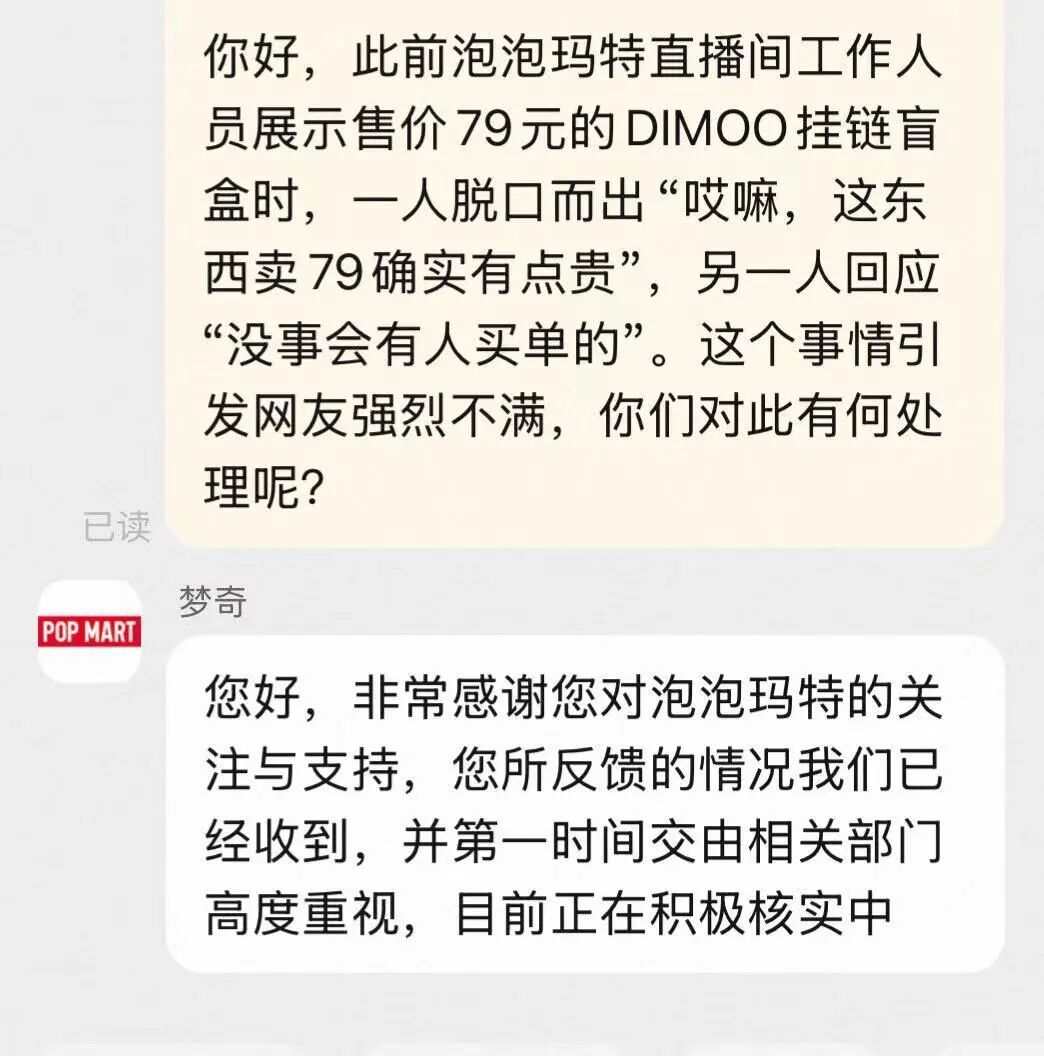
Core Viewpoint - The live streaming incident involving Pop Mart's new product has sparked significant public discussion and raised concerns about pricing and product quality [1][2]. Group 1: Incident Details - On November 6, during a live stream promoting the "DIMOO New Birthday Diary Series - Pendant Blind Box" priced at 79 yuan, a staff member commented that the price was indeed a bit high, which led to widespread online debate [1]. - The incident quickly gained traction, reaching the top of Weibo's trending topics with over 500 million views by November 7 [1]. Group 2: Company Response - Pop Mart's official customer service acknowledged the feedback and stated that the matter was being actively investigated and handled internally [2]. - The company has taken internal measures against the involved staff but has not indicated any plans to terminate their employment [2]. Group 3: Product Information - The "DIMOO New Birthday Diary Series - Pendant Blind Box" includes 6 regular items and 1 hidden item, with the regular items having a 1:6 chance of being found and the hidden item a 1:72 chance [2]. - The blind box is priced at 79 yuan individually, while a complete set (including 6 regular and 1 hidden item) costs 474 yuan [2]. - The product is made from various materials, including zinc alloy, polyester, resin, and glass/acrylic [2]. Group 4: Market Concerns - Media investigations revealed that counterfeit versions of the pendant could cost as low as 4 yuan, raising questions about the perceived value versus the actual pricing of the original product [2]. - The product has been temporarily removed from Pop Mart's Tmall flagship store, with customer service suggesting it may be sold out, while it remains available on the official mini-program [2]. Group 5: Regulatory Environment - Pop Mart has faced ongoing scrutiny, including previous complaints about quality control issues, such as misprinted brand names on products [4]. - The market regulatory authority is drafting guidelines for blind box sales, which may require companies to justify the pricing of items over 50 yuan [4].

11.7犀牛财经早报:22省快递价格上调 特斯拉股东会批准马斯克近万亿美元薪酬计划
Xi Niu Cai Jing· 2025-11-07 01:54
Group 1: Banking and Financial Products - As of the end of October, the scale of the bank wealth management market has reached 31.6 trillion yuan, an increase of 0.36 trillion yuan compared to September [1] - Some bank wealth management products have seen annualized returns rise above 10% over the past three months [1] - Experts are optimistic about the growth of bank wealth management scale in the fourth quarter, supported by the trend of "deposit migration" in a low-interest environment [1] Group 2: Bond Market - The "Technology Board" in the bond market has seen a strong growth, with a total issuance of 1.38 trillion yuan in the past six months [1] - Technology innovation bonds accounted for 77% of the total issuance this year, indicating a significant shift of funds towards the tech sector [1] - The current market for technology bonds is characterized by simultaneous increases in volume and price, along with enhanced institutional demand [1] Group 3: Gold Market - In the Shenzhen Shui Bei market, the price of gold jewelry has increased by nearly 60 yuan per gram, reaching close to 1,000 yuan [2] - The widening gap between buying and selling prices is noted, as the recovery price has decreased [2] - Some investors are attempting to extract physical gold through bank "accumulated gold" services for arbitrage, leading to several banks suspending related services [2] Group 4: Stock Market - The U.S. stock market experienced a significant sell-off, with major indices dropping over 2%, particularly in technology stocks [2] - Concerns over an "AI bubble" and worsening employment market conditions have heightened market anxiety, reflected in a sharp rise in the VIX fear index [2] - Uncertainty regarding the Federal Reserve's interest rate cut outlook has also contributed to the market decline [2] Group 5: Electric Vehicle and Battery Materials - As of the end of September, China's new energy storage installation capacity has exceeded 100 million kilowatts, growing over 30 times compared to the end of the 13th Five-Year Plan [3] - The price of electrolytes, a core material for batteries, is entering an upward cycle due to multiple driving factors, including the rise in new energy vehicles and explosive growth in the storage industry [3] Group 6: E-commerce and AI - This year's "Double Eleven" shopping festival has seen a significant integration of AI, with e-commerce platforms leveraging AI to enhance shopping experiences [4] - Consumers increasingly rely on AI for shopping decisions, leading to a transformation in how purchasing decisions are made [4] Group 7: Corporate Governance and Management - Tesla's shareholders approved a compensation plan for Elon Musk that could allow him to earn up to 878 billion yuan over the next ten years [4] - Guizhou Moutai addressed concerns regarding a significant reduction in advance payments from distributors, emphasizing the importance of maintaining stable partnerships [5] - Penghua Fund's managers denied rumors of a conflict, labeling them as malicious defamation [6]
