申万宏源金工

Search documents
申万金工成长组合2.0:非线性倾斜加权提升组合收益弹性——申万金工因子观察第3期20260210
申万宏源金工· 2026-02-12 08:01
l 申万金工成长组合是依托于对上市公司未来高业绩增速的预测来实现的 :通过分析师的一致预期数据,首先,对全市场有分析师覆盖的股票里,取当前一年盈利预测增速前一半的股票作为股票池;第 二,在股票池内, 10 月底时剔除前三季度累计盈利增速为负的样本;第三,在股票池里使用分析师一致预期变化因子最终筛选出 50 只股票。 l 在权重倾斜后个股最大的权重可以上升到 4% ,最小权重的个股则下降到 0.2% 附近,上调和下调的比例基本上是对称的。 l 风险提示与声明:本报告对于量化策略、指数的研究分析均基于历史公开信息,可能受指数样本股的变化而产生一定的分析偏差;阅读本报告时,投资者需结合自身风险偏好及风险承受能力,充分理解 因子表现及量化策略的波动、风格、历史表现、风险等因素。模型根据历史数据构建,历史表现不代表未来,市场环境发生重大变化时可能失效。 本文我们尝试对基于基本面预测而打造的成长组合进行进一步的升级改造,以行业轮动模型作为改造的强化点,提升组合的收益表现,构建申万金工成长组合2.0版本。 1. 申万金工成长组合 1.1 申万金工成长组合的构建逻辑和历史表现 申万金工在成长、红利、质量等方向构建了一系列量化 ...


情绪周中回落,价量一致性快速下降——量化择时周报20260208
申万宏源金工· 2026-02-09 08:03
Core Viewpoint - Market sentiment has cooled, with the sentiment indicator at 2.65 as of February 6, slightly up from 2.6 the previous week, indicating a neutral stance from a sentiment perspective [4][5]. Sentiment Model Viewpoint - The sentiment model indicates a decline in market sentiment, with a rapid decrease in price-volume consistency, suggesting a significant drop in the correlation between price increases and market attention [5][7]. - The sentiment structure indicator is calculated using various sub-indicators, with a scoring method that evaluates the sentiment direction and Bollinger band positions, resulting in a 20-day moving average of the summed scores [2][3]. Market Activity - The price-volume consistency indicator has rapidly declined, reflecting a significant reduction in the degree of price-volume matching, indicating a cooling market sentiment [5][7]. - The total trading volume for the A-share market decreased significantly by 21.43% week-on-week, with an average daily trading volume of 24,066.54 billion yuan, marking a notable drop in market activity [10][14]. Sector Analysis - As of February 6, 2026, the sectors with the highest short-term scores include construction materials and petroleum & petrochemicals, both scoring 93.22, indicating strong short-term performance [28]. - The correlation between sector congestion and weekly price changes is negative at -0.30, suggesting that high congestion sectors like food and beverage are experiencing significant price increases, while low congestion sectors may have more stable valuations [31][32]. Financing and Investment Sentiment - The financing balance ratio has slightly increased and remains above the upper Bollinger band, indicating a high level of leveraged funds and a generally positive risk appetite among investors [21][24]. - The RSI indicator has shown a decline, reflecting a decrease in short-term upward momentum and an increase in selling pressure, indicating a reduction in market participation willingness [23][34]. Overall Market Signals - The current model indicates a preference for large-cap and value styles, with signals suggesting potential strengthening in these areas as indicated by the rapid decline of the 5-day RSI relative to the 20-day RSI [28][35].

低波因子表现回归、形成共振——量化资产配置月报202602
申万宏源金工· 2026-02-04 01:03
● 经济前瞻指标:维持下行判断。 根据本月更新的经济前瞻指标模型提示,2026年2月处于2025年12月以来下降周期的初期,预计未来将持续下行。 ● 低波因子表现回归、形成共振。 按照定量指标的结果,目前经济出现转弱、流动性略偏松,信用指标略好,微观映射中经济(盈利预期)中等,流动性也为正,信用则继续 修正为偏弱,因此宏观各维度的方向继续为 经济偏弱、流动性偏松和信用收缩 ,与上期一致。本期我们主要按照对经济不敏感、对流动性敏感、对信用不敏感来选择得分前三 的因子,目前成长价值都无明显偏好,由于沪深300中低波动率因子回归,当前其成为宏观、动量选中的共振因子;中证500中去除反转因子,增配小市值,低波同样形成共 振;中证1000维持成长、低波的共振。 ● 大类资产配置观点:小幅配置美股。 结合当前指标,修正后目前经济偏弱、流动性偏松、信用收缩,债券的观点好转,但受其他资产影响仓位仍偏低,黄金虽然上周下跌但 目前基于动量维持配置。 ● 流动性:维持略偏松。 1月我国短端利率进一步有所回落,长端利率仍略高于均线,但利率信号保持宽松;货币量方面,货币投放量回升到0以上,但未突破1倍标准差,信 号维持中性,而超储率仍 ...

行业轮动模型的因子化:减少当前超额回撤的思路之一————申万金工因子观察第2期20260201
申万宏源金工· 2026-02-03 08:02
Core Viewpoint - The collective failure of traditional price and volume factors since 2026 has led to the emergence of a momentum-based industry rotation model, which provides a potential solution for enhancing portfolio stability and excess returns [1][4][54]. Group 1: Industry Rotation Model Characteristics - The industry rotation factor has shown strong characteristics, with a monthly Information Coefficient (IC) of 5.3% and an Information Coefficient Information Ratio (ICIR) of 4.0, indicating its robust performance [26][54]. - The industry rotation model has been effective in improving performance within traditional multi-factor frameworks, significantly enhancing excess returns and halting the decline in excess performance seen in recent years [2][54]. Group 2: Challenges and Conflicts - The industry rotation factor faces conflicts with the industry deviation constraints commonly used in index-enhanced frameworks, which can negatively impact its effectiveness [2][54]. - When applying the standard industry deviation constraint of 2% and individual stock deviation of 0.5%, the performance of the portfolio has declined, with excess returns turning negative in 2025 [2][54]. Group 3: Optimal Usage Strategy - The best approach for utilizing the industry rotation factor is to maintain the individual stock deviation constraint at 0.5% while relaxing the industry deviation constraint from 2% to 5%, which has shown to improve overall excess returns and reduce maximum drawdowns [3][54]. - Increasing the industry deviation to 4% or 5% has resulted in better overall performance, with maximum drawdowns decreasing, indicating a balanced approach to enhancing excess returns while controlling risk [3][54].

情绪指标整体平稳,资金切换较快——量化择时周报20260201
申万宏源金工· 2026-02-02 08:01
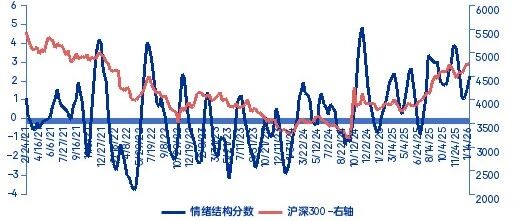
Core Viewpoint - The overall market sentiment indicators are stable, with rapid fund switching observed, indicating a bullish sentiment in the market [4][5]. Group 1: Market Sentiment Indicators - The market sentiment structure indicators include various metrics such as industry trading volatility, trading congestion, price-volume consistency, and others, which collectively inform the sentiment direction [2][3]. - As of January 30, the market sentiment indicator value is 2.6, a slight increase from 2.35 the previous week, suggesting a stable sentiment with a bullish bias [4]. - The sentiment structure indicator has fluctuated around the zero axis within the range of [-6, 6] over the past five years, with significant volatility observed in 2023 [3]. Group 2: Sub-indicator Analysis - The industry trading volatility has shown a slight recovery, indicating increased frequency of fund switching between different sectors, while the industry trend indicator has rapidly declined, suggesting growing divergence in short-term industry outlooks [5][18]. - The price-volume consistency indicator remains high, reflecting a strong correlation between market attention and stock price movements, indicating active market sentiment [7]. - The financing balance ratio has slightly increased, indicating that leveraged funds are maintaining a high level of sentiment, with overall investor risk appetite remaining positive [19]. Group 3: Sector Performance and Trends - The short-term score for the food and beverage sector has risen significantly, while growth and small-cap styles are currently favored [26]. - The highest short-term scores are observed in the oil and petrochemical, construction materials, and non-ferrous metals sectors, indicating strong performance in these areas [26][27]. - The average congestion levels are highest in sectors like non-ferrous metals and oil and petrochemicals, while the lowest are in transportation and real estate, suggesting varying levels of market focus and potential risks [32][34].

股债恒定ETF与传统固收+的竞争格局分析:指数特征、策略优势、对标产品————ETF兵器谱、金融产品每周见20260129
申万宏源金工· 2026-01-30 08:02
主要内容 股债恒定指数有哪些? ■ | 不无限 | 12.2 | Carl | 11-8-14 | 77 | 中证件值股價值; | 中国外国际管理会组合 | 沪漫300 | 中证 50 债券登数 | 無十年的家家以以我便應 | 日正的值段感情 | | --- | --- | --- | --- | --- | --- | --- | --- | --- | --- | --- | | 中证或长股份值; | 中正成长胶骨值走组合 | 中文500 | 中证 50 债券指数 | 本年就知量不可能感想 | 中证模长胶做值) | 中区汇利股價值 | | | | | | 中正汇到服债场变进台 | 中运足彩金收照教 | 就在家庭到激烈便是我都能在年50日世 | 国区域中国 | 中证汇制服务位 | 中证汇利股價值 | 上述到的感情 | | | | | | 上正式制度假面定组会 | 上证定利金收益有资 | 上述 0-5年要到設計學學生生活教 | 表示是平衡 | 上述如何度值; | 上证汇利股價值; | 中区汇利低波股债债 | | | | | | 中国汇别低波度假值危险合 | 中证 800 汇利低波动金收壁指数 | 中运国债券数 ...


期权杠杆科普:期权的杠杆从哪里来? ——白话期权系列之一
申万宏源金工· 2026-01-29 08:02
1. 期权的杠杆的来源 期权被誉为金融市场的 " 衍生品之王 " ,其最具吸引力也最具风险的特征之一便是 杠杆效应 。许多投资者被期权 " 以小额资金撬动大额收益 " 的潜力所吸引,却往往对其 杠杆原理与动态机制一知半解。深刻理解杠杆的本质与变化规律,是驾驭这一金融工具、避免被其反噬的关键。 与融资融券、期货等其他杠杆工具不同,期权的杠杆 内生于产品设计 。期权本质是一种 " 选择权 " ,买方通过支付 权利金 获得在未来约定时间以约定价格买入或卖出标 的资产的权利。该权利所对应的资产规模(如 100 股股票、一份指数合约等)的总市值,即为 标的资产价值 。期权的杠杆,正源于 标的资产价值 与 权利金 之间的悬殊比例 —— 以较小的资金代价,控制价值远高于自身的资产,从而形成收益与风险的放大效应。 这种"权利杠杆"与期货的"保证金杠杆"有本质区别。期货杠杆源于 投资者 为一份"未来必须履行"的买卖合同所缴纳的担保金,盈亏与标的资产波动直接挂钩,风险与收益对 称且可能无限。而期权(买方)杠杆则源于 投资者 为一份"未来可以选择是否履行"的权利所支付的"入场费",其最大损失在买入时即已锁定,风险与收益是非对称的。 ...

市场情绪平稳,价量一致性高位震荡——量化择时周报20260125
申万宏源金工· 2026-01-27 01:03
Core Viewpoint - The market sentiment is stable with high price-volume consistency, indicating a sideways trend in the market [1] Group 1: Market Sentiment Indicators - The market sentiment indicator value as of January 23 is 2.35, a slight increase from 2.25 the previous week, indicating a neutral sentiment [3] - Key indicators such as the proportion of transactions in the Sci-Tech 50 and inter-industry trading volatility have shown signs of recovery, suggesting a marginal improvement in market risk appetite [6][15][17] - The price-volume consistency indicator remains high, reflecting a strong correlation between market attention and stock price movements, indicating active market sentiment [9] - The financing balance ratio has shown a slight upward trend, indicating that leveraged funds are maintaining a high level of sentiment, suggesting overall market risk appetite remains positive [22] Group 2: Industry Trends and Performance - The scoring model indicates that non-ferrous metals, communication, and defense industries are leading in trend scores, with non-ferrous metals achieving a short-term score of 100.00, the highest among industries [30][31] - The average industry congestion level is highest in utilities, computers, media, banks, and oil and petrochemicals, while the lowest is in environmental protection, textiles, and light manufacturing [33] - The correlation between industry congestion and weekly price changes is negligible, indicating that high congestion sectors like oil and petrochemicals are experiencing significant price increases, while sectors with low congestion are lagging [35] Group 3: Technical Indicators - The RSI indicator has shown a decline, suggesting a decrease in short-term upward momentum and an increase in selling pressure, indicating a potential weakening of market sentiment [25][37] - The model indicates that small-cap and growth styles are currently favored, although there are signs of weakening in the short-term signals for these styles [38]

为何2026年以来中证500指数难以战胜?——申万金工因子观察第1期20260125
申万宏源金工· 2026-01-26 01:01
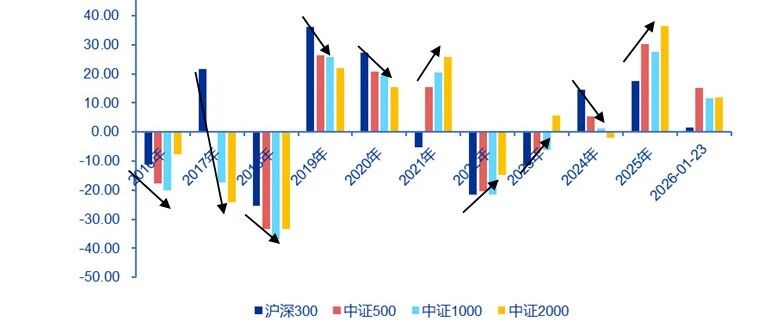
Group 1 - The core viewpoint of the article highlights the outstanding performance of the CSI 500 index since the beginning of 2026, with a rise of 15.06% as of January 23, 2026, outperforming other major indices like the CSI 300, CSI 1000, and CSI 2000 [1][2] - The article notes that the CSI 500 index's strong performance is attributed to its concentration in sectors that have performed well since 2026, including electronics, non-ferrous metals (7.148%), and defense industry (6.364%) [5] - A small number of stocks have significantly contributed to the index's gains, with the top 5 stocks contributing 1.47% and the top 10 stocks contributing 2.41%, indicating a high concentration of performance among a few stocks [6][8] Group 2 - The article discusses the challenges faced by enhanced index funds, which have collectively underperformed the CSI 500 index since 2026, with an average underperformance of 2.5% [10][11] - Active quantitative strategies have also struggled, with average underperformance reaching 3.91%, highlighting the difficulties in achieving excess returns in a strong market [12] - The article analyzes the changes in factors within the CSI 500 index, noting that many traditional factors have shown negative performance, contributing to the overall decline in excess returns [15][20] Group 3 - Historical comparisons indicate that the current market conditions represent an extreme situation for factor performance, with the article suggesting that the current environment is not solely due to a single factor's poor performance [28][29] - The article reviews past instances of similar market conditions, suggesting that extreme market behavior is unlikely to persist indefinitely, and a return to rational pricing based on factors is expected [31][45] - Future outlooks suggest that while factor reversals may not last long, adjustments to models should be cautious, as historical data indicates that significant factor failures typically do not exceed two months [46][47]
情绪继续修复,价量一致性维持高位——量化择时周报20260118
申万宏源金工· 2026-01-19 08:03
Core Viewpoint - The article emphasizes a positive market sentiment with increasing trading volume and consistency in price and volume, indicating a potential upward trend in the market [1][4]. Group 1: Market Sentiment Indicators - The market sentiment structure indicators include various metrics such as industry trading volatility, trading congestion, price-volume consistency, and others, which collectively suggest a positive sentiment direction [2]. - As of January 16, the market sentiment index reached 2.25, a significant increase from 1.6 the previous week, indicating a recovery in sentiment [4]. - The price-volume consistency indicator has shown a rapid increase, reflecting a strong correlation between market attention and price movements, suggesting an active market sentiment [6][10]. Group 2: Trading Activity and Volume - The total trading volume for the A-share market increased by 21.25% week-on-week, with an average daily trading volume of 34,650.61 billion yuan, highlighting heightened market activity [10]. - On January 14, a historical trading volume peak was recorded at 39,868.62 billion yuan, indicating strong market engagement [10]. Group 3: Sector Performance and Risk Appetite - The trading volatility between industries is on a downward trend, indicating a slowdown in capital switching between sectors, which may reflect a cautious market environment [13]. - The industry trend indicators remain stable, suggesting a high level of consensus on short-term value judgments across sectors, with a dominant beta effect in the market [16]. - The financing balance ratio remains high, indicating that leveraged capital sentiment is still elevated, reflecting a relatively positive risk appetite among investors [19]. Group 4: Short-term and Long-term Trends - The short-term scoring model indicates that sectors such as computers, pharmaceuticals, and media are showing upward trends, with the non-ferrous metals sector having the highest short-term score of 98.31 [25]. - The article notes that the correlation between industry congestion and weekly price changes is positive, suggesting that sectors with high congestion, like computers and media, are likely to experience significant price movements [28].