国泰海通证券研究

Search documents
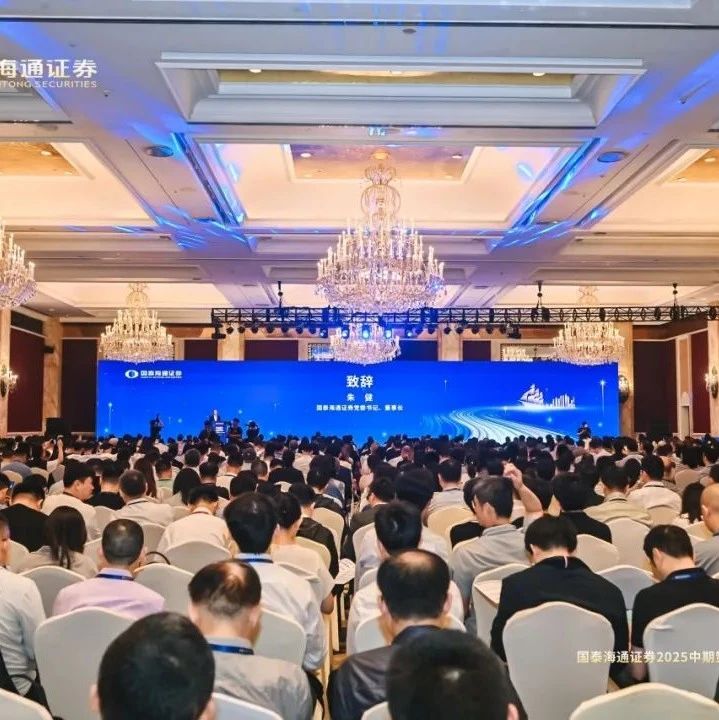
国泰海通证券2025年中期策略会成功召开
国泰海通证券研究· 2025-06-05 22:12
Core Viewpoint - The conference organized by Guotai Junan Securities highlighted the increasing confidence of domestic and international investors in investing in China, driven by a series of policies aimed at enhancing technological self-reliance, stabilizing capital markets, and expanding high-level openness [3]. Group 1: Conference Overview - The 2025 Mid-term Strategy Conference took place in Shanghai from June 4 to 5, featuring a main forum and 33 sub-forums, with over 200 speakers and nearly 1,000 executives from listed companies attending, marking record participation [1]. - The conference attracted over 5,000 registrations and organized more than 2,000 client interactions, setting new highs for Guotai Junan Securities' strategy meetings [1]. Group 2: Key Presentations - Notable speakers included Huang Qifan, Liu Shijun, and Guo Kai, who discussed topics such as new productive forces, consumption expansion, structural reforms, and the evolution of the Middle East situation [4]. - Guotai Junan's Chief Macro Analyst Liang Zhonghua emphasized the restructuring of the global economic and monetary systems, highlighting risks related to U.S. debt and the potential for further interest rate increases [7]. - Chief Strategy Analyst Fang Yi presented a bullish outlook for the Chinese stock market, identifying a "transformation bull" market driven by policy measures aimed at debt resolution and demand stimulation [8]. Group 3: Sub-forums and Topics - The first day featured 13 sub-forums, with a focus on macroeconomic outlooks and investment strategies for A-shares and Hong Kong stocks [6]. - The second day included 20 sub-forums covering various topics such as European market investment outlooks and wealth management strategies, featuring prominent international guests [9]. Group 4: Investor Engagement and Services - Guotai Junan Securities utilized its Daohe APP to provide live streaming of the forums and thematic services focused on emerging technologies, enhancing engagement with professional investors [10]. - The live streaming programs received positive feedback, with over 360,000 views, showcasing the company's commitment to delivering valuable insights and services to its clients [10].

国泰海通|传媒:AI应用发展,关注重点细分赛道机会
国泰海通证券研究· 2025-06-05 22:12
Core Insights - The article emphasizes the continuous improvement of AI applications driven by technological advancements, highlighting that certain sectors have achieved user growth, retention, and monetization, warranting sustained attention on key sectors and leading products [1][2]. Sector Comparison - The comprehensive assistant sector shows broad coverage, with deeper penetration in social, education, and office applications. Mature products attract user traffic, with AI assistants and image editing leading the way. Products like DeepSeek demonstrate breakthrough growth due to excellent performance [2]. - In terms of user stickiness, social interaction products have developed robust features that foster user engagement. The education sector exhibits strong payment habits, with customers willing to pay for high-quality products. Content production tools can command high prices due to significant computational demands and diverse needs [2]. Key Product Analysis - The comprehensive assistant sector is witnessing transformative changes, with products like Doubao introducing "video call" features, indicating a shift in AI interaction methods. Tencent's Yuanbao showcases the positive impact of its ecosystem on product capabilities and user acquisition [3]. - In the AI video domain, products such as Keli, Jimeng, and Hailuo have demonstrated excellent performance with stable user demand. Google's recent launch of VEO3 marks a new phase in "audio-visual synchronized generation," potentially guiding the next stage of AI video development [3]. - The popularity of AI Agents, particularly with Manus, has sparked interest, with domestic players like Kunlun Wanwei's Tiangong Super Intelligent Agent achieving impressive test scores. This suggests more opportunities in complex task completion [3]. - AI companionship products exhibit strong user stickiness, although monetization through UGC models remains a challenge. Future attention may be directed towards premium products like "EVE," which could offer new insights for the industry [3].

精彩花絮10|“潮起东方,新质领航”国泰海通证券2025中期策略会
国泰海通证券研究· 2025-06-05 19:56
本订阅号所载内容仅面向国泰海通证券研究服务签约客户。因本资料暂时无法设置访问限制,根据《证 券期货投资者适当性管理办法》的要求,若您并非国泰海通证券研究服务签约客户,为保证服务质量、 控制投资风险,还请取消关注,请勿订阅、接收或使用本订阅号中的任何信息。我们对由此给您造成的 不便表示诚挚歉意,非常感谢您的理解与配合!如有任何疑问,敬请按照文末联系方式与我们联系。 重要提醒 更多国泰海通研究和服务 亦可联系对口销售获取 法律声明 ...

精彩花絮9|“潮起东方,新质领航”国泰海通证券2025中期策略会
国泰海通证券研究· 2025-06-05 19:05
本订阅号所载内容仅面向国泰海通证券研究服务签约客户。因本资料暂时无法设置访问限制,根据《证 券期货投资者适当性管理办法》的要求,若您并非国泰海通证券研究服务签约客户,为保证服务质量、 控制投资风险,还请取消关注,请勿订阅、接收或使用本订阅号中的任何信息。我们对由此给您造成的 不便表示诚挚歉意,非常感谢您的理解与配合!如有任何疑问,敬请按照文末联系方式与我们联系。 法律声明 亦可联系对口销售获取 重要提醒 更多国泰海通研究和服务 ...
精彩花絮8|“潮起东方,新质领航”国泰海通证券2025中期策略会
国泰海通证券研究· 2025-06-05 19:05
本订阅号所载内容仅面向国泰海通证券研究服务签约客户。因本资料暂时无法设置访问限制,根据《证 券期货投资者适当性管理办法》的要求,若您并非国泰海通证券研究服务签约客户,为保证服务质量、 控制投资风险,还请取消关注,请勿订阅、接收或使用本订阅号中的任何信息。我们对由此给您造成的 不便表示诚挚歉意,非常感谢您的理解与配合!如有任何疑问,敬请按照文末联系方式与我们联系。 法律声明 重要提醒 更多国泰海通研究和服务 亦可联系对口销售获取 ...

精彩花絮7|“潮起东方,新质领航”国泰海通证券2025中期策略会
国泰海通证券研究· 2025-06-05 06:17
重要提醒 更多国泰海通研究和服务 法律声明 亦可联系对口销售获取 本订阅号所载内容仅面向国泰海通证券研究服务签约客户。因本资料暂时无法设置访问限制,根据《证 券期货投资者适当性管理办法》的要求,若您并非国泰海通证券研究服务签约客户,为保证服务质量、 控制投资风险,还请取消关注,请勿订阅、接收或使用本订阅号中的任何信息。我们对由此给您造成的 不便表示诚挚歉意,非常感谢您的理解与配合!如有任何疑问,敬请按照文末联系方式与我们联系。 ...

精彩花絮5|“潮起东方,新质领航”国泰海通证券2025中期策略会
国泰海通证券研究· 2025-06-05 02:25
本订阅号所载内容仅面向国泰海通证券研究服务签约客户。因本资料暂时无法设置访问限制,根据《证 券期货投资者适当性管理办法》的要求,若您并非国泰海通证券研究服务签约客户,为保证服务质量、 控制投资风险,还请取消关注,请勿订阅、接收或使用本订阅号中的任何信息。我们对由此给您造成的 不便表示诚挚歉意,非常感谢您的理解与配合!如有任何疑问,敬请按照文末联系方式与我们联系。 法律声明 亦可联系对口销售获取 重要提醒 更多国泰海通研究和服务 ...

精彩花絮6|“潮起东方,新质领航”国泰海通证券2025中期策略会
国泰海通证券研究· 2025-06-05 02:25
法律声明 重要提醒 本订阅号所载内容仅面向国泰海通证券研究服务签约客户。因本资料暂时无法设置访问限制,根据《证 券期货投资者适当性管理办法》的要求,若您并非国泰海通证券研究服务签约客户,为保证服务质量、 控制投资风险,还请取消关注,请勿订阅、接收或使用本订阅号中的任何信息。我们对由此给您造成的 不便表示诚挚歉意,非常感谢您的理解与配合!如有任何疑问,敬请按照文末联系方式与我们联系。 更多国泰海通研究和服务 亦可联系对口销售获取 ...
国泰海通|“潮起东方,新质领航”2025中期策略会观点集锦(下)——消费、医药、科技、先进制造、金融
国泰海通证券研究· 2025-06-04 15:00
Group 1: Food and Beverage - The investment suggestion emphasizes structural differentiation and growth potential, with a focus on new consumption and high growth in consumer goods, while the liquor sector is in a bottoming phase, highlighting its value for allocation [2][3] - The liquor industry is experiencing increased differentiation and rationality, with the industry still seeking a bottom in Q2 2025, and the head companies showing resilience during the off-season [2] - Beer is expected to recover as the peak season approaches, while the beverage sector is in a phase of releasing single product potential [3] Group 2: Cosmetics - The investment recommendation suggests increasing holdings in personal care and beauty sectors, focusing on companies benefiting from product innovation and new channel opportunities [6] - The demand for cosmetics remains stable, with domestic brands gaining market share, particularly in skincare and makeup categories [6] - Trends indicate accelerated product innovation and emotional consumption, with a focus on cost-effective products benefiting from supply-demand dynamics [6] Group 3: Education and Consumer Services - The high school education sector is projected to have a stable demand for the next 7-8 years, supported by policy initiatives aimed at expanding education [12] - Emotional and experiential consumption is accelerating, with traditional demands being met by new supply, particularly in the IP toy sector [12] - The tea and coffee sectors are undergoing product, channel, and technological iterations, indicating structural growth opportunities [12] Group 4: Home Appliances - The home appliance sector is witnessing a recovery led by major brands, with a focus on price competition and market consolidation [17] - New consumption trends are emerging, with high aesthetic product designs and AI integration driving innovation in the sector [17] - Investment suggestions highlight opportunities in both domestic and international markets for leading brands [17] Group 5: Agriculture and Animal Husbandry - The agricultural sector maintains a "buy" rating, with slow growth expected in livestock output and a recovery in the animal health feed sector [29] - The pet food market is experiencing robust growth, driven by domestic brands gaining market competitiveness [29] - The planting sector is expected to see rising grain prices due to reduced import volumes, with core seed varieties becoming increasingly important [30] Group 6: Internet and AI - The investment outlook for the internet sector remains positive, particularly for technology stocks, with a focus on AI-driven growth [34] - The AI narrative is expected to enhance the value of social networks, with a strong emphasis on user engagement and ecosystem development [59] - The evolution of AI capabilities is anticipated to create new demand and enhance the social network's value proposition [59] Group 7: Non-Banking Financials - The non-banking financial sector is undergoing significant transformation, with a focus on wealth management and asset management business models [73] - The recommendation is to favor leading comprehensive brokerages that demonstrate balanced business structures and strong professional capabilities [73] - The insurance sector is expected to see stable growth in new business value, with an emphasis on improving asset allocation [76] Group 8: Banking - The banking sector is projected to face revenue pressure but maintain positive net profit growth, with a stable policy environment supporting sustainable operations [79] - The expectation of increased long-term capital inflow into the banking sector is driven by regulatory changes and market dynamics [80] - Investment strategies suggest focusing on high-growth regional banks and those showing signs of loan recovery [81]
国泰海通 · 晨报0605|策略、固收
国泰海通证券研究· 2025-06-04 15:00
Group 1 - The core viewpoint of the article emphasizes that the Chinese stock market is entering a "transformation bull" phase, driven by a clearer understanding of economic conditions and a reduction in the marginal impact of valuation contraction [1][2] - The key drivers of the market include a decline in the risk-free interest rate and a systematic reduction in risk perception, which have historically hindered investor willingness to enter the market [2][3] - The article highlights the importance of timely and reasonable economic policies, as well as reforms in the capital market that focus on investor returns, which are crucial for changing the conservative attitudes of investors towards risk [2][3] Group 2 - Emerging technology is identified as a main investment theme, while cyclical finance is seen as a dark horse opportunity. The article suggests that the real issues in the Chinese economy are not solely in real estate but in broader economic stability and innovation [3] - Recommendations for investment include sectors such as financial services (brokerages, banks, insurance), high-dividend companies (telecom operators, highways, public utilities), and emerging technologies (internet, media, robotics, pharmaceuticals, military) [3] - The article also points to new consumption trends and cyclical recovery in commodities, recommending investments in rare earths, chemicals, retail, and cosmetics, as well as themes like AI, regional economic development, and self-sufficiency in technology [3]