国泰海通证券研究

Search documents
国泰海通 · 晨报260130|宏观
国泰海通证券研究· 2026-01-29 14:05
Group 1: Federal Reserve Meeting Insights - The Federal Reserve decided to pause interest rate cuts, with a significant internal division reflected in the 10:2 vote, where two members advocated for a 25 basis point cut [2] - The Fed expressed a more optimistic view on the U.S. economy and employment, although the labor market is facing challenges with stagnant supply growth and a slight decline in demand [2] - Inflation is not seen as a major concern, with expectations that it will rise initially and then decline, largely influenced by tariffs peaking in 2026 [2] Group 2: Future Projections and Challenges - The Fed's forward guidance has become less clear, with no specific timeline provided for future rate cuts, indicating that decisions will depend on incoming data [2] - The upcoming change in Fed leadership may pose challenges to its independence, with potential candidates including Rick Reed, Kevin Warsh, and Christopher Waller, and the possibility of multiple rate cuts in the near future [3] - The 10-year U.S. Treasury yield is expected to experience high volatility before ultimately trending down, with a mid-year low projected around 3.8% [4] Group 3: Silver Market Analysis - Silver prices are expected to be driven by industrial demand, with a strong correlation to global industrial cycles, particularly in emerging sectors like photovoltaics and electric vehicles [9] - The financial attributes of silver can amplify price volatility, influenced by speculative trading and the dynamics of silver ETFs [9] - A long-term bullish outlook for silver is supported by robust industrial demand, although caution is advised regarding potential short-term price corrections [10]


国泰海通|计算机:制度闭环叠加AI催化,迎接数据要素“价值释放年”
国泰海通证券研究· 2026-01-29 14:05
Core Insights - The article emphasizes that 2026 is designated as the "Year of Data Factor Value Release," aiming to enhance data flow and resource allocation channels, thereby promoting the integration of data factors into economic value creation [1] - The establishment of a closed-loop system for data factor policies has accelerated since 2024, transitioning from top-level design to practical implementation, which lays a solid foundation for the industrialization of data factors [1] Summary by Sections Data Factor Value Release - The national data work conference held on December 29-30, 2025, outlined strategies to clarify the roles of data circulation service institutions and enhance the efficiency of data transaction services, aiming to foster a vibrant data market ecosystem [1] AI Application Demand - The demand for AI applications is creating a significant supply gap in the data market, with daily token consumption for AI applications in China skyrocketing from 100 billion at the beginning of 2024 to over 30 trillion by the end of June 2025, reflecting a growth of over 300 times in just a year and a half [2] - The article suggests that the combination of a closed-loop system and AI catalysis will likely accelerate the release of data factor value and the flourishing of the industry in 2026, recommending attention to various segments of the data industry chain, including data supply, transaction circulation, application development, service, security, computing power, and network infrastructure [2]

国泰海通|食饮:食饮获配比例回落,乳品、零食板块加配——2025Q4机构持仓总结
国泰海通证券研究· 2026-01-29 14:05
Core Viewpoint - The allocation ratio of the food and beverage sector is expected to decline in Q4 2025, with a notable decrease in both the liquor and non-liquor segments, while other sectors such as beverages, dairy, and snacks show an increase in allocation [1][2]. Group 1: Investment Recommendations - Focus on five main investment lines: 1) Stocks with price elasticity; 2) Beverages benefiting from travel demand; prioritize low valuation and high dividend yields; 3) Growth stocks in snacks and food raw materials; 4) Beer; 5) Stable condiments and livestock capacity reduction, with a recovery expected in food service [2]. - The allocation ratio of actively managed equity public funds in the food and beverage sector decreased by 0.14 percentage points to 4.04%, ranking ninth among all sectors [2]. Group 2: Sector Analysis - In Q4 2025, the allocation ratio for liquor stocks decreased by 0.29 percentage points to 2.92%, driven by declines in leading liquor companies such as Wuliangye and Shanxi Fenjiu [3][4]. - Non-liquor segments, including food processing, beverage dairy, and snacks, saw an increase in allocation ratios, with notable gains in the dairy sector led by Yili and Mengniu, and in snacks led by companies like Wancheng Group and Ximai Foods [3][4]. - The condiment sector also experienced an increase in allocation, with significant rises in stocks like Angel Yeast and Zhongju High-tech, while Haitian Flavoring saw a decrease [4].

国泰海通|固收:债券ETF规模跃升之后:业绩归因、策略优化与未来挑战——2025年回顾与2026年展望
国泰海通证券研究· 2026-01-29 14:05
Core Insights - The bond ETF market is expected to experience significant growth in both scale and trading volume by the end of 2025, with total market size reaching 829 billion yuan, an increase of over 655 billion yuan from 2024, representing a 377% year-on-year growth [1] - The average weekly trading volume of bond ETFs is projected to exceed 150 billion yuan, marking a 311% increase compared to the previous year [1] Group 1: Market Performance - By the end of 2025, the sizes of credit bond ETFs, interest rate bond ETFs, and convertible bond ETFs are expected to be 615.2 billion yuan, 152.8 billion yuan, and 61 billion yuan respectively [1] - The pricing dynamics of various bond ETFs show that government bond ETFs are mostly at a premium, while local government bond ETFs are generally at a discount, and credit bond ETFs have shifted from premium to discount [1] - The introduction of benchmark market-making credit bond ETFs has led to increased demand, pushing secondary market prices higher, but a bearish bond market and the launch of sci-tech bond ETFs have caused a shift to discount territory [1] Group 2: Redemption Trends - The redemption patterns of interest rate bond ETFs exhibit a "government bond vs. policy financial bond seesaw" effect, with government bond ETFs and policy financial bond ETFs showing negative correlation in monthly net subscriptions [2] - The launch of sci-tech bond ETFs has rapidly diverted funds from benchmark market-making ETFs, leading to a significant reduction in subscription activity for the latter [2] - Convertible bond ETFs experienced net outflows for most months in 2025, with a shift to net subscriptions during periods of heightened equity sentiment in July and August [2] Group 3: Performance Outlook - The overall performance of interest rate bond ETFs in 2025 is expected to be poor, with maximum drawdowns larger than in 2024, and short-duration products outperforming long-duration ones [2] - The annualized returns of three existing credit bond ETF products are expected to decline, but the drop is smaller compared to interest rate bond ETFs [2] - The first batch of sci-tech bond ETFs is expected to have an optimal annualized return of 0.75% and a Calmar ratio of 1.24, while the second batch is projected to achieve an annualized return of 1.82% and a Calmar ratio of 8.02 [2] Group 4: Future Strategies - In 2026, the introduction of multi-asset ETFs is anticipated, with a focus on maintaining a constant stock-bond ratio, primarily with over 70% in bonds [3] - The performance of bond ETFs is likely to align with the overall bond market, with increasing congestion in sci-tech bonds and a preference for short-duration products [3] - A shift towards more diversified trading strategies is expected, including internal rotation within bond ETFs and arbitrage opportunities between credit ETFs and individual bonds [3]


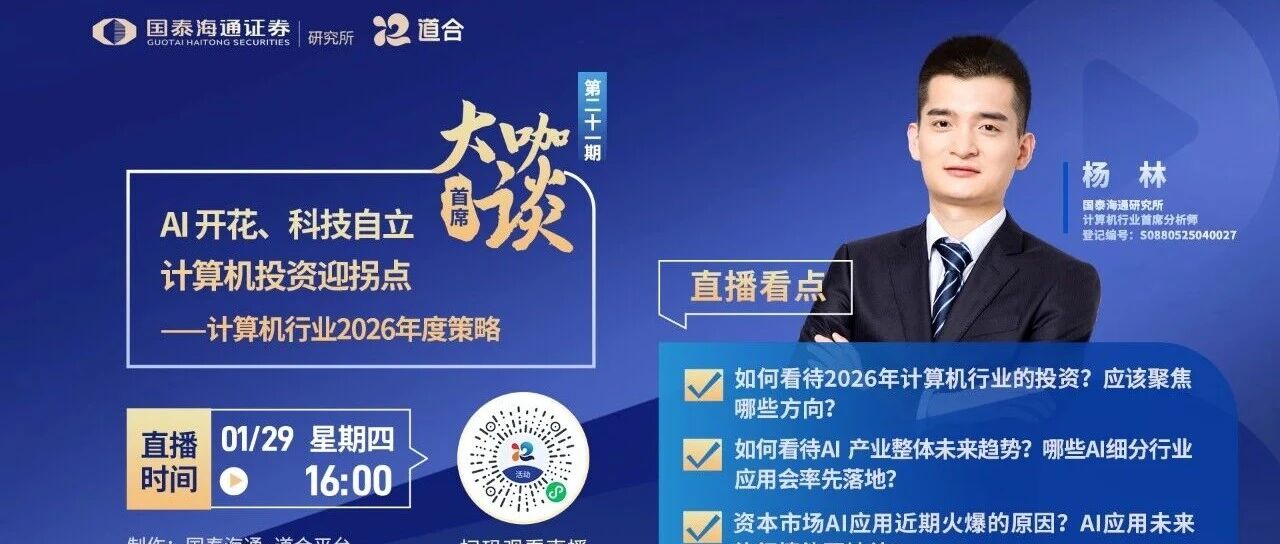
【直播预告】国泰海通 · 首席大咖谈|计算机杨林:AI开花、科技自立,计算机投资迎拐点
国泰海通证券研究· 2026-01-29 03:54
十一十 期 国泰海通证券 GUOTALHAITONG SEURITIES | 研究所 2 道合 AI 开花、科技自立 计算机投资迎拐点 计算机行业2026年度策略 国泰海通研究所 计算机行业首席分析师 登记编号: S0880525040027 直播看点 如何看待2026年计算机行业的投资?应该聚焦 哪些方向? 更多国泰海通研究和服务 亦可联系对口销售获取 重要提醒 本订阅号所载内容仅面向国泰海通证券研究服务签约客户。因本资料暂时无法设置访问限制,根据《证 券期货投资者适当性管理办法》的要求,若您并非国泰海通证券研究服务签约客户,为保证服务质量、 控制投资风险,还请取消关注,请勿订阅、接收或使用本订阅号中的任何信息。我们对由此给您造成的 不便表示诚挚歉意,非常感谢您的理解与配合!如有任何疑问,敬请按照文末联系方式与我们联系。 法律声明 ...
国泰海通|轻工:智能眼镜产品力系列二:大模型催化,AI眼镜异军突起
国泰海通证券研究· 2026-01-28 14:08
Core Viewpoint - The article emphasizes that AI glasses without display functions are better suited to meet the underlying needs of traditional eyewear, suggesting they are likely to see earlier market adoption compared to AR glasses [1] Industry Growth Potential - The smart glasses industry is expected to enter a rapid growth phase, with companies in the supply chain poised to benefit from an upturn in market conditions [2] - The launch of the Ray-Ban Meta smart glasses marks a new product cycle, featuring improved audio-visual quality and integration with Meta's social platforms, enhancing user experience and application scenarios [2] Market Penetration Insights - AI glasses are currently at a nascent stage, with a projected penetration rate of only 0.1% in 2024, similar to the early adoption phase of smartwatches [3] - Forecasts indicate that global AI glasses shipments could reach 291 million units by 2034, with a compound annual growth rate (CAGR) of 55.16% from 2025 to 2034 [3] Product Development Challenges - Key factors hindering the rapid penetration of smart glasses include reliance on traditional offline channels for customer engagement, necessitating partnerships between brands and retailers [4] - The comfort of AI glasses is influenced by weight and design, with current models averaging around 50g, while traditional glasses weigh about 20g; achieving a balance between functionality and comfort is crucial [4] - Battery capacity and performance are critical for convenience, requiring advancements in battery materials and technology to enhance longevity [4] - The system-on-chip (SoC) is vital for the performance of AI glasses, impacting user experience through its ability to handle various tasks efficiently [4]

国泰海通|AI应用· 合集(二)
国泰海通证券研究· 2026-01-28 14:08
Core Insights - The AI industry in China is expected to enter a phase of large-scale application and popularization, driven by significant developments such as Deepseek's open-source model launch and Meta's acquisition of Manus [2][5][6] - The government is actively promoting AI through policies like the "Artificial Intelligence +" initiative, which aims to integrate AI into various sectors [5][6] - The performance of AI applications is improving, leading to increased user engagement and diverse business models, which are expected to drive exponential growth in the industry [6][7] Group 1: AI Application Trends - AI applications are transitioning from being merely usable to highly effective, with the industry moving towards the development of intelligent agents capable of autonomous problem-solving [7] - The market for AI is projected to grow at a compound annual growth rate (CAGR) of over 35%, with the large model market expected to exceed 63% CAGR, particularly in enterprise applications [7][8] - The penetration of AI across various sectors, including finance, manufacturing, and education, is increasing, showcasing its potential to enhance productivity and reduce costs [8][9] Group 2: Investment Opportunities - The current AI industry revolution is characterized by a rotation between computing power and application, with applications expected to become the core focus by 2026 [9] - Investment recommendations include internet platform companies with strong user engagement and capital expenditure, as well as companies in vertical sectors like healthcare, finance, and education [9] - Companies like MiniMax and Zhizhu are leading the way in AI commercialization, with MiniMax's IPO showcasing a new path for AI business models [60][61] Group 3: GEO Marketing and Search Trends - The emergence of GEO (Generative Engine Optimization) marketing is a response to the shift in traffic sources due to AI, moving from traditional search engines to AI-driven platforms [18][19] - The GEO market is expected to grow significantly, with projections indicating a market size of approximately $29 billion in China by 2030, driven by the transition from SEO to GEO strategies [20][21] - Companies that are early adopters of GEO strategies are likely to benefit from the evolving landscape of AI-driven marketing [22] Group 4: AI in Manufacturing - AI is increasingly being integrated into manufacturing processes, leading to the development of "lighthouse factories" that exemplify advanced manufacturing practices [40][41] - The Chinese government is supporting the digital transformation of manufacturing through policies that promote AI and smart factory initiatives [42] - Local software and hardware companies are collaborating to create a robust ecosystem for AI-enabled manufacturing solutions [42] Group 5: AI Model Development - The release of advanced models like DeepSeek-V3.2 marks a significant milestone in open-source AI, achieving performance levels comparable to proprietary models [50][51] - The integration of reasoning capabilities into AI models is enhancing their utility in complex tasks, paving the way for broader applications [51][52] - The competitive landscape is evolving, with companies focusing on both technological advancements and practical applications to drive growth [56][57]

国泰海通|轻工:3D打印行业:产业浪潮已至,工业消费双向驱动
国泰海通证券研究· 2026-01-28 14:08
报告导读: " AI 赋能 + 定价亲民"加速消费级 3D 打印普及,国内设备商引领创新变革。 投资建议。 " AI 赋能 + 定价亲民"加速消费级 3D 打印普及,国内设备商引领创新变革,建议关注消费级赛道上游原材料相关企业与打印设备相关企业。 3D 打印浪潮已至,工业消费双向驱动: 3D 打印(增材制造)对比等材制造与减材制造具备"去模具、减废料、降库存"的特点,被广泛用于航空航天、医 疗、汽车、消费 / 电子产品等下游领域。在工业领域对缩短研发周期、轻量化零件、个性化 / 一体化成型需求,以及消费领域对个性化定制需求的双向增长 下, 3D 打印市场规模呈现快速增长状态。 2024 年全球 3D 打印市场规模为 219 亿美元,到 2034 年预计达到 1150 亿美元, CAGR 为 18% ;国内方 面, 2024 年中国 3D 打印行业市场规模为 419 亿元, 2020-2024 年 CAGR 为 19.42% 。 消费级市场驱动 PLA 需求放量,国内厂商加速布局。 1 )市场规模: 2024 年全球 3D 打印原材料市场规模为 44 亿美元,其中塑料原材料市场为 12 亿美 元。 PLA 由于 ...

国泰海通|建筑:美光未来十年将在新加坡投资240亿美元,驱动洁净室市场扩容
国泰海通证券研究· 2026-01-28 14:08
Group 1 - Micron Technology will build a new NAND factory in Singapore, investing approximately $24 billion over the next ten years [1] - The new facility will provide 700,000 square feet of cleanroom space and is expected to start production in the second half of 2028, driven by demand from AI and data center applications [1] - WSTS forecasts that the global semiconductor market will grow by 26.3% in 2026, reaching $975 billion, with storage and logic ICs being the main growth drivers [3] Group 2 - TSMC expects capital expenditures for 2026 to be between $52 billion and $56 billion, an increase of 27% to 37% compared to 2025 [2] - Micron's capital expenditure plan for fiscal year 2026 is set to increase from $18 billion to approximately $20 billion, focusing on enhancing HBM capacity and 1-gamma product supply [2] - The cleanroom industry is expanding due to increased investments in high-tech industries, with a trend towards consolidation and scale among service providers [3]



国泰海通 · 晨报260129|美联储换帅前瞻:历史复盘与影响展望
国泰海通证券研究· 2026-01-28 14:08
短期来看,宽松交易仍在延续,权益与金属市场受益。 我们认为: 1 )无论哪位候选人上任,短期美联储货币政策或将延续宽松,弱美元概率较大,但需注 意潜在的缩表政策力度与传导。 2 )贵金属方面,弱美元与实际利率下降将支撑黄金的货币与金融属性需求,而若哈塞特当选可能引发政策稳定性担忧,第 三重利好因素或推动黄金等贵金属避险资产进一步上行。 3 )宽松交易环境下,整体利好全球权益市场。对中国权益市场而言,随着经济转型加快、无风险 收益下沉与资本市场改革,"转型牛"的升势远未结束。 【策略】 美联储换帅前瞻:历史复盘与影响展望 全 球资本市场相关性显著提升。 2024 年 9 月美联储启动降息周期以来,中、欧等主要经济体同步推进,全球流动性宽松格局形成。我们认为这一现象本质 是全球化债,核心逻辑正是通过债务置换逐步降低资金成本,缓解政府债务的利息偿付压力。对于全球市场而言: 1 )权益市场同步走强,纳斯达克 100 、 日经 225 等发达市场指数涨幅居前,上证指数、胡志明指数等新兴市场指数亦表现亮眼,且上行斜率的拐点几乎同步出现; 2 )贵金属及工业金属价格同步 上涨,金融属性领先实物需求属性扩张。商品市场与权益市 ...