
GEELY AUTO(00175)

Search documents
销量在追近,市值在远离:吉利和比亚迪的差距在哪里?
Xin Lang Cai Jing· 2026-01-28 07:57
Core Viewpoint - The competition between Geely and BYD in the Chinese electric vehicle market is intensifying, with Geely's sales growth contrasting sharply with its market valuation and profitability compared to BYD [1][2]. Group 1: Sales Performance - In 2025, Geely achieved annual sales of 3.02 million vehicles, a year-on-year increase of 39%, positioning itself as the second-largest domestic brand [1]. - Geely's Galaxy brand contributed significantly, with sales reaching 1.6878 million units, a 150% increase, making it a formidable competitor to BYD [2][3]. - Despite the sales growth, Geely's total sales in December 2025 fell to 236,817 units, a 23.7% decrease from November, indicating potential issues in sustaining momentum [1]. Group 2: Market Valuation and Profitability - BYD's market capitalization recently surpassed HKD 908.5 billion, while Geely's stood at approximately HKD 181 billion, widening the valuation gap to 5:1 [1]. - Geely's profitability is lagging behind BYD, with significant differences in per-vehicle profit and total profit margins [1]. Group 3: Strategic Positioning - Geely's strategy of closely following BYD's product offerings has led to a reactive approach, limiting its ability to innovate independently [2][3]. - The rapid rise of the Galaxy brand has not fully addressed Geely's challenges in high-end market positioning and global expansion [7][8]. Group 4: Technological Development - Geely's technological advancements are perceived as reactive, with a notable delay in responding to BYD's innovations, such as the introduction of advanced driver-assistance systems [3][4]. - The disparity in research and development investment is evident, with BYD's R&D expenditure significantly outpacing that of Geely, reflecting a deeper commitment to technological advancement [10][11]. Group 5: Global Expansion Challenges - Geely's export volume declined by 4% in 2025, contrasting with BYD's 132% growth in overseas sales, highlighting Geely's struggles in international markets [7][8]. - The company's approach to global markets has been criticized for being outdated, relying on transferring domestic models without adapting to local demands [7][8]. Group 6: Future Outlook - Geely aims to achieve a sales target of 6.5 million vehicles by 2030, but this ambition hinges on overcoming its technological and operational challenges [1][14]. - The competition between Geely and BYD is seen as a pivotal moment for the Chinese automotive industry, transitioning from scale-based competition to one focused on systemic and paradigm shifts [15].


车企掀7年低息促销潮,特斯拉、小米、小鹏等都在列,月供低至千元
2 1 Shi Ji Jing Ji Bao Dao· 2026-01-28 00:59
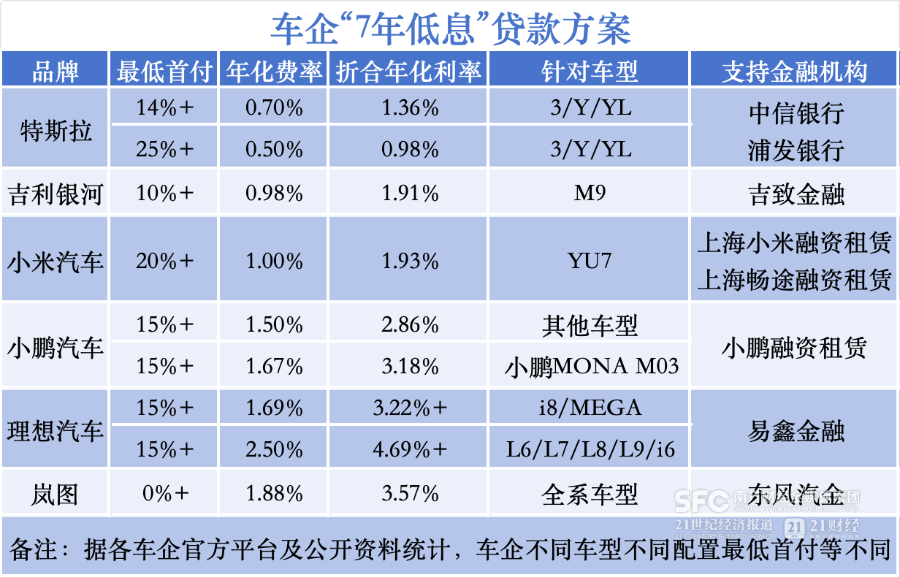
Core Insights - The automotive industry is experiencing a promotional wave of "7-year low-interest" financing plans, initiated by companies like Tesla, Xiaomi, and Xpeng, aimed at stimulating consumer demand and increasing sales before the Chinese New Year [1][2][4] Group 1: Financing Plans Overview - Various automakers have launched "7-year low-interest" loan policies to lower the purchase threshold and stimulate end-consumer demand [4] - The financing plans differ significantly among brands in terms of lending institutions, down payment requirements, funding costs, and model coverage [4][5] - Tesla offers a lower financing cost with a 0.50% annualized fee for a 25%+ down payment option, while other brands like Li Auto have higher costs, reaching up to 2.50% [5][6] Group 2: Consumer Impact - The extended repayment period significantly reduces monthly payment pressure for consumers, but total interest payments will increase [8][10] - For example, under Xiaomi's "7-year low-interest" plan, a consumer would pay a total interest of 14,252.28 yuan over the loan period [8] - Consumers are advised to assess their financial situation carefully, as the longer loan terms may lead to increased financial strain if not managed properly [17] Group 3: Market Dynamics - The push for longer loan terms aligns with national policies aimed at boosting consumption, allowing banks to extend personal consumption loan terms from 5 to 7 years [2] - The automotive market is seeing a shift in consumer preferences, with some opting for higher upfront payments to avoid long-term debt, while others appreciate the lower monthly payments offered by extended loans [10][15] - Concerns about vehicle depreciation and residual values are heightened with longer loan terms, especially for electric vehicles, which may face rapid technological obsolescence [10][11] Group 4: Risk and Regulatory Considerations - Financial institutions face increased risk management challenges due to the longer loan terms and lower down payments, necessitating more stringent consumer assessments [15][16] - The distinction between traditional auto loans and financing leases is crucial, as ownership rights differ significantly, impacting consumer decisions [20][21] - Legal experts emphasize the importance of understanding contract terms related to ownership and repayment obligations in financing leases [22][23]




车企掀7年低息促销潮,特斯拉、小米、小鹏等都在列,月供低至千元
21世纪经济报道· 2026-01-28 00:53
Core Viewpoint - The article discusses the recent trend of car manufacturers offering "7-year low-interest" financing plans to stimulate consumer demand, driven by government policies aimed at boosting consumption [2][5]. Group 1: Financing Trends - Various car manufacturers, including Tesla, Xiaomi, and Xpeng, have launched "7-year low-interest" financing options, breaking away from the traditional 1-5 year loan terms [1][5]. - The financing plans are designed to lower monthly payments and initial down payments, making it easier for consumers to purchase vehicles [1][5]. - The trend is a response to government initiatives encouraging consumer spending, particularly before the Lunar New Year [2][5]. Group 2: Loan Details and Variations - The financing options vary significantly among manufacturers, particularly in terms of lending institutions, down payment requirements, and interest rates [5][6]. - Tesla offers competitive rates, with a 0.50% annual fee translating to an effective annual rate of 0.98% for those making a 25% down payment [6]. - Other brands like Li Auto and Xpeng have higher effective annual rates, ranging from 1.9% to 4.69%, indicating a broader range of financing costs [6]. Group 3: Consumer Perception and Financial Implications - Consumers generally perceive the "7-year low-interest" loans as a way to reduce monthly financial burdens, although total interest payments may increase over the loan term [8][10]. - For example, a Xiaomi YU7 financed over 7 years with a 1% annual fee results in a total interest payment of approximately 14,252.28 yuan [8]. - Some consumers express caution, preferring to pay in full rather than take on long-term debt, indicating a desire to avoid overextending financially [10]. Group 4: Risk and Valuation Concerns - The longer loan terms raise concerns about vehicle depreciation and residual values, especially for electric vehicles, which may not hold their value as well as traditional combustion vehicles [11][14]. - The article notes that the average resale value for electric vehicles is lower than that of traditional vehicles, which could pose risks for consumers taking on long-term loans [11][14]. - The article highlights that the main models offered under these financing plans have relatively high resale values, which may mitigate some concerns [11][13]. Group 5: Consumer Eligibility and Approval Process - The approval process for "7-year low-interest" loans is more stringent, requiring higher credit qualifications compared to shorter-term loans [14][15]. - Financial institutions are increasing their risk assessment criteria, necessitating thorough evaluations of consumers' long-term repayment capabilities [14][15]. - Consumers are advised to assess their financial situations carefully before opting for these extended loan terms to avoid potential rejections or financial strain [15].
车企掀起“7年低息”促销潮
2 1 Shi Ji Jing Ji Bao Dao· 2026-01-28 00:45
Core Viewpoint - In early 2026, automotive companies are launching a "7-year low-interest" promotion, breaking the traditional 1-5 year loan terms, with a focus on low monthly payments and down payments [1] Group 1: Financial Offerings - Companies like Tesla, Xiaomi, Xpeng, Li Auto, Geely Galaxy, and Lantu are introducing "7-year low-interest" financial plans [1] - The annual interest rate varies significantly among brands, with Tesla offering a low-cost loan at 0.50% for a 25% down payment, translating to an effective annual rate of 0.98% [1] - Li Auto has higher costs, with an annual interest rate of 2.50%, equating to an effective annual rate of 4.69% [1] - Other brands like Xpeng, Geely Galaxy, and Xiaomi have effective annual rates ranging from 1.9% to 3.5%, placing them in the mid-range [1] Group 2: Consumer Sentiment - Many consumers express that the "7-year low-interest" car loans significantly reduce monthly payment pressure, with some stating, "A few thousand yuan down and only one or two thousand yuan monthly makes it much easier" [1] - However, some consumers remain cautious, indicating that while monthly payments are lighter, they prefer to pay in full if possible, as relying on a 7-year loan suggests exceeding their normal financial capacity [1]
战略升维,吉利锚定2030年:跻身全球前五大车企、向万亿营收迈进
2 1 Shi Ji Jing Ji Bao Dao· 2026-01-27 22:52
Core Insights - Geely Holding Group is transitioning from a traditional automobile manufacturer to a smart mobility technology company, marking a significant transformation as it celebrates its 40th anniversary [1] - The company aims to achieve a sales target of 6.5 million vehicles and over 1 trillion yuan in revenue by 2030, with a focus on electric vehicles making up approximately 75% of sales [2][3] Sales Performance - In 2025, Geely's total global sales reached 4.116 million vehicles, a 26% increase year-on-year, marking the first time it surpassed 4 million units and ranking seventh among global automakers [1] - New energy vehicle sales reached 2.293 million units, a 58% increase, with a penetration rate of 56% [1] Strategic Goals - Geely's 2030 strategy, titled "One Geely, Fully Leading," includes achieving annual sales of over 6.5 million vehicles and entering the top five global automakers [2] - The company plans to enhance its strategic capabilities through a "six-in-one" approach focusing on brand, technology, vehicle, ecosystem, talent, and sustainable development [3][5] Brand and Market Strategy - Geely is refining its brand matrix, integrating its sub-brands into a cohesive strategy to enhance market positioning and operational efficiency [5][6] - The company aims to strengthen its global brand presence and operational capabilities, leveraging partnerships with international brands like Volvo and Renault [10][12] Technological Advancements - Geely is building a comprehensive technology ecosystem that includes smart driving, electric architecture, and battery technology, aiming for a 75% penetration rate of new energy vehicles by 2030 [7][9] - The company has introduced advanced driving assistance systems and aims to achieve significant improvements in vehicle efficiency and safety standards [8][9] International Expansion - Geely's overseas sales reached 420,000 units in 2025, with plans to expand its international market presence significantly [10] - The company is adopting a localized approach to international expansion, focusing on partnerships and joint ventures to enhance market penetration and reduce trade barriers [11][12]
战略升维 吉利锚定2030年:跻身全球前五大车企、向万亿营收迈进
2 1 Shi Ji Jing Ji Bao Dao· 2026-01-27 16:17
Core Insights - The automotive industry is undergoing a transformation towards electrification and intelligence, with Geely Holdings transitioning from a traditional car manufacturer to a smart mobility technology company [2] - Geely's strategic goals for 2030 include achieving annual sales of over 6.5 million vehicles, revenue exceeding 1 trillion yuan, and becoming one of the top five global automakers, with 75% of sales from new energy vehicles [2][3] Group 1: Strategic Goals and Achievements - In 2025, Geely's total global sales reached 4.116 million vehicles, a 26% increase year-on-year, marking its entry into the top seven global automakers [2] - The company aims for an annual compound growth rate of approximately 9.5% to reach its 2030 sales target of 6.5 million vehicles [4] - Geely's new energy vehicle sales reached 2.293 million units in 2025, a 58% increase, with a penetration rate of 56% [2][7] Group 2: Strategic Framework - Geely's strategy focuses on a "six-in-one" capability system, emphasizing brand, technology, vehicle, ecology, talent, and sustainable development [4][5] - The company is enhancing its brand matrix by integrating its sub-brands into a cohesive global strategy, ensuring clear positioning and complementary strengths [5][6] Group 3: Technological Advancements - Geely is building a comprehensive technology ecosystem covering smart driving, smart cockpit, electronic architecture, battery, and electric drive systems [8][11] - The company has introduced the "Qianli Haohan" smart driving solution, which includes multiple levels of autonomous driving capabilities, with plans for L3 and L4 functionalities [10][12] Group 4: International Expansion - Geely's overseas sales reached 420,000 units in 2025, with over 1200 sales outlets established in 88 countries [12][13] - The company is pursuing a localized approach to international markets, exemplified by its collaboration with Renault in Brazil and the AHTV project in Malaysia [14][15]
2026、1、19-2026、1、25汽车周报:关注业绩支撑的白马反弹,科技与通胀共振-20260127
Shenwan Hongyuan Securities· 2026-01-27 10:29
行 业 及 产 业 行 业 研 究 / 行 业 点 《整车出海、机器人预期强化;同时关注 业绩确定性白马——2026/1/12- 2026/1/18 汽车周报》 2026/01/19 证券分析师 戴文杰 A0230522100006 daiwj@swsresearch.com 联系人 请务必仔细阅读正文之后的各项信息披露与声明 本研究报告仅通过邮件提供给 博时基金 博时基金管理有限公司(researchreport@bosera.com) 使用。1 评 证 券 研 究 报 告 汽车 邵翼 A0230524120001 shaoyi@swsresearch.com 2026 年 01 月 27 日 关注业绩支撑的白马反弹,科技与 通胀共振 看好 ——2026/1/19-2026/1/25 汽车周报 本期投资提示: 行业折扣率环比下行,终端让利减少。我们整理懂车帝报价并加权计算得,2025Q4 行业平均折扣率环比-1.33pct 至 12.28%,其中自主品牌折扣率-1.25pct 至 6.91%,合 资品牌折扣率-2.19pct 至 18.03%,豪华品牌折扣率-1.74pct 至 27.38%。 2025Q4 ...

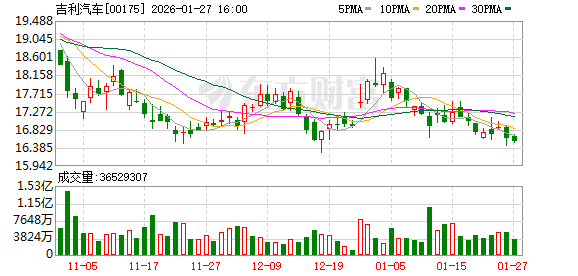
吉利汽车(00175.HK)连续2日回购,累计斥资1.11亿港元
Zheng Quan Shi Bao Wang· 2026-01-27 09:39
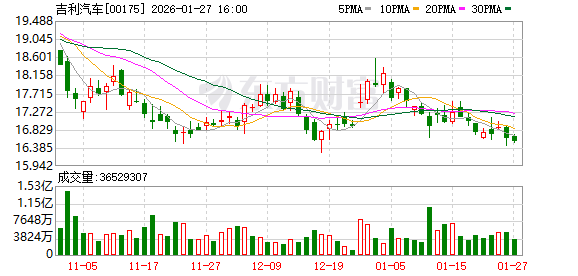
Core Viewpoint - Geely Automobile has been actively repurchasing its shares, indicating a strategy to support its stock price amid recent declines [2] Group 1: Share Buyback Details - On January 27, Geely repurchased 2.29 million shares at a price range of HKD 16.510 to HKD 16.600, totaling HKD 37.87 million [2] - The stock closed at HKD 16.530 on the same day, reflecting a decrease of 0.54%, with a total trading volume of HKD 604 million [2] - Since January 26, the company has conducted buybacks for two consecutive days, acquiring a total of 6.69 million shares for a cumulative amount of HKD 111 million, during which the stock price fell by 2.13% [2] Group 2: Year-to-Date Buyback Summary - Year-to-date, Geely has completed 12 buybacks, acquiring a total of 35.23 million shares for a total expenditure of HKD 598 million [2] - The buyback activity reflects a consistent effort by the company to stabilize its stock price in the market [2] Group 3: Detailed Buyback Transactions - The buyback transactions from January 5 to January 27 include: - January 5: 3.42 million shares at HKD 17.900, totaling HKD 60.31 million [2] - January 6: 0.42 million shares at HKD 17.810, totaling HKD 0.75 million [2] - January 7: 0.34 million shares at HKD 17.650, totaling HKD 5.92 million [2] - January 8: 0.39 million shares at HKD 17.380, totaling HKD 6.76 million [2] - January 9: 0.15 million shares at HKD 17.250, totaling HKD 2.66 million [2] - January 12: 0.90 million shares at HKD 17.150, totaling HKD 15.13 million [2] - January 19: 0.01 million shares at HKD 17.090, totaling HKD 0.17 million [2] - January 20: 0.38 million shares at HKD 16.950, totaling HKD 6.36 million [2] - January 21: 0.24 million shares at HKD 16.810, totaling HKD 3.96 million [2] - January 22: 0.06 million shares at HKD 16.740, totaling HKD 0.95 million [2] - January 26: 0.44 million shares at HKD 16.650, totaling HKD 7.30 million [2] - January 27: 0.23 million shares at HKD 16.600, totaling HKD 3.79 million [2]
【新能源周报】新能源汽车行业信息周报(2026年1月19日-1月25日)
乘联分会· 2026-01-27 09:00
Industry Information - The National Bureau of Statistics projects that by 2025, the production of new energy vehicles (NEVs) will increase by 25.1%, driving a 41.7% growth in lithium-ion power batteries [8][9] - The China Association of Automobile Manufacturers aims to develop high-level group standards for vehicles and key components within 1-2 years [9][11] - Shanghai's 14th Five-Year Plan emphasizes the development of smart connected NEVs through soft and hard collaboration and digital intelligence [11] - By the end of 2025, the total number of electric vehicle charging infrastructure in China is expected to exceed 20 million, marking the largest electric vehicle charging network globally [12][13] - The Ministry of Finance has introduced a loan interest subsidy policy focusing on 14 key industries, including new energy and automotive sectors [14] - By 2025, Guangxi Nanning plans to establish 30,199 public charging piles for NEVs [12] - The Ministry of Commerce anticipates that by the end of 2025, 60% of passenger cars sold will be NEVs [12] Corporate Information - Xpeng Motors reported that 57.2% of X9 Super Range owners are born in the 1990s, with a total of 5,424 units delivered by December 2025, marking a 289.1% year-on-year increase [40] - The Wuling Bingo Pro offers two battery options with a maximum range of 403 kilometers [40] - Ideal Auto's subsidiary has increased its registered capital to 300 million RMB, a 67% increase [11] - NIO has doubled its battery investment, with over 7,309 new batteries added, achieving over 90% progress in battery doubling [40] - The first sample of Hongqi's all-solid-state battery has successfully rolled off the production line [40]
吉利汽车(00175)1月27日斥资3786.53万港元回购229万股
智通财经网· 2026-01-27 08:49
智通财经APP讯,吉利汽车(00175)发布公告,于2026年1月27日,该公司斥资3786.53万港元回购229万 股股份,每股回购价16.51-16.6港元。 ...