TENCENT(00700)

Search documents
微盟集团涨超8% 腾讯加入AI应用入口争夺战 公司加速AI战略布局
Zhi Tong Cai Jing· 2026-01-26 02:34
Core Viewpoint - Weimob Group (02013) saw a significant stock increase of over 8% in early trading, attributed to Tencent's AI platform Yuanbao launching a new Spring Festival activity that includes a cash red envelope giveaway [1] Group 1: Company Performance - As of the report, Weimob's stock price rose by 7.26% to HKD 2.51, with a trading volume of HKD 188 million [1] - Weimob Group is a provider of cloud-based business and marketing solutions in China, focusing on decentralized digital transformation SaaS products and full-link growth services for merchants [1] Group 2: Industry Developments - Tencent's Yuanbao is set to start a new Spring Festival activity on February 1, offering 1 billion cash red envelopes, with individual users eligible for up to HKD 10,000 [1] - The new red envelope activity is seen as Tencent's entry into the competition for consumer-facing AI application super gateways, potentially increasing Yuanbao's download and daily active user numbers [1] - Weimob recently launched its GEO solution, Weimob Xingqi, aiming to capitalize on AI-generated application ecosystems and explore new opportunities in AI traffic applications [1]

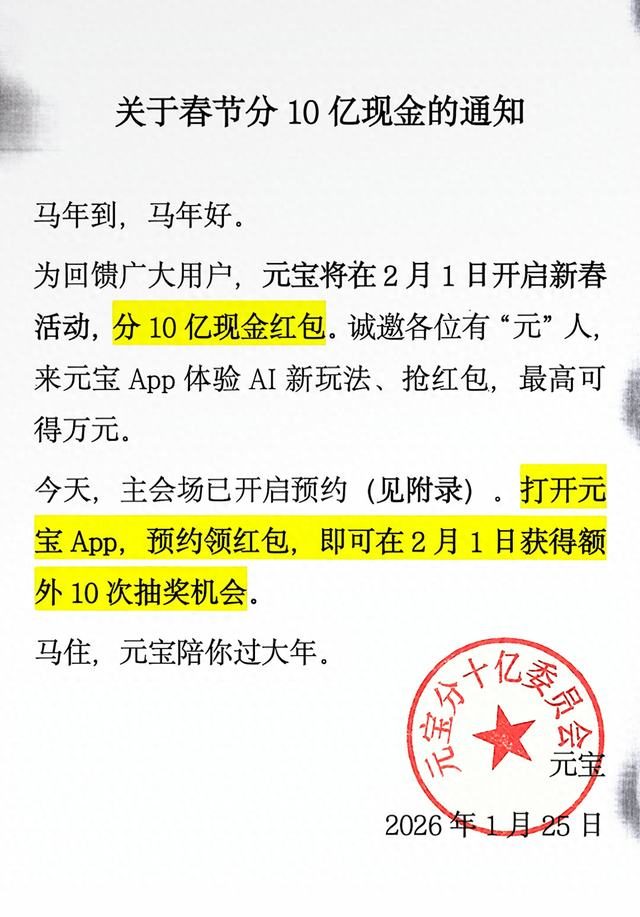
元宝放大招,腾讯春节分10亿现金
Huan Qiu Wang· 2026-01-26 02:29
Group 1 - Tencent announced a cash giveaway of 1 billion yuan during the Spring Festival, starting on February 1, with individual red envelopes worth up to 10,000 yuan [1] - The Yuanbao App has been updated to version 2.55.0, allowing users to reserve a spot for the Spring Festival event, with additional rewards for early reservations [4] - The event features various forms of red envelopes, including cash and a special 10,000 yuan "Little Horse Card," which can be won through daily tasks and sharing with friends [4][6] Group 2 - Tencent is reportedly preparing to launch new AI features within the Yuanbao App, with a new tab labeled "Send" appearing in the product interface [8] - The cash giveaway is reminiscent of Tencent's previous successful campaign during the 2015 Spring Festival, where 500 million yuan was distributed via WeChat, marking a significant milestone for WeChat Pay [8]

港股异动 | 微盟集团(02013)涨超8% 腾讯加入AI应用入口争夺战 公司加速AI战略布局
Zhi Tong Cai Jing· 2026-01-26 01:53
Core Viewpoint - Weimob Group's stock price increased by over 8% in early trading, reflecting positive market sentiment driven by Tencent's new AI platform initiative [1] Group 1: Company Overview - Weimob Group is a cloud-based business and marketing solutions provider in China, focusing on decentralized digital transformation SaaS products and full-chain growth services [1] - Tencent is both a shareholder of Weimob Group and a key service provider within the Tencent WeChat ecosystem [1] Group 2: Recent Developments - Tencent's AI platform, Yuanbao, announced a new Spring Festival activity starting February 1, offering 1 billion cash red envelopes, with individual users eligible for up to 10,000 yuan [1] - The red envelope activity is expected to significantly boost Yuanbao's download volume and daily active user count, indicating an escalation in competition among large model vendors for AI application entry points [1] Group 3: Strategic Focus - Weimob Group recently launched the GEO solution, Weimob Xingqi, aiming to capitalize on AI-generated application ecosystems and explore new opportunities in AI traffic applications [1]
互联网传媒行业25Q4基金持仓
GF SECURITIES· 2026-01-26 01:28
Investment Rating - The industry investment rating is "Buy" [2] Core Insights - The report indicates a decrease in the heavy allocation ratio of A-share media stocks by public funds, with a concentration decline [4] - The report highlights a shift in fund allocation towards the news publishing sector, while gaming and advertising sectors saw reductions [4] - The report suggests continued focus on segments with favorable market conditions and AI industry logic, particularly in gaming and IP derivatives [4] Summary by Sections A-share Media Fund Heavy Allocation Ratio Decline - In Q4 2025, the heavy allocation ratio for A-share media stocks was 1.32%, down from 2.56% in Q3 2025, a decrease of 1.24 percentage points [13] - For A+H shares, the allocation ratio was 4.41%, down from 5.99%, a decrease of 1.58 percentage points [13] Changes in Fund Allocation by Sector - The gaming sector's allocation decreased from 67.34% in Q3 2025 to 65.20% in Q4 2025, a drop of 2.14 percentage points [27] - The advertising sector's allocation fell from 24.35% to 22.41%, a decrease of 1.94 percentage points [27] - The news publishing sector saw an increase in allocation from 1.93% to 6.29%, an increase of 4.35 percentage points [27] Concentration of A-share Media Heavy Holdings - The top five heavy holdings in the A-share media sector accounted for 78.48% of the total heavy holdings value, down 6.57 percentage points [42] - The top ten heavy holdings accounted for 88.04%, down 4.93 percentage points [42] Hong Kong Internet Sector Fund Holdings - In Q4 2025, companies like DaMai Entertainment and Meituan-W saw increased holdings, while Kuaishou-W and Pop Mart experienced reductions [4] Investment Recommendations - The report recommends focusing on segments with favorable market conditions and AI applications, particularly in gaming and long video sectors [4]





科技产业链显现多元化机会 傅鹏博、李晓星四季报调仓路径分化明显
Zhong Guo Jing Ji Wang· 2026-01-26 00:37
Core Insights - The article highlights the contrasting investment strategies of two prominent fund managers, Fu Pengbo and Li Xiaoxing, as they adjust their portfolios in response to market conditions and their investment philosophies [1][2][3]. Group 1: Fu Pengbo's Strategy - Fu Pengbo significantly reduced holdings in major stocks like CATL and Tencent, decreasing positions by 23% and 18% respectively, while increasing investments in hard tech companies such as Maiwei and Cambrian [1][2]. - The total assets under management for Fu's fund reached 31.2 billion yuan, maintaining a high stock position of 92% [1]. - Fu's rationale centers on the belief that the global tech competition will focus on critical manufacturing sectors with core technological barriers, suggesting a shift from platform companies to manufacturing firms [2][3]. Group 2: Li Xiaoxing's Strategy - In contrast, Li Xiaoxing increased his stakes in internet platform companies, raising Tencent's position from 1.8 billion yuan to 2.6 billion yuan, and Alibaba by 35% to 1.9 billion yuan [3]. - Li's fund size is 28.5 billion yuan, and he believes that the internet sector is undervalued due to regulatory pressures and economic expectations, predicting a recovery in 2026 [3]. - His strategy reflects a dual focus on consumer and technology sectors, with significant investments in companies like Yili [3]. Group 3: Market Implications - The divergence in strategies between the two fund managers illustrates a broader trend in the public fund industry, where funds focusing on electronics outperformed those in computing sectors [4]. - The article suggests that the technology sector presents diverse opportunities across various stages of the supply chain, from semiconductor equipment to AI chips and platform applications [5]. - It emphasizes the importance of selecting investments based on valuation and growth potential, while also noting the liquidity constraints faced by larger funds [5][6].
智通港股沽空统计|1月26日
智通财经网· 2026-01-26 00:25
Group 1 - The top short-selling ratios are led by AIA Group (81299) and JD Health (86618) at 100.00%, followed by Baidu Group (89888) at 95.46% [1][2] - The highest short-selling amounts are recorded for Pop Mart (09992) at 1.3 billion, Alibaba (09988) at 1.26 billion, and Xiaomi Group (01810) at 1.064 billion [1][2] - The highest deviation values are for Baidu Group (89888) at 62.11%, Shenzhen Expressway (00548) at 37.02%, and SenseTime (80020) at 34.65% [1][2] Group 2 - The top ten short-selling ratios include AIA Group (81299) at 100.00%, JD Health (86618) at 100.00%, and Baidu Group (89888) at 95.46% [2] - The top ten short-selling amounts show Pop Mart (09992) leading with 1.3 billion, followed by Alibaba (09988) with 1.26 billion, and Xiaomi Group (01810) with 1.064 billion [2] - The top ten deviation values highlight Baidu Group (89888) at 62.11%, Shenzhen Expressway (00548) at 37.02%, and SenseTime (80020) at 34.65% [2]



腾讯宣布:春节发10亿元现金,单个红包最高达1万元;百度:发5亿现金;荣耀与泡泡玛特联名手机开售丨邦早报
创业邦· 2026-01-26 00:10
【腾讯宣布:春节发 10 亿元现金!单个红包最高达 1 万元,可直接提现到微信】 1 月 25 日,腾 讯宣布,将在 2 月 1 日上线春节活动,用户上元宝 App 分 10 亿现金红包,单个红包金额可达万 元。 App 内点击主页的预约卡片即可进入春节会场预约页面,提前预约的用户将在 2 月 1 日活动开 启当天,额外获得 10 次抽奖次数。 腾讯方面相关人士透露,上述红包金额可以从元宝直接提现到微信。(每日经济新闻) 【百度:发5亿现金】 1月25日 ,百度发布文心助手关于春节现金红包活动的通知。自1月26日至3 月12日,用户在百度APP使用文心助手,有机会瓜分5亿现金红包,最高可获得1万元奖励。此外, 完整早报音频,请点击标题下方小耳机收听 百度APP还将作为首席AI合作伙伴合作《2026北京广播电视台春节联欢晚会》。 (凤凰网) 【雷军:新一代小米 SU7 争取春节前部分样车进店】 1 月 25 日,小米创办人、董事长兼 CEO 雷 军发文表示,新一代 SU7 卡布里蓝实车非常漂亮,争取春节前部分样车能够进店,到时候大家就可 以到店感受。现在已经开始小订。 ( 新浪财经) 【苹果客服回应 iPhon ...



智通港股通资金流向统计(T+2)|1月26日
智通财经网· 2026-01-25 23:38
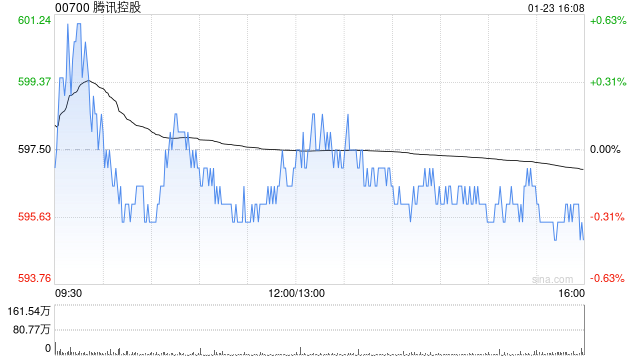
1月21日,盈富基金(02800)、恒生中国企业(02828)、阿里巴巴-W(09988)南向资金净流入金额位 列市场前三,分别净流入41.45 亿、18.13 亿、10.68 亿 中国移动(00941)、腾讯控股(00700)、江西铜业股份(00358)南向资金净流出金额位列市场前 三,分别净流出-9.50 亿、-2.76 亿、-2.27 亿 | 股票名称 | 净流出(元)↓ | 净流出比 | 收盘价 | | --- | --- | --- | --- | | 中国移动(00941) | -9.50 亿 | -27.81% | 79.200(-0.13%) | | 腾讯控股(00700) | -2.76 亿 | -2.87% | 602.500(+0.25%) | | 江西铜业股份(00358) | -2.27 亿 | -22.46% | 45.360(-0.22%) | | 优必选(09880) | -1.87 亿 | -14.41% | 145.000(+4.02%) | | 信达生物(01801) | -1.76 亿 | -22.00% | 82.700(-0.60%) | | 中国宏桥(01378) ...


春节抢红包!腾讯元宝将发放10亿元 百度将发放5亿元
Zhong Guo Zheng Quan Bao· 2026-01-25 23:38
热点栏目 自选股 数据中心 行情中心 资金流向 模拟交易 客户端 炒股就看金麒麟分析师研报,权威,专业,及时,全面,助您挖掘潜力主题机会! 1月25日,腾讯元宝、百度App分别宣布了其春节红包派发计划。 当日,腾讯元宝微信公众号发布《关于春节分10亿现金的通知》称,将在2月1日上线春节活动,用户上元宝App分10亿元现金红包,单个红包金额可达万 元。 来源:元宝微信公众号 据介绍,用户可于1月25日将元宝App更新到2.55.0 以上版本,点击主页的预约卡片即可进入春节会场预约页面,提前预约的用户将在2月1日活动开启当 天,额外获得10次抽奖次数。 来源:元宝App页面截图 腾讯元宝的派红包活动设置了万元小马卡、现金红包和分享红包等红包形态,用户每天上元宝App都能领现金红包,通过做任务可抽更多红包,并有几率 抽中限量100张的价值1万元现金小马卡。分享红包支持转发给微信、QQ好友和社群。 除了将发放10亿元现金红包,腾讯还在酝酿AI大招。据腾讯内部人士透露,元宝即将上线全新玩法,已开启内测邀约,官方公布的产品界面图中已悄然 新增一个名为"派"的入口。 值得一提的是,2015年春晚,腾讯通过微信"摇一摇"形式 ...
【早报】锋龙股份、嘉美包装两牛股今起停牌核查;三星闪存,涨价100%
财联社· 2026-01-25 23:11
Industry News - Samsung Electronics raised the supply price of NAND flash memory by over 100% in the first quarter of this year, significantly exceeding market expectations and highlighting the severe supply-demand imbalance in the semiconductor market [5]. - The global first automated production line for robotic joints by Yiyou Technology has been launched in Pudong, marking a critical breakthrough in the mass production of core components for humanoid robots, which accelerates their large-scale application [5]. - The China Securities Regulatory Commission (CSRC) has issued new regulations on the performance comparison benchmarks for publicly offered securities investment funds, focusing on four key areas: precise profiling, full-process supervision, linking with compensation, and enhancing information transparency [3]. - The CSRC disclosed its first fine of 2026, imposing a total penalty of 1.022 billion yuan on Yu Han for manipulating the securities market, along with a three-year ban from the securities market [3][5]. Company News - Fenglong Co. announced a stock price increase of 405.74% from December 25, 2025, to January 23, 2026, and will be suspended from trading for verification starting January 26 [6]. - Jiamei Packaging reported a stock price increase of 408% from December 17, 2025, to January 23, 2026, and will also be suspended from trading for verification starting January 26 [9]. - Shannon Chip announced a projected net profit increase of 82%-135% year-on-year for 2025, driven by increased sales of enterprise storage products [7]. - Chip Origin Co. expects a net loss of 449 million yuan for 2025, although the loss is narrowing [7]. - Dongxin Co. announced a projected net loss of 174 million to 214 million yuan for 2025 [9].