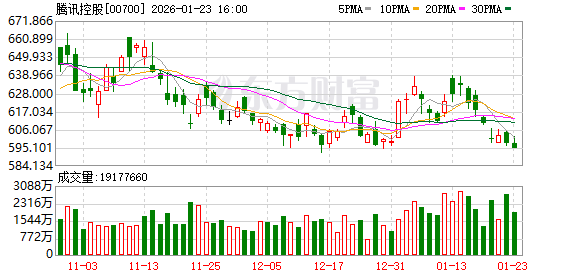
TENCENT(00700)

Search documents
腾讯宣布:春节发10亿元现金,单个红包最高达1万元;百度:发5亿现金;荣耀与泡泡玛特联名手机开售丨邦早报
创业邦· 2026-01-26 00:10
【腾讯宣布:春节发 10 亿元现金!单个红包最高达 1 万元,可直接提现到微信】 1 月 25 日,腾 讯宣布,将在 2 月 1 日上线春节活动,用户上元宝 App 分 10 亿现金红包,单个红包金额可达万 元。 App 内点击主页的预约卡片即可进入春节会场预约页面,提前预约的用户将在 2 月 1 日活动开 启当天,额外获得 10 次抽奖次数。 腾讯方面相关人士透露,上述红包金额可以从元宝直接提现到微信。(每日经济新闻) 【百度:发5亿现金】 1月25日 ,百度发布文心助手关于春节现金红包活动的通知。自1月26日至3 月12日,用户在百度APP使用文心助手,有机会瓜分5亿现金红包,最高可获得1万元奖励。此外, 完整早报音频,请点击标题下方小耳机收听 百度APP还将作为首席AI合作伙伴合作《2026北京广播电视台春节联欢晚会》。 (凤凰网) 【雷军:新一代小米 SU7 争取春节前部分样车进店】 1 月 25 日,小米创办人、董事长兼 CEO 雷 军发文表示,新一代 SU7 卡布里蓝实车非常漂亮,争取春节前部分样车能够进店,到时候大家就可 以到店感受。现在已经开始小订。 ( 新浪财经) 【苹果客服回应 iPhon ...





智通港股通资金流向统计(T+2)|1月26日
智通财经网· 2026-01-25 23:38
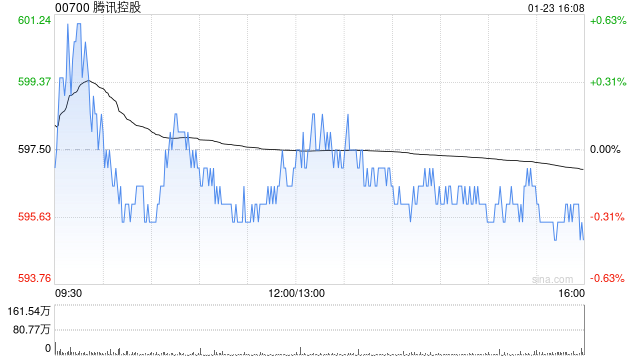
1月21日,盈富基金(02800)、恒生中国企业(02828)、阿里巴巴-W(09988)南向资金净流入金额位 列市场前三,分别净流入41.45 亿、18.13 亿、10.68 亿 中国移动(00941)、腾讯控股(00700)、江西铜业股份(00358)南向资金净流出金额位列市场前 三,分别净流出-9.50 亿、-2.76 亿、-2.27 亿 | 股票名称 | 净流出(元)↓ | 净流出比 | 收盘价 | | --- | --- | --- | --- | | 中国移动(00941) | -9.50 亿 | -27.81% | 79.200(-0.13%) | | 腾讯控股(00700) | -2.76 亿 | -2.87% | 602.500(+0.25%) | | 江西铜业股份(00358) | -2.27 亿 | -22.46% | 45.360(-0.22%) | | 优必选(09880) | -1.87 亿 | -14.41% | 145.000(+4.02%) | | 信达生物(01801) | -1.76 亿 | -22.00% | 82.700(-0.60%) | | 中国宏桥(01378) ...


春节抢红包!腾讯元宝将发放10亿元 百度将发放5亿元
Zhong Guo Zheng Quan Bao· 2026-01-25 23:38
热点栏目 自选股 数据中心 行情中心 资金流向 模拟交易 客户端 炒股就看金麒麟分析师研报,权威,专业,及时,全面,助您挖掘潜力主题机会! 1月25日,腾讯元宝、百度App分别宣布了其春节红包派发计划。 当日,腾讯元宝微信公众号发布《关于春节分10亿现金的通知》称,将在2月1日上线春节活动,用户上元宝App分10亿元现金红包,单个红包金额可达万 元。 来源:元宝微信公众号 据介绍,用户可于1月25日将元宝App更新到2.55.0 以上版本,点击主页的预约卡片即可进入春节会场预约页面,提前预约的用户将在2月1日活动开启当 天,额外获得10次抽奖次数。 来源:元宝App页面截图 腾讯元宝的派红包活动设置了万元小马卡、现金红包和分享红包等红包形态,用户每天上元宝App都能领现金红包,通过做任务可抽更多红包,并有几率 抽中限量100张的价值1万元现金小马卡。分享红包支持转发给微信、QQ好友和社群。 除了将发放10亿元现金红包,腾讯还在酝酿AI大招。据腾讯内部人士透露,元宝即将上线全新玩法,已开启内测邀约,官方公布的产品界面图中已悄然 新增一个名为"派"的入口。 值得一提的是,2015年春晚,腾讯通过微信"摇一摇"形式 ...
【早报】锋龙股份、嘉美包装两牛股今起停牌核查;三星闪存,涨价100%
财联社· 2026-01-25 23:11
Industry News - Samsung Electronics raised the supply price of NAND flash memory by over 100% in the first quarter of this year, significantly exceeding market expectations and highlighting the severe supply-demand imbalance in the semiconductor market [5]. - The global first automated production line for robotic joints by Yiyou Technology has been launched in Pudong, marking a critical breakthrough in the mass production of core components for humanoid robots, which accelerates their large-scale application [5]. - The China Securities Regulatory Commission (CSRC) has issued new regulations on the performance comparison benchmarks for publicly offered securities investment funds, focusing on four key areas: precise profiling, full-process supervision, linking with compensation, and enhancing information transparency [3]. - The CSRC disclosed its first fine of 2026, imposing a total penalty of 1.022 billion yuan on Yu Han for manipulating the securities market, along with a three-year ban from the securities market [3][5]. Company News - Fenglong Co. announced a stock price increase of 405.74% from December 25, 2025, to January 23, 2026, and will be suspended from trading for verification starting January 26 [6]. - Jiamei Packaging reported a stock price increase of 408% from December 17, 2025, to January 23, 2026, and will also be suspended from trading for verification starting January 26 [9]. - Shannon Chip announced a projected net profit increase of 82%-135% year-on-year for 2025, driven by increased sales of enterprise storage products [7]. - Chip Origin Co. expects a net loss of 449 million yuan for 2025, although the loss is narrowing [7]. - Dongxin Co. announced a projected net loss of 174 million to 214 million yuan for 2025 [9].

全球大公司要闻 | 苹果降价促销,AI巨头春节“撒钱”
Wind万得· 2026-01-25 22:43
Group 1 - Tencent and Baidu are distributing significant cash rewards during the Spring Festival, with Tencent offering 1 billion yuan in cash red envelopes and Baidu providing 500 million yuan in cash rewards through its app [2] - Apple has initiated a major discount on the iPhone Air 256GB model, reducing the price from 7999 yuan to 5499 yuan, marking the largest price drop for this model in history [2] - Nvidia's CEO Jensen Huang is visiting China to deepen cooperation in AI technology, while the company faces production halts for certain components [3] Group 2 - Xiaomi's CEO Lei Jun announced that the new generation of Xiaomi SU7 is expected to have sample cars available before the Spring Festival [5] - NIO's subsidiary has achieved 91.36% progress in its battery doubling plan, with over 7309 new batteries invested as of January 24 [5] - Hunan Gold plans to acquire 100% equity of two companies to enhance its competitiveness in the precious metals refining and processing sector [5] Group 3 - Microsoft is addressing issues with Windows 11 that have affected basic applications, while also expanding its gaming strategy to include Xbox games on PS5 and Switch [8] - Amazon's low Earth orbit satellites are facing criticism for their brightness affecting astronomical observations, and the company is experiencing a decline in order volume [8] - The U.S. government plans to invest 1.6 billion USD in a rare earth company to secure critical mineral supplies, acquiring a 10% stake [8] Group 4 - Samsung Electronics plans to increase NAND flash supply prices by 100% in Q1 2026, reflecting ongoing tensions in the semiconductor market [10] - Toyota maintains its leading position in the Thai automotive market while facing challenges in electric vehicle transitions in China [10] - SK Hynix aims to launch high bandwidth memory samples by 2026 to meet the demands of AI and data center high-performance computing [10] Group 5 - Volkswagen's CEO stated that plans to build an Audi factory in the U.S. are contingent on tariff reductions, while its joint venture plans to launch 13 new models by 2026 [12] - BMW is implementing a second official price adjustment in 2026, with some models seeing price reductions exceeding 60,000 yuan [12] - LVMH is increasing investments in the beauty sector to strengthen its position in the high-end beauty market [12]


陆家嘴财经早餐2026年1月26日星期一
Wind万得· 2026-01-25 22:43
Group 1 - The Federal Reserve is set to announce its January interest rate decision on January 30, with significant implications for global markets [3] - Major tech companies, including Apple and Microsoft, are expected to release their earnings reports during this "super earnings week" [5] - The North Exchange has seen a surge in new IPO applications, with the total subscription amount for new stocks exceeding 1 trillion yuan [8] Group 2 - Beijing has set a GDP growth target of around 5% for 2026, with a focus on new growth areas such as AI, 6G, and quantum technology [4] - Jiangsu province plans to continue promoting large-scale equipment upgrades and implement a nationwide subsidy standard for replacing old consumer goods [4] - Zhejiang province will introduce 23 measures to stimulate consumption during the Spring Festival, focusing on six key areas: food, accommodation, transportation, tourism, shopping, and entertainment [4] Group 3 - Foreign public funds are maintaining a high allocation strategy, with a focus on quality tech assets in the A-share market for 2026 [6] - The issuance of equity funds has rebounded significantly, with over 700 billion yuan raised in new funds this year [6] - The A-share market is expected to see structural opportunities, particularly in technology and resource sectors [7] Group 4 - The North Exchange has reached a total of 290 listed companies with a market capitalization nearing 1 trillion yuan [8] - The new stock issuance results for Meidele show a subscription amount of 10.5886 billion yuan, marking a significant milestone for the North Exchange [8] - Companies like Aixin Yuanzhi and Kangnuo Biopharmaceuticals are preparing for IPOs, indicating a growing interest in the semiconductor and biopharmaceutical sectors [8] Group 5 - The new train operation schedule in China will increase the number of scheduled passenger trains to 12,130, enhancing transportation capacity [11] - The release of new standards for clean and efficient coal utilization is expected to promote the use of coal as a raw material [12] - The Chongqing automotive replacement subsidy program has opened for applications, with a total of 185 million yuan allocated for the first batch [12]


“陈小群”概念股炒作利益链曝光;2026春晚指定具身大模型机器人;腾讯宣布春节发10亿现金!贾国龙发声:不再打造个人IP丨每经早参
Mei Ri Jing Ji Xin Wen· 2026-01-25 22:01
Group 1 - The National Development and Reform Commission (NDRC) has issued guidelines for the sustainable development of intercity railways, stating that new projects should have a minimum bidirectional passenger flow density of 15 million trips per year [5] - New standards for the coal industry have been released to promote clean and efficient utilization, aiming to elevate coal products from primary fuels to high-value products [6] - Beijing's new energy vehicle ownership has surpassed 1.3 million, with over 80% of vehicles meeting the "National V" emission standards [8] Group 2 - Tencent announced a cash giveaway of 1 billion yuan for the upcoming Spring Festival, aimed at increasing user engagement on its Yuanbao app [13] - Baidu plans to distribute 500 million yuan in cash through its Wenxin assistant during the Spring Festival, enhancing user stickiness [14] - China Southern Airlines will increase its flights on the Guangzhou-Istanbul route from three to ten weekly, capitalizing on Turkey's visa-free policy [16] Group 3 - Samsung Electronics has raised the price of its NAND flash memory by over 100% for the first quarter, indicating a strong demand driven by the AI boom [23] - The first automated production line for robot joints has been launched by Yiyou Technology, marking a significant step towards mass production in the humanoid robot sector [20] - The "Chen Xiaoqun" concept stock has been under scrutiny for its speculative trading practices, highlighting the influence of algorithm-driven trading in the A-share market [9]



外资公募坚定看多A股 布局科技赛道
Zheng Quan Ri Bao· 2026-01-25 17:16
Group 1 - The core viewpoint is that foreign public funds have significantly increased their investments in China's technology sector, with many products achieving over 50% net value growth in 2025, driven by a focus on leading tech companies like Zhongji Xuchuang, Hanwha, and Xinyisheng [1][2] - In 2025, several foreign public fund products, such as BlackRock Advanced Manufacturing One-Year Holding Mixed A and Allianz China Select Mixed A, reported net value growth rates exceeding 50%, despite a fourth-quarter pullback in A-share tech growth stocks [2][3] - Foreign public funds maintained a "neutral to high" position in the fourth quarter of 2025, focusing on technology sectors including AI, high-end manufacturing, and low-carbon growth [3] Group 2 - Foreign public funds are optimistic about the A-share market for 2026, believing that high-quality tech assets will continue to lead, with a preference for "overweight equities" in their portfolio strategies [4] - Fund managers from Allianz and BlackRock expressed that A-shares are more attractive compared to RMB bonds, indicating a sustained focus on equities while dynamically adjusting their overweight positions based on market conditions [4] - The emphasis on technology assets as a core investment theme is expected to yield significant excess returns in 2026, as foreign public funds increase their allocation to Chinese tech assets [4]



未来的机会在这里!任泽平带你看前沿科技
泽平宏观· 2026-01-25 16:06
以下文章来源于泽平宏观商学 ,作者泽平宏观商学 泽平宏观商学 . 前沿科技企业实战研学 读万卷书行万里路 2025 年 12 月 用心打造最有品质的实战研学。读万卷书,行万里路。把教室搬到世界上最优秀的企业, 请最优秀的企业家和科学家讲课。顺势而为,把握机遇。正心正念,坚持做长期正确的 事! 我们期待与更多的企业家朋友们携手同行,共赴 2026 实战研学之旅! 泽 ZEP 平 INGM 宏 ACR 观 O RE 商 SEAR 学 CH 国内头部智驾科技企业 人形机器人 年研学安 型成 11月4日-11日 1-6月日程安排 · 2月27日 北京 洛杉矶、拉斯维加斯、旧金山 CES、英伟达、特斯拉 谷歌、罗宾汉、playground 斯坦福大学、伯克利大学 3月27日-28日 苏州 追觅科技、魔法原子、灵猴机器人 闭门投研会-2026 Al 的中国力量(一) 3月29日 上海 长三角校友会 4月20日-21日 香港 2026 香港 Web3 嘉年华 复星财富、HashKey、港交所 5月22日-23日 1151 11:47:50 深圳 华为、新凯来、江波龙、莫界科技 闭门投研会—2026 Al 的中国力量(二) ...


狂“撒钱”!腾讯发10亿现金,百度也宣布要发5亿
Mei Ri Jing Ji Xin Wen· 2026-01-25 15:00
Group 1 - Baidu announced a cash red envelope activity for the Spring Festival, offering a total of 500 million yuan in cash rewards from January 26 to March 12, with individual rewards up to 10,000 yuan [2][4] - The Baidu APP will serve as the chief AI partner for the 2026 Beijing Radio and Television Spring Festival Gala [2][3] Group 2 - Tencent's Yuanbao will launch a similar Spring Festival activity on February 1, distributing 1 billion yuan in cash red envelopes, with users able to gain extra lottery chances by pre-registering [7][8] - Yuanbao's activity includes various forms of red envelopes, such as cash rewards and shareable red envelopes, allowing users to earn rewards daily and participate in tasks for additional chances [12]