TENCENT(00700)

Search documents
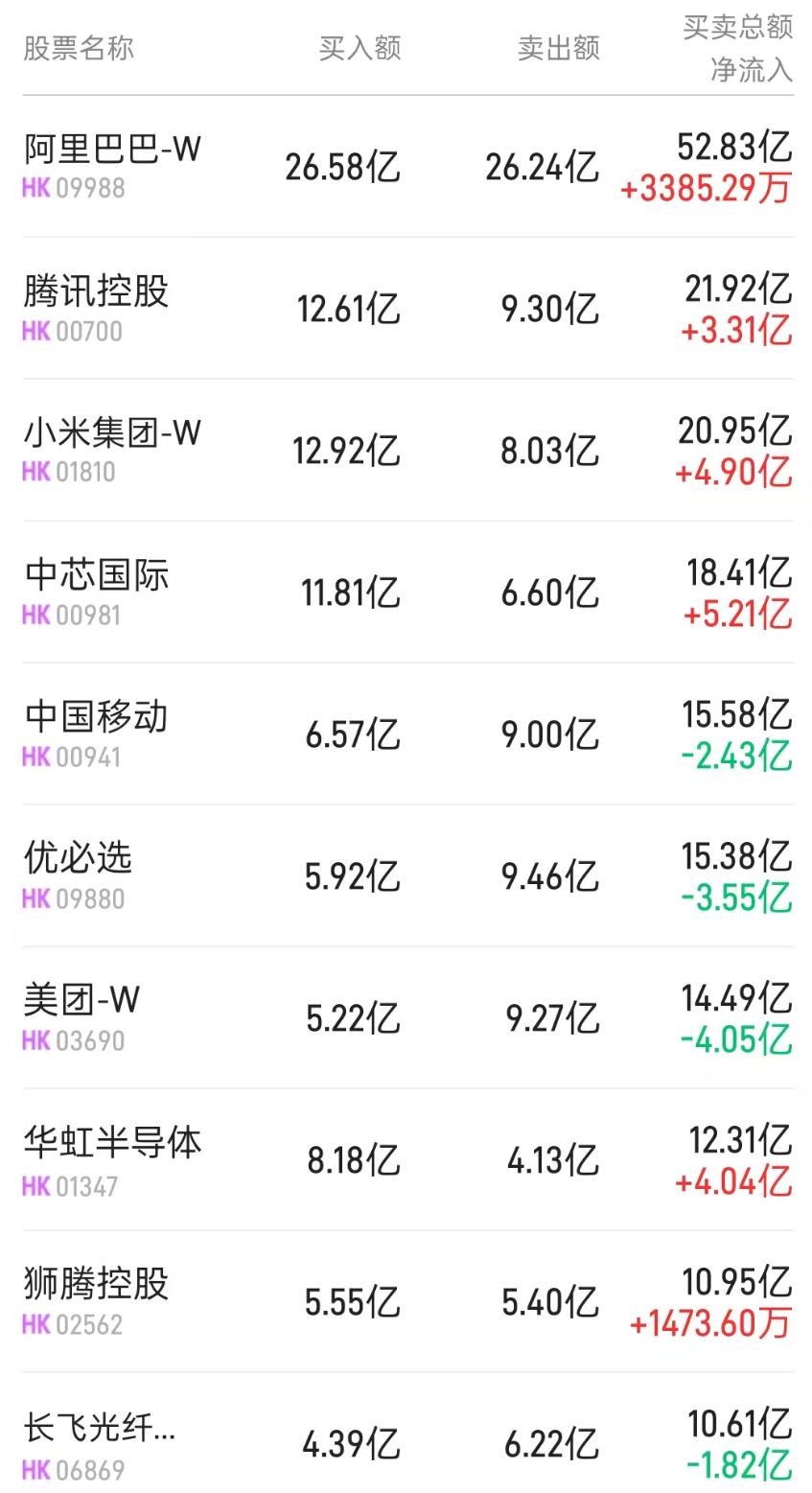
北水动向|北水成交净买入22.92亿 内资继续加仓芯片股 增持中芯国际(00981)超4亿港元
智通财经网· 2026-01-19 10:00
Group 1: Market Overview - Northbound trading recorded a net buy of HKD 22.92 billion, with HKD 30.42 billion net buying through Shanghai Stock Connect and HKD 7.5 billion net selling through Shenzhen Stock Connect [1] - The most bought stocks by northbound investors included SMIC (00981), Hua Hong Semiconductor (01347), and Tencent (00700), while China Mobile (00941) saw the highest net sell [1] Group 2: Individual Stock Performance - Alibaba (09988) had a net inflow of HKD 26.58 billion in buying and HKD 26.24 billion in selling, totaling HKD 52.83 billion [2] - Tencent Holdings (00700) recorded a net buy of HKD 12.61 billion against HKD 9.30 billion in selling, resulting in a total of HKD 21.92 billion [2] - Xiaomi Group (01810) saw a net buy of HKD 12.92 billion with HKD 8.03 billion in selling, totaling HKD 20.95 billion [2] - SMIC (00981) had a net buy of HKD 11.81 billion and HKD 6.60 billion in selling, resulting in a total of HKD 18.41 billion [2] - China Mobile (00941) experienced a net sell of HKD 6.57 billion against HKD 9.00 billion in selling, totaling HKD 15.58 billion [2] Group 3: Analyst Insights - TSMC raised its capital expenditure guidance for 2026 to USD 52-56 billion, indicating strong long-term demand driven by AI [4] - DRAM prices are on the rise, with certain DDR4 models seeing weekly increases exceeding 12%, and Micron noted that AI demand now accounts for 50-60% of the DRAM market [4] - Nomura forecasts Tencent's revenue to grow by 12% year-on-year to RMB 193.5 billion, with non-IFRS net profit expected to rise by 15% to RMB 63.9 billion [5] - Alibaba's new app, Qianwen, integrates various services within its ecosystem, enhancing its competitive edge in AI and consumer markets [5] - Bubble Mart (09992) is projected to have multiple growth drivers, including monetization of existing IPs and new IP launches targeting overseas markets [6]





南向资金 | 中芯国际获净买入4.62亿港元
Di Yi Cai Jing· 2026-01-19 09:50
Group 1 - The net inflow of southbound funds today amounted to 2.292 billion HKD [1] - The top three companies with net inflows were SMIC, Hua Hong Semiconductor, and Tencent Holdings, with net purchases of 462 million HKD, 393 million HKD, and 273 million HKD respectively [1] - On the other hand, China Mobile, UBTECH, and Meituan-W experienced net outflows of 600 million HKD, 517 million HKD, and 287 million HKD respectively [1]

OpenAI及谷歌等巨头齐攻AI医疗,健康 160(2656.HK) 与京东健康(6618.HK)等国内龙头如何打造中国方案
Zhong Jin Zai Xian· 2026-01-19 09:16
Core Insights - The global tech giants are intensifying their efforts in the AI healthcare sector, with Chinese companies adopting pragmatic approaches that are becoming essential [1] - The AI healthcare market in China is experiencing rapid growth, driven by an aging population and a structural imbalance in quality medical resources [7] Group 1: Major Players and Their Strategies - OpenAI's ChatGPT Health focuses on consumer engagement, allowing users to upload medical records for personalized health advice, processing over 230 million health interactions weekly [2] - Google has launched the MedGemma 1.5 model, which operates offline and supports 3D scanning and medical text analysis, with a speech-to-text error rate of only 5.2% [2] - Anthropic targets the enterprise market with Claude for Healthcare, emphasizing privacy and compliance, and has partnered with institutions like Boston Children's Hospital [2] Group 2: Chinese Companies' Developments - Health 160 has connected over 44,800 healthcare institutions and developed an AI health management system that covers the entire patient journey, achieving a content click-through rate increase of 90% [3][4] - JD Health aims to evolve AI from a tool to a core engine for personalized health management, launching the "Zhi Yi" AI for evidence-based medicine [5][6] - JD Health's AI initiatives include a comprehensive health service matrix and specialized systems for cancer treatment, showcasing the potential of AI in personalized medicine [6] Group 3: Market Trends and Challenges - The AI medical device market in China is projected to grow from 292 million yuan in 2020 to 24.2 billion yuan by 2025, highlighting the sector's rapid expansion [7] - The competitive focus in AI healthcare is shifting from utility to stable, compliant, and sustainable implementation, with ecological layouts being crucial for achieving these goals [7] - Challenges include data privacy, ethical standards, and the need for improved data quality and interoperability among healthcare systems [8] Group 4: Future Directions - The future of AI healthcare in China will see a complementary relationship between major players' comprehensive strategies and targeted niche developments [9] - As technology matures, AI models are expected to further empower the healthcare industry, shifting the focus from treatment to proactive health management [9]


腾讯控股“五连阴”,多家投行发报告看好却连跌三天
Di Yi Cai Jing Zi Xun· 2026-01-19 08:58
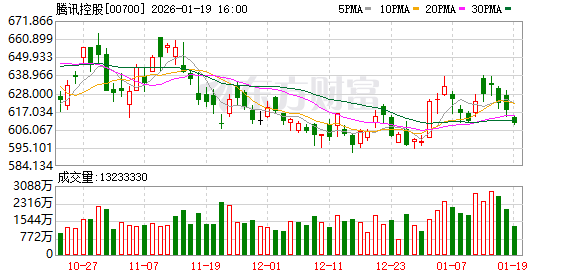
Core Viewpoint - Tencent Holdings has experienced a downward trend in stock price after reaching a peak of 639 HKD on January 13, 2026, with a significant drop below 610 HKD recently, indicating a potential profit-taking phase by investors [2][3]. Group 1: Stock Performance - Tencent's stock price has shown a "lower high" pattern since reaching 683 HKD on October 2, 2025, with subsequent peaks at 662 HKD and 639 HKD, reflecting a technical downtrend [2]. - Despite a cumulative increase of over 200% in stock price since October 2022, recent performance has lagged behind the Hang Seng Index, suggesting a short-term consolidation phase [2][5]. - The stock has faced selling pressure even after positive reports from multiple investment banks, indicating a cautious market sentiment [3][4]. Group 2: Business Developments - On January 15, 2026, Tencent reported significant growth in its WeChat mini-programs, with usage exceeding 5 billion times globally, and a 320% increase in transaction volume for WeChat stores from August to December 2025 [3]. - Investment banks like CICC and UBS have maintained positive ratings for Tencent, with target prices set at 700 HKD and 780 HKD respectively, reflecting confidence in the company's long-term growth prospects [3][4]. - UBS highlighted Tencent's unique advantages in AI applications due to its large user base and robust mini-program ecosystem, bolstered by the recent hiring of a new AI head from OpenAI [4]. Group 3: Share Buybacks - Tencent has been actively repurchasing shares, with over 40 million shares bought back at a cost exceeding 25 billion HKD since November 2025, signaling confidence in its long-term value [5]. - The company's buyback strategy is viewed favorably by international investors, who prefer buybacks over dividends to avoid tax costs, aligning with Tencent's shareholder return policies [6].

大行评级|大摩:预计今年AI发展道路更光明,予腾讯、阿里巴巴、拼多多等“增持”评级
Ge Long Hui· 2026-01-19 08:51
Core Insights - Morgan Stanley's report on Chinese tech stocks presents an optimistic outlook for AI development by 2026, driven by both supply and demand factors [1] - The overseas expansion of internet companies is highlighted as a crucial strategy to address macroeconomic, competitive, regulatory, and geopolitical risks [1] Company Preferences - The report lists preferred stocks with an "overweight" rating, including Tencent, Alibaba, Pinduoduo, Tencent Music, NetEase, BOSS Zhipin, Manbang, Meituan, Trip.com, Tongcheng Travel, TAL Education, and Beike [1]


腾讯控股“五连阴”,多家投行发报告看好却连跌三天
第一财经· 2026-01-19 08:50
本文字数:2128,阅读时长大约4分钟 2026.01. 19 作者 | 第一财经 李隽 封图 | AI生成 腾讯控股(00700.HK)1月13日触及639港元的阶段性顶部之后,走出了连续五根阴线。1月19日跌幅超过1%,一度跌破610港元大关。 从2025年10月2日触及683港元高点至今,腾讯走出了"一浪低于一浪"的走势:恒生指数4次突破27000点,但腾讯三个重要顶部分别是683港元(2025 年10月2日),662港元(2025年11月11日),639港元(2026年1月13日),呈现出阶段性顶部不断向下的技术走势。 业内人士认为,2022年10月至今腾讯股价累计上涨超过两倍,长线表现优于多数科技股,近期资金锁定利润并部分撤离,南下资金流入放缓,近几个 月的走势弱于恒生指数,预计短期依然会震荡。长期来看,公司基本面仍向好,人工智能业务持续推进,持续回购股份都向市场传递信心。 投行看好却连跌三天 1月15日前后,腾讯控股密集释放业务进展信息,多家投行发布看好的研究报告,但股价仍连跌三日,折射海内外资金态度。 根据媒体报道,在1月15日举行的2026微信公开课PRO活动上,腾讯披露多项备受市场关注的最新 ...

腾讯控股“五连阴”,回购步伐加快|公司观察
Di Yi Cai Jing· 2026-01-19 08:34
Core Viewpoint - Tencent Holdings has experienced a downward trend in stock price despite positive business developments and favorable analyst reports, indicating a cautious market sentiment towards the stock [2][3][4]. Group 1: Stock Performance - Tencent's stock reached a peak of 639 HKD on January 13, followed by five consecutive days of decline, dropping below the 610 HKD mark [2]. - Since the peak of 683 HKD on October 2, 2025, Tencent's stock has shown a pattern of lower highs, with significant resistance levels at 683 HKD, 662 HKD, and 639 HKD [2]. - Despite a more than twofold increase in stock price since October 2022, recent profit-taking and reduced inflow from southbound funds have led to weaker performance compared to the Hang Seng Index [2]. Group 2: Analyst Reports and Business Developments - On January 15, Tencent shared significant updates during the WeChat Open Class PRO event, including over 5 billion uses of WeChat mini-programs globally and a 320% increase in transaction volume for WeChat stores from August to December 2025 [3]. - CICC maintained a "outperform" rating for Tencent with a target price of 700 HKD, while slightly adjusting revenue forecasts for 2026 down by 1% to 831.7 billion HKD [3]. - UBS highlighted Tencent's restructuring in its AI division and the recruitment of top talent, reinforcing its position as a preferred stock with a target price of 780 HKD [4]. Group 3: Share Buybacks and Market Sentiment - Tencent has been actively repurchasing shares, buying back 1.017 million shares at prices between 619 HKD and 632 HKD on January 15, totaling 636 million HKD [5]. - Since November 18, 2025, Tencent has repurchased over 40 million shares for more than 25 billion HKD, reflecting confidence in its long-term value [5]. - Analysts suggest that while Tencent's stock has lagged recently, it has performed better than many large tech stocks since its low point below 200 HKD at the end of 2022, indicating a need for time to digest profit-taking [5].
炸锅了!腾讯突然给 GitHub 发函,下架 4000 多个微信聊天记录相关开源仓库。网友:自己的记录都不让导出?
程序员的那些事· 2026-01-19 06:40
1 月 18 日,小程程在网上多次刷到,腾讯向 GitHub 发函要求下架一批与微信相关的开源工具。 说白了,这就是是一场大厂维权和开发者、用户需求之间的冲突。 到底是怎么回事呢? 简单说,就是一批程序员在 GitHub 上公开的免费工具,核心功能大多是帮用户导出、查看自己手机里的微信 聊天记录,有的还能清理微信缓存、整理聊天数据。 早在 2025 年 7 月,腾讯就发现了这些工具,当时就给 GitHub 发过通知,说这些项目有问题,但 GitHub 那 会回复说"没看出违反我们的规定",没把工具下架。 2、" 被投诉的开源项目,违反并诱导他人违反微信服务条款,非法干涉腾讯的合同" 这事就拖到了最近,在 1 月 8 日左右,腾讯直接走了更正式的法律流程:发 DMCA 投诉函 ,要求平台下 架。 腾讯的投诉理由 在发给 GitHub 平台的函件中,腾讯提出了 2 项指控: 1、" 被投诉的开源项目,违反 DMCA 法案第 1201 条 。" 这些非法代码仓库提供的软件代码和文档,允许未经授权提取和解密微信用户的完整聊天记录。这些记录存储在 微信的本地数据库中,腾讯通过使用专有加密算法、独特加密密钥和专有数据库协 ...

天价挖来OpenAI大神,腾讯还能后来居上吗
首席商业评论· 2026-01-19 05:09
Core Viewpoint - The article discusses Tencent's position in the AI landscape, highlighting its slower pace compared to competitors like ByteDance and Alibaba, while also emphasizing its strategic focus on application-level optimization rather than large model development [3][4][6][10]. Group 1: Tencent's AI Strategy - Tencent's AI strategy has been perceived as conservative, focusing on application-level enhancements such as advertising algorithms and content recommendations, rather than investing heavily in large model technologies [7][10]. - Despite concerns about falling behind, Tencent's management believes that the current competition in AI is close, with no single model dominating the market [6][10]. - The company has been cautious in its approach, reflecting a history of prudent financial management during market downturns, which has shaped its current strategy [9][10]. Group 2: Competitive Landscape - By 2025, AI applications have transitioned from hype to initial commercialization, with notable overseas companies achieving significant valuations, indicating a competitive environment [3]. - Tencent's AI application "Tencent Yuanbao" has significantly lower daily active users compared to ByteDance's "Doubao," indicating a need for improvement in user engagement [4]. - The article notes that U.S. companies are investing approximately ten times more in AI than their Chinese counterparts, which may limit opportunities for Chinese firms like Tencent [6]. Group 3: Talent Acquisition and Investment - Tencent has made significant investments in talent acquisition, including hiring top researchers from competitors and offering competitive salaries to attract graduates [12]. - The company reported a capital expenditure of 102.3 billion yuan from Q3 2024 to Q2 2025, a 178% increase year-on-year, indicating a strong commitment to AI infrastructure [15]. - Tencent has launched over 30 new models and integrated them into more than 900 business scenarios, demonstrating its ongoing efforts to apply AI effectively [15]. Group 4: Future Outlook - The competition in AI is evolving from a focus on model parameters to a more complex battle involving capital efficiency, infrastructure, and user engagement [16]. - Tencent aims to create a "social × service × AI" ecosystem, leveraging its existing user base and services to enhance AI integration [10]. - The article concludes that Tencent's unique ecosystem, particularly through WeChat, positions it well to develop AI applications that are practical and user-friendly, potentially leading to a sustainable competitive advantage [18].
GYBrand发布2026年全球品牌价值500强榜单!中国78家企业名单一览
Sou Hu Cai Jing· 2026-01-19 04:13
Core Insights - The globalization of Chinese brands is accelerating, with brand value assessment becoming a strategic priority for sustainable development, shifting from an optional to a necessary approach for companies [2] - The GYBrand 2026 World Brand 500 list emphasizes a comprehensive evaluation system based on brand value, financial performance, brand strength, contribution, and sustainability [2] Group 1: Brand Rankings and Distribution - The 2026 GYBrand World Brand 500 includes brands from 33 countries, with a total value exceeding $14 trillion, representing a 7.11% increase from the previous year, and an average brand value of $28.544 billion [3] - The United States leads with 180 companies, while China ranks second with 78 companies, accounting for 15.6% of the total list [3] - Major cities like Beijing, Shanghai, Shenzhen, Guangzhou, and Hangzhou show significant brand concentration, with "Beijing, Shanghai, Shenzhen, Guangzhou, and Hangzhou" collectively contributing 60 companies to the list [3][12] Group 2: Chinese Brand Performance - In 2026, 78 Chinese companies made the GYBrand list, with a total brand value of $22,764 billion, representing 15.9% of the global total, and an average brand value of approximately $292 million [12] - Beijing is the leading city with 38 companies and a total brand value of $12,178 billion, while Shenzhen has 7 companies, all from the private sector [13] - The presence of state-owned enterprises in Beijing highlights its advantages in innovation resources and industrial clusters, reinforcing its leading position in brand value [13] Group 3: Challenges and Opportunities - Chinese brands face a "large but weak" dilemma, needing to transition from scale expansion to value deepening to enhance brand strength [16] - Comparisons with the Fortune Global 500 reveal that while China has a significant number of companies, their average revenue and profit lag behind those of U.S. companies [16] - The ongoing technological revolution and industrial transformation present new opportunities for Chinese brands to enhance their value through innovation, emotional connection, and cultural empowerment [17]