
TENCENT(00700)

Search documents
亚洲互联网2026 前瞻_核心稳健,边缘动态;人工智能实际应用之年-Year Ahead 2026_ Stable Core, Dynamic Edge; Year of Real AI Adoption
2026-01-20 01:50
Summary of Key Points from the Conference Call Industry Overview - **Industry**: Internet sector in Asia Pacific - **Outlook for 2026**: Stable fundamentals with reasonable valuations, driven by steady competition, improving regulatory clarity, and a focus on balancing revenue growth with profitability [1][2] Core Themes and Insights - **AI Adoption**: Transition from hype to real-world adoption of Generative AI (Gen AI) is a key theme, with companies leveraging AI expected to outperform [2][38] - **Competition**: Stable competition across most sectors, with notable exceptions in quick commerce in China and India, and pressure from ByteDance across various sub-sectors [4][9] - **Regulatory Environment**: Key regulations to monitor include the enforcement of the Mobile Software Competition Act in Japan and gig-economy regulations in India [4][10] Preferred Companies and Investment Picks - **Tencent**: Leading in AI-driven growth with stable competition and attractive valuation [3][13] - **Baidu**: Unlocking value through fast-growing cloud services and AI applications [3][13] - **Eternal**: Positioned well in the quick commerce sector in India, with potential for market share increase [3][13] - **Recruit**: Expected rise in average revenue per user (ARPU) due to AI-driven recommendations [3][13] - **Naver**: Anticipated growth in search and commerce business through AI implementation [3][13] Market Dynamics - **China**: Focus on AI deployment, with Tencent, Alibaba, and ByteDance leading the charge. E-commerce remains competitive, but online gaming is preferred for investment [32][38] - **India**: Strong fundamentals but high valuations. Quick commerce expected to rationalize in 2026, with potential consolidation [56][60] - **Australia**: Classifieds sector under pressure from Gen AI narratives, but seen as undervalued with significant moats [21][23] Financial Metrics and Projections - **Valuations**: Most companies in the sector are trading at reasonable multiples, with Tencent and Baidu highlighted for their growth potential [3][13] - **Earnings Growth**: Expected double-digit EPS growth for classifieds in Australia, with SEK projected to deliver the fastest growth [26][29] Risks and Challenges - **Competition from ByteDance**: Increasing pressure on incumbents across various sectors, particularly in e-commerce and online services [39] - **Regulatory Risks**: Potential for stricter regulations impacting profitability and operational flexibility [10][40] - **Market Sentiment**: Concerns over AI's impact on traditional business models, particularly in classifieds and online travel [21][60] Conclusion - The Asia Pacific internet sector is poised for stable growth in 2026, driven by AI adoption and a rationalization of competition in key markets. Investors are encouraged to focus on companies with strong fundamentals and growth potential, while remaining cautious of regulatory changes and competitive pressures.


腾讯控股(00700):游戏广告稳健增长,把握机遇加大AI投入
Guoxin Securities· 2026-01-20 01:18
Investment Rating - The investment rating for Tencent Holdings is "Outperform the Market" (maintained) [2][8][23] Core Views - Tencent is expected to achieve revenue of CNY 194.6 billion in Q4 2025, representing a year-on-year growth of 13%. The network advertising sector is anticipated to perform steadily, benefiting from the release of advertising inventory and AI integration. The gaming business is expected to show strong performance, particularly with the game "Delta Action" [4][9] - The company is increasing its investment in AI, which is expected to offset some operational leverage release. The R&D expenses related to AI are projected to grow by 28% in Q4 2025 [4][10] - The gaming revenue is projected to reach CNY 58 billion in Q4 2025, with a year-on-year growth of 18%. Domestic game revenue is expected to grow by 16%, supported by established titles like "Honor of Kings" and "Peacekeeper Elite" [5][21] - Marketing services revenue is expected to be CNY 41.3 billion in Q4 2025, reflecting an 18% year-on-year increase, driven by AI enhancements in advertising [6][19] - Financial technology and enterprise services are projected to grow by 9% year-on-year, with revenue expected to reach CNY 61.2 billion in Q4 2025 [20] Summary by Sections Financial Performance - For Q4 2025, Tencent's Non-IFRS operating profit is expected to be CNY 68.1 billion, a 15% increase year-on-year. The Non-IFRS net profit is projected to be CNY 65.2 billion, reflecting an 18% year-on-year growth, with a net profit margin of 34% [10][11] - The overall revenue for 2025 is forecasted to be CNY 752 billion, with a year-on-year growth of 14% [11][30] Gaming Sector - The gaming business is expected to generate CNY 58 billion in revenue for Q4 2025, with a year-on-year growth of 18%. The domestic gaming revenue is projected to grow by 16% [5][21] - Upcoming game releases, including "Delta Action" and "Future of Counterattack," are anticipated to enhance revenue streams [21] Marketing Services - Marketing services revenue is expected to reach CNY 41.3 billion in Q4 2025, with an 18% year-on-year increase. AI-driven advertising solutions are expected to improve operational efficiency for advertisers [6][19] Financial Technology and Enterprise Services - Financial technology and enterprise services are projected to grow by 9% year-on-year, with expected revenue of CNY 61.2 billion in Q4 2025. The growth is primarily driven by payment services and the introduction of AI applications in WeChat mini-programs [20]
智通港股通持股解析|1月20日
智通财经网· 2026-01-20 00:36
Group 1 - The top three companies by Hong Kong Stock Connect holding ratios are China Telecom (71.07%), Gree Power Environmental (69.49%), and Kaisa New Energy (67.59%) [1][2] - Alibaba-W, Tencent Holdings, and China Construction Bank have seen the largest increases in holding amounts over the last five trading days, with increases of +4.028 billion, +3.291 billion, and +1.432 billion respectively [1][2] - The companies with the largest decreases in holding amounts over the last five trading days are China Mobile (-2.322 billion), China Aluminum (-0.963 billion), and SMIC (-0.934 billion) [1][3] Group 2 - The latest holding ratios for the top 20 companies in Hong Kong Stock Connect show that China Telecom leads with 98.63 billion shares, followed by Gree Power Environmental with 2.81 billion shares and Kaisa New Energy with 1.69 billion shares [2] - The top 10 companies with the largest increases in holdings over the last five trading days include Alibaba-W (+40.28 billion), Tencent Holdings (+32.91 billion), and China Construction Bank (+14.32 billion) [2] - The top 10 companies with the largest decreases in holdings over the last five trading days include China Mobile (-23.22 billion), China Aluminum (-9.63 billion), and Zijin Mining (-8.69 billion) [3]


8点1氪丨SK海力士向全体员工发放人均超64万元绩效奖金;深圳水贝市场推出投资铜条;茶颜悦色回应在北上深开店传闻
3 6 Ke· 2026-01-20 00:12
Group 1 - SK Hynix announced a record performance bonus of over 1.36 million KRW (approximately 640,000 RMB) per employee, benefiting from the AI boom, with stock prices increasing by 275% in 2025 [1] - The company has sold out all chip production capacity for 2026, indicating strong demand [1] Group 2 - Bubble Mart announced a share buyback plan, investing 251 million HKD to repurchase 1.4 million shares at prices ranging from 177.7 to 181.2 HKD per share [11] - Tencent and Taobao have invested in Zhijia Power Technology, a smart driving technology developer, indicating growing interest in AI and smart driving sectors [9] Group 3 - Tea Yan Yue Se is expanding its workforce in major cities, leading to speculation about market expansion, although the company clarified that this is part of regular personnel reserves [2][3] - The company currently operates 758 stores across four provinces and is known for its cautious expansion strategy [2] Group 4 - Vanke has been ordered to pay over 1.089 billion RMB due to enforcement actions, highlighting potential financial challenges [4] - The company is facing scrutiny as it navigates legal and financial obligations [4] Group 5 - The price of gold and silver has risen, with new investment copper bars being introduced in Shenzhen, although concerns about copper's investment viability were raised [2] - The market is reacting to rising commodity prices, which may influence consumer behavior and investment strategies [2]




智通港股通资金流向统计(T+2)|1月20日
智通财经网· 2026-01-19 23:36
Group 1 - The top three companies with net inflow of southbound funds are Alibaba-W (09988) with 1.954 billion, Tencent Holdings (00700) with 638 million, and China Construction Bank (00939) with 358 million [1][2] - The top three companies with net outflow of southbound funds are China Mobile (00941) with -883 million, Zijin Mining (02899) with -450 million, and Innovent Biologics (01801) with -435 million [1][2] - In terms of net inflow ratio, ICBC South China (03167) leads with 100.00%, followed by 361 Degrees (01361) with 78.85%, and Qin Port Co. (03369) with 67.10% [1][2] Group 2 - The top ten companies by net inflow include Alibaba-W (09988) with 1.954 billion and a closing price of 164.600, and Tencent Holdings (00700) with 638 million and a closing price of 622.000 [2] - The top ten companies by net outflow include China Mobile (00941) with -883 million and a closing price of 80.600, and Zijin Mining (02899) with -450 million and a closing price of 40.000 [2] - The top three companies by net inflow ratio also include South China Airlines (01055) with 59.53% and a closing price of 5.630 [3]


算力猛增耗电惊人!东数西算能解数据中心能源困局吗?
Sou Hu Cai Jing· 2026-01-19 18:17
Core Insights - The article discusses the increasing energy consumption of data centers in China and the government's initiative "East Data West Computing" to address this issue [2][4][6] - The focus is on the energy transition of data centers, particularly the challenges and opportunities related to green energy usage and cost management [14][19][35] Group 1: Energy Consumption and Government Initiatives - Data centers are significant energy consumers, with their electricity usage continuing to rise [2] - The "East Data West Computing" initiative was established to redirect data processing from the eastern regions to the western regions of China, where energy costs are lower [4][6] - The initiative has led to the establishment of eight national computing hubs and ten clusters to facilitate this energy transfer [6] Group 2: Cost and Resource Management - Western regions offer attractive electricity prices, with costs potentially below 0.4 yuan per kilowatt-hour due to abundant renewable resources [8] - Many companies are shifting their focus to the west for data center construction due to high electricity costs in the east [10] - However, challenges such as high network transmission costs and a shortage of skilled personnel in the west remain significant barriers [10][12] Group 3: Green Energy Transition - Companies are exploring various methods to increase the use of green energy, including distributed renewable energy projects and direct green electricity purchasing [16][19] - The government mandates that new data centers in computing hubs must achieve over 80% green energy usage, presenting a significant challenge for companies [24] - Storage technology, particularly lithium batteries, faces limitations in terms of lifespan and cost, while liquid flow batteries have potential but are not yet widely adopted [21][22] Group 4: Future Technologies and Strategies - Small Modular Reactors (SMRs) are gaining attention as a potential solution for powering data centers, although large-scale application is still a distance away [29] - The integration of microgrids and distributed power systems could enhance energy efficiency and supply stability [33] - The article emphasizes the need for a multi-faceted approach to achieve a green transition in data centers, balancing cost, technology, and policy [35][39]

资金动向 | 北水连续11日抛售中移动!继续加仓芯片股
Ge Long Hui· 2026-01-19 17:04
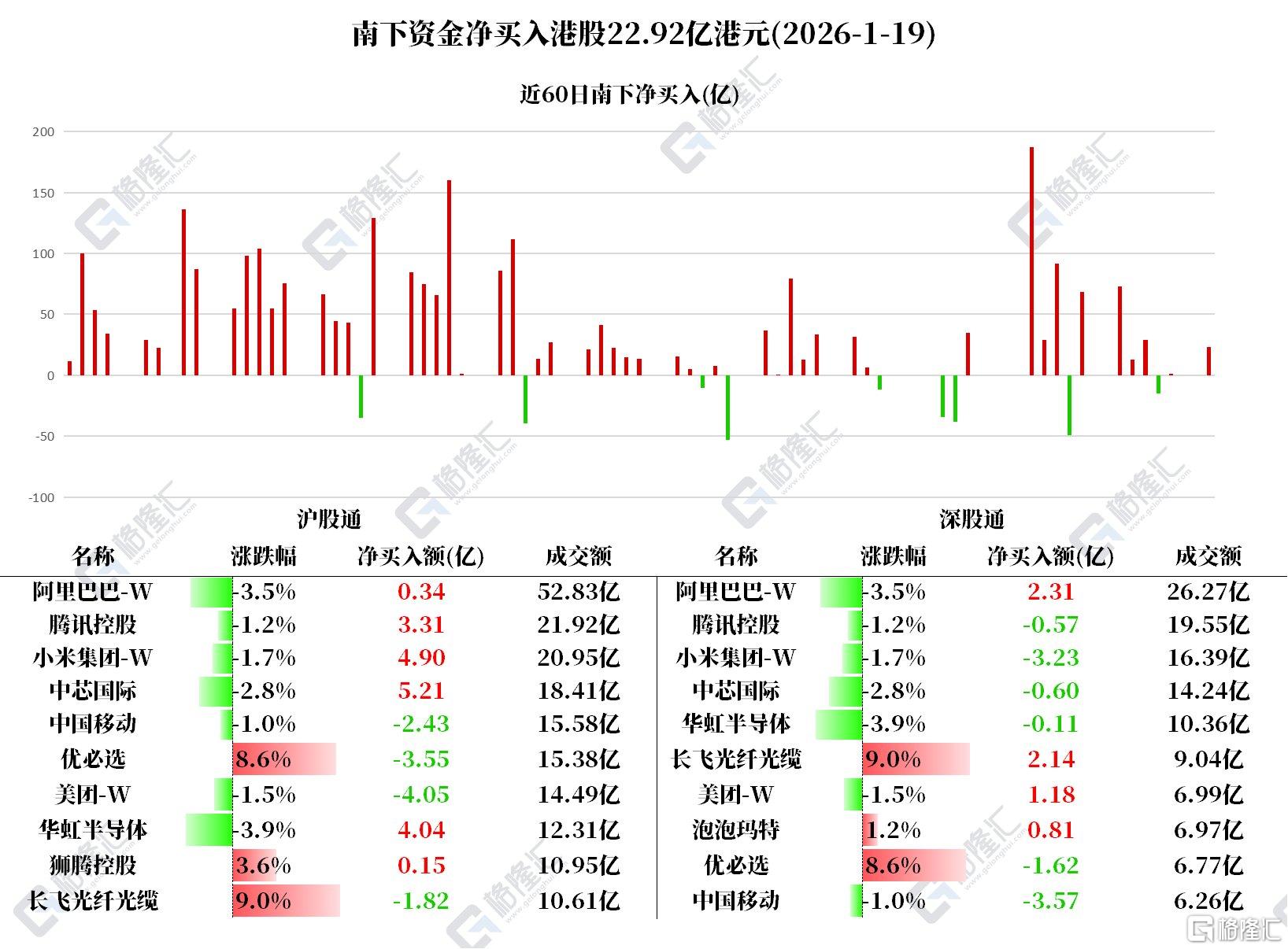
Group 1 - The net buying of stocks includes SMIC at 4.61 billion, Hua Hong Semiconductor at 3.93 billion, Tencent Holdings at 2.73 billion, Alibaba-W at 2.65 billion, and Xiaomi Group-W at 1.66 billion [1] - The net selling includes China Mobile at 5.99 billion, UBTECH at 5.17 billion, and Meituan-W at 2.86 billion [1] - Southbound funds have continuously net bought Tencent for 9 days, totaling 99.5789 billion HKD; Alibaba for 6 days, totaling 46.8976 billion HKD; SMIC for 3 days, totaling 17.2669 billion HKD; and Hua Hong Semiconductor for 3 days, totaling 10.9327 billion HKD [3] Group 2 - China Mobile has seen net selling for 11 consecutive days, totaling 86.6225 billion HKD [4] - TSMC has raised its capital expenditure guidance for 2026 to 52-56 billion USD, indicating long-term demand driven by AI [6] - DRAM prices are rising, with some DDR4 models seeing weekly increases of over 12%, and Micron reports that AI demand now accounts for 50-60% of the DRAM market [6] Group 3 - Tencent's revenue is expected to grow by 12% year-on-year to 193.5 billion RMB, in line with market expectations, with a projected non-IFRS net profit increase of 15% to 63.9 billion RMB [7] - Alibaba's shareholding by Citigroup increased from 5.38% to 6.03% as of January 13 [7] - Xiaomi Group repurchased 4 million B shares for approximately 146 million HKD at a price of 36.36-36.52 HKD per share [8] Group 4 - UBTECH signed a humanoid robot service agreement with Airbus, which has purchased UBTECH's latest industrial humanoid robot Walker S2 for its manufacturing plant [8]
大摩深度解析:中国互联网公司海外收入占比超10%,AI与出海成投资新焦点
傅里叶的猫· 2026-01-19 15:39
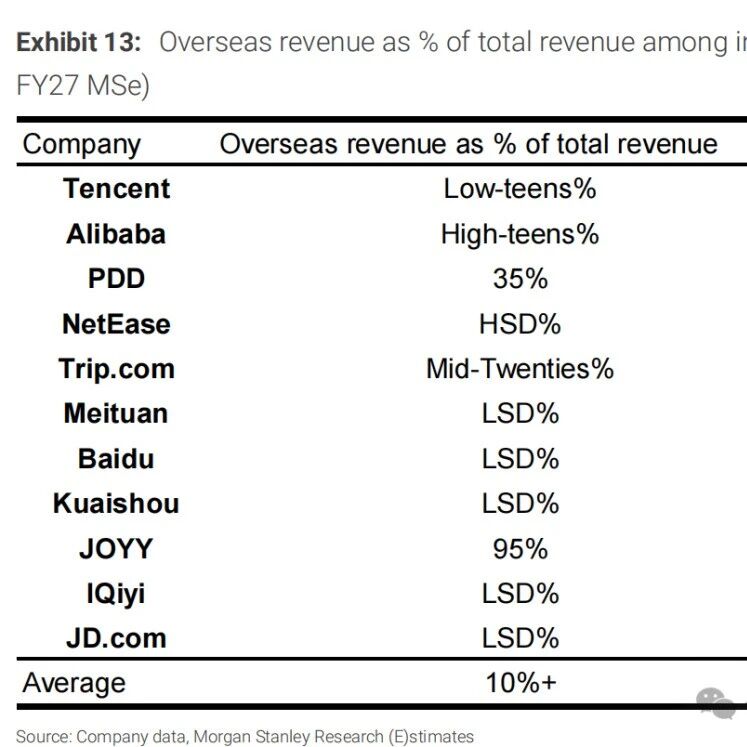
Core Insights - The article emphasizes the significance of AI in investment decisions, particularly in the context of Chinese internet companies and their overseas revenue potential [2][3]. Group 1: Overseas Revenue of Chinese Internet Companies - Chinese internet companies have an average overseas revenue exceeding 10%, with Pinduoduo leading at 35% [3]. - Companies like Tencent and Alibaba have low to high teens percentages of overseas revenue, indicating a growing trend towards international markets [3]. Group 2: Cloud Computing Sector - Alibaba Cloud and Tencent Cloud are rapidly expanding their international presence, with Alibaba planning new business regions in Brazil, France, and the Netherlands, and Tencent deploying services in 22 regions globally [4]. - Morgan Stanley projects that Alibaba Cloud's revenue growth will exceed 40% by FY2027, while Tencent's enterprise service revenue is expected to grow by 25% by FY2026 [5]. Group 3: Autonomous Driving Services - Baidu's autonomous driving service, "Luobo Kuaipao," is a leader in the sector, achieving over 250,000 weekly orders in fully autonomous mode as of Q3 2025, and has expanded to 22 cities including Dubai and Switzerland [7]. - Despite its leadership, Morgan Stanley anticipates that Baidu's revenue from this service will remain low and require continued investment [9]. Group 4: AI Models and Applications - Alibaba's Tongyi Qianwen model has gained significant traction globally, becoming the most downloaded AI model with over 700 million downloads by January 2026 [11]. - Kuaishou's Keling is expected to generate substantial revenue from overseas markets, with projections indicating an 80% year-on-year growth to reach $270 million by 2026, driven by B2B customer expansion [14].


我们正在亲手撰写历史
腾讯研究院· 2026-01-19 13:24
Core Viewpoint - The article emphasizes the transformative impact of AI on society, highlighting the transition from the initial phase of AI development to a deeper exploration of human identity and values in the context of technological advancement [2][6]. Group 1: AI Development and Impact - The rapid advancement of AI technologies has shifted from experimental phases to practical applications in various sectors, including factories, hospitals, and homes [2]. - The narrative suggests that the first phase of AI development is complete, and the focus is now on understanding the implications of AI on human existence and identity [3][6]. - The article reflects on the efficiency brought by AI, questioning whether the optimization of tasks has led to a loss of essential human experiences and qualities [4][5]. Group 2: Future Challenges and Exploration - The future challenges lie in exploring the fundamental question of what it means to be human in an AI-driven world, moving beyond mere technological advancements [6][7]. - The upcoming Tencent Technology for Good Innovation Festival in 2026 aims to address how AI shapes the world and how humanity can maintain its core values amidst technological changes [9][10]. - The article invites participation in the ongoing narrative of AI civilization, emphasizing that every interaction contributes to shaping this history [11][12]. Group 3: Event Details - The Tencent Technology for Good Innovation Festival will feature 23 sessions with 52 speakers discussing the influence of AI on society and the importance of preserving human values [9]. - The event will include various topics, such as the evolution of organizations and individuals in the AI era, the role of AI in education, and the ethical considerations surrounding AI governance [18][19][27].

粤企领跑扩招涨薪潮,腾讯、比亚迪、研祥如何招才引智
Nan Fang Du Shi Bao· 2026-01-19 13:17
以上内容由AI大模型生成,仅供参考 "稳就业"关乎"稳经济"的大局。2025年12月,中央经济工作会议在部署2026年经济工作时明确要求,实 施稳岗扩容提质行动,切实稳定高校毕业生、农民工等重点群体就业。开年以来,广东作为"我国经济 第一大省",率先把稳岗扩容提质的要求落到企业用工与人才机制上,一批粤企在校招、实习、技能岗 位补充等方面持续加力,成为稳就业的重要承接端。 从用工市场信号看,扩招与涨薪正在同步出现。据不完全统计,2025年,比亚迪(002594)新发"AI infra算法工程师"岗位平均月薪上涨超过36%;大疆"工业设计师"岗位平均月薪上涨20%,腾讯"AI 产品 经理"岗位平均月薪上涨5.56%。岗位与薪酬变化背后,指向同一条主线:新技术驱动的岗位需求加速 释放,企业在关键岗位上提升吸引力,同时通过更系统的人才培养与发展通道提高留用率、提升就业质 量。 腾讯滨海总部大厦。 近日,南都湾财社记者采访了腾讯、比亚迪、研祥集团三家企业,发现"稳就业"的落点正在发生迁移: 从"多招人"转向"招对人、育好人、留住人"。腾讯作为平台企业,将扩招重点更多压在AI等新兴业务 上;比亚迪作为制造业龙头,在产业链 ...
