
SMIC(00981)

Search documents
恒生科技指数涨幅扩大至1.7%:快手涨超5%,百度涨超4%
Jin Rong Jie· 2026-01-21 08:03
Group 1 - The Hang Seng Tech Index experienced a significant increase, with a peak rise of 1.7% [1] - Notable individual stocks included Kuaishou and Hua Hong Semiconductor, both rising over 5% [1] - Baidu Group and Tongcheng Travel saw increases of over 4%, while SMIC and Alibaba Health rose over 3% [1] Group 2 - Alibaba, BYD Electronics, Bilibili, Sunny Optical, and BYD Company all recorded gains exceeding 2% [1]


ETF盘中资讯|半导体大涨原因或已找到!硬科技宽基——双创龙头ETF(588330)盘中拉升3%,龙芯中科20CM涨停
Sou Hu Cai Jing· 2026-01-21 06:39
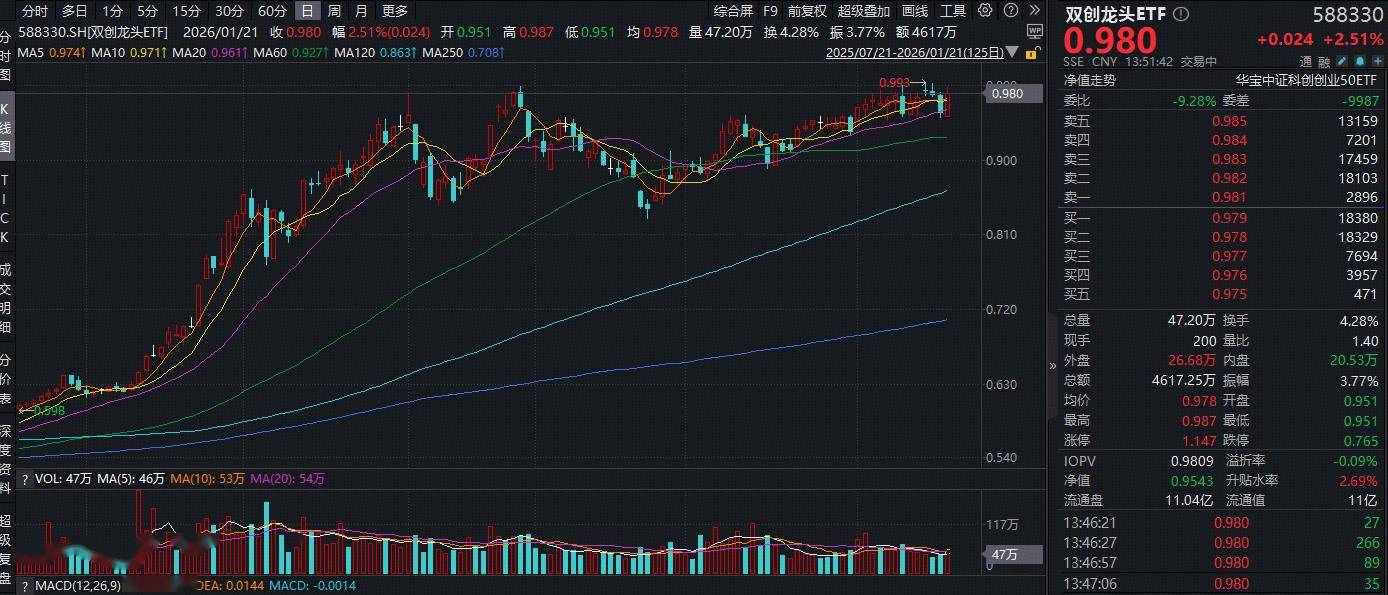
Core Viewpoint - The technology sector, particularly in AI and semiconductors, is experiencing significant growth, driven by strong demand and supportive policies, leading to notable stock performance in related ETFs and companies. Group 1: Market Performance - The STAR Market and ChiNext have shown strong performance, with the Double Innovation Leader ETF (588330) rising over 3.1% intraday and currently up 2.51% [1] - The top-performing stocks in the semiconductor sector include Chengdu Zhongke, which surged by 20%, and several others like Lianqi Technology and Haiguang Information, which saw increases of 13.96% and 13.63% respectively [2] Group 2: AI Sector Developments - TSMC reported financial results that exceeded market expectations, indicating a strong growth forecast for 2026, signaling the ongoing AI boom [3] - Micron Technology noted a persistent shortage of memory chips due to surging demand for AI infrastructure, highlighting the critical role of advanced packaging technology [3] - NVIDIA announced that its GB300 AI servers will begin large-scale deliveries in Q2 2026 [3] - OpenAI has invested $10 billion in Cerebras for up to 750 megawatts of computing power over three years [3] Group 3: Domestic Policy and Market Outlook - The Ministry of Industry and Information Technology in China is accelerating the development of the AI industry through the implementation of key policies [3] - China Galaxy Securities predicts a recovery in domestic AIDC bidding by Q4 2025, with major internet companies ramping up data center investments in 2026 [3] - Xinda Securities suggests that the ongoing demand for AI will lead to increased orders and utilization rates in the semiconductor sector [4] Group 4: ETF Characteristics and Performance - The Double Innovation Leader ETF (588330) focuses on 50 large-cap strategic emerging companies from the STAR Market and ChiNext, covering sectors like new energy and semiconductors [4] - The ETF has shown a cumulative increase of 60.86% year-to-date, outperforming major indices such as the ChiNext 50 and the STAR 50 [6] - The ETF offers a low entry point for investors, allowing participation in the tech sector with a minimum investment of less than 100 yuan [6]




刷新17年纪录的“公募冠军基金经理”任桀,持仓大调整!新赛道布局+最新研判来了
Mei Ri Jing Ji Xin Wen· 2026-01-21 05:24
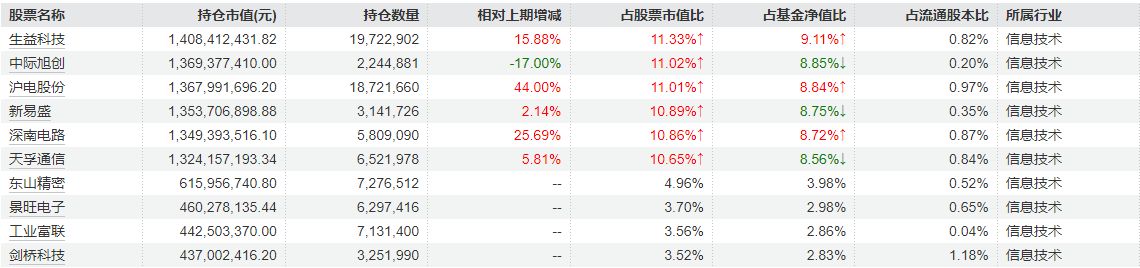
Group 1 - The core point of the article highlights that Yongying Fund's manager Ren Jie achieved a remarkable annual return of 233.29% for the Yongying Technology Smart A fund in 2025, breaking a 17-year record in the public fund industry [1] - The fund significantly reduced its equity investment from 91.59% in Q3 to 78.76% by the end of Q4 2025, reallocating assets to bank deposits and clearing out bond investments [2] - The top ten holdings of the Yongying Technology Smart A fund saw changes, with new additions including Dongshan Precision, Jingwang Electronics, Industrial Fulian, and Cambridge Technology, while previous holdings like Taicheng Light, Lanke Technology, and Shijia Light did not appear in the top ten [2][3] Group 2 - The fund manager emphasized a continued focus on global cloud computing investments, particularly in the optical communication and PCB sectors, while also acknowledging the potential for mean reversion after valuation expansion cycles [1][4] - The Yongying Hong Kong Stock Connect Technology Smart fund also underwent significant changes, with major reductions in holdings of Tencent Holdings and Bilibili-W, both exceeding 20% [5][7] - The performance of the Yongying Hong Kong Stock Connect Technology Smart A and C shares showed a net value growth rate of -22.02% and -22.14% respectively, underperforming their benchmarks by 7.88 and 8.00 percentage points [7]




银华基金李晓星Q4加仓港股互联网和消费股,包括腾讯、阿里等
Zhong Guo Zheng Quan Bao· 2026-01-21 05:21
Group 1 - The core viewpoint of the report indicates that the overall opportunities in the equity market for 2026 outweigh the risks, with AI remaining the main theme of global technological innovation [1] - As of the end of Q4 2025, the stock position of the Silver Hua Xinyi fund was 88.55%, a decrease of 4.54 percentage points compared to the end of Q3 2025 [1] - The top ten holdings of the fund as of Q4 2025 include Tencent Holdings, Alibaba-W, SMIC, Meituan-W, Xiaomi Group-W, Focus Media, Shenzhou International, Yili Group, Luzhou Laojiao, and Wuliangye [1] Group 2 - The AI industry is experiencing explosive growth in capital expenditure globally, with domestic internet companies also showing rapid growth in capital spending [2] - The consumer sector is expected to lag in 2025, with consumers remaining cautious and price-sensitive, although there are opportunities in high-quality consumer stocks with attractive dividend yields [2] - The pharmaceutical sector experienced fluctuations in Q4, attributed to previously high market expectations and capital flowing to other popular sectors, but there is a long-term positive outlook for domestic innovative drugs and the CRO/CDMO segments [2]




科技股涨停潮,发生了什么?
天天基金网· 2026-01-21 05:20
Core Viewpoint - The technology sector is experiencing a significant rebound, particularly in the semiconductor and computing power supply chains, with notable stock performances from companies like Haiguang Information and Longxin Zhongke [2][9]. Group 1: Technology Sector Performance - The technology stocks have rebounded, with the semiconductor, computing power, and consumer electronics sectors showing strong gains [6][7]. - Haiguang Information's stock rose over 12%, reaching a historical high with a market capitalization of 664.16 billion yuan and a trading volume of 13.851 billion yuan, leading the A-share market [2]. - Other leading stocks in the semiconductor sector, such as Longxin Zhongke and Tongfu Microelectronics, also saw significant increases, with some stocks hitting their daily limit [9][10]. Group 2: Semiconductor Price Trends - There are two new narratives regarding price increases in the technology sector: expectations of CPU price hikes and rising packaging costs [9][10]. - The demand for AI servers is increasing, with a projected growth of over 20% in global AI server shipments by 2026, which is expected to drive up CPU prices due to a shift in procurement budgets [9]. - The packaging sector is facing price increases due to capacity shortages and rising costs of raw materials, such as precious metals [10]. Group 3: Precious Metals and Lithium Market - The precious metals sector is also experiencing a rise, with significant increases in stocks like Hunan Silver and Zhaojin Gold, driven by a surge in gold prices [12][13]. - Lithium carbonate futures have seen a substantial increase due to supply chain disruptions and renewed subsidies for electric vehicles in Germany, which are expected to boost demand [15][16].

主力板块资金流入前10:半导体流入89.88亿元、计算机设备流入30.42亿元
Jin Rong Jie· 2026-01-21 04:04
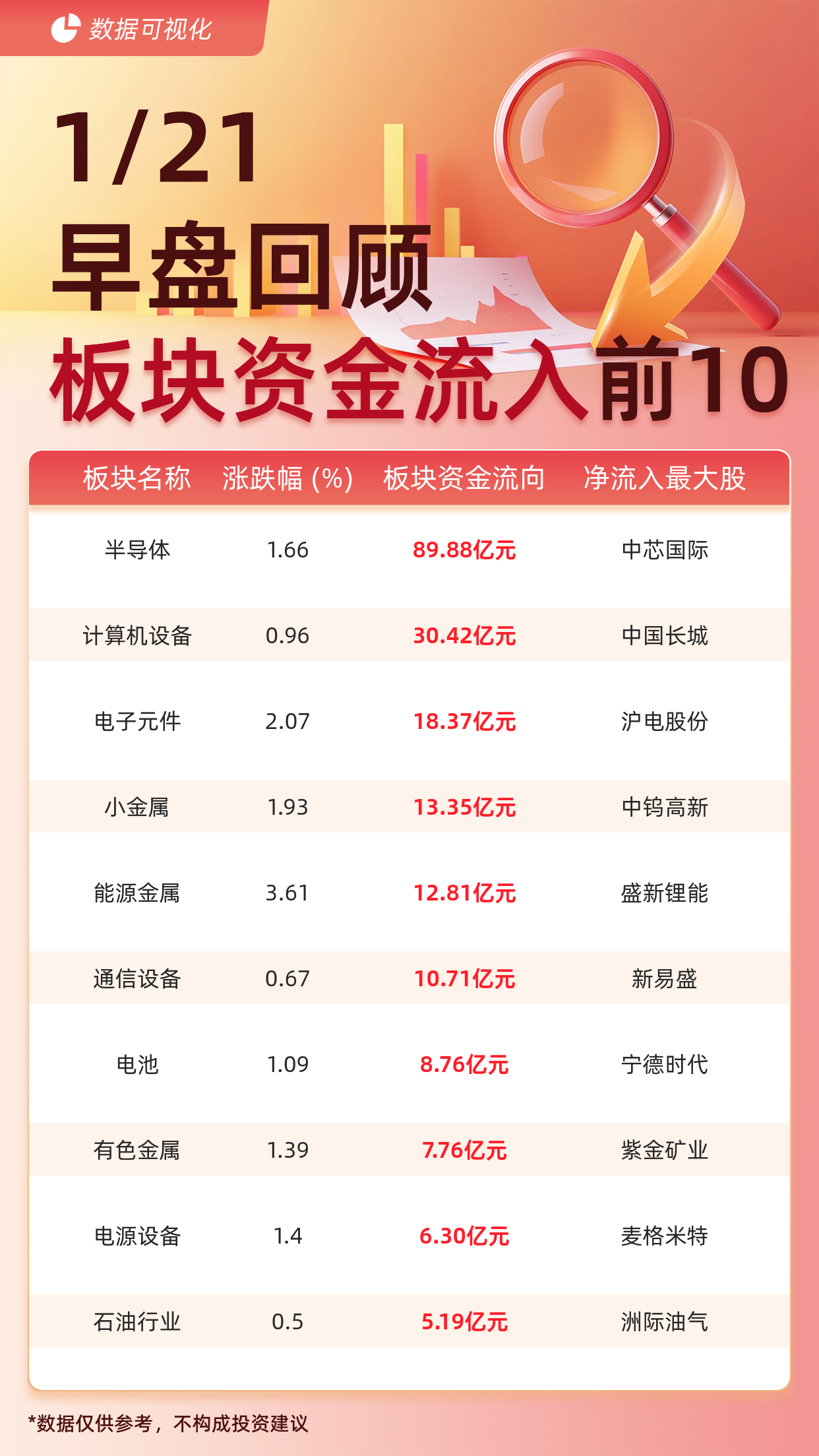
Core Insights - The main market saw a net inflow of 77.65 billion yuan as of January 21, with significant investments in various sectors [1] Sector Summaries - **Semiconductors**: Experienced a net inflow of 89.88 billion yuan with a price increase of 1.66%, led by companies like SMIC [2] - **Computer Equipment**: Saw a net inflow of 30.42 billion yuan and a price increase of 0.96%, with China Great Wall Technology as a notable performer [2] - **Electronic Components**: Recorded a net inflow of 18.37 billion yuan and a price increase of 2.07%, highlighted by Huadian Technology [2] - **Minor Metals**: Achieved a net inflow of 13.35 billion yuan with a price increase of 1.93%, driven by Zhongtung High-tech [2] - **Energy Metals**: Noted a significant net inflow of 12.81 billion yuan and a price increase of 3.61%, with Shengxin Lithium Energy leading the sector [2] - **Communication Equipment**: Had a net inflow of 10.71 billion yuan and a price increase of 0.67%, with Xinyi Technology as a key player [2] - **Batteries**: Experienced a net inflow of 8.76 billion yuan and a price increase of 1.09%, with CATL being a major contributor [3] - **Non-ferrous Metals**: Recorded a net inflow of 7.76 billion yuan and a price increase of 1.39%, with ZD Technology as a notable company [3] - **Power Equipment**: Saw a net inflow of 6.30 billion yuan and a price increase of 1.4%, with Magpower as a significant player [3] - **Oil Industry**: Experienced a net inflow of 5.19 billion yuan and a price increase of 0.5%, with Intercontinental Oil and Gas leading the sector [3]
主力资金流入前20:航天电子流入13.74亿元、新易盛流入13.59亿元
Jin Rong Jie· 2026-01-21 04:04
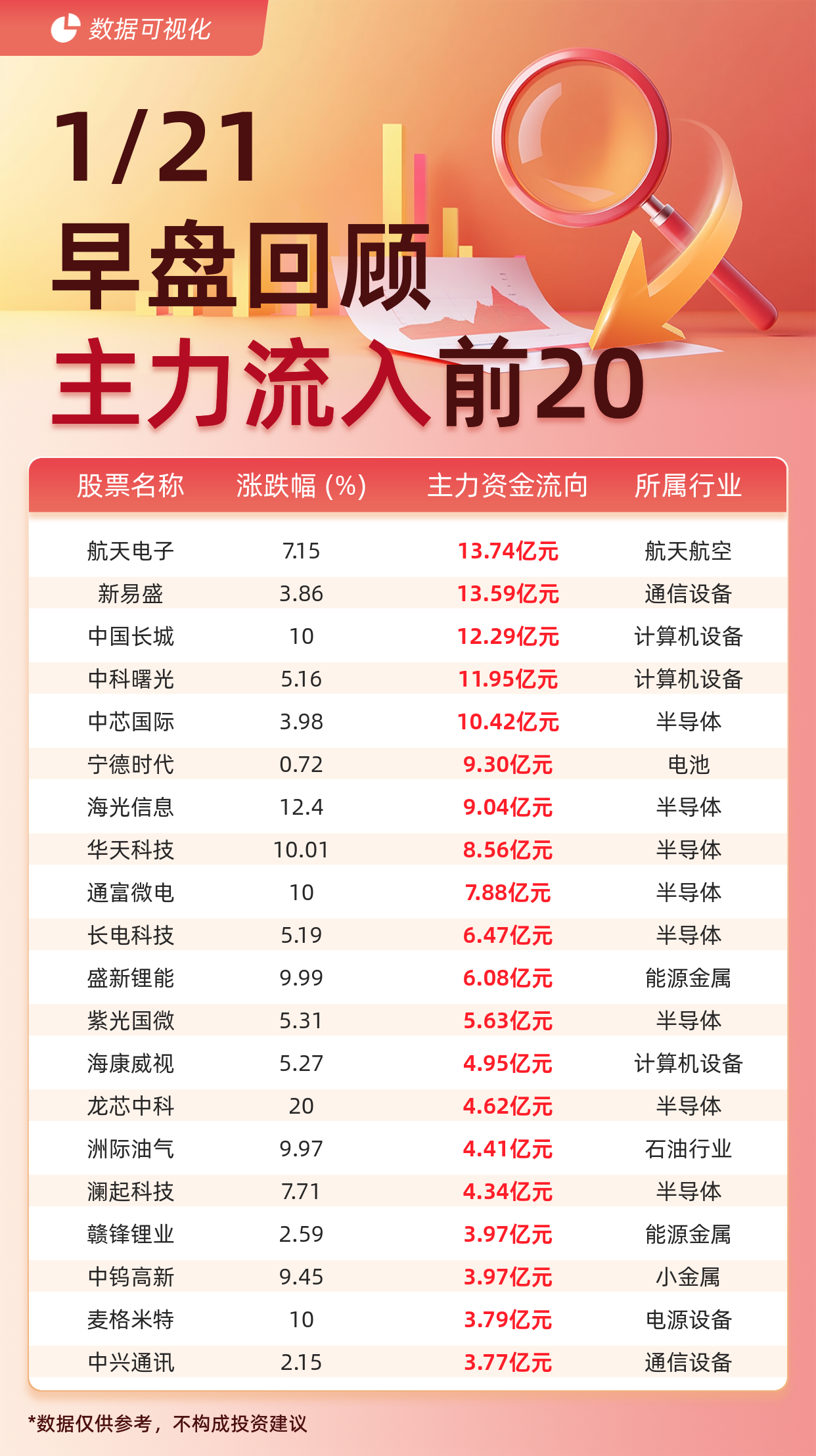
Core Insights - The main focus of the news is on the significant inflow of capital into specific stocks, indicating strong investor interest and potential growth in these companies. Group 1: Stock Performance and Capital Inflow - Aerospace Electronic (航天电子) saw a capital inflow of 1.374 billion yuan with a price increase of 7.15% [1][2] - New Yisheng (新易盛) experienced a capital inflow of 1.359 billion yuan and a price rise of 3.86% [1][2] - China Great Wall (中国长城) had a capital inflow of 1.229 billion yuan, with a notable increase of 10% in its stock price [1][2] - Zhongke Shuguang (中科曙光) attracted 1.195 billion yuan in capital, reflecting a 5.16% increase [1][2] - SMIC (中芯国际) received 1.042 billion yuan with a stock price increase of 3.98% [1][2] - CATL (宁德时代) had a capital inflow of 930 million yuan, with a modest increase of 0.72% [1][2] - Haiguang Information (海光信息) saw a significant capital inflow of 904 million yuan and a price increase of 12.4% [1][3] - Huatian Technology (华天科技) attracted 856 million yuan with a stock price increase of 10.01% [1][3] - Tongfu Microelectronics (通富微电) had a capital inflow of 788 million yuan and a price increase of 10% [1][3] - Changdian Technology (长电科技) received 647 million yuan with a 5.19% increase in stock price [1][3] - Shengxin Lithium Energy (盛新锂能) saw a capital inflow of 608 million yuan and a price increase of 9.99% [1][3] Group 2: Additional Stocks and Their Performance - Unigroup Guowei (紫光国微) had a capital inflow of 563 million yuan with a price increase of 5.31% [3] - Hikvision (海康威视) attracted 495 million yuan with a stock price increase of 5.27% [3] - Loongson Technology (龙芯中科) saw a significant capital inflow of 462 million yuan and a remarkable price increase of 20% [3] - Intercontinental Oil and Gas (洲际油气) had a capital inflow of 441 million yuan with a price increase of 9.97% [3] - Lanke Technology (澜起科技) received 434 million yuan with a stock price increase of 7.71% [3] - Ganfeng Lithium (赣锋锂业) attracted 397 million yuan with a modest price increase of 2.59% [3] - Zhongtung High-tech (中钨高新) saw a capital inflow of 397 million yuan and a price increase of 9.45% [3] - Magpow (麦格米特) had a capital inflow of 379 million yuan with a price increase of 10% [3] - ZTE Corporation (中兴通讯) attracted 377 million yuan with a stock price increase of 2.15% [3]


AI算力需求持续爆发拉动存储涨价潮,科创芯片ETF(588200)一键布局国产芯片投资机遇
Xin Lang Cai Jing· 2026-01-21 02:39
Group 1 - The semiconductor and chip sector experienced a significant rally, with the STAR Market chip index rising by 3.92% as of 10:14 AM on January 21, 2026, driven by strong performances from companies like Loongson Technology (up 20.00%) and Haiguang Information (up 12.46%) [1] - CITIC Securities believes that the storage chip market is currently in a price uptrend due to the explosive demand from AI and supply-side contractions, leading to a performance surge for global storage industry enterprises [1] - The construction of storage production lines and the increase in domestic production rates are expected to accelerate, creating investment opportunities in domestic semiconductor equipment and packaging/testing sectors [1] Group 2 - TSMC is projected to achieve record-high revenue in Q4 2025, with advanced process technology (7nm and below) accounting for 77% of its revenue, and 3nm process shipments reaching 28% [1] - The company anticipates a significant increase in capital expenditure for 2026, estimated between $52 billion and $56 billion, aimed at enhancing its technological advantages and capacity expansion in the high-end wafer foundry sector [1] - The ongoing demand for AI computing power is expected to strongly drive the semiconductor manufacturing sector [1] Group 3 - As of December 31, 2025, the top ten weighted stocks in the STAR Market chip index accounted for 57.76% of the index, including companies like SMIC, Haiguang Information, and Cambrian [2] - The STAR Chip ETF (588200) serves as a convenient tool for investors looking to gain exposure to the STAR Market chip sector [2] Group 4 - Investors without stock accounts can explore investment opportunities in domestic chips through the STAR Chip ETF linked fund (017470) [3]


龙芯中科封板,科创50ETF涨超3%,冲击前期高点
Mei Ri Jing Ji Xin Wen· 2026-01-21 02:15
Market Performance - The A-share market showed signs of recovery in the early session, with all three major indices rising: the Shanghai Composite Index increased by 0.17%, the Shenzhen Component Index rose by 0.54%, and the ChiNext Index climbed by 1.15% [1] - The Kweichow Moutai ETF (588000) surged by 3.46%, with the latest price at 1.614 yuan, and the intraday trading volume reached 2.121 billion yuan, resulting in a turnover rate of 2.67% [1] Semiconductor Sector - The semiconductor sector experienced a significant rally, with notable stocks such as Longxin Technology hitting the limit up, Haiguang Information rising by 14.07%, Lanke Technology increasing by 6.80%, Zhongwei Company up by 3.97%, and SMIC gaining 3.04% [1] - The domestic semiconductor equipment sector is witnessing dual catalysts: the successful launch of the first high-energy hydrogen ion implanter developed by China National Nuclear Corporation, breaking foreign monopolies in key semiconductor manufacturing processes, and TSMC's financial report indicating a projected 35% increase in net profit by Q4 2025 and a gross margin of 62% [1] Industry Outlook - The dual catalysts are expected to accelerate the localization of domestic equipment, combined with AI-driven technological upgrades and capacity expansion, suggesting that the industry may enter a "golden period" of expansion cycles and technological breakthroughs [1] - The Kweichow Moutai ETF (588000) tracks the Sci-Tech 50 Index, which has a 70.35% allocation in the electronics sector, aligning well with the current development trends in artificial intelligence and robotics [1] - The ETF also covers multiple sub-sectors, including semiconductors, medical devices, software development, and photovoltaic equipment, indicating a high content of hard technology, and investors optimistic about the long-term development prospects of China's hard technology are encouraged to continue monitoring [1]

中芯国际等巨头集体提价 8英寸芯片最高涨20%
Ge Long Hui· 2026-01-21 01:11
Core Viewpoint - The global 8-inch wafer supply and demand is entering a period of imbalance, primarily due to strategic capacity reductions by TSMC and Samsung, leading to a projected 2.4% shrinkage in global 8-inch foundry capacity by 2026 [1] Group 1: Industry Overview - The demand for AI-driven power management chips (Power IC) remains strong, pushing the average industry capacity utilization rate back up to a high of 90% [1] - Chinese mainland wafer foundries are emerging as alternative solutions to meet the demand for 8-inch chips, with price increases expected between 5% and 20% [1] Group 2: Company-Specific Insights - TSMC currently operates four 8-inch wafer fabs and one 6-inch fab in Taiwan, with a monthly production capacity of approximately 528,000 wafers. A complete exit from the 8-inch market by 2027 would require continued capacity reductions starting in 2026 [1] - Samsung Electronics plans to reduce 8-inch wafer production starting in the second half of 2025, reallocating resources to compete in the 12-inch wafer market. Samsung's monthly production capacity for 8-inch wafers is also around 528,000 wafers [1] - United Microelectronics Corporation (UMC) has an 8-inch wafer monthly production capacity that previously exceeded 360,000 wafers, with a current utilization rate of about 70%. UMC is optimistic about continued growth in operations through 2026 by focusing on specialized process technologies [1] - Semiconductor Manufacturing International Corporation (SMIC) operates three 8-inch fabs and four 12-inch fabs, with a historical monthly production capacity of 1,023,000 wafers (equivalent to 8-inch) as of Q3 2025, achieving a capacity utilization rate of 95.8%, the highest since Q2 2022 [1] - Hua Hong Semiconductor demonstrates competitive strength in specialty processes, with some 8-inch production lines nearing 100% utilization, benefiting from orders transferred from international power semiconductor giants [1]