
SMIC(00981)

Search documents
图解丨南下资金连续10日净买入腾讯,连续12日净卖出中国移动
Ge Long Hui A P P· 2026-01-20 10:07
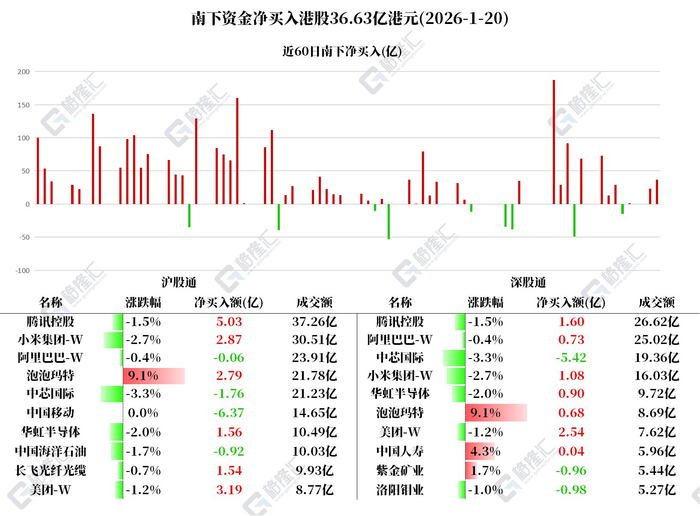
Group 1 - Southbound funds net bought Hong Kong stocks worth HKD 3.663 billion today [1] - The top net purchases included Tencent Holdings at HKD 663 million, Meituan-W at HKD 573 million, and Xiaomi Group-W at HKD 395 million [1] - Continuous net buying trends were observed for Tencent over 10 days totaling HKD 10.62116 billion and Alibaba over 7 days totaling HKD 4.75655 billion [1] Group 2 - Southbound funds net sold shares of SMIC at HKD 717 million and China Mobile at HKD 637 million [1] - China Mobile has seen continuous net selling for 12 days, amounting to HKD 9.29936 billion [1] - Hua Hong Semiconductor and Xiaomi also experienced net buying trends over multiple days, with Hua Hong totaling HKD 1.33901 billion over 4 days and Xiaomi HKD 1.42914 billion over 3 days [1]





北水动向|北水成交净买入36.63亿 泡泡玛特(09992)时隔两年回购 北水抢筹超3亿港元
智通财经网· 2026-01-20 10:01
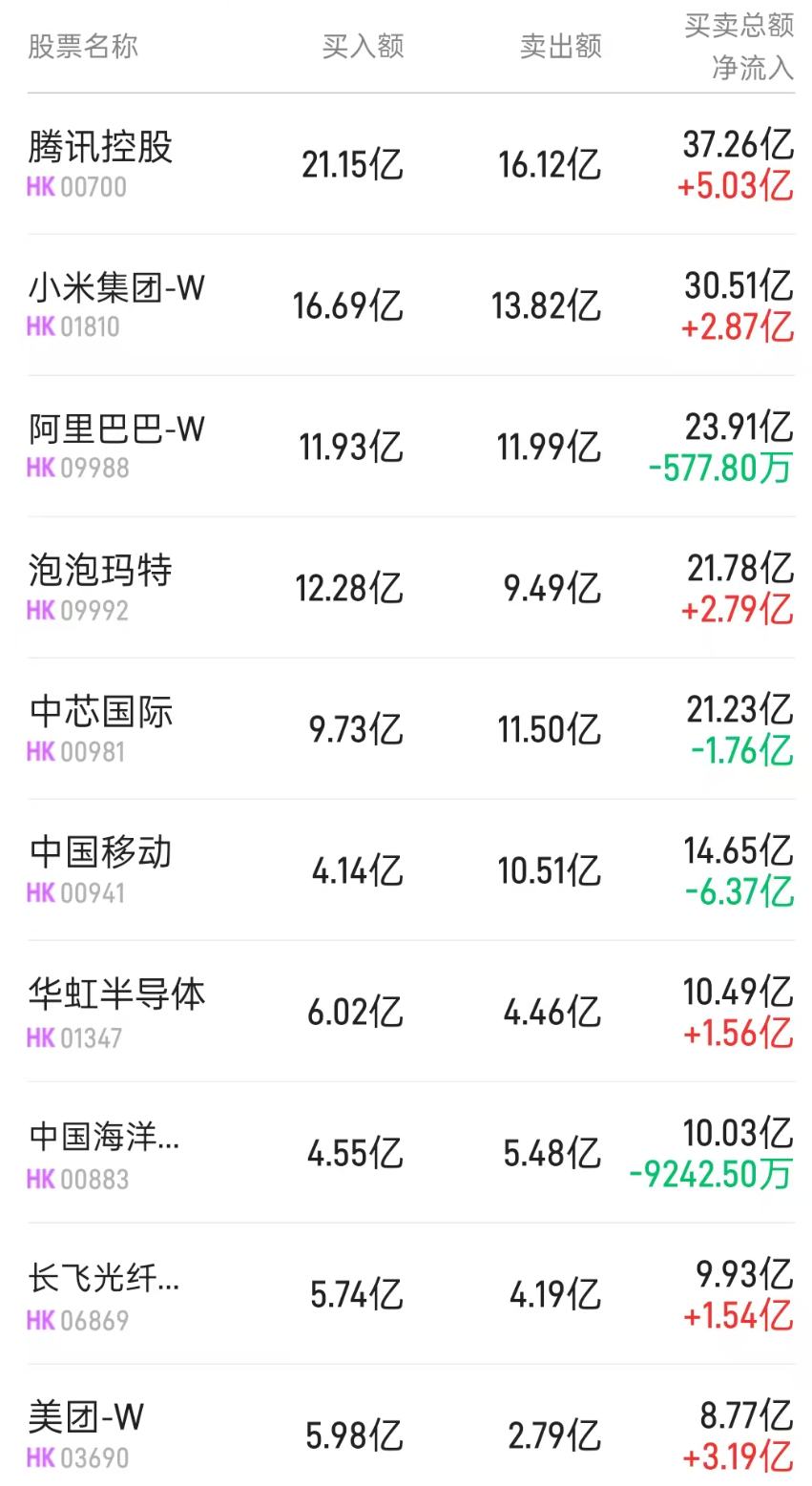
Core Viewpoint - The Hong Kong stock market experienced significant net inflows from northbound trading, with a total net buy of HKD 36.63 billion on January 20, 2023, indicating strong investor interest in certain stocks [1]. Group 1: Net Buying and Selling Activities - Tencent (00700) received the highest net buy of HKD 21.15 billion, with a total trading volume of HKD 37.26 billion, reflecting a net inflow of HKD 5.03 billion [2]. - Meituan-W (03690) saw a net buy of HKD 16.69 billion, with a total trading volume of HKD 30.51 billion, resulting in a net inflow of HKD 2.87 billion [2]. - Xiaomi Group-W (01810) had a net buy of HKD 3.95 billion, contributing to the overall positive sentiment in the tech sector [7]. - Conversely, SMIC (00981) faced the largest net sell of HKD 9.73 billion, with a total trading volume of HKD 21.23 billion, indicating a net outflow of HKD 1.76 billion [2]. - China Mobile (00941) also experienced significant net selling, with a net outflow of HKD 6.37 billion [7]. Group 2: Sector Insights and Market Trends - The technology sector, particularly companies like Tencent, Meituan, and Alibaba, is seeing increased investment interest, driven by expectations of growth in AI and cloud computing [4]. - The semiconductor sector showed divergence, with Hua Hong Semiconductor (01347) receiving a net buy of HKD 2.45 billion, while SMIC faced a net sell of HKD 7.17 billion, reflecting varying investor confidence [5]. - The optical fiber and cable industry is experiencing a price recovery, with Longi Optical Fiber (06869) receiving a net buy of HKD 1.54 billion, supported by rising market prices for G.652.D optical fibers [5]. - The mining sector, particularly Zijin Mining (02899) and Luoyang Molybdenum (03993), faced net selling pressures, attributed to changing market sentiments regarding metal demand and supply dynamics [6].

闪德资讯存储市场洞察报告 2025年5月
闪德资讯· 2026-01-20 08:45
Investment Rating - The report indicates a positive outlook for the storage industry, particularly in DRAM and NAND sectors, with expectations of price increases and demand recovery in the coming quarters [6][20][44]. Core Insights - The report highlights a significant transition in the memory market, with major manufacturers like Samsung, SK Hynix, and Micron phasing out DDR4 production in favor of DDR5 and HBM technologies, which is expected to tighten supply and drive prices up [6][23][24]. - DRAM prices have surged, leading to increased activity in the spot market, while NAND prices have stabilized after a period of volatility [6][47]. - The rise of AI PCs is anticipated to boost demand for high-performance memory solutions, with projections indicating a 37% penetration rate by 2025 [6][21][22]. - ODM manufacturers are cautious about demand in the second half of the year, anticipating a slowdown due to earlier stockpiling and market uncertainties [6][20]. - Ongoing geopolitical tensions and tariff adjustments are influencing supply chain dynamics and market stability, with potential long-term implications for pricing and availability [6][7][20]. Summary by Sections Macro Economy - In May, China's manufacturing PMI rose to 49.5%, indicating improved manufacturing activity, while the U.S. PMI remained below expansion levels at 48.5% [7][9]. - The report notes a 10.8% year-on-year growth in China's electronic information manufacturing sector from January to April [12][13]. Upstream Market - Global laptop shipments are expected to increase by 5.8% in Q2, driven by preemptive stockpiling and seasonal demand [20][21]. - Major manufacturers are transitioning away from DDR4, with supply constraints expected to impact pricing significantly [23][24]. Storage Market Dynamics - The report details a notable increase in DRAM prices, with DDR4 prices rising from $2.4 to $3.95, a 64% increase [23]. - NAND flash market dynamics are shifting, with Samsung's exit from the MLC market expected to create supply shortages and price increases [28][29]. Application Market - The PC market is experiencing fluctuations, with major manufacturers reporting mixed results in shipments and revenues due to seasonal effects and tariff uncertainties [71][72]. - AI server-related revenues are projected to grow significantly, while traditional PC demand remains uncertain [72][74].




港股收盘 | 恒指收跌0.29% 黄金、消费股走高 泡泡玛特劲升9%领跑蓝筹
Zhi Tong Cai Jing· 2026-01-20 08:37
Market Overview - The Hong Kong stock market experienced fluctuations today, with all three major indices closing lower. The Hang Seng Index fell by 0.29% or 76.39 points to 26,487.51 points, with a total turnover of HKD 2,377.66 million. The Hang Seng China Enterprises Index decreased by 0.43% to 9,094.76 points, and the Hang Seng Tech Index dropped by 1.16% to 5,683.44 points [1] Blue Chip Performance - Pop Mart (09992) led the blue-chip stocks, rising by 9.07% to HKD 197.2, contributing 19.52 points to the Hang Seng Index. The company announced a share buyback of 1.4 million shares for HKD 2.51 million at prices between HKD 177.7 and HKD 181.2. Morgan Stanley noted that this buyback could attract more investors [2] - Other notable blue-chip performances included China Life (601628) (02628) up 4.31% to HKD 33.4, contributing 16.6 points, and China Resources Land (01109) up 3.71% to HKD 29.64, contributing 5.52 points. Conversely, WuXi AppTec (603259) (02359) fell by 4.13% to HKD 113.7, detracting 3.73 points, and SMIC (00981) dropped by 3.25% to HKD 74.5, detracting 18.11 points [2] Sector Highlights - The technology sector showed mixed results, with Baidu rising by 0.95% while Tencent fell over 1%. Gold stocks rebounded, with spot gold surpassing USD 4,700 for the first time, and consumer stocks gained traction due to favorable consumption policies. Notably, Pop Mart's buyback led to a price increase of over 10% [3] - Gold stocks saw a recovery, with Zijin Mining International (02259) up 5.47% to HKD 179.4, Chifeng Jilong Gold Mining (600988) (06693) up 3.6% to HKD 33.94, Shandong Gold Mining (600547) (01787) up 2.73% to HKD 43.7, and China National Gold International (600916) (02099) up 2.04% to HKD 195 [3] Real Estate Sector - The National Bureau of Statistics reported a 0.3% month-on-month decline in new residential sales prices in first-tier cities for December 2025, with the decline narrowing by 0.1 percentage points from the previous month. Shenwan Hongyuan believes that the real estate sector has undergone deep adjustments, and recent central government directives to stabilize the market may lead to positive policy changes [5] - The real estate sector showed positive performance, with China Overseas Land & Investment (00081) up 4.93% to HKD 2.13, and China Resources Land (01109) up 3.71% to HKD 29.64 [4][5] Insurance Sector - The insurance sector performed well, with China Pacific Insurance (00966) up 4.39% to HKD 23.8, China Life (02628) up 4.31% to HKD 33.4, and New China Life Insurance (601336) (01336) up 2.72% to HKD 62.35. Reports indicated that major insurance companies saw significant growth in premium income through bancassurance channels [4][5] Aviation Sector - The aviation sector continued its upward trend, with China Southern Airlines (600029) (01055) up 4.57% to HKD 6.18, China National Aviation (601111) (00753) up 3.91% to HKD 7.45, and Cathay Pacific (00293) up 1.63% to HKD 12.49. Analysts expect strong demand during the upcoming Spring Festival travel season, with improved ticket pricing and revenue management driving profitability [6] Notable Stock Movements - Youjia Innovation (02431) saw a significant increase of 7.21% to HKD 15.77 after signing a memorandum of understanding with India's Sterling Tools Ltd. to focus on the automotive market [7] - Nanshan Aluminum International (02610) reached a new high, rising 6.04% to HKD 71.95, as the company plans to initiate a 250,000-ton electrolytic aluminum project with an estimated investment of USD 436.6 million [8] - GigaDevice Semiconductor (603986) (03986) continued to rise by 5.52% to HKD 306, benefiting from a tight supply of memory chips [9] - Shanghai Petrochemical (600688) (00338) issued a profit warning, expecting a net loss of approximately RMB 1.289 billion to RMB 1.576 billion for the year ending December 31, 2025 [10]



港股收评:恒生指数跌0.29% 恒生科技指数跌1.16%

Zheng Quan Shi Bao Wang· 2026-01-20 08:23
Market Performance - The Hang Seng Index closed down by 0.29% [1] - The Hang Seng Tech Index decreased by 1.16% [1] Notable Stock Movements - Pop Mart and Hu Shang Ayi both saw increases of over 9% [1] - Wan Guo Gold Group rose by more than 7% [1] - Zijin Gold International increased by over 5% [1] - Zhihui fell by more than 7% [1] - SMIC declined by over 3% [1]
全球半导体材料市场复苏提速 中国产业突围 “卡脖子” 难题
Quan Jing Wang· 2026-01-20 07:23
Core Insights - The global semiconductor materials market is experiencing a strong recovery, with a market size of $66.7 billion in 2023 and expected to exceed $73 billion by 2025, driven by demand from AI and wafer fab expansions [1] - China is becoming a key growth engine in the semiconductor materials market, with a sales figure of $13.1 billion in 2023, marking a year-on-year growth of 3.8% and increasing its global market share to 20% [1] Market Structure - Semiconductor materials are divided into wafer manufacturing materials and packaging materials, with wafer manufacturing materials dominating the market at 62.2% share ($41.5 billion) in 2023 [2] - Silicon wafers hold the largest share in wafer manufacturing materials at 33%, followed by electronic specialty gases (14%) and photomasks (13%) [2] - The market is highly concentrated, with major players in silicon wafers and photolithography materials predominantly from Japan and the U.S. [2] Core Material Breakthroughs - Domestic companies are making significant progress in wafer manufacturing materials, with local firms achieving breakthroughs in 12-inch silicon wafers and photolithography materials [3][4] - The domestic market for electronic specialty gases is also advancing, with companies like Huate Gas entering the TSMC supply chain [4] Packaging Materials - The global packaging materials market saw a decline of 10.1% to $25.2 billion in 2023, but advanced packaging is driving growth, with a projected increase of 19.62% [5] - Domestic companies are rapidly iterating technology in advanced packaging materials, with significant market shares in lead frames and packaging substrates [5] Import Dependency and Policy Support - China still faces significant import dependency in key categories like photolithography materials and electronic specialty gases, with over 90% reliance on imports for high-end materials below 14nm [6][8] - The government is focusing on critical areas through initiatives like the National Big Fund, aiming for 70% self-sufficiency in core materials by 2030 [6][8] Challenges and Future Outlook - Despite notable advancements, the industry faces challenges such as reliance on foreign technology for EUV-grade silicon wafers and high-end photolithography materials [7] - The advanced packaging materials market is expected to reach $39.3 billion by 2025, indicating a significant growth opportunity for domestic companies [7]


主力个股资金流出前20:新易盛流出20.21亿元、中际旭创流出18.09亿元
Jin Rong Jie· 2026-01-20 06:26
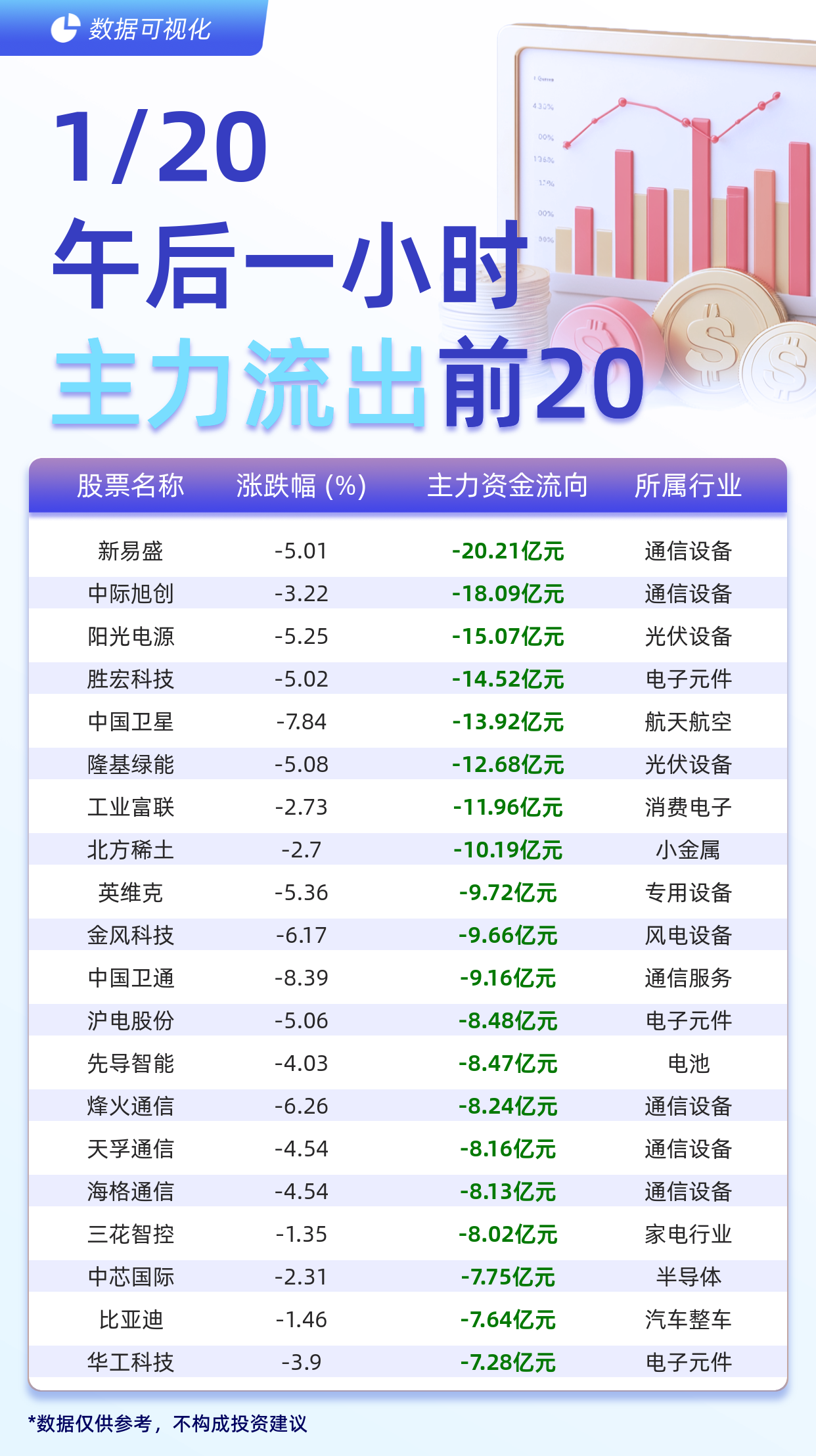
Core Viewpoint - The data indicates significant outflows of main funds from various stocks, particularly in the communication equipment and renewable energy sectors, suggesting a potential shift in investor sentiment and market dynamics [1][2][3] Group 1: Stock Performance and Fund Outflows - The top stock with the largest fund outflow is Xinye Technology, with a decrease of 20.21 billion yuan and a drop of 5.01% [2] - Zhongji Xuchuang follows with an outflow of 18.09 billion yuan and a decline of 3.22% [2] - Yangguang Electric Power experienced an outflow of 15.07 billion yuan, with a decrease of 5.25% [2] - Shenghong Technology saw a fund outflow of 14.52 billion yuan and a drop of 5.02% [2] - China Satellite had an outflow of 13.92 billion yuan, with a significant decline of 7.84% [2] Group 2: Sector Analysis - The communication equipment sector is notably affected, with multiple companies like Xinye Technology, Zhongji Xuchuang, and Fenghuo Communication experiencing substantial fund outflows [2][3] - The photovoltaic equipment sector, represented by Yangguang Electric Power and Longi Green Energy, also shows significant outflows, indicating potential challenges in this industry [2][3] - The electronic components sector, including Shenghong Technology and Huadian Co., is facing similar trends with notable fund withdrawals [2][3]





中芯国际取得掩膜版图形成方法专利
Sou Hu Cai Jing· 2026-01-20 05:30
国家知识产权局信息显示,中芯国际集成电路制造(上海)有限公司、中芯国际集成电路制造(北京) 有限公司取得一项名为"掩膜版图的形成方法"的专利,授权公告号CN116413995B,申请日期为2021年 12月。 天眼查资料显示,中芯国际集成电路制造(上海)有限公司,成立于2000年,位于上海市,是一家以从事 计算机、通信和其他电子设备制造业为主的企业。企业注册资本244000万美元。通过天眼查大数据分 析,中芯国际集成电路制造(上海)有限公司共对外投资了4家企业,参与招投标项目129次,财产线索方 面有商标信息150条,专利信息5000条,此外企业还拥有行政许可446个。 中芯国际集成电路制造(北京)有限公司,成立于2002年,位于北京市,是一家以从事计算机、通信和其 他电子设备制造业为主的企业。企业注册资本100000万美元。通过天眼查大数据分析,中芯国际集成电 路制造(北京)有限公司共对外投资了1家企业,参与招投标项目53次,专利信息5000条,此外企业还拥 有行政许可225个。 声明:市场有风险,投资需谨慎。本文为AI基于第三方数据生成,仅供参考,不构成个人投资建议。 来源:市场资讯 ...

中芯国际申请套刻误差测量方法专利,有利于降低获得套刻误差的难度
Sou Hu Cai Jing· 2026-01-20 05:30
声明:市场有风险,投资需谨慎。本文为AI基于第三方数据生成,仅供参考,不构成个人投资建议。 来源:市场资讯 国家知识产权局信息显示,中芯国际集成电路制造(上海)有限公司申请一项名为"套刻误差的测量方 法及系统、装置、程序产品和存储介质"的专利,公开号CN121348661A,申请日期为2024年7月。 专利摘要显示,一种套刻误差的测量方法及系统、装置、程序产品和存储介质,套刻误差的测量方法包 括:获取第一状态下的产品晶圆和参考晶圆的第一参考套刻误差,第一参考套刻误差为产品晶圆上的第 一前层套刻标记与参考晶圆上的第二前层套刻标记之间的套刻误差;获取第二状态下的产品晶圆和第一 状态下的参考晶圆的第二参考套刻误差,第二参考套刻误差为产品晶圆上的当层套刻标记与参考晶圆上 的第二前层套刻标记之间的套刻误差;根据第一参考套刻误差和第二参考套刻误差之间的偏差,获取产 品晶圆的当层套刻标记和第一前层套刻标记的套刻误差。本发明实施例中获取套刻误差不受第一前层套 刻标记与当层套刻标记之间纵向距离的限制,有利于降低获得套刻误差的难度。 天眼查资料显示,中芯国际集成电路制造(上海)有限公司,成立于2000年,位于上海市,是一家以从 ...
港股芯片股走低
Jin Rong Jie· 2026-01-20 02:37
Group 1 - The Hong Kong stock market for semiconductor stocks has declined, with notable drops in several companies [1] - Hua Hong Semiconductor (01347.HK) experienced a decline of over 5% [1] - SMIC (00981.HK) fell by 3.8%, while InnoCare Pharma (02577.HK) and Wallen Technology (06082.HK) saw decreases of 2.5% and 2.4% respectively [1]