
CSEC,China Shenhua(01088)

Search documents
煤炭行业七问七答:煤炭红利:不确定性中确定性
Changjiang Securities· 2025-05-08 11:16
Investment Rating - The report maintains a "Positive" investment rating for the coal industry [3]. Core Viewpoints - The coal industry is experiencing a paradigm shift from performance-driven growth to valuation-driven growth, influenced by supply constraints and stable coal prices [10][16]. - The long-term contracts in the coal sector are enhancing the stability of earnings, providing a buffer against market volatility [24][28]. - The report highlights that despite recent price declines, the coal sector's defensive attributes may offer unique advantages in uncertain market conditions [60][66]. Summary by Sections 1. What to Invest in the Coal Industry? - The focus is on long-term contracts and stable coal prices as key investment areas [8]. 2. Why Shift from Performance to Valuation? - Supply elasticity is decreasing, leading to enhanced stability in return on equity (ROE) [18][21]. - The increase in capital expenditures since 2021 has been significant, with new coal mine approvals becoming more complex and costly [19][20]. - The long-term contract mechanism is crucial for stabilizing earnings expectations in the coal sector [24][27]. 3. Why Has the Coal Sector Seen Significant Corrections Since H2 2024? - The fundamental issue stems from strong supply and weak demand, leading to a surplus in coal supply [39][41]. - The decline in electricity prices has pressured profit margins across the coal-electricity supply chain [39][41]. 4. Can the Sector Still Rise Despite Weak Demand? - Concerns about demand are driven by a slowdown in electricity consumption growth and the increasing substitution of coal by renewable energy sources [48][53]. - The report suggests that even with demand concerns, coal's defensive characteristics may still provide stability in performance [60][66]. 5. Long-term Outlook for Thermal Coal - The report anticipates a marginal improvement in coal supply-demand dynamics by late May 2025, with potential support for coal prices [66][67].




中证香港300能源指数报2212.60点,前十大权重包含兖矿能源等
Jin Rong Jie· 2025-05-07 07:41
Group 1 - The core viewpoint of the articles highlights the performance of the China Securities Hong Kong 300 Energy Index, which has seen a decline of 7.31% in the past month, 8.77% in the past three months, and 10.93% year-to-date [1] - The top ten holdings of the China Securities Hong Kong 300 Energy Index include China National Offshore Oil (41.44%), PetroChina (17.49%), China Shenhua Energy (13.95%), Sinopec (13.62%), and others, indicating a concentration in a few major companies [1] - The index is designed to reflect the overall performance of different industries in the Hong Kong market, with a base date of December 31, 2004, set at 1000.0 points [1] Group 2 - The market segments represented in the China Securities Hong Kong 300 Energy Index are entirely from the Hong Kong Stock Exchange, with fuel refining accounting for 42.01%, integrated oil and gas companies for 31.12%, and coal for 24.17% [2] - The index samples are adjusted biannually, with changes implemented on the next trading day following the second Friday of June and December, ensuring that the weight factors are updated accordingly [2] - Adjustments to the index samples occur in response to special events affecting the companies, such as mergers or delistings, ensuring the index remains reflective of the current market landscape [2]


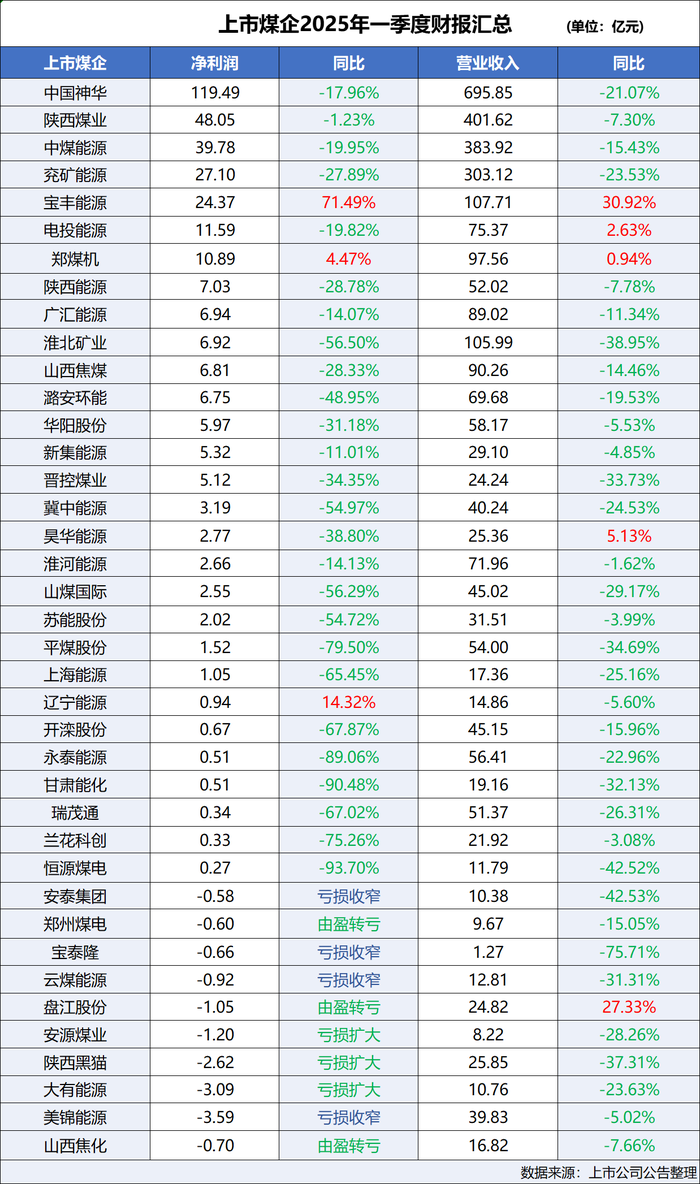
煤企业绩喜忧参半,宁夏首富一枝独秀
Xin Lang Cai Jing· 2025-05-07 03:06
Core Insights - The coal industry in China reported mixed results for Q1 2025, with over 70% of listed coal companies remaining profitable, yet most experienced significant declines in net profit year-on-year, with some companies even reporting losses [1][4][12] - Baofeng Energy, led by Ningxia's richest man, achieved a remarkable net profit growth of 71.49%, standing out in an otherwise declining industry [1][8] Financial Performance Summary - Major coal companies reported the following net profits and year-on-year changes: - China Shenhua: 11.949 billion, -17.96% - Shaanxi Coal and Chemical: 4.805 billion, -1.23% - Baofeng Energy: 2.437 billion, +71.49% [2] - A total of 32 out of 39 listed coal companies saw a decline in net profit, with 12 companies experiencing declines over 30% [4][12] Factors Behind Profit Decline - Market price fluctuations have directly impacted coal company profits, with average prices for major coal types, such as thermal coal, dropping approximately 25% year-on-year [5][6] - The supply-demand imbalance is exacerbated by a warm winter and increased renewable energy generation, which saw a 18.7% year-on-year increase in wind and solar power output [5][12] - Rising production costs due to deeper mining and increased safety and environmental expenditures have further squeezed profit margins [6][12] Baofeng Energy's Growth Strategy - Baofeng Energy's success is attributed to its integrated "coal-coke-chemical" business model, which allows it to convert raw material advantages into high-value products [8][9] - The company's olefin project has become a significant profit driver, with a production efficiency that exceeds industry averages [8][9] - Investment in technology and digital transformation has enhanced operational efficiency and reduced costs, contributing to its strong performance [9][11] Industry Challenges - The coal industry faces significant challenges from the dual carbon goals and the increasing competitiveness of renewable energy sources [12][13] - The average utilization hours for thermal power plants have decreased, indicating a decline in coal demand [13][14] - The industry is experiencing a supply surplus, with total coal production capacity exceeding 4.5 billion tons per year, while consumption is projected at around 4.2 billion tons [13][14] Conclusion - The Q1 2025 performance of the coal industry reflects the urgent need for transformation amid evolving energy dynamics, with a clear divide emerging between companies that adapt and those that do not [16]


中证香港100能源指数报2211.74点,前十大权重包含中国神华等
Jin Rong Jie· 2025-05-06 07:47
Core Points - The Shanghai Composite Index opened high and the China Securities Hong Kong 100 Energy Index (H100 Energy) reported at 2211.74 points [1] - The China Securities Hong Kong 100 Energy Index has seen a decline of 6.97% over the past month, 6.89% over the past three months, and 10.44% year-to-date [2] Industry Analysis - The China Securities Hong Kong 100 Energy Index is fully composed of stocks listed on the Hong Kong Stock Exchange, with fuel refining accounting for 48.23%, integrated oil and gas companies for 35.85%, and coal for 15.93% of the index [3] - The index samples are adjusted biannually, with adjustments occurring on the next trading day after the second Friday of June and December each year [3] - Weight factors are generally fixed until the next scheduled adjustment, with special circumstances allowing for temporary adjustments [3]
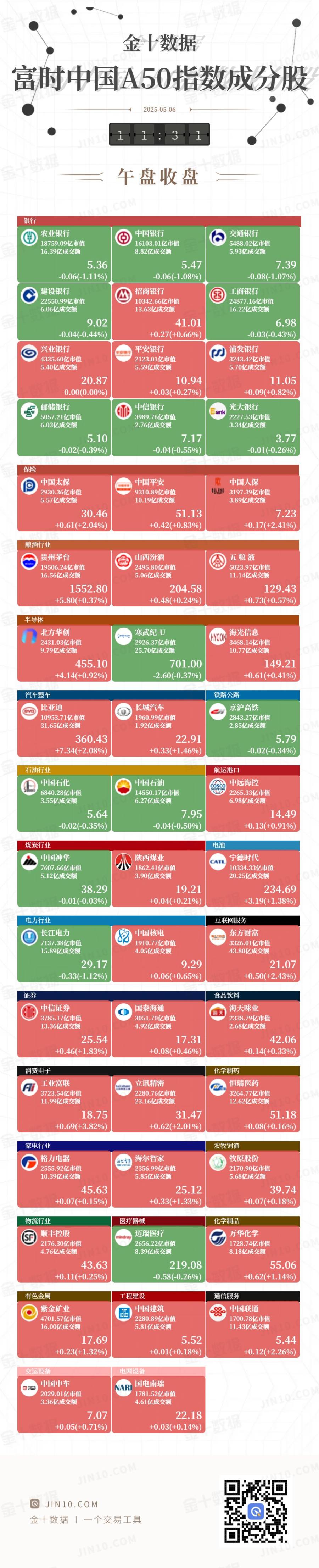
金十图示:2025年05月06日(周二)富时中国A50指数成分股午盘收盘行情一览:保险、白酒汽车板块上涨,银行、半导体板块涨跌不一,电力等板块走弱
news flash· 2025-05-06 03:40
Market Overview - The FTSE China A50 index components showed mixed performance with insurance and liquor sectors rising, while banking and semiconductor sectors had varied results, and the power sector weakened [1][4]. Insurance Sector - China Pacific Insurance, Ping An Insurance, and China Life Insurance had market capitalizations of CNY 293.04 billion, CNY 931.09 billion, and CNY 319.74 billion respectively, with trading volumes of CNY 557 million, CNY 1.019 billion, and CNY 389 million [3]. - China Pacific Insurance rose by 2.04%, Ping An by 0.83%, and China Life by 2.41% [3]. Liquor Industry - Kweichow Moutai, Wuliangye, and Shanxi Xinghuacun Fenjiu had market capitalizations of CNY 1,950.62 billion, CNY 249.58 billion, and CNY 502.40 billion respectively, with trading volumes of CNY 1.656 billion, CNY 506 million, and CNY 1.114 billion [3]. - Kweichow Moutai increased by 0.37%, Wuliangye by 0.24%, and Shanxi Xinghuacun by 0.57% [3]. Semiconductor Sector - Northern Huachuang, Cambricon Technologies, and Haiguang Information had market capitalizations of CNY 243.10 billion, CNY 292.64 billion, and CNY 346.81 billion respectively, with trading volumes of CNY 979 million, CNY 2.570 billion, and CNY 1.077 billion [3]. - Northern Huachuang rose by 0.92%, while Cambricon Technologies fell by 0.37% and Haiguang Information increased by 0.41% [3]. Automotive Sector - BYD, Great Wall Motors, and Beijing-Shanghai High-Speed Railway had market capitalizations of CNY 196.10 billion, CNY 284.33 billion, and CNY 1,095.37 billion respectively, with trading volumes of CNY 3.165 billion, CNY 192 million, and CNY 285 million [3]. - BYD increased by 2.08%, Great Wall Motors by 1.46%, while Beijing-Shanghai High-Speed Railway decreased by 0.34% [3]. Power Sector - China Yangtze Power, China Nuclear Power, and China Power had market capitalizations of CNY 713.74 billion, CNY 191.08 billion, and CNY 332.60 billion respectively, with trading volumes of CNY 1.589 billion, CNY 405 million, and CNY 4.380 billion [4]. - China Nuclear Power rose by 2.43%, while China Yangtze Power fell by 1.12% [4]. Other Sectors - Various sectors including food and beverage, electronics, and pharmaceuticals showed diverse performances with notable market capitalizations and trading volumes [4][5].




煤炭开采行业周报:煤价淡季或逐步趋稳,关注迎峰度夏补库情况
Xinda Securities· 2025-05-05 08:23
Investment Rating - The investment rating for the coal industry is "Positive" [2] Core Viewpoints - The current phase is seen as the beginning of a new upward cycle for the coal economy, with a resonance between fundamentals and policies, making it an opportune time to accumulate coal sector investments [11][12] - The underlying investment logic of coal capacity shortages remains unchanged, with a short-term supply-demand balance and a long-term gap still present [11][12] - The trend of coal prices establishing a bottom and moving to a new platform is expected to continue, with high profitability, cash flow, return on equity (ROE) of 10-20%, and dividend yields over 5% for quality coal companies [11][12] - The coal sector is considered undervalued, with overall valuation expected to improve, supported by high premiums in the primary mining rights market and a price-to-book (PB) ratio around 1 for most companies [11][12] Summary by Sections Coal Price Trends - As of May 4, the market price for Qinhuangdao port thermal coal (Q5500) is 652 CNY/ton, down 3 CNY/ton week-on-week [3][30] - The price for Shanxi-produced coking coal at Jingtang port remains stable at 1400 CNY/ton [32] Supply and Demand Tracking - The capacity utilization rate for sample thermal coal mines is 93.9%, down 0.3 percentage points week-on-week, while the utilization rate for coking coal mines is 89.74%, up 1.36 percentage points [4][47] - Daily coal consumption in inland provinces decreased by 18.40 thousand tons/day (-6.21%), while consumption in coastal provinces increased by 9.30 thousand tons/day (+5.27%) [4][48] Inventory and Transportation - As of April 29, coal inventory in inland provinces increased by 2.59% week-on-week, while coastal provinces saw a 0.77% increase [48] - The daily coal consumption in coastal provinces is showing an upward trend, indicating a potential increase in demand as the summer peak approaches [4][48] Investment Recommendations - Focus on stable and robust performers such as China Shenhua, Shaanxi Coal, and China Coal Energy, as well as companies with high elasticity like Yanzhou Coal and China Power Investment [12]
煤价淡季或逐步趋稳,关注迎峰度夏补库情况
Xinda Securities· 2025-05-05 07:22
Investment Rating - The investment rating for the coal industry is "Positive" [2] Core Viewpoints - The current phase is seen as the beginning of a new upward cycle for the coal economy, with a resonance between fundamentals and policies, making it an opportune time to accumulate coal sector investments [11][12] - The underlying investment logic of coal capacity shortages remains unchanged, with a short-term supply-demand balance and a long-term gap still present [11] - The trend of coal prices establishing a bottom and moving to a new platform is expected to continue, with high profitability, cash flow, return on equity (ROE) of 10-20%, and dividend yields over 5% for quality coal companies [11][12] - The coal sector is considered undervalued, with overall valuation expected to improve, supported by high premiums in the primary mining rights market and a price-to-book (PB) ratio around 1 for most companies [11][12] Summary by Sections Coal Price Trends - As of May 4, the market price for Qinhuangdao port thermal coal (Q5500) is 652 CNY/ton, down 3 CNY/ton week-on-week [3][30] - The price for Shanxi-produced coking coal at Jingtang port remains stable at 1400 CNY/ton [32] Supply and Demand Tracking - The capacity utilization rate for sample thermal coal mines is 93.9%, down 0.3 percentage points week-on-week, while the utilization rate for coking coal mines is 89.74%, up 1.36 percentage points [4][47] - Daily coal consumption in inland provinces decreased by 18.40 thousand tons/day (-6.21%), while consumption in coastal provinces increased by 9.30 thousand tons/day (+5.27%) [4][48] Inventory and Transportation - As of April 29, coal inventory in inland provinces increased by 2.59% week-on-week, while coastal provinces saw a 0.77% increase [48] - The daily coal consumption in coastal provinces is showing an upward trend, indicating a potential increase in demand as the summer peak approaches [4][48] Investment Recommendations - Focus on stable and robust performers such as China Shenhua, Shaanxi Coal, and China Coal Energy, as well as companies with high elasticity like Yanzhou Coal and China Power Investment [12]
2025年一季度数据及业绩综述:一季度业绩下降,静待需求好转
ZHESHANG SECURITIES· 2025-05-01 01:53
Investment Rating - The industry investment rating is maintained as "Positive" [1] Core Viewpoints - The coal sector's overall performance in Q1 2025 showed a decline, with a total net profit of 24.12 billion yuan, down 41.5% year-on-year. Among 37 listed companies, 25 reported profits, with 23 experiencing a year-on-year decline in net profit [3] - The report suggests that the weak demand in Q1, influenced by holidays and higher temperatures, led to increased supply and falling coal prices. However, due to long-term contract pricing, the performance of thermal coal companies remained relatively stable. A rebound in coal prices is expected around mid-May [3] - The report emphasizes the importance of monitoring demand recovery and suggests that the current demand may represent the annual bottom, with a potential rebound in prices during the peak season [3] Industry Market Performance - As of April 29, the CITIC coal industry index fell by 3.69%, underperforming the CSI 300 index, which declined by 2.89%. Year-to-date, the coal sector has dropped by 13.99%, lagging behind the CSI 300 by 9.93 percentage points [10] - The coal industry's price-to-earnings ratio (TTM) is 11.5, which is relatively low compared to other sectors, ranking 27th among 30 CITIC primary industries [10] Supply and Demand Situation - In Q1 2025, the average daily sales of the top 20 coal groups decreased by 3.5% year-on-year, while national coal production increased by 8.1% to 1.2 billion tons [4][40] - The total coal consumption in China for Q1 2025 was 1.27 billion tons, a slight increase of 0.2% year-on-year, with the power sector consuming 740 million tons, down 3% [59] - The report indicates that coal prices have generally declined in Q1, with thermal coal prices at 767.6 yuan/ton, down 16.5% year-on-year [4] Investment Recommendations - The report recommends focusing on high-dividend thermal coal companies during market dips, specifically mentioning China Shenhua, Shaanxi Coal and Chemical Industry, and China Coal Energy for thermal coal, and Huabei Mining and Lu'an Environmental Energy for coking coal [3]

中国神华20250429
2025-04-30 02:08
Summary of China Shenhua's Conference Call Company Overview - **Company**: China Shenhua Energy Company Limited - **Industry**: Coal and Energy Key Points and Arguments Financial Performance - In Q1 2025, China Shenhua reported a net profit of 13.37 billion yuan, a year-on-year decline of 18% [4][2] - Operating revenue decreased by 21% to 69.6 billion yuan, primarily due to falling coal sales volume and prices, as well as reduced electricity sales [4][2] - The net cash flow from operating activities fell by 26% to 20.5 billion yuan [2][4] Coal Market Dynamics - The coal industry is facing significant performance challenges, with net profit declines ranging from 20% to 90% across different companies [2][6] - Coal prices at pitheads and ports are inverted, with coastal imported coal suppressing average prices [2][9] - China Shenhua's coal production decreased by 1.1% year-on-year, while sales volume dropped by 15.3% [2][10] Cost and Pricing Trends - The annual long-term coal price increased by 2.4% to 502 yuan/ton, despite a decline in trade coal prices [2][11] - Production costs for self-produced coal rose, with labor costs increasing by 6.7% and repair costs by 15.5% [2][14] - The company anticipates a minimum 6% increase in overall production costs for the year [2][14] Strategic Initiatives - China Shenhua plans to continue its capital expenditure program, focusing on new mining areas, railways, and power plants to enhance resource and transportation advantages [3][18] - The company is committed to improving operational efficiency and maintaining cash flow stability despite market challenges [18][20] Market Sentiment and Investor Engagement - Investor interest in the coal sector has diminished, as evidenced by a significant drop in questions during annual online communications [2][8] - The company emphasizes the importance of detailed information disclosure to help investors understand data fluctuations and assess operational conditions [17][22] Future Outlook - Despite a weak overall market environment, China Shenhua remains optimistic about its long-term value and competitive advantages [23][22] - The company is expected to face challenges in the second quarter due to increased port inventory and lower demand during holidays, but it aims to manage costs effectively [15][20] International Projects - The Zashulan project, a 5 million ton cooperation initiative, is progressing but faces challenges due to tariffs and sanctions [21][21] - Collaboration on the Ganquan Railway with Mongolia is expected to enhance resource security in the long term, despite limited short-term contributions [21][21] Additional Important Insights - The coal market is expected to remain under pressure, with ongoing price volatility and structural changes in sales impacting overall performance [12][13] - The company is focusing on enhancing its long-term contracts to stabilize revenue amidst fluctuating market conditions [12][13]
中国神华(601088):煤电量价齐跌致业绩回落 高分红中长期价值凸显
Xin Lang Cai Jing· 2025-04-29 02:35
Core Viewpoint - The company's performance has declined due to falling coal prices and electricity sales, but its high dividend yield and stable earnings present long-term investment value, maintaining a "buy" rating [1] Group 1: Financial Performance - In Q1 2025, the company reported revenue of 69.59 billion yuan, a year-on-year decrease of 21.1% and a quarter-on-quarter decrease of 17.6% [1] - The net profit attributable to shareholders was 11.95 billion yuan, down 18% year-on-year and 5.1% quarter-on-quarter [1] - The adjusted net profit was 11.7 billion yuan, reflecting a year-on-year decline of 28.9% and a quarter-on-quarter decline of 16.9% [1] Group 2: Coal Business Performance - In Q1 2025, the company's coal production was 8.25 million tons, a decrease of 1.1% year-on-year and 0.2% quarter-on-quarter [2] - Coal sales volume was 9.93 million tons, down 15.3% year-on-year and 12.9% quarter-on-quarter, with self-produced coal sales at 7.85 million tons, down 4.7% year-on-year [2] - The average selling price of coal was 506 yuan per ton, a decrease of 11.7% year-on-year [2] Group 3: Electricity Business Performance - The company's electricity generation in Q1 2025 was 50.42 billion kWh, down 10.7% year-on-year [2] - Electricity sales volume was 47.47 billion kWh, also down 10.7% year-on-year [2] - The average selling price of electricity was 0.4393 yuan per kWh, a decrease of 4.5% year-on-year [2] Group 4: Future Outlook and Dividends - The company has three major coal mines under construction, expected to enhance production capacity by 2028 [4] - The dividend payout ratio for 2024 is projected to be 76.53%, an increase of 1.31 percentage points from 2023, with a current dividend yield of 5.8% [4] - The company plans to increase the minimum cash dividend payout ratio to 65% for 2025-2027 and consider increasing the frequency of dividends [4]