XIAOMI(01810)

Search documents
小米集团-W1月26日斥资1.4亿港元回购398.72万股
Zhi Tong Cai Jing· 2026-01-26 11:27
Group 1 - The company announced a share buyback of 3.9872 million shares at a total cost of HKD 140 million, with a buyback price ranging from HKD 35.04 to HKD 35.22 per share [1] - On the same day, the company issued 127,600 shares under its share scheme [1]
小米集团-W(01810.HK)1月26日耗资1.4亿港元回购398.7万股
Ge Long Hui· 2026-01-26 11:23
格隆汇1月26日丨小米集团-W(01810.HK)公告,1月26日耗资1.4亿港元回购398.7万股。 ...
小米集团-W(01810)1月26日斥资1.4亿港元回购398.72万股
智通财经网· 2026-01-26 11:23
于同日,公司根据股份计划发行12.76万股股份。 智通财经APP讯,小米集团-W(01810)发布公告,于2026年1月26日,该公司斥资1.4亿港元回购398.72万 股股份,每股回购价35.04-35.22港元。 ...
小米集团(01810) - 翌日披露报表
2026-01-26 11:13
FF305 翌日披露報表 (股份發行人 ── 已發行股份或庫存股份變動、股份購回及/或在場内出售庫存股份) 表格類別: 股票 狀態: 新提交 公司名稱: 小米集团 (於開曼群島註冊成立以不同投票權控制的有限公司) 呈交日期: 2026年1月26日 如上市發行人的已發行股份或庫存股份出現變動而須根據《香港聯合交易所有限公司(「香港聯交所」)證券上市規則》(「《主板上市規則》」)第13.25A條 / 《香港聯合交易所有限公司GEM證券 上市規則》(「《GEM上市規則》」)第17.27A條作出披露,必須填妥第一章節 。 | 第一章節 | | | | | | | | | | | --- | --- | --- | --- | --- | --- | --- | --- | --- | --- | | 1. 股份分類 | 不同投票權架構公司普通股 | | 股份類別 | B | | 於香港聯交所上市 | 是 | | | | 證券代號 (如上市) | 01810 | | 說明 | | | | | | | | 多櫃檯證券代號 | 81810 | RMB | 說明 | | | | | | | | A. 已發行股份或庫存股份變動 ...
长久物流荣获“小米先进保障供应商”称号
Zheng Quan Ri Bao· 2026-01-26 11:12
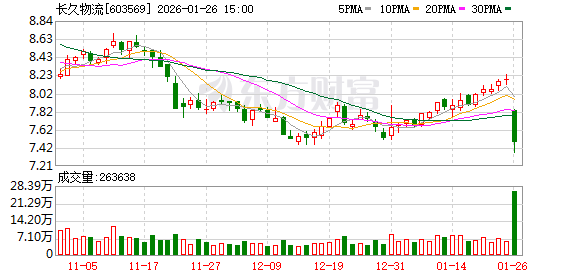
Core Viewpoint - Changjiu Logistics has been awarded the title of "Advanced Guarantee Supplier" by Xiaomi for its outstanding performance in the delivery assurance of Xiaomi vehicles in 2025, reflecting high recognition from the client for the company's professional capabilities and problem-solving spirit [2]. Group 1: Company Performance - Since the establishment of cooperation, Changjiu Logistics has demonstrated strong transportation capacity in the complete vehicle transport sector, maintaining high efficiency and service KPIs in supplier rankings [2]. - The company has effectively managed high-intensity delivery tasks through scientific scheduling and meticulous management, particularly excelling in responding to urgent transportation needs during transit [2]. Group 2: Client Relationship - The recognition not only affirms Changjiu Logistics' past achievements but also signifies a deepening of the cooperative relationship with Xiaomi [2]. - Looking ahead, Changjiu Logistics aims to uphold high service standards and provide superior and efficient logistics solutions to support Xiaomi's market expansion [2].


智通港股通活跃成交|1月26日





智通财经网· 2026-01-26 11:02
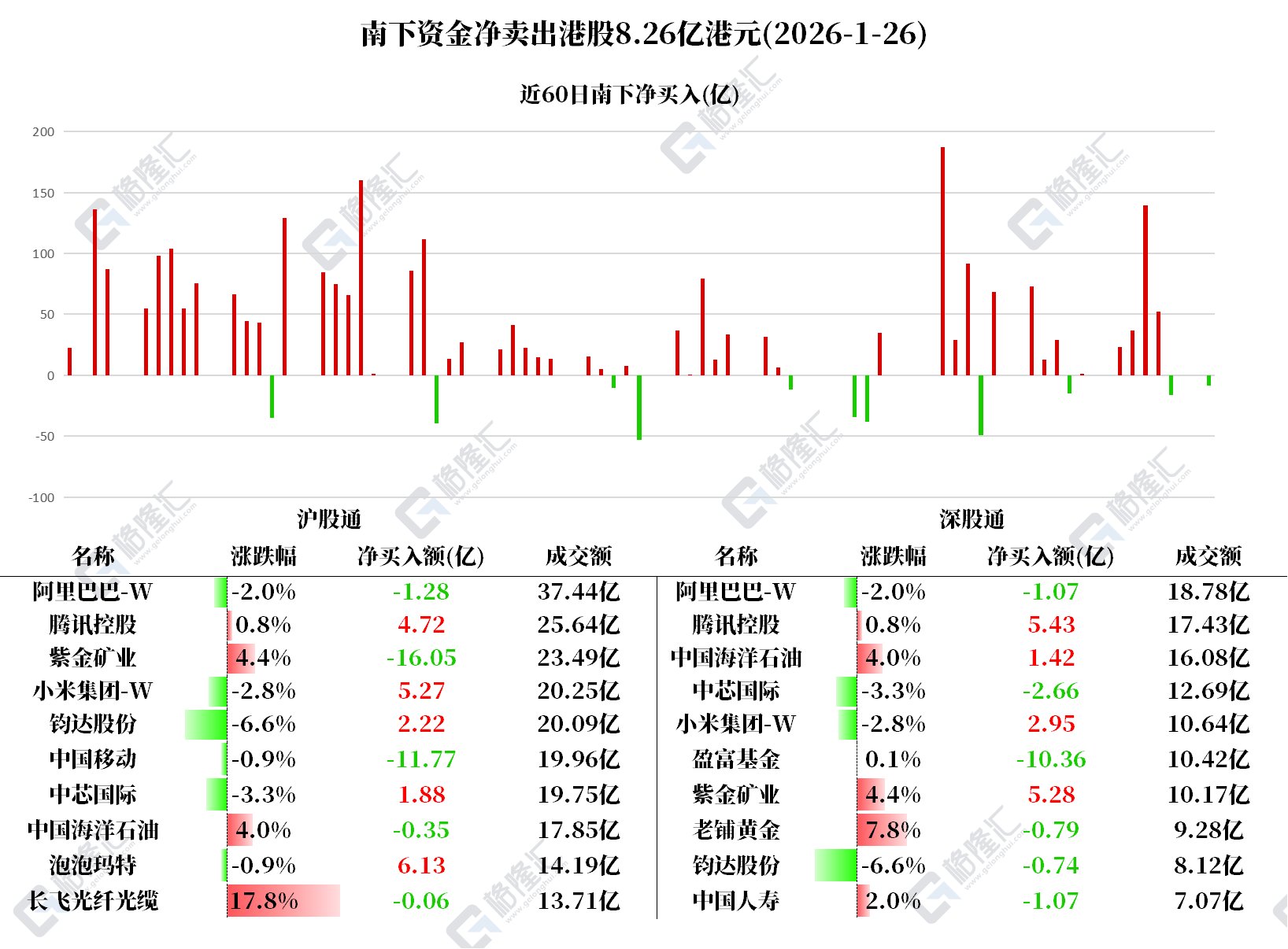
Core Insights - On January 26, 2026, Alibaba-W (09988), Tencent Holdings (00700), and Zijin Mining (02899) were the top three companies by trading volume in the Southbound Stock Connect, with trading amounts of 3.744 billion, 2.564 billion, and 2.349 billion respectively [1] - In the Shenzhen-Hong Kong Stock Connect, Alibaba-W (09988), Tencent Holdings (00700), and China National Offshore Oil Corporation (00883) also ranked as the top three, with trading amounts of 1.878 billion, 1.743 billion, and 1.608 billion respectively [1] Southbound Stock Connect - Top Active Companies - Alibaba-W (09988) had a trading amount of 3.744 billion with a net buy of -128 million [2] - Tencent Holdings (00700) recorded a trading amount of 2.564 billion with a net buy of 472 million [2] - Zijin Mining (02899) had a trading amount of 2.349 billion with a net buy of -1.605 billion [2] - Xiaomi Group-W (01810) achieved a trading amount of 2.025 billion with a net buy of 527 million [2] - JunDa Co., Ltd. (02865) had a trading amount of 2.009 billion with a net buy of 222 million [2] - China Mobile (00941) recorded a trading amount of 1.996 billion with a net buy of -1.177 billion [2] - SMIC (00981) had a trading amount of 1.975 billion with a net buy of 188 million [2] - China National Offshore Oil Corporation (00883) achieved a trading amount of 1.785 billion with a net buy of -35.021 million [2] - Pop Mart (09992) had a trading amount of 1.419 billion with a net buy of 613 million [2] - Yangtze Optical Fibre and Cable (06869) recorded a trading amount of 1.371 billion with a net buy of -6.072 million [2] Shenzhen-Hong Kong Stock Connect - Top Active Companies - Alibaba-W (09988) had a trading amount of 1.878 billion with a net buy of -107 million [2] - Tencent Holdings (00700) recorded a trading amount of 1.743 billion with a net buy of 543 million [2] - China National Offshore Oil Corporation (00883) achieved a trading amount of 1.608 billion with a net buy of 142 million [2] - SMIC (00981) had a trading amount of 1.269 billion with a net buy of -266 million [2] - Xiaomi Group-W (01810) recorded a trading amount of 1.064 billion with a net buy of 295 million [2] - Yingfu Fund (02800) had a trading amount of 1.042 billion with a net buy of -1.036 billion [2] - Zijin Mining (02899) achieved a trading amount of 1.017 billion with a net buy of 528 million [2] - Laopu Gold (06181) had a trading amount of 0.928 billion with a net buy of -78.823 million [2] - JunDa Co., Ltd. (02865) recorded a trading amount of 0.812 billion with a net buy of -74.468 million [2] - China Life (02628) had a trading amount of 0.707 billion with a net buy of -107 million [2]
南向资金 | 中国移动遭净卖出11.77亿港元

Di Yi Cai Jing· 2026-01-26 10:13
南向资金今日净卖出8.26亿港元,中国移动、紫金矿业、盈富基金分别遭净卖出11.77亿港元、10.77亿 港元、10.36亿港元。净买入方面,腾讯控股、小米集团-W、泡泡玛特净买入额位列前三,分别获净买 入10.15亿港元、8.22亿港元、6.13亿港元。 (本文来自第一财经) ...
雷军转发央视报道 详解小米智能家电工厂生产细节
Feng Huang Wang· 2026-01-26 09:57
Core Viewpoint - Xiaomi Group is expanding its manufacturing capabilities with the establishment of a new smart appliance factory, which is the second large-scale smart manufacturing base following its smartphone and automotive factories [1] Group 1: Factory Details - The new factory is driven by user demand for innovation and is empowered by artificial intelligence [1] - Specific production features include a production line that can produce an air conditioner every 6.5 seconds and 100% AI quality inspection for key components and complete units [1] - The factory utilizes a magnetic levitation mainboard assembly line, showcasing advanced manufacturing technology [1] Group 2: Future Outlook - Xiaomi's smart home appliances are expected to be distributed globally from this new manufacturing base [1]
图解丨南下资金连续第二日净卖出港股,加仓腾讯、小米,持续出中国移动
Ge Long Hui A P P· 2026-01-26 09:52
Group 1 - Southbound funds recorded a net sell of HKD 826 million in Hong Kong stocks for the second consecutive day [1] - Notable net purchases included Tencent Holdings at HKD 1.015 billion, Xiaomi Group at HKD 822 million, and Pop Mart at HKD 613 million [1] - Significant net sales were observed in China Mobile at HKD 1.177 billion, Zijin Mining at HKD 1.077 billion, and Alibaba at HKD 235 million [1] Group 2 - Southbound funds have consistently net bought Xiaomi for 7 days, totaling HKD 3.89621 billion [1] - Continuous net buying for China National Offshore Oil Corporation (CNOOC) for 4 days, amounting to HKD 1.09627 billion [1] - Pop Mart has seen net buying for 3 consecutive days, totaling HKD 1.73397 billion [1] - China Mobile has faced net selling for 16 days, accumulating to HKD 12.89303 billion [1]
1月23日【港股Podcast】恆指、美團、攜程、贛鋒鋰業、招金礦業、小米
Ge Long Hui· 2026-01-26 09:21
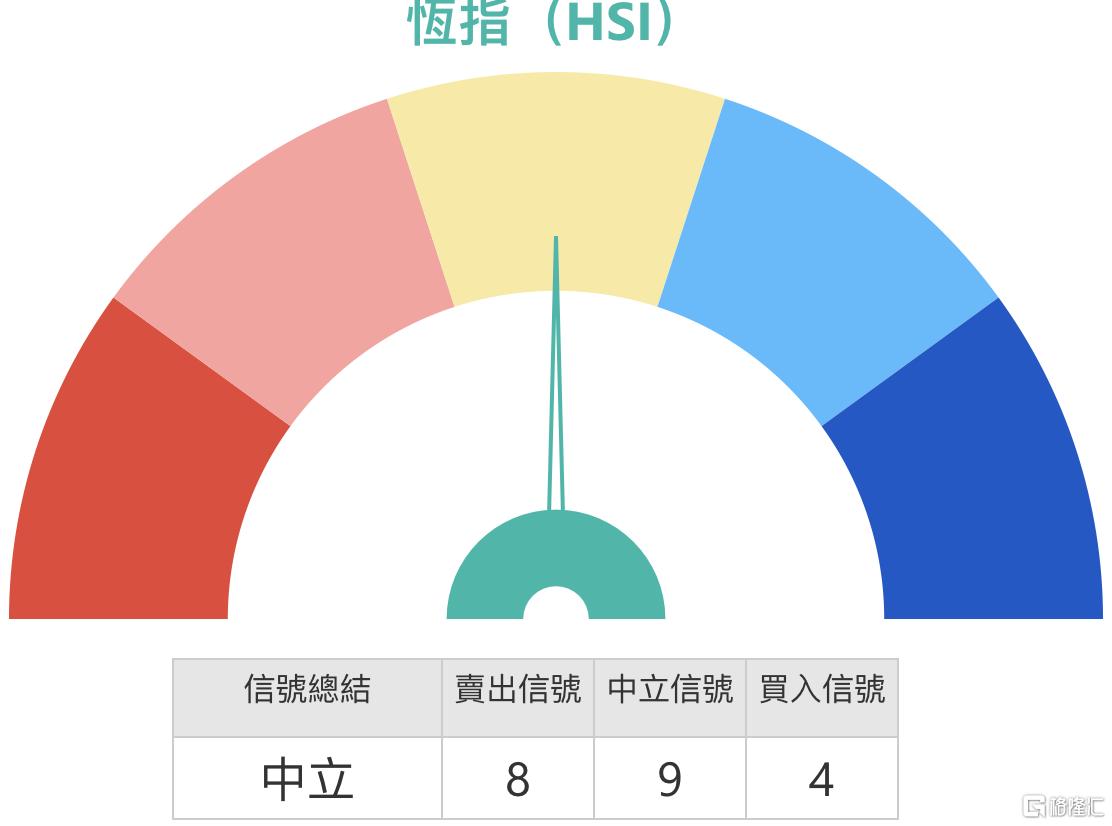
Group 1: Hang Seng Index (HSI) - The Hang Seng Index (HSI) showed a slight upward movement on January 23, closing with an increase of approximately 100 points, indicating a neutral short-term trend with mixed market sentiment [1] - Current technical signals for HSI are neutral, with the index fluctuating around 26,700 points and a resistance level at approximately 27,100 points, while support levels are at 26,200 points and 25,800 points [1] - Investors are divided, with bullish investors holding call warrants with recovery prices of 25,788 and 26,428, while bearish investors are planning to buy put warrants with a recovery price of 26,900 [1] Group 2: Meituan-W (03690.HK) - Meituan-W's stock price has been weak, with a slight increase on January 23, closing at 97.5 HKD, while trading volume increased compared to the previous day [7] - Current technical signals show a predominance of buy signals, totaling 10, with resistance levels at 101.8 HKD and 105 HKD [7] - Investors are advised to avoid out-of-the-money products and consider near-the-money call warrants with exercise prices around 99-100 HKD, expiring in April 2025 [7] Group 3: Trip.com Group (09961.HK) - Trip.com Group's stock price has gradually recovered from a low of 446 HKD, closing at 485.4 HKD on January 23, although trading volume has decreased during this upward movement [13] - The current technical signals indicate a majority of buy signals, with 9 buy signals and 5 sell signals [13] - Investors are recommended to choose bull warrants with recovery prices between 382 and 457 HKD to mitigate risks [13] Group 4: Ganfeng Lithium (01772.HK) - Ganfeng Lithium's stock price reached 70 HKD on January 23, breaking through the upper band of the Bollinger Bands, with increased trading volume [19] - The technical signals currently show a predominance of sell signals, with 10 sell signals and 4 buy signals, suggesting caution for bullish investors [19] - Investors interested in put warrants are advised to wait for more suitable products to be issued due to limited options currently available [19] Group 5: Zhaojin Mining (01818.HK) - Zhaojin Mining's stock price slightly increased to 38.6 HKD on January 23, influenced by rising gold prices, but the market sentiment remains cautious [25] - Current support is around 35.5 HKD, with a resistance level at 41.4 HKD, which needs to be broken for further upward movement [25] - Investors should wait for confirmation of a breakout above the resistance level before making further investment decisions [25] Group 6: Xiaomi Group-W (01810.HK) - Xiaomi Group-W's stock price has been on a downward trend, with a slight increase to 36.2 HKD on January 23, accompanied by increased trading volume [30] - Current technical signals show a slight majority of buy signals, but the stock lacks momentum to surpass 50 HKD in the short term [30] - Investors are advised to avoid out-of-the-money products and consider near-the-money call warrants with leverage around 3 times, which are more suitable for current market conditions [30]