
XIAOMI(01810)

Search documents
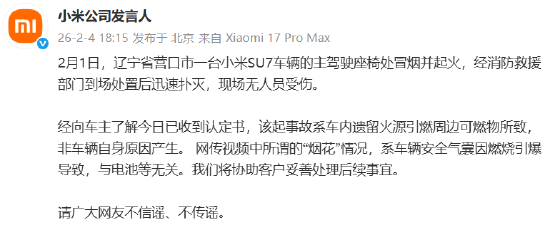
小米回应营口市SU7起火:所谓“烟花”系安全气囊引爆所致,与电池无关
Xin Lang Cai Jing· 2026-02-05 09:45
Core Viewpoint - The incident involving a Xiaomi SU7 vehicle in Yingkou, Liaoning Province, where smoke and fire occurred from the driver's seat, was quickly extinguished by fire rescue services, and no injuries were reported. Xiaomi clarified that the cause was due to an external fire source igniting surrounding combustible materials, not a fault of the vehicle itself [1][2]. Summary by Categories Incident Details - A Xiaomi SU7 vehicle experienced smoke and fire from the driver's seat, which was promptly handled by fire rescue services, resulting in no injuries [1][2]. - The company received a report confirming that the incident was caused by an external fire source rather than an internal vehicle malfunction [1][2]. Company Response - Xiaomi stated that the so-called "fireworks" seen in online videos were due to the vehicle's airbag igniting, unrelated to the battery or other vehicle components [1][2]. - The company expressed its commitment to assist the customer in managing subsequent matters and urged the public not to spread rumors [1][2].


2025年绿色工厂、绿色工业园区!工信部发布公示名单
中国能源报· 2026-02-05 09:39
Core Viewpoint - The Ministry of Industry and Information Technology (MIIT) has released a public list of new green factories and green industrial parks for the year 2025, following recommendations from provincial departments and expert reviews [1][2]. Group 1: Announcement Details - The public announcement period for the 2025 green factories and industrial parks is from February 5, 2026, to February 19, 2026 [2]. - Contact information for inquiries includes a phone number (010—68205340) and an email address (hbc@miit.gov.cn) [2]. Group 2: Green Factory List - The list includes various companies from different regions, with a significant number located in Beijing and Tianjin, such as: - Beijing Ideal Automotive Co., Ltd. - Xiaomi Automotive Technology Co., Ltd. - Tianjin Toyota Motor Co., Ltd. New Energy Division [4][5][6]. - The list highlights a diverse range of industries, including automotive, electronics, and chemicals, indicating a broad commitment to green manufacturing practices across sectors [4][5][6].



雷军:新一代SU7预计2026年4月上市
Zhong Guo Qi Che Bao Wang· 2026-02-05 09:08
Core Viewpoint - The founder of Xiaomi, Lei Jun, announced on Weibo that the new generation SU7 is positioned as a vehicle for a new era of drivers, emphasizing enhanced driving experience and control [1] Group 1 - The SU7 features significant upgrades to its chassis, resulting in improved driving quality [1] - The intelligent electronic control system allows for more precise and stable handling [1] - Pre-orders for the SU7 have already begun, with an expected launch date in April 2026 [1]
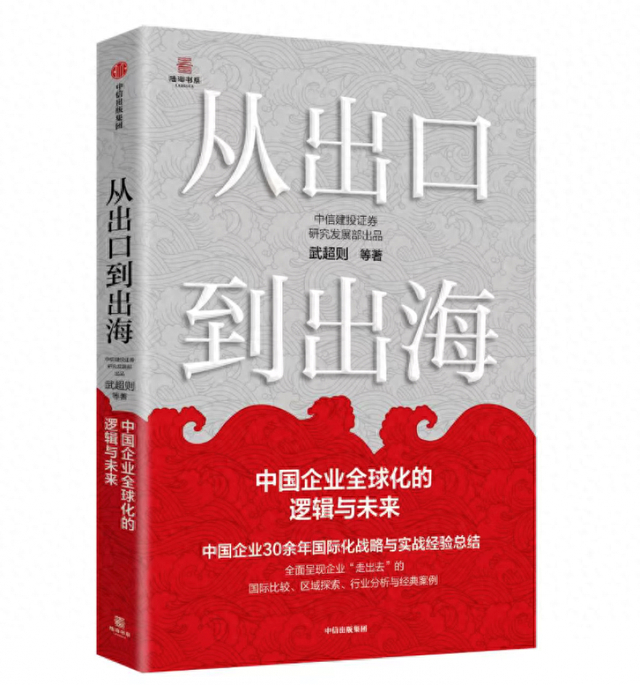
中国企业出海的十大展望
Hua Xia Shi Bao· 2026-02-05 09:01
Group 1: Global Expansion of Chinese Manufacturing - The trend of Chinese manufacturing companies expanding globally is accelerating, particularly in tariff-sensitive sectors such as automotive, consumer electronics, and machinery, which are relocating production to countries with lower tariffs or favorable policies to reduce costs and mitigate trade risks [2][3] - Chinese manufacturers are diversifying their global supply chains by exploring emerging markets in Latin America, the Middle East, and Africa, thereby enhancing supply chain stability and risk resilience [2][3] - The implementation of regional economic cooperation mechanisms and free trade agreements, such as RCEP, is creating a more favorable policy environment for the globalization of Chinese manufacturing [3] Group 2: Overseas Mergers and Acquisitions - Chinese manufacturing companies are leveraging overseas mergers and acquisitions to transition from OEMs to self-owned brands, gaining market share, sales channels, and high-end brand images [3][4] - The focus of these acquisitions is shifting towards strategic alignment in brand, market, technology, and supply chain integration, enhancing global competitiveness [3][4] - Companies like Haier exemplify this trend by achieving breakthroughs in the European and American markets through acquisitions, thereby strengthening their global competitive advantage [3][4] Group 3: Labor-Intensive Industries and Cost Migration - Labor-intensive industries are increasingly relocating to low-cost regions such as Southeast Asia and South Asia, benefiting from local labor advantages and policy support [4][5] - The trend of regional industrial clusters is forming as companies seek to reduce costs and improve response efficiency through localized production [4][5] - The global supply chain is becoming more regionalized, with multinational companies establishing collaborative industrial clusters in emerging regions to enhance supply chain resilience [4][5] Group 4: Resource Sector Globalization - Chinese resource companies are accelerating their global expansion by constructing complete industrial chains from mining to processing and application, enhancing their control and influence in the global resource sector [6][7] - The focus is shifting from merely acquiring resources to deep integration of upstream and downstream operations, utilizing diverse cooperation methods such as equity investments and joint ventures [6][7] - Notable examples include the acquisition of cobalt mines in the Democratic Republic of Congo and lithium companies in Australia, showcasing the strategic foresight of Chinese enterprises [6][7] Group 5: Digital Transformation and Brand Value - Chinese companies are transitioning from low-cost manufacturing to brand value creation, utilizing digitalization to enhance brand building and global competitiveness [9][10] - Companies like Anker and Xiaomi are leveraging localized operations and digital marketing to establish strong brand identities and achieve significant sales growth [9][10] - The focus on digital transformation is enabling companies to create differentiated brand matrices and improve supply chain management, enhancing market competitiveness [9][10] Group 6: Compliance and Localization - Compliance and localized operations are becoming core competitive advantages for Chinese enterprises in international markets, with a focus on establishing robust global compliance systems [11][12] - Companies are actively building global compliance monitoring systems to ensure adherence to regulations in areas such as data security and environmental standards [11][12] - The ability to navigate compliance challenges is increasingly seen as integral to brand value and international market acceptance [11][12] Group 7: Policy Support for Globalization - Recent policy initiatives from the Chinese government are creating unprecedented opportunities for enterprises to expand internationally, emphasizing high-level openness and integration into the global economy [13][14] - The focus on developing new production capabilities and promoting the integration of the real economy with the digital economy is expected to provide clear guidance for companies in the new round of global competition [13][14] - Structural monetary policies are anticipated to offer targeted financial support to foreign trade enterprises, aiding their internationalization efforts [14] Group 8: Cultural and Ideological Export - Chinese enterprises are increasingly integrating cultural content with brand ideology to enhance cultural soft power and global brand value [18][19] - The growth of cultural consumption globally is driving the export of diverse cultural products, including games and films, with significant revenue growth reported [18][19] - The focus on building a robust IP ecosystem and localizing content production is crucial for enhancing global appeal and emotional resonance with audiences [18][19]


智通港股52周新高、新低统计|2月5日
智通财经网· 2026-02-05 08:41
Key Points - As of February 5, 67 stocks reached their 52-week highs, with Rongda Technology (09881), Jiurong Holdings (02358), and Haojiang Electromechanical (01408) leading the increase rates at 162.10%, 91.30%, and 24.59% respectively [1] - The highest closing price for Rongda Technology was 20.620, with a peak of 65.000, indicating significant growth [1] - Jiurong Holdings closed at 0.016, reaching a high of 0.044, reflecting a strong performance [1] - Haojiang Electromechanical had a closing price of 0.330 and a peak of 0.380, showing a notable increase [1] 52-Week High Rankings - The top three stocks with the highest growth rates are: - Rongda Technology (162.10%) - Jiurong Holdings (91.30%) - Haojiang Electromechanical (24.59%) [1] - Other notable mentions include: - Honghai Holdings Group (08020) at 24.14% - Shangyu Group (01633) at 20.60% [1] 52-Week Low Rankings - The stocks that reached their 52-week lows include: - LeMo Technology (02539) with a decline of -42.01% - Weihai Bank (09677) at -20.42% - XL Ernan CO (07711) at -17.57% [2] - Additional stocks with significant declines are: - Songdu Service (09608) at -16.00% - XL Ernan Strategy (07799) at -13.86% [2]

低开高走,港股三大指数全线飘红!小米、百度、美团等齐涨,黄金股跳水!南向资金净买入超249亿港元|港股收盘
Mei Ri Jing Ji Xin Wen· 2026-02-05 08:39
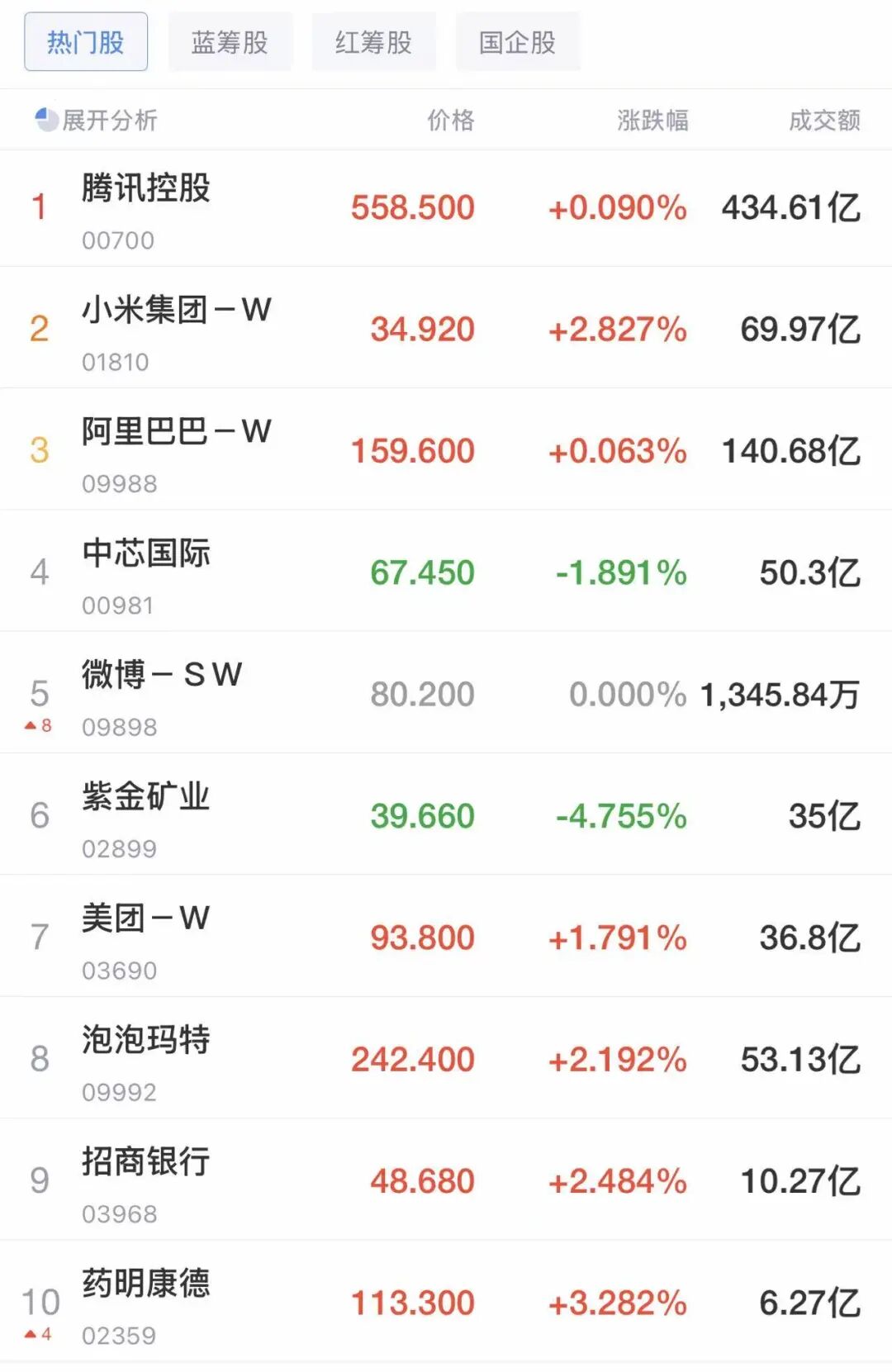
Market Performance - The Hong Kong stock market saw a positive trend with the Hang Seng Index rising by 0.141%, the Hang Seng China Enterprises Index increasing by 0.497%, and the Hang Seng Tech Index up by 0.74% as of the market close [1] - Southbound funds recorded a net inflow exceeding 24.9 billion HKD [1] Sector Performance - Strong performance was noted in sectors such as new energy vehicles, aviation, telecommunications, biomedicine, domestic banks, and logistics [1] - Conversely, sectors like non-ferrous metals, commercial aerospace, optical communications, semiconductors, and photovoltaic solar energy experienced declines [1] Notable Stocks - Tech stocks showed recovery in the afternoon, with Lenovo rising over 3%, Xiaomi and Baidu increasing by more than 2%, and Meituan up by over 1% [1] - Gold stocks generally fell, with Chifeng Jilong Gold Mining dropping over 5% [1] Company Announcements - Baidu announced a new share repurchase plan, allowing for the buyback of up to 5 billion USD of its shares, effective until December 31, 2028 [3] - The board of Baidu also indicated plans to announce its first dividend by 2026, supported by sustainable funding sources [3] Market Outlook - Huazhang Fund noted a significant style rotation in the market, highlighting a "seesaw" effect between the previously strong tech growth sector and dividend value styles [3] - The fund emphasized the attractiveness of dividend stocks due to their high yield and low valuation, alongside expectations of a cyclical recovery and demand from long-term capital [3]




2025胡润中国500强榜单发布,小米超越华为排第八
Qi Lu Wan Bao· 2026-02-05 08:22
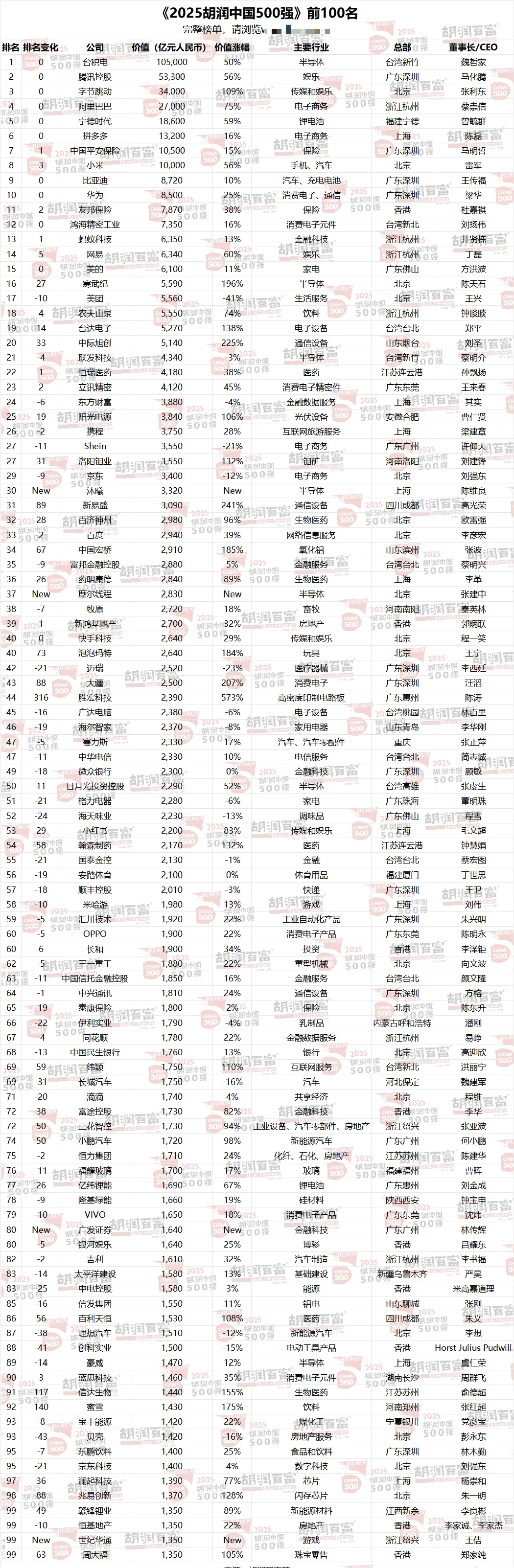
Core Insights - The "2025 Hurun China 500" list ranks the top 500 non-state-owned enterprises in China based on their value, with TSMC, Tencent, and ByteDance leading the rankings [1][2] Group 1: Company Rankings - TSMC retains its position as the highest-valued private enterprise in China, with a value of 10.5 trillion RMB, an increase of 3.5 trillion RMB [1][2] - Tencent follows in second place with a value of 5.3 trillion RMB, up by 1.9 trillion RMB [1][2] - ByteDance ranks third with a value of 3.4 trillion RMB, increasing by 1.8 trillion RMB [1][2] Group 2: Overall Market Trends - The threshold for entering the top 500 increased by 7.5 billion RMB to 34 billion RMB, reflecting a growth rate of 28% [2] - The total value of the top 500 companies grew by 21 trillion RMB, a 38% increase, reaching a total of 77 trillion RMB [2] - Among the 500 companies, 386 saw an increase in value, including 95 new entrants, while 102 experienced a decline [2] Group 3: Industry Distribution - 75% of the companies provide physical products, while 25% offer software or services [2] - The semiconductor, media and entertainment, industrial products, and consumer goods sectors account for half of the total value of the Hurun China 500 [2] Group 4: Geographic Distribution - Beijing, Shanghai, and Shenzhen are the top three cities with the most companies in the Hurun China 500, with 59, 57, and 49 companies respectively [5][6] - The Yangtze River Delta region has 161 companies in the list, making up 32% of the total, while the Guangdong-Hong Kong-Macau Greater Bay Area has 108 companies, accounting for 22% [7]


小米首进中国500强前十,台积电腾讯稳居前二
Bei Ke Cai Jing· 2026-02-05 07:49
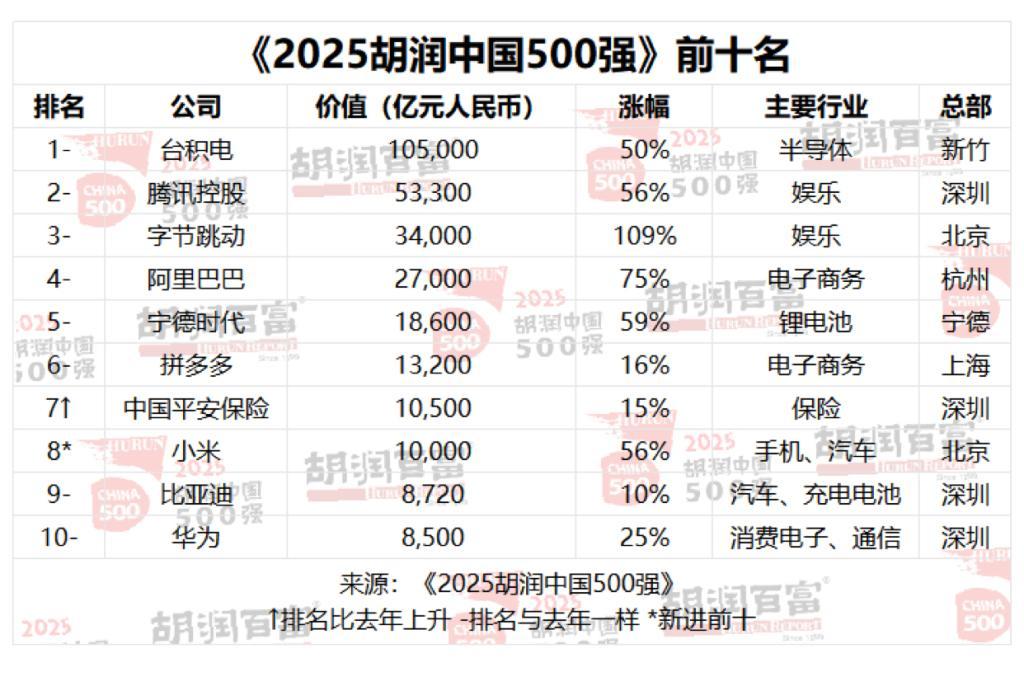
Core Insights - Xiaomi has entered the top ten of the "2025 Hurun China 500" list for the first time, ranking eighth with a valuation of 1 trillion RMB, reflecting a growth of 357 billion RMB [1] Group 1: Company Rankings - TSMC retains its position as the highest-valued private enterprise in China with a valuation of 10.5 trillion RMB, an increase of 3.5 trillion RMB [1] - Tencent ranks second with a valuation of 5.3 trillion RMB, growing by 1.9 trillion RMB [1] - ByteDance holds the third position with a valuation of 3.4 trillion RMB, increasing by 1.8 trillion RMB [1] - Alibaba is fourth with a valuation of 2.7 trillion RMB, reflecting a growth of 75% [1] - Xiaomi's valuation growth of 56% places it eighth among the top ten companies [1] Group 2: Industry Insights - The top ten companies are primarily from the semiconductor, entertainment, e-commerce, and battery industries, indicating a diverse range of sectors driving growth in the Chinese market [1] - The significant valuation increases across these companies suggest a robust recovery and expansion within the Chinese economy [1]
《2025胡润中国500强》发布,小米、比亚迪、华为进入前十
Jin Rong Jie· 2026-02-05 07:07
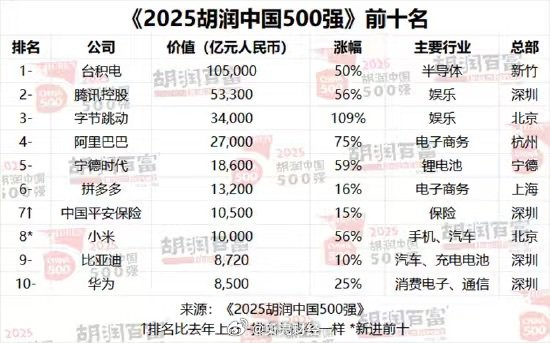
Core Insights - TSMC retains the top position in the "2025 Hurun China 500" list with a value of 10.5 trillion RMB, marking a 50% increase [1][4] - Tencent, ByteDance, Alibaba, and CATL follow in the rankings with values of 5.33 trillion, 3.4 trillion, 2.7 trillion, and 1.86 trillion RMB respectively [1][4] - The total value of the top 500 companies reached 77 trillion RMB, an increase of 21 trillion RMB, representing a growth rate of 38% [4] Company Rankings - TSMC: 10.5 trillion RMB, 50% increase [1][4] - Tencent: 5.33 trillion RMB, 56% increase [2][4] - ByteDance: 3.4 trillion RMB, 109% decrease [2][4] - Alibaba: 2.7 trillion RMB, 75% increase [2][4] - CATL: 1.86 trillion RMB, 59% increase [2][4] - Xiaomi: 1 trillion RMB, 3-position rise [1][4] - BYD: 872 billion RMB, 10% increase [1][4] - Huawei: 850 billion RMB, 25% increase [1][4] Industry Insights - The semiconductor industry, represented by companies like TSMC, has shown the most significant growth [4] - Major cities such as Beijing, Shanghai, and Shenzhen host the highest number of companies in the top 500, with 59, 57, and 49 companies respectively [4] - The combined presence of these six cities accounts for 50% of the total companies in the Hurun China 500 list [4]
资金逆势加仓!恒生科技ETF南方(520570)近20日资金净流入5.19亿元,机构认为港股科技板块仍是中长期投资主线
Ge Long Hui· 2026-02-05 06:37
Group 1 - The core viewpoint of the news is that the Hong Kong stock market, particularly the Hang Seng Technology ETF, is experiencing significant capital inflow despite market adjustments, indicating strong investor interest in technology stocks [1] - As of February 4, the Hang Seng Technology Index saw a net inflow of 28.84 billion yuan, leading the stock ETF market, with the ETF tracking this index having an annual share increase of 244.97 million shares [1] - The Hang Seng Technology ETF (Southern, 520570) received a net inflow of 78.75 million yuan yesterday and a total of 519 million yuan over the past 20 days, reflecting robust trading activity [1] Group 2 - The Hang Seng Technology Index covers key sectors of the Chinese technology industry, including internet platforms, AI and computing, semiconductors, new energy vehicles, smart hardware, and biomedicine, featuring major companies like Tencent, Alibaba, and JD [1] - The current price-to-earnings ratio (PE-TTM) of the Hang Seng Technology Index is 22.38 times, which is at the 25.69% historical percentile since the index's inception, indicating a relatively low historical valuation [1] - According to Galaxy Securities, the technology sector in the Hong Kong stock market remains a long-term investment focus, with expectations of upward movement due to multiple favorable factors such as price increases in the supply chain, domestic substitution, and accelerated AI applications [2]
