
LI AUTO-W(02015)

Search documents
汽车股普涨 比亚迪股份涨约4% 商务部召开座谈会推动汽车消费
Ge Long Hui· 2026-02-10 03:02
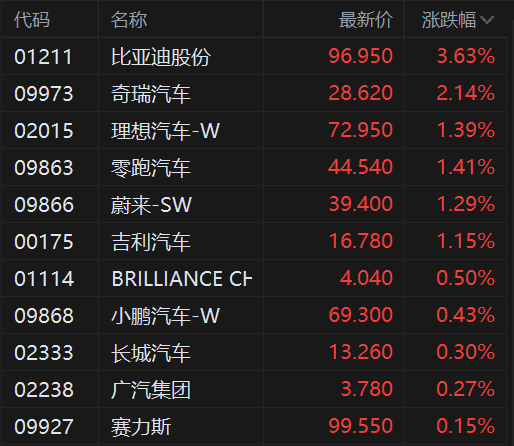
Group 1 - The core viewpoint of the news is that the Hong Kong automotive stocks experienced a collective rise, driven by positive signals from the Ministry of Commerce regarding future automotive consumption policies [1] - The Ministry of Commerce held a meeting to discuss automotive circulation and consumption, indicating a commitment to support and reform the automotive sector by 2026 [1] - Analysts interpret the signals from the meeting as a positive indication for automotive consumption support policies, providing a clear expectation for industry stabilization and structural growth direction [1] Group 2 - BYD shares rose approximately 4% to a latest price of 96.950, while Chery Automobile increased by over 2% to 28.620 [2] - Other automotive companies also saw gains, including Li Auto (1.39% increase), Leap Motor (1.41% increase), NIO (1.29% increase), and Geely (1.15% increase) [2] - The overall positive trend in the automotive sector reflects investor confidence in the upcoming policy changes and market support initiatives [1][2]




瑞银:理想汽车-W(02015)L9焕新在即催化重估 重申“买入”评级
智通财经网· 2026-02-10 02:38
Core Viewpoint - UBS reports that Li Auto-W (02015) currently has an attractive valuation level, trading below 95% of its listing time, with net cash accounting for about two-thirds of its market value, indicating a very pessimistic market sentiment [1] Group 1: Valuation and Market Sentiment - Li Auto's current trading valuation is lower than 95% of the time since its IPO, reflecting a significant pessimism in market sentiment [1] - The company's net cash constitutes approximately 66% of its market value, further emphasizing the undervaluation [1] Group 2: Product Launch and Growth Potential - The new generation L9 is set to be launched in the second quarter, with the flagship L9 Livis priced at 559,800 RMB [1] - UBS believes that market sentiment is likely to improve gradually from now until the official launch, which will enhance investor visibility on other model updates [1] - The flagship SUV L9 is expected to drive growth acceleration from a low base in 2025 [1] Group 3: Competitive Position and Resilience - Despite facing challenges from rising commodity costs, the company is expected to demonstrate more resilience than most peers due to its high-end positioning and profit buffer [1] - UBS considers this an appropriate time to refocus on the stock, given its high risk-reward attractiveness [1]
瑞银:理想汽车-WL9焕新在即催化重估 重申“买入”评级
Zhi Tong Cai Jing· 2026-02-10 02:35
Core Viewpoint - UBS reports that Li Auto-W (02015) currently has an attractive valuation level, trading below 95% of its historical valuation since its listing, with net cash accounting for about two-thirds of its market value, indicating a very pessimistic market sentiment [1] Group 1: Valuation and Market Sentiment - Li Auto's current trading valuation is below 95% of the time since its IPO, reflecting a significant market pessimism [1] - Net cash represents approximately two-thirds of the company's market value, highlighting the financial strength amidst negative sentiment [1] Group 2: Product Launch and Growth Potential - The new generation L9 is set to be launched in the second quarter, with the flagship L9 Livis priced at 559,800 RMB [1] - UBS believes that market sentiment is likely to improve gradually leading up to the official launch, which will enhance visibility on other model updates [1] - The flagship SUV L9 is expected to drive growth acceleration from a low base in 2025 [1] Group 3: Competitive Positioning - Despite facing challenges from rising commodity costs, the company is expected to demonstrate more resilience than most peers due to its high-end positioning and profit buffer [1] - UBS reiterates that now is an appropriate time to refocus on the stock given its high risk-reward attractiveness [1]
港股异动丨汽车股普涨 比亚迪股份涨约4% 商务部召开座谈会推动汽车消费
Ge Long Hui· 2026-02-10 02:29
Group 1 - The core viewpoint of the news is that Hong Kong automotive stocks have collectively risen, with significant gains observed in companies like BYD, Chery, and others, following a meeting held by the Ministry of Commerce regarding automotive consumption policies for 2026 [1] - The Ministry of Commerce plans to implement a series of measures to boost automotive consumption, including optimizing the vehicle trade-in program and conducting pilot reforms in automotive circulation [1] - Analysts interpret the signals from the Ministry's meeting as positive, viewing it as a "starting gun" for supportive automotive consumption policies in 2026, which provides a clear expectation for industry support and structural growth direction [1] Group 2 - BYD shares rose approximately 4% to a latest price of 96.950, while Chery Automotive increased by over 2% to 28.620 [2] - Other automotive companies also saw gains, with Li Auto up 1.39%, Leap Motor up 1.41%, NIO up 1.29%, and Geely up 1.15% [2] - The overall positive sentiment in the automotive sector is reflected in the stock performance of various companies, indicating investor confidence in future growth driven by government policies [1][2]
2026格局与趋势 |(上):天黑请睁眼
3 6 Ke· 2026-02-10 01:20
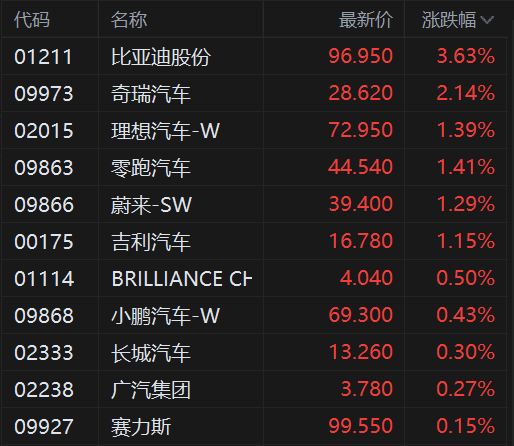
Core Viewpoint - The Chinese automotive market is facing significant challenges in 2026, with predictions of a decline in sales due to economic pressures and changing consumer behavior, despite some optimistic forecasts for growth in exports and specific segments like new energy vehicles [1][3][4]. Group 1: Market Trends and Predictions - In 2026, the overall automotive sales in China are expected to range between 34.5 million to 35 million units, with a potential decline in domestic retail sales by over 5% if no significant policy changes occur [3][7]. - January 2026 data shows a dramatic decline in retail sales, with a 28% year-on-year drop, indicating a challenging start to the year [6]. - Various institutions predict a range of outcomes for 2026, with the most pessimistic forecasts suggesting a 7% decline in sales, while the most optimistic predict only a 1% increase [4][7][8]. Group 2: Policy and Economic Influences - Key factors affecting the market include adjustments to subsidy policies for new energy vehicles, which have shifted from full exemptions to partial reductions, impacting consumer purchasing behavior [6][9]. - The decline in consumer confidence and shrinking middle-class income due to economic downturns are expected to further suppress automotive sales [6][9]. Group 3: Competitive Landscape - The automotive industry is experiencing intense competition, with a shift from price wars to a focus on technological advancements and value creation as companies seek to stabilize their market positions [12][16]. - Major players are adjusting their sales targets, with some aiming for significant growth while others adopt more conservative strategies in response to market conditions [18][19]. Group 4: Export Opportunities - Exports are projected to be a key growth area, with expectations of a 12-15% increase, potentially reaching 8 million units, which could help offset domestic market declines [22][26]. - The global supply chain dynamics are pushing Chinese automotive companies to enhance their international presence, with a focus on building global production and R&D capabilities [26][28]. Group 5: Segment-Specific Insights - The new energy vehicle segment is anticipated to grow, with retail sales expected to increase by 12-15%, driven by favorable policies for mid-range models [9][10]. - The large six-seat SUV market is projected to maintain strong growth, with expectations of a 30-50% increase in sales, despite overall market challenges [31][32].



美股三大指数集体收涨,纳指涨0.9%,甲骨文涨超9%
Ge Long Hui· 2026-02-10 01:04
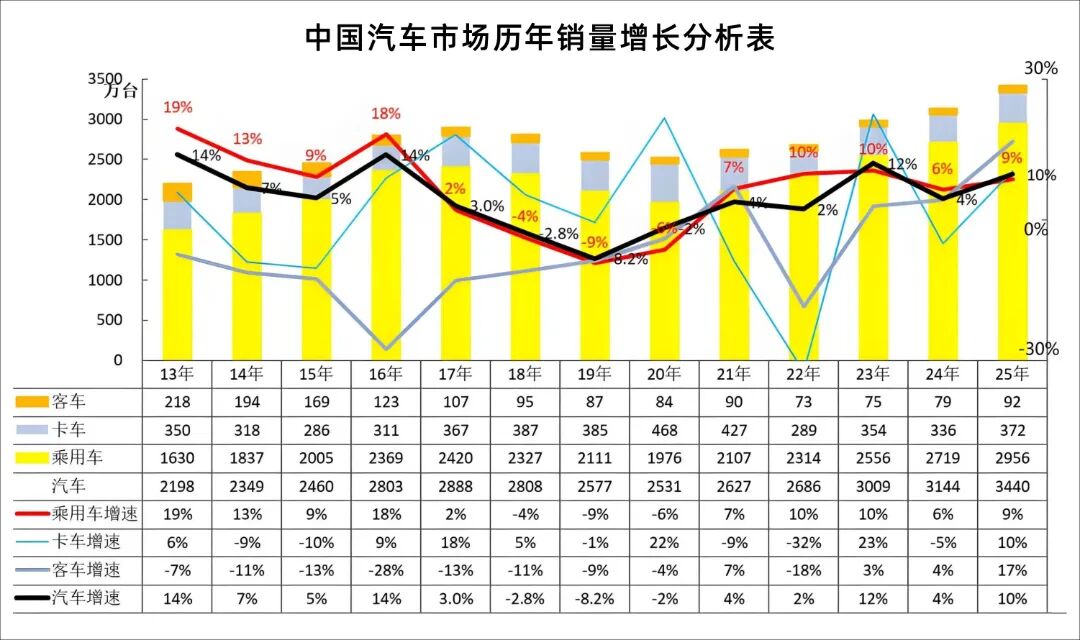
Market Performance - The three major U.S. stock indices closed higher, with the Dow Jones up 0.04%, the Nasdaq up 0.9%, and the S&P 500 up 0.47% [1] - Major technology stocks saw significant gains, with Oracle rising over 9%, Microsoft and Broadcom up over 3%, and Nvidia and Meta up over 2% [1] Sector Performance - Cryptocurrency mining companies, precious metals, and non-ferrous metals led the gains, with Vista Gold up over 14%, Hut 8 up over 7%, and Pan American Silver up over 6% [1] - Other notable performers included Alcoa and Royal Gold, both rising over 5%, and Southern Copper up over 4% [1] - Retail and insurance brokerage sectors faced declines, with Macy's and Kohl's both down over 5%, and the American Reinsurance Group down over 2% [1] Chinese Stocks - The Nasdaq Golden Dragon China Index rose 0.12%, with notable gains in Chinese concept stocks such as Kingsoft Cloud, Pony.ai, and JinkoSolar, which rose up to 3.79% [1] - Other gainers included Zai Lab up 2.44%, Huazhu up 1.66%, while companies like Yum China, XPeng, Ctrip, Bilibili, NIO, Li Auto, and New Oriental experienced declines, with New Oriental down 4.24% [1]






整车主线周报:404批工信部新车公告发布,蔚来25Q4业绩超预期
Soochow Securities· 2026-02-10 00:25
Investment Rating - The industry investment rating is "Overweight," indicating an expected outperformance of the industry index relative to the benchmark by more than 5% over the next six months [35]. Core Insights - The report highlights a recovery in the passenger vehicle sector, driven by the implementation of subsidy policies and a shift in consumer demand. It emphasizes the importance of focusing on high-end electric vehicle manufacturers that are less sensitive to policy fluctuations, such as Jianghuai Automobile and Geely [25][26]. - In the heavy truck segment, the report anticipates a positive outlook for 2026, projecting domestic sales to reach 800,000 to 850,000 units, a year-on-year increase of 3% [30][28]. - The bus market is expected to see growth in 2026, with a conservative estimate of 40,000 units sold, reflecting a 40% year-on-year increase, supported by the continuation of subsidy policies [30][29]. - The motorcycle sector is projected to achieve total sales of 19.38 million units in 2026, a 14% increase year-on-year, with a significant focus on the large-displacement motorcycle market [26]. Summary by Sections Passenger Vehicles - Short-term recovery is anticipated in the passenger vehicle sector due to established subsidy policies, with a focus on high-end electric vehicles and companies less affected by policy changes [25][26]. - Key companies to watch include Jianghuai Automobile, Geely, Great Wall Motors, and BYD, among others [25]. Heavy Trucks - In 2025, wholesale heavy truck sales reached 1.144 million units, a 26.8% increase year-on-year, with domestic sales of 799,000 units, up 32.8% [30]. - The report recommends leading heavy truck manufacturers such as China National Heavy Duty Truck Group, Weichai Power, and FAW Jiefang [30][28]. Buses - The bus market saw a slight decline in 2025, with sales of 29,000 units, down 6% year-on-year. However, a rebound is expected in 2026, with a projected 40% increase in sales [30][29]. - Recommended companies include Yutong Bus and King Long [30]. Motorcycles - The motorcycle industry is forecasted to grow, with total sales expected to reach 19.38 million units in 2026, a 14% increase year-on-year, driven by large-displacement models [26]. - Recommended companies include Chunfeng Power and Longxin General [26].



智通港股沽空统计|2月10日
智通财经网· 2026-02-10 00:24
Group 1 - The top three stocks with the highest short-selling ratios are New World Development Co. Ltd. (80016) at 100.00%, SenseTime Group Inc. (80020) at 80.12%, and Great Wall Motor Co. Ltd. (82333) at 75.14% [1][2] - The highest short-selling amounts are recorded for Xiaomi Corporation (01810) at 1.731 billion, Alibaba Group Holding Ltd. (09988) at 1.550 billion, and Meituan (03690) at 1.518 billion [1][3] - The top three stocks with the highest deviation values are New World Development Co. Ltd. (80016) at 44.46%, SenseTime Group Inc. (80020) at 35.88%, and China National Offshore Oil Corporation (80883) at 26.39% [1][3] Group 2 - The detailed short-selling ratio rankings show New World Development Co. Ltd. (80016) leading with a short-selling amount of 345,900 and a deviation value of 44.46% [2][3] - SenseTime Group Inc. (80020) follows with a short-selling amount of 257,500 and a deviation value of 35.88% [2][3] - Great Wall Motor Co. Ltd. (82333) has a short-selling amount of 70,700 and a deviation value of -3.29% [2] Group 3 - The short-selling amount rankings indicate Xiaomi Corporation (01810) at 1.731 billion with a short-selling ratio of 39.72% and a deviation value of 21.05% [3] - Alibaba Group Holding Ltd. (09988) has a short-selling amount of 1.550 billion with a short-selling ratio of 16.68% and a deviation value of 4.47% [3] - Meituan (03690) shows a short-selling amount of 1.518 billion with a short-selling ratio of 39.18% and a deviation value of 22.10% [3]

道指再创新高,美股科技股反弹,甲骨文飙涨9%,金银、原油大涨
2 1 Shi Ji Jing Ji Bao Dao· 2026-02-09 23:15
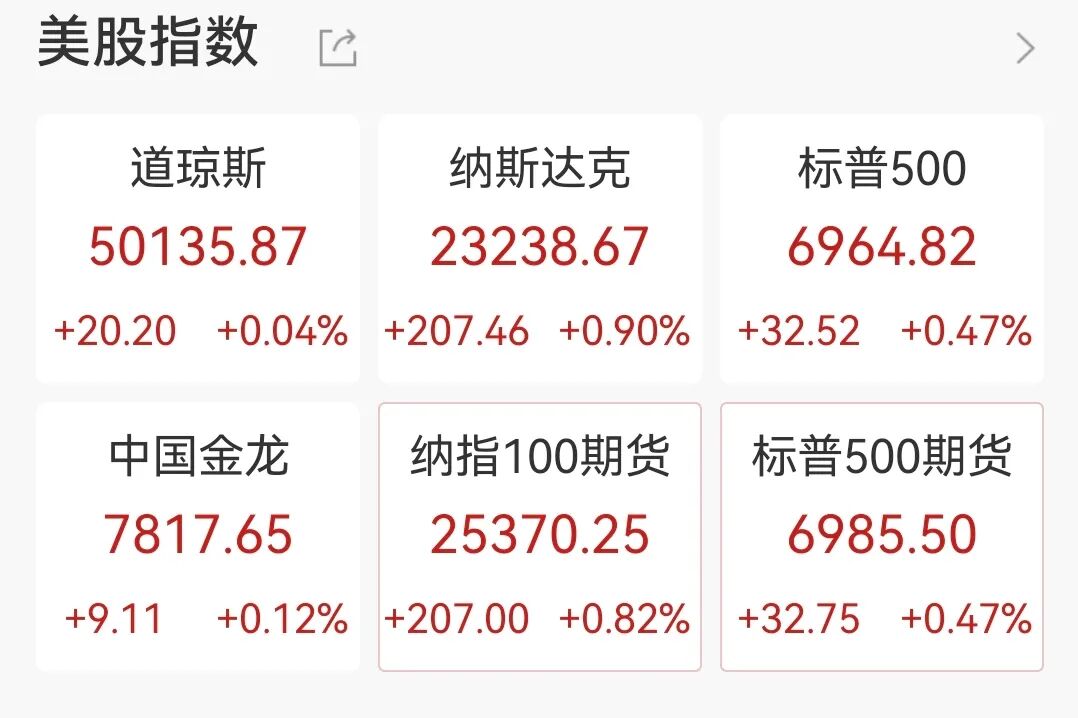
Market Performance - The US stock indices all closed higher, with the Nasdaq rising nearly 1%, the Dow Jones slightly up, and the S&P 500 increasing by 0.5%, nearing its historical high [1] - The Dow Jones closed at 50,135.87, up by 20.20 points (0.04%), the Nasdaq at 23,238.67, up by 207.46 points (0.90%), and the S&P 500 at 6,964.82, up by 32.52 points (0.47%) [2] Technology Sector - Major US tech stocks rebounded after a recent sell-off triggered by AI concerns, with the tech giants index rising by 1.02% [2] - Microsoft saw an increase of over 3%, while Nvidia and Facebook rose by over 2%. However, Apple and Amazon experienced declines of over 1% and 0.76%, respectively, marking Amazon's fifth consecutive day of decline [2] Chip Sector - The chip stock index increased by 1.9%, with Oracle rising over 9%, and Microsoft and Broadcom up by over 3%. In contrast, Micron Technology and SanDisk fell by nearly 3% [3] Commodity Market - Gold prices continued their upward trend, with spot gold rising nearly 2% to surpass $5,050. COMEX gold increased by over 2%, while spot silver rose by over 7% and COMEX silver by 8% [6][7] - Crude oil prices rose by over 1%, influenced by new US guidelines for ships passing through the Strait of Hormuz [6] Employment and Inflation Data - Upcoming US non-farm payroll and CPI reports are expected to provide important insights into the Federal Reserve's monetary policy direction, with potential for significant market volatility if the data indicates "weak employment + stubborn inflation" [8] - Current probabilities for Federal Reserve interest rate changes indicate a 17.7% chance of a 25 basis point cut by March and a 50.4% chance of a 25 basis point cut by June [8]




2月10日热门中概股涨跌不一 日月光半导体涨6.01%,理想汽车跌3.27%
Xin Lang Cai Jing· 2026-02-09 21:17
Group 1 - The Nasdaq China Golden Dragon Index (HXC) showed mixed performance among Chinese concept stocks on February 10, with some stocks rising while others fell [1][7] - Notable gainers included TSMC up 1.83%, Alibaba up 0.28%, Pinduoduo up 0.32%, and Netease up 0.50% [1][7] - Significant losers included JD.com down 0.21%, Ctrip down 1.38%, and Li Auto down 3.27% [1][7] Group 2 - U.S. stock markets closed higher on Monday, with technology stocks leading the gains, and the Dow Jones Industrial Average reaching a new all-time high [2][8] - The Dow Jones increased by 20.20 points, or 0.04%, closing at 50,135.87 points; the Nasdaq rose by 207.46 points, or 0.90%, to 23,238.67 points; and the S&P 500 gained 32.51 points, or 0.47%, to 6,964.81 points [2][8] Group 3 - A list of top-performing Chinese concept stocks showed significant increases, with Xuniao Software up 48.55% and IFBD up 36.51% in after-hours trading [3][11] - Other notable gainers included Yingzhong Group up 29.30% and ATXG up 21.61% in after-hours trading [4][11] Group 4 - The list of underperforming Chinese concept stocks included Mingcheng Group down 29.42% and Zhongwang Zai Line down 24.65% [6][13] - Other significant decliners were Lanv down 20.71% and JZXN down 18.56% [6][14]


