
LI AUTO-W(02015)

Search documents
中国车企,要接受新车销量“仅微涨”的新常态
虎嗅APP· 2026-02-10 14:12
Core Viewpoint - The Chinese automotive market is experiencing a downturn in new car sales, with significant declines reported for major brands, while the used car market is thriving, indicating a shift in consumer preferences and market dynamics [2][3][24]. Group 1: New Car Market Trends - In January 2026, BYD's sales dropped by 30%, and Li Auto's sales fell by 7.55%, with Geely only seeing a slight increase of 1% due to strong overseas performance [2]. - The overall passenger car sales in China are projected to reach 24 million in 2026, with a growth rate slowing to 1% [2]. - The decline in consumer confidence, exacerbated by reduced subsidies and macroeconomic factors, is expected to keep consumer sentiment below the breakeven line [2]. Group 2: Used Car Market Dynamics - The used car market in China is booming, with a transaction volume of 20.1 million units in 2025, marking a year-on-year growth of 2.52% and a total transaction value of 1.28979 trillion yuan [3]. - The demand for used electric vehicles is expected to grow by over 50% [3]. - The trend of purchasing used cars is driven by practical needs, such as commuting and returning home during holidays, with a notable increase in cross-regional vehicle registrations [6][8]. Group 3: Consumer Preferences and Behavior - Consumers are increasingly opting for used cars due to price advantages, allowing them to afford better models compared to new cars [10]. - The introduction of new policies has increased the variety of available used car models, enhancing consumer choice [11]. - The demand for used cars is becoming more personalized, with consumers selecting vehicles based on specific needs such as fuel efficiency and durability [14]. Group 4: Implications for Automotive Companies - The rise in used car sales may negatively impact new car sales in the short term, as each additional used car sold could equate to one less new car sold [17]. - In the long term, a healthy used car market can stabilize the residual values of new cars, encouraging new car purchases [20]. - The growing interest in used cars among younger consumers may lead to future brand loyalty and new car purchases from the same manufacturers [21]. Group 5: Market Evolution and Future Outlook - The automotive market in China is maturing, with new car sales growth plateauing, while the used car market is expected to continue expanding [24]. - The automotive industry must adapt to this new normal by focusing on vehicle durability and reliability, rather than solely on sales volume [24]. - The overall automotive market is projected to exceed 10 trillion yuan in 2025, with significant implications for the aftermarket services sector [22].





理想汽车春节后将推“门店合伙人”计划
Mei Ri Jing Ji Xin Wen· 2026-02-10 10:57
Group 1 - The core point of the article is that Li Auto plans to implement a "store partner" program after the 2026 Spring Festival to enhance store operational efficiency and market responsiveness [1] - The "store partner" program will grant store managers greater decision-making authority and optimize the assessment mechanism, transitioning from a single sales evaluation to a comprehensive evaluation system that includes sales, profit, and customer satisfaction [1] - Li Auto will also close some low-efficiency stores that were opened during the expansion phase, which is currently under evaluation [3] Group 2 - Other new energy vehicle brands, such as Tesla, Xpeng, and NIO, are also optimizing their channel layouts by closing underperforming stores [3][4] - The adjustment in channels is driven by cost pressures, with many new energy brands shifting from direct sales models to agency or dealer models to reduce operational costs [5] - Traditional automotive brands are also facing similar pressures and are exploring channel transformations, including the adoption of a mixed model that combines direct sales and dealer networks [6][7] Group 3 - The trend of channel adjustment indicates a convergence between traditional and new energy vehicle brands, with both adapting their store models based on resources and market demands [7] - The future channel model is expected to be a hybrid approach, featuring flagship stores, satellite stores, and temporary touchpoints to enhance efficiency and reduce costs [7] - The industry is likely to evolve from an integrated 4S store model to a more diversified operational model, with an increase in the total number of outlets while reducing the number of traditional 4S stores [7]
【新能源周报】新能源汽车行业信息周报(2026年2月2日-2月8日)
乘联分会· 2026-02-10 08:37
Industry Information - Beijing Economic and Technological Development Zone implements intelligent connected vehicle initiatives to enhance AI's role in data-driven technology [2] - Shenzhen releases a three-year consumption action plan focusing on green electricity consumption and charging infrastructure [2] - The largest high-speed supercharging station in China is operational in Hangzhou [2] - NIO achieves a milestone of 100 million battery swaps, with a network covering 8,627 stations nationwide [39] - CATL signs a comprehensive strategic agreement with Yunnan to promote green energy and transportation [10] Policy Information - The 2026 Central Document No. 1 emphasizes expanding rural consumption and supporting the adoption of new energy vehicles [26] - The Ministry of Transport plans to build over 10,000 charging guns in national highway service areas by 2026 [14] - The 2026 action plan for Beijing's traffic governance includes increasing the coverage of charging facilities [25] - Canada plans to abolish mandatory electric vehicle regulations and reintroduce consumer subsidies for electric vehicles [12] Company Information - BYD launches a new brand "Linghui" focused on the mobility market, aiming to provide affordable and advanced electric vehicles [33] - Xpeng Motors announces the launch of its AIOS 6.0 OTA update, featuring the industry's first proactive service cockpit [35] - Li Auto is set to open its 4,000th supercharging station, enhancing its charging network [39] - Xiaomi Motors updates its city driving assistance feature, lowering the mileage threshold for users [37] - NIO collaborates with a local company to enhance battery swapping services during the Spring Festival [39]


港股策略观点更新:恒生科技:战略配置区间已至,逆势布局正当时-20260210
EBSCN· 2026-02-10 06:59
Group 1 - The current Hong Kong stock market is in a phase of oscillation and correction, with the Hang Seng Technology Index dropping from a peak of around 6000 points in mid-January to 5346.2 points by February 6, marking a weekly decline of 6.51%, the largest in recent weeks [1] - The adjustment within the sector shows significant differentiation, with semiconductor and internet leaders experiencing larger declines, while new energy vehicles and home appliances showed relative resilience, indicating that funds are concentrating on quality core assets rather than exiting the market entirely [1][2] - The report emphasizes that the current market conditions represent a "golden layout window" for investors, characterized by oversold valuations, counter-cyclical capital inflows, and improving fundamentals [1][10] Group 2 - Southbound capital has shown a "buy the dip" behavior, with a net inflow of 560.7 billion HKD in the week of February 6, the highest weekly net inflow in three months, indicating strong confidence from domestic investors in the Hong Kong technology sector [2] - The concentration of capital flows has increased, with technology ETFs becoming key tools for domestic investors, reflecting a shift from traditional high-dividend sectors to technology growth sectors [2][3] - The report notes that the Hang Seng Technology Index's PE (TTM) is at 22.1 times, significantly below its historical average of 32.1 times and the global comparable technology indices, highlighting a valuation discount of over 35% [4] Group 3 - The report identifies four solid support dimensions for the Hang Seng Technology Index: technical, valuation, capital, and fundamental aspects, which collectively create a "margin of safety" for the sector [3] - The technical indicators show that the index is severely oversold, with a strong support level around 5400 points, which has not been effectively breached despite recent declines [3][4] - The fundamental outlook is bolstered by the sector's deep integration with the AI wave, with over 70% of the index's components related to AI, indicating strong growth potential as the industry transitions from R&D to commercialization [6][7] Group 4 - The report attributes the recent decline in the Hang Seng Technology Index to short-term emotional disturbances rather than a reversal of fundamental trends, driven by external tightening expectations, internal profit-taking, and unfounded rumors [7][8] - It emphasizes that the current market downturn is a valuable opportunity for investors to acquire quality assets, as the emotional "panic low" often represents a "golden buying point" [9][10] - The report suggests a strategy of "buying in batches and holding long-term," focusing on core stocks that are rapidly commercializing AI applications and have stable cash flows [9][10]




贝壳车评|理想汽车驶向具身智能,锚定下一个技术迁徙
Bei Ke Cai Jing· 2026-02-10 06:07
Group 1: Core Strategy - The chairman of Li Auto, Li Xiang, outlined the company's embodied intelligence strategy, aiming to evolve into an embodied intelligence enterprise with the ultimate form of a car being a robot [1] - Li Auto has made significant organizational changes, including the establishment of new teams focused on software and humanoid robots, indicating a shift towards an AI-centric approach [1][4] - The company plans to dismantle its autonomous driving team to pave the way for broader applications of embodied intelligence, positioning itself for competition in the high-end automotive market [1][4] Group 2: Industry Context - Beijing's supportive policies and initiatives, such as the "Beijing Embodied Intelligence Technology Innovation and Industry Cultivation Action Plan (2025-2027)," provide a fertile ground for the development of the embodied intelligence industry [2] - The automotive industry is increasingly exploring the integration of robotics, with companies recognizing the potential of embodied intelligence as a new growth avenue amid a saturated market [4] Group 3: Challenges and Considerations - The transition to embodied intelligence faces multiple challenges, including technological bottlenecks and the difficulty of commercializing complex tasks [5][6] - While embodied intelligence is seen as a long-term trend, the current cash flow for companies like Li Auto still heavily relies on their core automotive business [7] - The development cycle for embodied intelligence is lengthy and requires sustained investment and patience, emphasizing the need for a steady approach rather than a rush for immediate results [8][9]
理想汽车驶向具身智能,锚定下一个技术迁徙
Xin Jing Bao· 2026-02-10 06:05
Core Insights - Li Auto's chairman, Li Xiang, outlined the company's strategy to evolve into an embodiment intelligence enterprise, viewing the ultimate form of automobiles as robots [1] - The company has undergone significant organizational restructuring to support this strategic shift, including the establishment of new teams focused on software and humanoid robots, and the reorganization of its autonomous driving department [1] - Li Auto aims to become a leader in the embodiment intelligence sector within the next 3-5 years, indicating a long-term vision for the integration of AI into its business model [1] Company Strategy - The strategic shift towards embodiment intelligence is not merely a departmental reorganization but a critical move to position Li Auto in the competitive landscape of AI-driven automotive technology [1] - The company is responding to a new wave of AI competition, with Li Xiang asserting that the competition in the mid-to-high-end automotive market will fundamentally revolve around embodiment intelligence [1][2] - Li Auto's transition aligns with broader industry trends, as other automakers also explore the integration of robotics into their vehicles, indicating a growing market for "car + robot" solutions [2] Industry Context - Beijing's supportive policies and initiatives, such as the "Beijing Embodiment Intelligence Technology Innovation and Industry Cultivation Action Plan (2025-2027)," provide a conducive environment for companies like Li Auto to innovate and grow [2] - The automotive industry is entering a phase where growth must come from new avenues, with embodiment intelligence emerging as a significant direction for transformation [2] - The inherent advantages of automotive companies in the embodiment intelligence space stem from the shared core architecture of perception, decision-making, and execution between smart vehicles and intelligent robots [2] Challenges and Considerations - The transition to embodiment intelligence faces multiple challenges, including high costs of advanced technologies and the need for a mature commercial framework [3] - Current cash flow for companies like Li Auto still primarily comes from their core automotive business, highlighting the need for a balanced approach during the transition [3] - The development of embodiment intelligence requires long-term investment and patience, as the path to commercialization and product differentiation is still evolving [3]
理想汽车OTA 8.3升级 新增超充站状态展示等23项功能
Zhong Guo Zhi Liang Xin Wen Wang· 2026-02-10 04:24
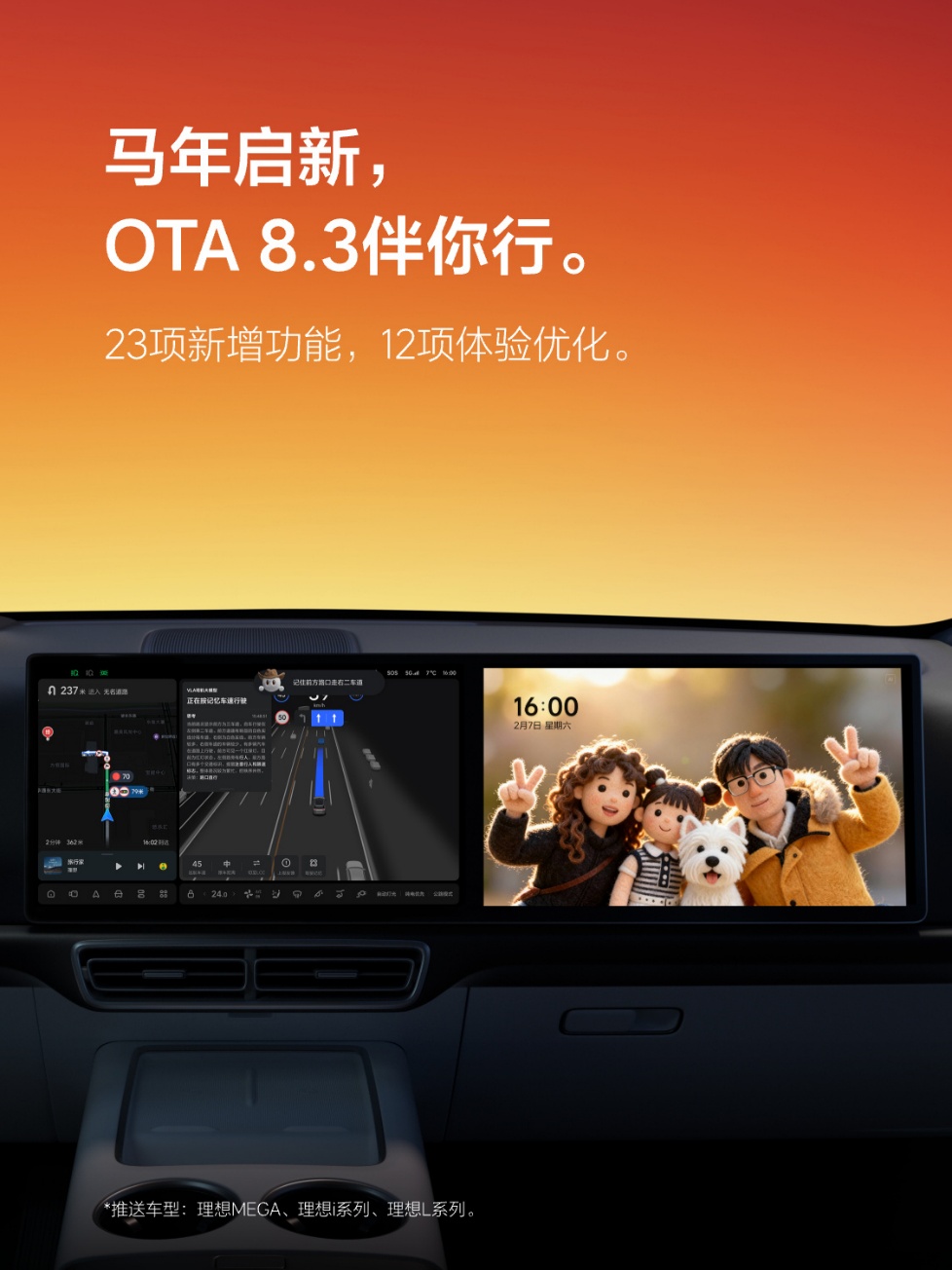
Core Insights - Li Auto has released the OTA 8.3 version, introducing 23 new features and 12 experience optimizations across various dimensions including smart driving, charging, vehicle interaction, and entertainment, applicable to models such as Li MEGA, Li L series, and Li i series [1] Group 1: Charging and User Experience - The upgrade includes a real-time display feature for Li Supercharging station status, helping users check charging station conditions during peak times to avoid long queues [3] - Electric vehicle users can now remotely activate charging preheating or precooling via the Li Auto App to enhance charging speed and experience [3] Group 2: Smart Driving Enhancements - The VLA driver model has received algorithm upgrades for lane change decision-making accuracy and now includes intersection speed and lane memory capabilities, allowing vehicles to learn drivers' habits at specific intersections to improve commuting efficiency [6] - For closed park scenarios, the AD Max model has added a parking fee reminder feature when exiting, in collaboration with Alipay, to optimize the exit experience [6] Group 3: Entertainment and Personalization Features - The Li L series and Li MEGA have introduced an art frame feature, allowing users to upload images and use AI technology to create personalized static or dynamic screensavers, with some templates adapting to the vehicle's color [9] - New alert sounds have been unlocked for the Li L series and Li MEGA, suitable for various notification scenarios [9] - The OTA update has added local audio and video playback capabilities, supporting direct reading of mainstream audio and video formats from USB drives, and introduced a Unity game virtual controller feature, enabling passengers to connect their phones to the vehicle's system as controllers without needing to purchase physical ones [9]
小摩:降理想汽车-W(02015)评级至“减持” 首选吉利汽车(00175)与中国重汽
智通财经网· 2026-02-10 03:55
Core Viewpoint - The report from JPMorgan indicates that the performance of the Chinese automotive market in 2023 will exhibit a mixed trend reminiscent of both 2018 and 2025, with overall passenger vehicle market growth expected to decline into negative territory, similar to 2018, while market volatility may increase due to new model releases and seasonal trends, akin to 2025 [1] Market Performance - The overall performance of the automotive industry is anticipated to be relatively weak due to the decline in market growth [1] - The potential for absolute or relative returns will depend on whether corporate earnings can exceed expectations, which is expected to be more challenging amid rising costs [1] Investment Recommendations - The preferred stocks identified by the firm are Geely Automobile (00175) and China National Heavy Duty Truck Group (03808) [1] - Companies such as BYD Company (01211), Leap Motor (09863), Xpeng Motors-W (09868), and NIO Inc. (09866, NIO.US) may present noteworthy investment opportunities in March or the second quarter of this year [1] - Conversely, the rating for Li Auto-W (02015) has been downgraded to "Reduce" [1]



小摩:降理想汽车-W(02015)评级至“减持” 首选吉利汽车(00175)与中国重汽(03808)
智通财经网· 2026-02-10 03:52
Group 1 - The core viewpoint of the article indicates that the performance of the Chinese automotive market in 2023 will exhibit a mixed trend reminiscent of both 2018 and 2025 [1] - The overall passenger car market growth has fallen into negative territory, similar to the situation in 2018, suggesting a potentially weak industry performance for the year [1] - Market fluctuations throughout the year may intensify due to new model releases, seasonal trends, and changes in profit expectations, akin to the dynamics observed in 2025 [1] Group 2 - The ability to achieve absolute or relative returns will depend on whether corporate earnings can exceed expectations, which is expected to be more challenging amid rising costs [1] - The preferred stocks identified by the bank are Geely Automobile (00175) and China National Heavy Duty Truck Group (03808) [1] - The bank also sees potential investment opportunities in BYD Company (01211), Leap Motor (09863), Xpeng Motors (09868), and NIO Inc. (09866) that may arise in March or the second quarter of this year [1] - Conversely, the rating for Ideal Automotive (02015) has been downgraded to "Reduce" [1]
大行评级丨瑞银:重申理想汽车“买入”评级,L9焕新上市在即催化重估
Ge Long Hui· 2026-02-10 03:20
Core Viewpoint - UBS reports that Li Auto's current valuation level is attractive, with a catalyst being the flagship SUV L9 set to be refreshed and launched in the second quarter, which is expected to accelerate growth from a low base in 2025 [1] Group 1: Market Sentiment and Growth Potential - The market sentiment is expected to gradually improve from now until the official launch in the second quarter, which will enhance investor visibility on other model update plans [1] - The flagship SUV L9's launch is anticipated to drive growth, leveraging a low base in 2025 [1] Group 2: Competitive Positioning - Despite facing challenges from rising commodity costs, the company is expected to demonstrate more resilience than most peers due to its high-end positioning and profit buffer [1] - UBS believes that now is an appropriate time to refocus on the stock, reiterating a "buy" rating with a target price of $30 for the U.S. stock [1]