HAIDILAO(06862)

Search documents
连锁餐饮的“中间地带危机”
远川研究所· 2025-12-16 13:10
Core Viewpoint - The public relations crisis surrounding Xibei has subsided, but consumer backlash against pre-made dishes continues, highlighting a divide in the restaurant industry between different types of dining establishments [1] Group 1: Industry Dynamics - The restaurant industry is experiencing a split, with brands like Laoxiangji and Dami Xiansheng being favored by workers despite their use of pre-made dishes, while others similar to Xibei are facing public scrutiny [1] - The "middle ground" in the restaurant sector is characterized by brands with moderate pricing and a specific number of outlets, typically around 500, such as Xibei (470+ stores, average spending of 98 yuan) and Xiaocaiyuan (700+ stores, average spending of 60 yuan) [3][4] - High-end dining establishments like Xinrongji, which focus on quality and exclusivity, contrast sharply with budget-friendly fast food chains like Laoxiangji, which prioritize standardization and rapid expansion [4][7] Group 2: Business Models - The operational model of budget restaurants relies on "standardized pre-made dishes and franchise expansion," allowing for rapid growth while minimizing cooking processes at the store level [5] - In contrast, high-end restaurants like Xinrongji operate on a "high average spending and non-standardized direct management" model, focusing on quality control and customer experience [7][9] - The "middle ground" restaurants attempt to balance the benefits of both models, leveraging standardized expansion while also enjoying higher profit margins associated with direct management [11] Group 3: Market Challenges - The restaurant industry has faced challenges in maintaining customer turnover rates, with many brands in the "middle ground" experiencing a disconnect between store expansion and operational efficiency [23] - The expansion strategy of these mid-tier restaurants, which often mirrors that of Haidilao, has encountered limitations in lower-tier cities where local brands dominate [25] - Despite attempts to increase average spending, many restaurants have seen a decline in customer spending, with brands like Tai Er experiencing a drop from 79 yuan to 70 yuan over four years [29][32]


胡润全球餐饮企业价值TOP50发布,蜜雪、瑞幸、海底捞等11家中国企业上榜
Yang Zi Wan Bao Wang· 2025-12-16 07:25
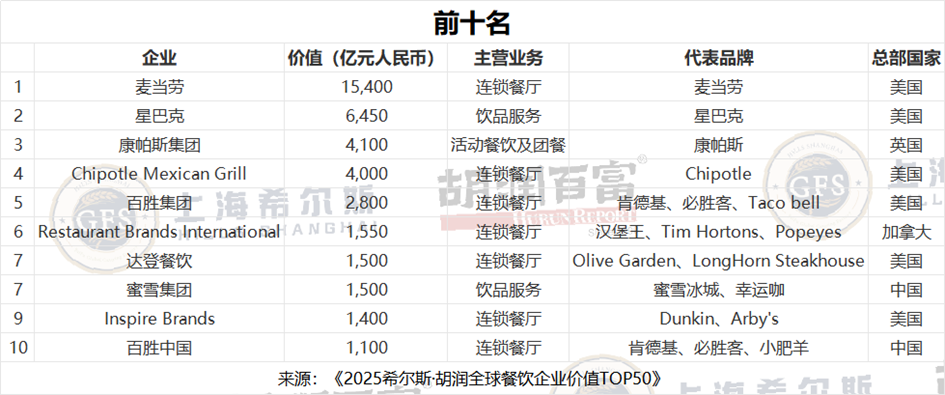
Core Insights - The HuRun Research Institute released the "2025 HuRun Global Restaurant Enterprise Value TOP 50" on December 15, with a threshold of 12 billion RMB for inclusion [1] - A total of 11 Chinese companies made the list, including Mixue Group, Yum China, Luckin Coffee, Haidilao, and others [1] - This is the fourth release of the restaurant industry ranking by HuRun and the first global valuation list for restaurant enterprises [1] Summary by Categories - The top three companies in the ranking are McDonald's valued at 15.4 billion RMB, Starbucks at 6.45 billion RMB, and Compass Group at 4.1 billion RMB [2][3] - The top 10 companies have a minimum valuation of 110 billion RMB, while the top 20 have a threshold of 61 billion RMB [3] - The ranking categorizes companies into three main types: chain restaurants, beverage services, and event catering [3] Chinese Companies Performance - Among the 11 Chinese companies, Mixue Group and Yum China are in the top 10, valued at 15 billion RMB and 11 billion RMB respectively [3] - The total value of all listed companies amounts to 55 trillion RMB [5] - Notably, three of the four recently established companies on the list are from China, including Bawang Chaji, Luckin Coffee, and Manner Coffee [5] International Expansion - Mixue Ice City has expanded significantly overseas, with over 4,700 stores in 12 countries, particularly in Indonesia [5] - Haidilao has established over 100 self-operated stores across 14 countries [5] - Heytea has successfully entered markets in Singapore, the UK, and Canada, with over 100 overseas stores [5]


海底捞_重申为中国餐饮行业首选标的;11 月餐饮零售销售额企稳
2025-12-16 03:30
Summary of Haidilao International Holding Ltd (6862.HK) Conference Call Company Overview - **Company**: Haidilao International Holding Ltd - **Ticker**: 6862.HK - **Market Cap**: HK$80,377 million (approximately US$10,326 million) [3] Industry Context - **Industry**: China Restaurant Sector - **Retail Sales Growth**: China restaurant retail sales showed a year-over-year (YoY) growth of 3.2% in November, stabilizing compared to 3.8% in October. This growth is significantly higher than the 0.9%-2.1% range observed from June to September 2025 [1][2]. Key Insights - **Positive Outlook**: Haidilao is reiterated as a "Top Buy" in the China restaurant sector, with expectations of benefiting from reduced e-commerce subsidies, which should enhance store traffic recovery in the dine-in business over the next few quarters [1]. - **Government Support**: The Central Economic Work Conference (CEWC) emphasized plans to eliminate unreasonable consumption restrictions and boost service consumption, which is expected to favor casual dining players like Haidilao over quick-service restaurants (QSRs) in 2026 [1]. - **Operational Improvements**: Management anticipates positive momentum in table-turn rates in Q1 2026, aided by a longer Chinese New Year holiday period and improved operational efficiencies from remodeled stores [2]. Financial Performance - **Table-Turn Rates**: Haidilao experienced flat table-turn rates in November, with a slight deceleration attributed to fewer holidays compared to October. However, management expects less pressure on table-turns in Q4 2025 due to seasonal factors [2]. - **Gross Profit Margin (GPM)**: GPM improved sequentially in Q3 2025 compared to the first half of 2025, reaching 60.2%. This improvement was driven by menu optimization efforts to mitigate raw material cost pressures [2]. - **Operational Cost Management**: Management plans to terminate several loss-making pilot programs in Q1 2026, which is expected to yield operational expense savings for the full year [5]. Risks and Challenges - **Brand Ownership**: Haidilao does not own the "Haidilao" brand, which is also used by connected parties, posing a potential risk [10]. - **Market Competition**: Intensified competition and cannibalization from new store openings could impact store efficiency and performance [10]. - **Economic Factors**: A slowdown in consumption in China and higher-than-expected commodity and wage inflation are key downside risks [10]. Valuation - **Target Price**: The target price for Haidilao is set at HK$18.50, based on a 12x 2025E EV/adjusted EBITDA multiple, aligning with the trading average of global restaurant peers [9]. Investment Returns - **Expected Returns**: The expected share price return is 28.3%, with an expected dividend yield of 1.8%, leading to a total expected return of 30.1% [3]. Conclusion Haidilao International Holding Ltd is positioned favorably within the China restaurant sector, with operational improvements and supportive government policies expected to drive growth. However, potential risks related to brand ownership and market competition must be monitored closely.
海底捞20251215
2025-12-16 03:26
Summary of Haidilao Conference Call Company Overview - Haidilao is a leading player in the Chinese restaurant industry, with an estimated valuation of approximately 17 times earnings by the end of the year and a dividend yield close to 5%, making it an attractive investment target [2][3]. Development Stages - The development of Haidilao can be divided into three stages: 1. **Initial Expansion**: Focused on classic products like the beef tallow hot pot. 2. **Deep Adjustment During Pandemic**: Implemented the "Pomegranate Plan" to adapt to market changes. 3. **Current New Brand Exploration**: Actively exploring new brands such as "Banquet Barbecue" [2][4]. Industry Position - The hot pot segment is the largest in Chinese cuisine, with a projected market size of approximately 600 billion yuan in 2024, accounting for 14.5% of the entire Chinese dining market. The hot pot industry is characterized by high standardization, operational efficiency, and long lifecycle, positioning Haidilao with a market share of about 6.9% [2][5][6]. Core Competitive Advantages - Haidilao's core competitive barriers include: - **Service Management Capability**: Known for exceptional service, including family-friendly spaces and additional services like nail care. - **Mentorship Management System**: Ensures standardized service and operational management through a unique apprenticeship model. - **Mystery Shopper Program**: Maintains service quality at the front end of operations. - **Integrated Supply Chain**: Manages everything from ingredient supply to store decoration, ensuring quality stability and cost control [2][7]. Future Growth Potential - The main brand's stores have stabilized and are showing a gradual recovery in table turnover rates. The company is also exploring franchise models to expand its reach in more cities and regions. New brands like "Banquet Barbecue" have made significant progress, and the exploration of small hot pot brands is ongoing. This positions Haidilao for substantial future growth potential [2][8]. - Projected net profits for the next two years are estimated at 4.8 billion yuan and 5.3 billion yuan, respectively, with a current PE ratio of about 17 times and a generous dividend payout of over 95%, providing a relatively secure investment return [2][8].
中国11家上榜全球餐饮TOP50
Shen Zhen Shang Bao· 2025-12-15 22:55
Core Insights - The "Hurun Global Restaurant Enterprise Value TOP 50" list was released, ranking companies based on market value or valuation, marking the first global ranking in the restaurant sector by Hurun Research Institute [1] - McDonald's is the most valuable restaurant company globally, valued at 1.54 trillion RMB, accounting for nearly 30% of the total value of the list [1] - China has 11 companies on the list, with two in the top ten: Mixue Group valued at 150 billion RMB and Yum China at 110 billion RMB [1] Group 1: Company Rankings - McDonald's holds the top position with a brand value of 1.54 trillion RMB, surpassing the combined value of the next three companies [1] - Starbucks ranks second with a brand value of 645 billion RMB, while Luckin Coffee, a Chinese brand, is the second coffee company on the list valued at 70 billion RMB [1][2] Group 2: Chinese Companies Performance - The highest-valued restaurant company in China is Mixue Ice City, which has over 4,700 overseas stores across 12 countries, particularly strong in Indonesia with about 2,600 stores [2] - Haidilao has also performed well internationally, operating over 100 self-operated stores across 14 countries [2] - New tea brands like Heytea and Bawang Chaji are expanding rapidly, with Bawang Chaji exceeding 200 overseas stores and adding over 50 stores in the second quarter of 2025 [2] Group 3: Industry Trends - The average age of Chinese companies on the list is only 16 years, with 7 out of 9 beverage service companies being Chinese [3] - Three of the four companies established in the last decade on the list are from China, including Bawang Chaji and Luckin Coffee [3] - The domestic consumption market in China is seen as a fertile ground for restaurant enterprises, enabling brands like Mixue and Luckin to build extensive store networks [3]
花旗:料海底捞受惠中央提振服务消费 开启正面催化观察 目标价18.5港元
Zhi Tong Cai Jing· 2025-12-15 03:51
营运方面,该行预期明年首季海底捞的翻桌率将有正面势头,料经营利润率压力将于今年下半年逐步纾 缓,并于明年进一步恢复,受惠于公司在今年完成店铺改造,该行指,海底捞仍然是其在中国餐饮板块 的首选,明年将更看好休闲餐饮企业而非快餐公司。 花旗发布研报称,刚闭幕的中央经济工作会议中,政府强调计划清理消费领域不合理限制措施,释放服 务消费潜力。该行预期政府将在2026年放宽部分反奢华消费措施,而休闲餐饮企业如海底捞(06862), 较快餐企业更能受惠。该行对海底捞开启30天正面催化观察,现予目标价18.5港元及"买入"评级。 ...
花旗:料海底捞(06862)受惠中央提振服务消费 开启正面催化观察 目标价18.5港元
智通财经网· 2025-12-15 03:47
营运方面,该行预期明年首季海底捞的翻桌率将有正面势头,料经营利润率压力将于今年下半年逐步纾 缓,并于明年进一步恢复,受惠于公司在今年完成店铺改造,该行指,海底捞仍然是其在中国餐饮板块 的首选,明年将更看好休闲餐饮企业而非快餐公司。 智通财经APP获悉,花旗发布研报称,刚闭幕的中央经济工作会议中,政府强调计划清理消费领域不合 理限制措施,释放服务消费潜力。该行预期政府将在2026年放宽部分反奢华消费措施,而休闲餐饮企业 如海底捞(06862),较快餐企业更能受惠。该行对海底捞开启30天正面催化观察,现予目标价18.5港元 及"买入"评级。 ...
大行评级丨花旗:对海底捞开启30天正面催化观察 目标价18.5港元
Ge Long Hui· 2025-12-15 03:02
Core Viewpoint - The report from Citigroup indicates that the Central Economic Work Conference emphasizes plans to eliminate unreasonable restrictions in the consumption sector, aiming to unleash the potential of service consumption. The government is expected to relax certain anti-luxury consumption measures by 2026, which will benefit leisure dining companies like Haidilao more than fast-food enterprises [1] Group 1: Company Insights - Citigroup anticipates a positive trend in Haidilao's table turnover rate in the first quarter of next year, with operating profit margin pressures expected to ease gradually in the second half of this year and further recover next year [1] - The company has completed store renovations this year and plans to terminate some loss-making pilot projects in the first quarter of next year, contributing to its recovery [1] - Haidilao remains Citigroup's top pick in the Chinese dining sector, with a more favorable outlook on leisure dining companies compared to fast-food chains [1] Group 2: Market Outlook - Citigroup has initiated a 30-day positive catalyst observation for Haidilao, setting a target price of HKD 18.5 and a "Buy" rating [1]
海底捞:中国餐饮行业首选买入标的,30 天积极催化因素观察
2025-12-15 01:55
12 Dec 2025 01:08:59 ET │ 12 pages Haidilao International Holding Ltd (6862.HK) Top Buy in China Restaurant Industry; Open 30D Positive Catalyst Watch CITI'S TAKE In the Central Economic Work Conference (CEWC) concluded yesterday (Xinhua, Dec 11th), the government highlighted its plan to "eliminate unreasonable restrictions on consumption and boost service consumption" as one of the priorities in pro-consumption policy execution in 2026E. With this context, we reasonably expect government's easing of anti-e ...
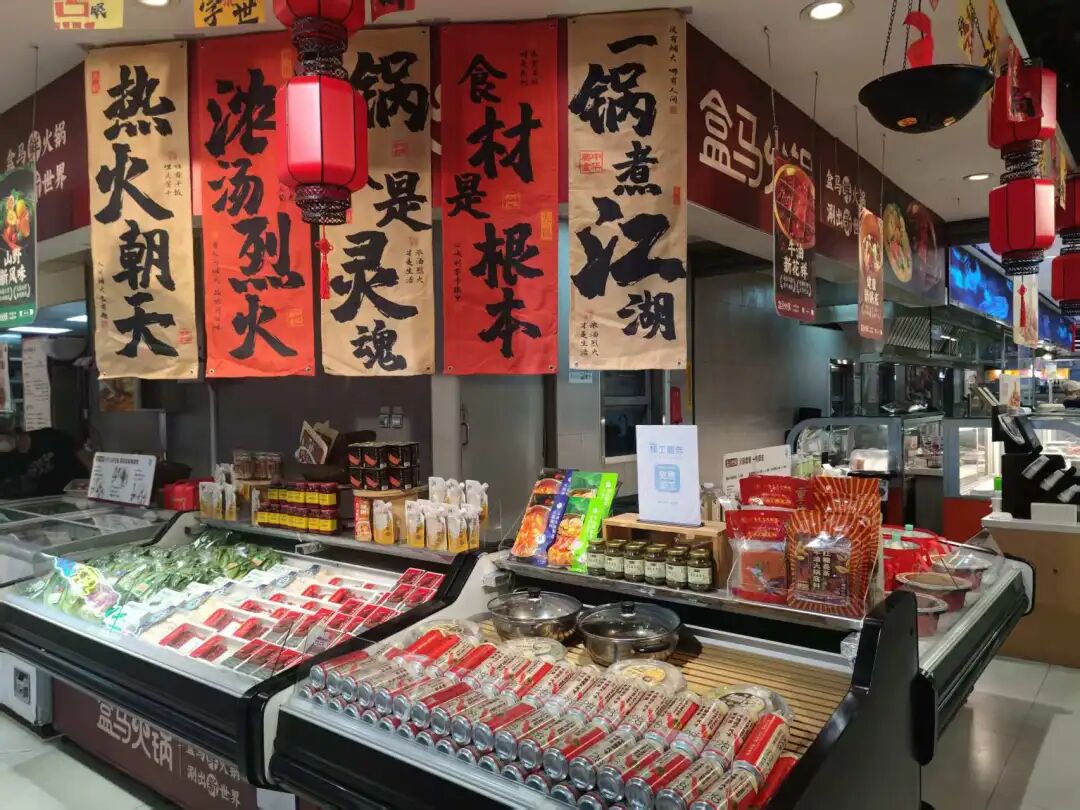
人均60元涮火锅,盒马胖东来偷家海底捞?
3 6 Ke· 2025-12-15 01:40
Core Insights - The rise of hot pot dining in supermarkets and markets is becoming a new trend, with major players like Hema, Yonghui, and Pang Donglai entering the market [1][4][14] - The hot pot dining experience in supermarkets offers a unique combination of fresh ingredients and flexible meal options, appealing to consumers seeking social dining experiences [1][7][14] Supermarket Hot Pot Business - Supermarkets are increasingly incorporating hot pot dining into their offerings, leveraging existing food court spaces to add hot pot services with minimal additional investment [1][4] - Hema's hot pot dining includes both set menus and self-service options, with prices for hot pot sets ranging from 78 to 88 yuan [4][14] - Yonghui focuses on individual hot pot meals with a low price point, offering a variety of self-selected ingredients at competitive prices [5][14] - Pang Donglai operates a brand-style hot pot service, allowing customers to order from a menu, with prices for vegetable platters starting as low as 9 yuan [6][14] Consumer Trends and Preferences - The average spending per customer at these hot pot dining options ranges from 60 to 100 yuan, catering to various consumer needs [5][7] - The appeal of supermarket hot pot lies in its cost-effectiveness and the freshness of ingredients, which can be more appealing than traditional hot pot restaurants [7][14] - The hot pot dining experience in supermarkets is designed to attract young consumers and families, with Hema targeting office workers and Yonghui focusing on residential areas [14][15] Market Dynamics and Competition - The hot pot market is experiencing significant growth, with Hema reporting a 59.7% year-on-year increase in hot pot-related sales since November [13][14] - The competition is intensifying as more supermarkets and local hot pot restaurants enter the market, with a focus on fresh ingredients and unique dining experiences [14][15] - New hot pot concepts are emerging, including market-based hot pot restaurants that allow customers to select their own ingredients, reflecting a shift in consumer preferences towards fresh and customizable dining options [8][12][14] Challenges and Future Outlook - Despite the growth potential, challenges remain for scaling these new hot pot concepts, particularly in terms of regional taste preferences and operational logistics [14][15] - The integration of hot pot dining into supermarkets represents a significant shift in the food retail landscape, blurring the lines between grocery shopping and dining experiences [15]