JD(09618)

Search documents
京东:2025年3C趋势品类白皮书
Xin Lang Cai Jing· 2026-01-04 01:29
Core Insights - The Chinese 3C digital product market is projected to reach $19.4 billion by 2025, driven by both mature and emerging product categories [6][8][9]. Market Overview - The growth of the 3C industry is supported by stable sales in mature categories like smartphones and laptops, with AI-related technologies contributing positively [9][10]. - Emerging categories such as smart wearables, XR devices, and action cameras are experiencing significant growth, with smart wearables seeing a year-on-year increase of 612% [9][10]. Growth Drivers - The growth of the 3C industry is driven by four key factors: policy guidance, technological penetration, supply chain upgrades, and expanding consumer demand [10][12]. - Policies aimed at stimulating market activity and consumer demand are expected to continue in 2025, enhancing the efficiency of market conversion [12][13]. Technological Innovations - The transition from "point intelligence" to "ecological collaboration" in technology is evident, with platforms like JD leveraging AI and green technologies to enhance the 3C ecosystem [15][16]. Consumer Demand Trends - There is a shift in consumer demand towards personalized, high-quality, and health-oriented products, moving the focus from merely selling hardware to providing value based on user identity and interests [20][21]. - The demand for products that offer a blend of functionality and aesthetic appeal is increasing, particularly among younger demographics [21][60]. Consumption Scenarios - The 3C consumption landscape is evolving from a focus on product functionality to an emphasis on experiential and scenario-based usage, driven by efficiency, self-satisfaction, and community recognition [22][23]. - Various consumption scenarios such as home entertainment, efficient office setups, and outdoor activities are emerging, with brands innovating to meet diverse consumer needs [29][45]. User Preferences - Users are increasingly looking for products that offer seamless integration across devices, emphasizing the importance of multi-device compatibility and smart functionalities [50][57]. - The trend towards stylish and practical wearable technology is gaining traction, with consumers prioritizing both aesthetic and functional attributes in their purchasing decisions [59][61].



2025年杀青汽车渠道瘦身进行时
Xin Lang Cai Jing· 2026-01-04 01:19
Core Viewpoint - In 2025, the Chinese automotive industry is at a historic turning point, with the penetration rate of new energy vehicles exceeding 50%, marking a shift towards a high-quality development phase characterized by a balance between traditional and electric vehicles [2][16]. Group 1: Industry Transformation - The automotive channel system is undergoing unprecedented restructuring, shifting from scale expansion to integration optimization, model innovation, and deepening market penetration [2][16]. - The era of merely pursuing the number of outlets has ended, with a focus on quality improvement and efficiency optimization becoming the core issues [2][3]. - The automotive channel transformation is clearly presenting three major trends: lightweight, hybrid, and downward expansion, aimed at addressing high costs and low efficiency in the industry [2][3][11]. Group 2: Lightweight Trend - The traditional heavy asset 4S stores are facing high rent and inventory pressures, prompting automakers to explore lightweight outlet models [4][19]. - Lincoln China's "Spark Plan" serves as a benchmark for lightweight transformation, significantly reducing single-store investment from 20-30 million yuan to 4 million yuan, leading to a 40% decrease in dealer operating costs [4][18]. - The optimization of profit structure in lightweight stores allows after-sales profits to fully cover operating costs, enhancing profitability [4][18]. Group 3: Hybrid Trend - The trend of channel hybridization, which began in 2024, continues to deepen in 2025, with brands exploring flexible combinations of direct sales, agency, and authorization models [7][21]. - NIO is cautiously adopting a hybrid approach, allowing local agents to manage market operations while maintaining brand control [7][21]. - BYD's Tengshi and Fangchengbao brands are implementing a dual-track system of direct sales and authorization to enhance channel efficiency [8][22]. Group 4: Downward Expansion Trend - The trend of channel downward expansion is accelerating, with significant sales growth in lower-tier cities, reflecting a clear shift in the automotive consumption market [11][25]. - Leap Motor's strategy of lowering the price of main models to the 150,000 yuan range has led to a 113.42% year-on-year increase in deliveries, with over 60% of sales coming from lower-tier markets [11][25]. - Third-party involvement, such as JD Auto's collaboration with GAC and CATL, is creating new models for the lower-tier market, significantly reducing the purchase threshold [12][26]. Group 5: Efficiency Revolution - The core of channel transformation is an efficiency revolution, focusing on serving more users at lower costs [12][26]. - The automotive channel is undergoing structural reshaping through lightweight, hybrid, and downward expansion trends, but the evolution of channels is far from over [12][26].




瞄准5万亿美元市场:跨界布局机器人,时代的新共识
3 6 Ke· 2026-01-04 00:26
Core Insights - The Chinese robotics industry is poised for significant growth by the end of 2025, with humanoid robots transitioning from experimental concepts to practical applications, achieving over 50% growth and indicating a trillion-yuan industry on the horizon [1] - The entry of major players from various sectors such as automotive, electronics, and the internet into the robotics field marks a shift from niche exploration to widespread competition, creating a unique trend of "cross-industry integration" [1] Group 1: Market Dynamics - In the first eight months of 2025, the primary market financing in the robotics sector reached 38.624 billion yuan, 1.8 times the total for 2024, highlighting the blue ocean effect attracting significant investment [2] - The global industrial robot sales are projected to reach 542,000 units in 2024, with China accounting for 295,000 units, representing 54% of the global market [2] - By 2025, the Chinese robotics market is expected to exceed 150 billion yuan, capturing 35% of the global market share, with predictions suggesting the market for embodied intelligence could reach 400 billion yuan by 2030 and over a trillion yuan by 2035 [2] Group 2: Industry Trends - At least 20 automotive companies have entered the humanoid robot market by the end of 2025, with notable developments including Chery's humanoid robot Mocha and BYD's production line for core robot components [3] - The automotive industry's supply chain overlaps significantly with robotics, with a 60% compatibility rate, driving car manufacturers to invest in robotics as they view vehicles as "mobile intelligent robots" [3] - Home appliance manufacturers are transitioning from traditional manufacturing to smart ecosystems, with companies like Midea establishing dedicated innovation centers for humanoid robots and developing comprehensive R&D systems [7] Group 3: Strategic Shifts - The automotive sector is seen as a key player in the transition to robotics, with companies like Geely planning to invest 5 billion yuan over three years to develop critical components and establish an ecosystem covering all robotics applications [6] - Internet giants are leveraging their technological and capital advantages to enter the robotics space, with ByteDance and Huawei making significant investments in developing advanced robotic models and systems [8] - The competition in the robotics sector is viewed as a strategic restructuring driven by technological advancements, with companies aiming to activate existing technological capabilities and build new ecosystems [9] Group 4: Challenges Ahead - Despite the enthusiasm for entering the robotics market, cross-industry players face challenges such as adapting core competencies to the robotics field, where technology paths are still being defined [10] - The high precision and stability required for industrial applications pose significant challenges for companies transitioning from other sectors, as they may struggle to meet the diverse demands of various operational environments [11] - Cost remains a critical issue, with companies like BYD and GAC aiming to reduce the production cost of humanoid robots to below 200,000 yuan, which requires overcoming substantial supply chain and process optimization challenges [11]




“国际金融中心遗址论”不攻自破 港股逆袭,问鼎全球IPO募资额
Sou Hu Cai Jing· 2026-01-03 23:42
Core Viewpoint - The Hong Kong capital market has made a strong comeback, with 114 companies completing IPOs in 2025, raising approximately 286.3 billion HKD, surpassing the total fundraising of 2023 and 2024 combined, and reclaiming the top position globally for IPO fundraising [2][4]. Group 1: IPO Market Recovery - In 2023, the Hong Kong IPO market faced significant challenges, with only 70 companies listed and total fundraising dropping to 46.3 billion HKD, a 44% year-on-year decline, marking a historical low [4]. - The market showed signs of recovery in 2024, with 79 companies raising a total of 87.6 billion HKD, ranking Hong Kong as the fourth largest IPO market globally [4]. - The year 2025 saw a remarkable 227% increase in IPO fundraising compared to 2024, with the number of listed companies growing by 63%, making Hong Kong the largest contributor to the global IPO market recovery [4][5]. Group 2: Major Contributors to IPO Success - Eight large IPOs in 2025 raised over 10 billion HKD each, accounting for about 50% of the total fundraising, with CATL leading at approximately 41 billion HKD, marking the largest IPO in Hong Kong in nearly four years [4][5]. - A significant portion of the IPOs in 2025 came from mainland companies, with 89% of new listings originating from this sector, contributing to a total fundraising increase from 83.9 billion HKD to 233.1 billion HKD [9][12]. Group 3: Strengthening Financial Connectivity - The unique mutual market access mechanism between Hong Kong and mainland China is highlighted as a key advantage for the Hong Kong Stock Exchange compared to other international exchanges [6]. - The Chinese government's ongoing efforts to deepen capital market openness and enhance cross-border connectivity further solidify Hong Kong's role as a financial hub [6][7]. Group 4: Technological and Financial Integration - Hong Kong's capital market is increasingly integrating technology and finance, supporting the development of innovative enterprises, particularly in sectors like artificial intelligence and semiconductors [11][12]. - The introduction of supportive regulations for tech companies, including the 18A and 18C chapters, aims to facilitate the listing of innovative firms, enhancing the market's appeal to high-growth sectors [11][12].
2026国补开启!全国多地手机数码家电元旦迎“开门红”
Yang Zi Wan Bao Wang· 2026-01-03 13:39
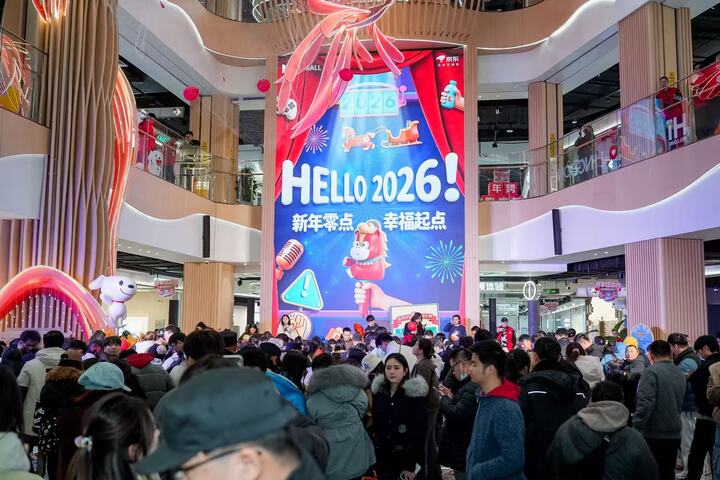
Core Insights - The implementation of the national "old-for-new" policy starting January 1, 2026, has sparked a surge in consumer demand for mobile and home appliance products across various regions in China, particularly benefiting platforms like JD MALL [1][5] Group 1: Consumer Behavior - The first "old-for-new" order under the national subsidy program was completed at JD MALL in Guangzhou shortly after midnight on January 1, 2026, with consumers taking advantage of significant discounts [3][5] - Consumers are motivated to purchase due to the combination of national subsidies and additional manufacturer discounts, leading to a vibrant shopping atmosphere during the New Year [1][11] Group 2: Sales and Promotions - JD MALL experienced a notable increase in foot traffic during the New Year holiday, with many stores reporting high sales volumes for electronic products, particularly mobile phones and computers [1][9] - The promotion includes a 15% subsidy on eligible products, with specific limits on the amount of subsidy available for different categories, such as a maximum of 1,500 yuan for home appliances and 500 yuan for digital products [14] Group 3: Service Enhancements - JD MALL and JD Electric have introduced integrated services such as free installation and old product recycling for large appliances, enhancing the overall shopping experience for consumers [14] - Additional services for mobile products include on-site activation and data migration, allowing consumers to use their new devices immediately [14]

本市“国补”上线点燃消费热情
Xin Lang Cai Jing· 2026-01-03 05:55
Group 1 - The core viewpoint of the article highlights the launch of the "National Subsidy" policy for consumer goods recycling, which has significantly boosted consumer enthusiasm for upgrading appliances in Beijing [1] - The subsidy program officially started on January 1, 2026, and quickly gained traction, with the qualification for subsidies on JD.com being claimed rapidly after its release [1] - The subsidy applies to six categories of home appliances and four categories of digital and smart products, with specific eligibility criteria and subsidy limits outlined [1] Group 2 - Consumers in Beijing can receive subsidies for purchasing energy-efficient appliances and certain digital products, with a subsidy rate of 15% of the final sales price after discounts [1] - The maximum subsidy amounts are capped at 1500 yuan for home appliances and 500 yuan for digital products, with each individual eligible for one subsidy per category [1] - The qualification process involves real-name authentication through the Jingtong app, allowing consumers to access online or offline subsidy qualifications for eligible products [1]

智通ADR统计 | 1月3日





智通财经网· 2026-01-03 00:08
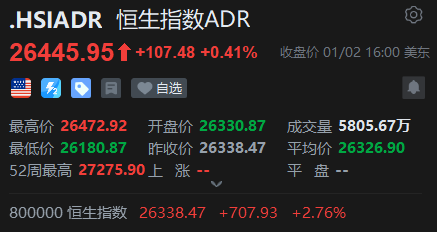
Group 1 - The Hang Seng Index (HSI) closed at 26,445.95, up by 107.48 points or 0.41% as of January 2, 16:00 Eastern Time [1] - The highest price during the trading session was 26,472.92, while the lowest was 26,180.87, with a trading volume of 58.0567 million [1] - The HSI has a 52-week high of 27,275.90 [1] Group 2 - Major blue-chip stocks showed mixed performance, with HSBC Holdings closing at HKD 125.368, up 0.86% from the Hong Kong close [2] - Tencent Holdings closed at HKD 627.621, reflecting a 0.74% increase from the Hong Kong close [2] Group 3 - Tencent Holdings (code: 00700) latest price is HKD 623.000, with an increase of HKD 24.000 or 4.01% [3] - Alibaba Group (code: 09988) latest price is HKD 149.000, up by HKD 6.200 or 4.34% [3] - HSBC Holdings (code: 00005) latest price is HKD 124.300, increasing by HKD 1.900 or 1.55% [3] - Other notable stocks include AIA Group (code: 01299) at HKD 83.300, up 4.26%, and Baidu Group (code: 09888) at HKD 143.800, up 9.35% [3]
即时零售大会战:谁失血 谁生长?
Zhong Guo Jing Ying Bao· 2026-01-02 19:35
文 李立 吴清 2025年,中国互联网商业舞台的中心,被一场前所未有、代价高昂的战役——"即时零售"大战牢 牢占据。 以阿里巴巴、美团、京东为代表的三大巨头,从年初的外卖补贴燃起战火,迅速蔓延至覆盖餐饮、生 鲜、商超、数码乃至美妆服饰的全品类展开近场零售争夺。 这场战争规模之大、卷入之深,几乎重新定义了电商与本地生活的边界,也向市场抛出了一系列尖锐问 题:天量投入换来了什么?这是一个真实可持续的新大陆,还是资本催生的海市蜃楼?血流不止的战 局,2026年又将走向何方? 账单:战损严重 当三大巨头相继交出2025年第三季度(自然年Q3)的财务成绩单时,市场预期被冰冷的数字证实:这 是一场代价惨烈的消耗战,目前看"没有赢家"。 阿里巴巴以利润换规模,生态协同初显效。阿里2026财年第二季度(对应自然年2025年Q3)营收 2477.95亿元,同比增长5%,但净利润同比下滑53%,经营利润更是同比暴跌85%。核心原因直指对"淘 宝闪购"(即时零售业务)的巨额投入。该季度阿里销售和市场费用高达665亿元,同比激增104.8%。 高投入带来了高增长:即时零售收入达229亿元,同比暴涨60%;淘宝闪购日订单峰值在8月曾达 ...


“国补”新政落地,江苏家电汽车市场掀起新一轮“焕新”热潮
Xin Lang Cai Jing· 2026-01-02 15:24
Core Viewpoint - The 2026 national subsidy policy for replacing old consumer goods has been officially implemented in Jiangsu, leading to a surge in consumer enthusiasm and market activity in home appliances, automobiles, and digital smart products [1][3]. Group 1: Policy Overview - The 2026 national subsidy policy has three major upgrades: expanded support scope, precise subsidy standards, and efficient implementation mechanisms [3]. - The support scope now includes the installation of elevators in old residential areas, equipment for elderly care institutions, firefighting facilities, and commercial consumer facilities, alongside the existing categories of automobiles and six types of home appliances [3]. - Subsidity standards have been upgraded, with automotive subsidies shifting from fixed amounts to a percentage of the vehicle price, and home appliance subsidies focusing on energy-efficient products [3]. Group 2: Market Response - The launch of the subsidy policy has resulted in a booming market for home appliances and digital products, with nearly 10,000 items included in the subsidy pool on platforms like JD.com [4]. - Retailers have adjusted their operations to accommodate the increased consumer demand, with some stores opening earlier to handle the influx of customers [4]. - Online orders have also surged, with consumers quickly receiving their purchases, demonstrating the efficiency of the subsidy implementation [5]. Group 3: Automotive Market Dynamics - The automotive market is experiencing a significant uptick in consumer activity, with many dealerships reporting high foot traffic and sales due to the new subsidy policies [5][6]. - Consumers can receive up to 20,000 yuan in subsidies for vehicle replacements, further incentivizing purchases [5]. - Dealerships are offering additional benefits, such as low-interest financing and manufacturer subsidies, to attract buyers [6]. Group 4: Consumer Experience and Feedback - The optimization of subsidy mechanisms has enhanced the consumer experience, with local registration requirements for new vehicles ensuring better service [7]. - Consumers have expressed satisfaction with the dual benefits of the subsidies, leading to increased sales and a positive outlook among retailers [7]. - Various local initiatives have been introduced to streamline the subsidy application process, making it easier for consumers to access benefits [8]. Group 5: Future Outlook - The continuous refinement of local implementation details and the expansion of participating merchants are expected to sustain the momentum in the consumer goods market [8]. - The policy is anticipated to significantly boost consumer spending and improve living standards, contributing positively to the overall economy [8].
杀疯了!刘强东拿下宇树科技!
商业洞察· 2026-01-02 09:21
Core Viewpoint - The collaboration between JD.com and Yushu Technology marks a significant step in bringing advanced robotics to the mainstream market, with JD.com leveraging this partnership to enhance its technological offerings and market presence [3][5][7]. Group 1: Yushu Technology - Yushu Technology is recognized as a leading player in the consumer robotics sector, with over 60% market share in its niche and products sold globally [13]. - The company has successfully launched consumer and industrial humanoid robots on JD.com, which sold out immediately upon release [10]. - Yushu is currently in the process of going public, positioning itself as a frontrunner in the "embodied intelligence" sector [14]. Group 2: JD.com's Ambitions - JD.com is not merely adding a new experience store; it is strategically positioning itself within the burgeoning robotics industry through a 10 billion yuan "smart robotics industry acceleration plan" [19][21]. - The partnership provides Yushu with a prime platform for brand recognition and consumer engagement, showcasing its products to a mainstream audience [22]. - JD.com aims to integrate robotics technology into its logistics and operational systems, preparing consumers for future technological advancements [24]. Group 3: Changing Dynamics in the Robotics Industry - The collaboration shifts the focus of competition in the robotics industry from pure technical prowess to the ability to commercialize and reach consumers effectively [30]. - The importance of user engagement and product appeal is becoming more critical than just technical specifications, indicating a transition in industry priorities [31][33]. - This partnership suggests that the era of "technology first" in robotics is waning, with a greater emphasis on finding viable commercial pathways for advanced technologies [34][36].