LEAPMOTOR(09863)

Search documents
零跑汽车回应一汽集团收购传闻:不实
Xin Lang Ke Ji· 2025-11-04 14:31
Core Viewpoint - The report indicates that FAW Group plans to acquire shares of Leap Motor through a targeted issuance, ultimately becoming its largest shareholder, with the announcement expected on November 17 [1] Group 1 - FAW Group's acquisition plan has reportedly received approval from relevant authorities [1] - Leap Motor has publicly denied the accuracy of the acquisition report [1]

零跑汽车回应一汽收购其股权:相关报道不实
Xin Lang Cai Jing· 2025-11-04 14:28
Core Viewpoint - The news regarding FAW Group's acquisition of Leap Motor has been officially denied by Leap Motor, stating that the reports are untrue [1] Group 1 - FAW Group was reported to be acquiring shares of Leap Motor through a targeted issuance, eventually becoming its largest shareholder [1] - The acquisition plan was said to have received approval from relevant authorities and was scheduled for public announcement on November 17 [1]
被一汽收购?零跑官方回应
第一财经· 2025-11-04 14:19
Core Viewpoint - The news regarding FAW Group's acquisition of Leap Motor has been officially denied by Leap Motor, stating it is "false information" [1] Group 1 - Leap Motor's founder and CEO, Zhu Jiangming, confirmed that the acquisition rumors are not true [1] - Prior reports suggested that FAW Group would acquire shares of Leap Motor through a targeted issuance, eventually becoming its largest shareholder [1] - The acquisition plan was reportedly approved by relevant authorities and was set to be publicly announced on November 17 [1]

一汽集团将成零跑汽车第一大股东 分步收购方案已获批
Zhong Guo Jing Ji Wang· 2025-11-04 13:16
Core Viewpoint - The collaboration between FAW Group and Leap Motor has transitioned from speculation to reality, with FAW Group set to acquire a significant stake in Leap Motor, ultimately becoming its largest shareholder. The acquisition plan has received approval and is expected to be officially announced on November 17 [1][2]. Group 1: Acquisition Details - FAW Group will acquire shares in Leap Motor through a targeted issuance, aiming to become the largest shareholder [1]. - The acquisition plan has been in discussion since August, with initial reports suggesting FAW Group was looking to acquire around 10% of Leap Motor [2]. - The collaboration has been in the works since 2019, with both companies engaging in joint research and development of key components for electric vehicles [2][3]. Group 2: Historical Context - FAW Group and Leap Motor signed a strategic cooperation agreement in April 2020, focusing on the development and manufacturing of key components for smart electric vehicles [3]. - Previous attempts at collaboration, including a partnership involving the Jetta brand, were unsuccessful due to competitive concerns from stakeholders [3]. - In March 2025, a memorandum of understanding was signed to enhance cooperation in both technology and capital [4]. Group 3: Leap Motor's Growth - Leap Motor has rapidly evolved from an unknown entity to a leading player in the electric vehicle market, achieving significant sales growth from 4,000 units in 2021 to over 100,000 units in 2022 and 2023 [5]. - The company received a substantial investment of approximately €1.5 billion from Stellantis, acquiring a 21.26% stake, which has bolstered its financial position [5][6]. - Leap Motor's sales surged to nearly 300,000 units in 2024, solidifying its position as a major player in the new energy vehicle sector [6][7]. Group 4: Strategic Implications for FAW Group - FAW Group is seeking to enhance its presence in the electric vehicle market, as its own sales of new energy vehicles remain low, accounting for only about 10% of total sales [8]. - The acquisition of Leap Motor is seen as a strategic move to quickly gain technological advancements and improve market competitiveness [8]. - The partnership with Leap Motor may provide FAW Group with a pathway to explore further reforms within the state-owned enterprise framework, especially in light of recent industry changes [8]. Group 5: Challenges Ahead - Leap Motor faces the challenge of balancing the interests of its two major shareholders, FAW Group and Stellantis, which may have differing strategic directions [9].
中泰汽车:25Q3汽车行业总结:乘用车分化加剧,重卡内销出口共振
ZHONGTAI SECURITIES· 2025-11-04 11:31
Investment Rating - The report maintains a positive outlook on the automotive industry, particularly on the segments of robot components, heavy truck exports, and intelligent autonomous vehicles [5]. Core Insights - The automotive market shows strong demand with a significant increase in wholesale and retail sales, particularly in the new energy vehicle (NEV) sector, which reached a penetration rate of 52.5% in Q3 2025 [5][9]. - The price war in the passenger car segment is easing, leading to improved gross margins for many automakers, including BYD, Changan, and others [5][21]. - The heavy truck market is experiencing a dual boost from domestic sales and exports, with heavy truck sales reaching 21.5 million units in Q3, a year-on-year increase of 65% [5][30]. Summary by Sections Passenger Vehicles - In Q3 2025, wholesale sales of passenger vehicles reached 7.686 million units, up 14.7% year-on-year and 8.1% quarter-on-quarter; retail sales were 6.11 million units, up 6.5% year-on-year and 5.5% quarter-on-quarter [5][9]. - The NEV wholesale volume reached 4.04 million units, a year-on-year increase of 24.5%, with a penetration rate of 52.5%, marking a new high [5][9]. Auto Parts - The auto parts sector is seeing increased profitability differentiation, with overall revenue growth lagging behind the industry due to intensified competition and supply chain pressures [5][21]. - Companies like Bojun Technology and Jifeng Co. have reported better-than-expected performance in Q3 2025 [5]. Heavy Trucks - Heavy truck sales in Q3 reached 21.5 million units, a year-on-year increase of 65%, while exports were 81,000 units, down 1% year-on-year but up 26% quarter-on-quarter [5][30]. - The domestic market is expected to continue growing due to policy support, despite a decline in exports to Russia [5]. Investment Recommendations - The report recommends focusing on robot components, heavy truck export leaders, and intelligent autonomous vehicles, highlighting companies such as Top Group and BYD for investment opportunities [5].




汽车图谱|“银十”旺季成色足,吉利、奇瑞新能源车销量创新高
Xin Jing Bao· 2025-11-03 11:42
Group 1 - The Chinese automotive market continued its strong growth momentum in October, with 14 out of 18 surveyed automakers reporting both year-on-year and month-on-month sales increases [2][5] - SAIC Motor Corporation led the sales chart with approximately 454,000 vehicles sold in October, marking a year-on-year increase of 12.96%. BYD followed closely with 441,700 vehicles sold, achieving over 11% month-on-month growth [5][6] - New energy vehicle sales saw significant growth, with Geely and Chery achieving breakthroughs in multi-brand operations and transitions to new energy. Geely's sales exceeded 300,000 vehicles for the first time in October, while Chery's sales grew by 3.3% year-on-year, with over 110,000 new energy vehicles sold [2][5] Group 2 - New energy vehicle brands under traditional automakers, such as Deep Blue, Lantu, and Zhiji, also experienced strong sales growth in October [3] - The China Automobile Dealers Association reported an increase in the automotive consumption index for October 2025, indicating a slight rise in the market for November. Factors contributing to this include the arrival of government subsidies and promotional activities during the Guangzhou Auto Show [3] - The market is expected to maintain an upward trend in November, driven by increased consumer demand due to government incentives and promotional efforts from dealers [3]


行业总量专题:2026年购置税补贴减半,预计电车销量仍可维持中高个位数增长
Hua Yuan Zheng Quan· 2025-11-03 09:20
Investment Rating - The industry investment rating is "Positive" (maintained) [3] Core Viewpoints - The 2026 purchase tax subsidy for new energy vehicles (NEVs) is set to be halved, yet it is expected that electric vehicle (EV) sales can still maintain a mid-to-high single-digit growth rate [3][9] - The impact of the subsidy reduction will be significant, affecting approximately 90% of NEV consumers, particularly in the low-price segment [6][17] - The overall market for NEVs is influenced by multiple factors beyond subsidies, including the introduction of quality supply and the gradual penetration of NEVs into various channels [7][9] Summary by Sections 1. Analysis of the Impact of the 2026 New Energy Vehicle Purchase Tax Policy - The purchase tax subsidy for NEVs will be halved from 2026 to 2027, with the maximum subsidy per vehicle reduced to 15,000 yuan [5][13] - The technical requirements for subsidies will also increase, with the pure electric range requirement for plug-in hybrid and extended-range vehicles rising from 43 km to 100 km [5][13][24] - The subsidy reduction will have broad implications, with 90% of low-price segment consumers feeling the impact significantly [6][17] 2. Overall Forecast - The expected growth rates for NEV insurance registrations are 19% for 2025 and 9% for 2026, with potential upward adjustments depending on advancements in autonomous driving technology [8][33] - Despite the subsidy reduction, the NEV penetration rate is anticipated to maintain a slight increase due to factors such as quality supply and market dynamics [7][9][41] - The total volume of NEVs is projected to grow moderately, with the potential for unexpected demand driven by technological innovations [8][40] 3. Investment Opportunities - Focus on high-end automakers less affected by the subsidy reduction, such as Jianghuai Automobile [9] - Attention to automakers with strong new product cycles that can offset the impact of subsidy reductions, including Geely Automobile and SAIC Group [9] - Consider companies that may create additional demand through technological innovations, such as Li Auto and Xpeng Motors [9]

港股收盘(11.3) | 恒指收涨0.97% 煤炭、石油股等走高 黄金珠宝股下挫
智通财经网· 2025-11-03 08:50
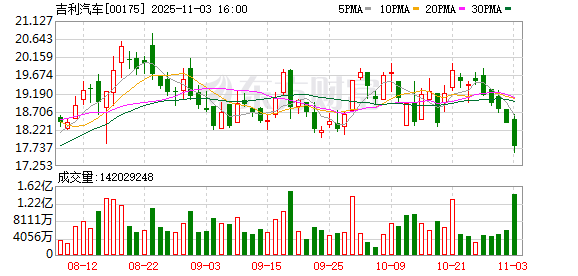
Market Overview - Hong Kong stocks opened positively in November, with major indices rising, and the Hang Seng Index closing at 26,158.36 points, up 0.97% or 251.71 points, with a total turnover of HKD 228.68 billion [1] - The Hang Seng China Enterprises Index increased by 0.98% to 9,258.73 points, while the Hang Seng Tech Index rose by 0.24% to 5,922.48 points [1] Blue Chip Performance - Chow Tai Fook (01929) led the blue-chip decline, falling 8.67% to HKD 13.9, impacting the Hang Seng Index by 4.04 points [2] - AIA Group (01299) rose 5.96%, contributing 75.25 points to the index, while Wanzhou International (00288) increased by 4.69%, adding 4.62 points [2] Sector Performance Technology Sector - Technology stocks showed mixed results, with Alibaba down 1.15% and Tencent down 0.16%, while Kuaishou rose 1.52% [3] Oil Sector - Oil stocks experienced a broad increase, with China National Offshore Oil Corporation (00883) up 3.49% and China Petroleum (00857) up 3.37%, following OPEC+'s announcement to pause production increases in early 2024 [3] Coal Sector - Coal stocks generally rose, with China Qinfa (00866) up 7.53% and Yanzhou Coal (01171) up 4.69%, driven by seasonal demand and safety production assessments [4] AI Application Sector - AI application stocks were active, with Fenbi (02469) surging 10.36% after announcing a share buyback plan, reflecting strong market interest in AI education products [4][10] Gold and Jewelry Sector - Gold mining and jewelry stocks fell sharply, with Chow Tai Fook down 8.67% and Lao Pu Gold (06181) down 7.16%, following new tax policies affecting gold trading [6] Automotive Sector - The automotive sector showed varied performance, with XPeng Motors (09868) up 4.59% and NIO (09866) up 4.21%, supported by strong October delivery figures for new energy vehicles [7] Notable Stock Movements - Minglue Technology (02718) debuted with a significant rise of 106.1%, closing at HKD 290.6, indicating strong investor interest in data intelligence applications [8] - WuXi AppTec (02126) surged 16.09% due to positive developments regarding its CAR-T cell therapy's inclusion in commercial health insurance [9]

“银十”变“金十” 多家新能源车企10月销量创新高
Bei Jing Ri Bao Ke Hu Duan· 2025-11-03 08:23
Core Insights - The automotive market in October experienced strong performance, driven by favorable policies and the launch of new models, leading to a "golden October" for the industry [3] Group 1: New Energy Vehicle Sales - Leap Motor achieved a monthly delivery of 70,289 units, marking a year-on-year increase of over 84%, maintaining its position as the monthly sales champion among new forces [1] - Xiaopeng Motors delivered 42,013 vehicles in October, a historical high with a year-on-year growth of 76% and a month-on-month increase of 1% [1] - NIO's deliveries reached 40,397 units, a year-on-year increase of 92.6%, supported by the launch of new models [1] - Xiaomi Motors also surpassed 40,000 monthly deliveries [1] - Li Auto's deliveries decreased both year-on-year and month-on-month, totaling 31,767 units in October [1] Group 2: Traditional Automakers' Performance - Geely's Zeekr brand sold 21,400 units in October, a year-on-year increase of 63.8% [2] - BAIC's Arcfox brand achieved sales of 23,400 units, a remarkable year-on-year growth of 110% [2] - Dongfeng's Lantu delivered 17,200 units, while Changan's Avita Technology sold 13,500 units, both reaching historical highs [2] - SAIC's Zhiji brand sold 13,200 units, also a record for the brand [2] Group 3: Overall Market Trends - BYD's new energy vehicle sales reached 441,706 units in October, showing a year-on-year decline of 12% but a month-on-month increase of 11.47%, with overseas sales surging by 155% [2] - SAIC's total vehicle sales for October were 453,978 units, reflecting a year-on-year growth of 12.96%, with new energy vehicle sales increasing by 31.6% [2] - Chery Group's total sales reached 281,161 units, a year-on-year increase of 3.3%, with new energy vehicle sales surpassing 110,000 units for the first time [2]

10月各家车企销量
数说新能源· 2025-11-03 03:16
Sales Performance Summary - BYD achieved sales of 441,700 units in October, representing a year-on-year increase of 5.31% and a month-on-month increase of 11%. Cumulative sales for 2025 reached 3.7019 million units, with a year-on-year growth of 20.93% [1] - Geely Automobile reported sales of 307,100 units in October, showing a year-on-year increase of 35.49% and a month-on-month increase of 12%. Cumulative sales for 2025 reached 2.4773 million units, with a year-on-year growth of 44.33% [1] - Great Wall Motors sold 143,100 units in October, marking a year-on-year increase of 22.50% and a month-on-month increase of 7%. Cumulative sales for 2025 reached 1.0664 million units, with a year-on-year growth of 9.87% [1] - Xpeng Motors recorded sales of 42,000 units in October, a significant year-on-year increase of 76% and a month-on-month increase of 1%. Cumulative sales for 2025 reached 355,200 units, with a year-on-year growth of 190.02% [1] - Li Auto's sales were 31,800 units in October, reflecting a year-on-year decline of 38.25% and a month-on-month decline of 6%. Cumulative sales for 2025 reached 328,900 units, with a year-on-year decrease of 16.36% [1] - NIO sold 40,400 units in October, achieving a year-on-year increase of 92.59% and a month-on-month increase of 16%. Cumulative sales for 2025 reached 241,600 units, with a year-on-year growth of 41.91% [1] - Leap Motor reported sales of 70,300 units in October, with a year-on-year increase of 94.78% and a month-on-month increase of 5%. Cumulative sales for 2025 reached 465,800 units, with a year-on-year growth of 126.93% [1] - Zeekr's sales were 21,400 units in October, showing a year-on-year decline of 14.48% but a month-on-month increase of 17%. Cumulative sales for 2025 reached 165,000 units, with a year-on-year decrease of 1.73% [1] - Deep Blue sold 36,800 units in October, marking a year-on-year increase of 69.33% and a month-on-month increase of 9%. Cumulative sales for 2025 reached 262,400 units, with a year-on-year growth of 80.66% [1] - Lantu reported sales of 17,200 units in October, achieving a year-on-year increase of 69.52% and a month-on-month increase of 13%. Cumulative sales for 2025 reached 114,200 units, with a year-on-year growth of 82.14% [1]