
NIO(09866)

Search documents
纳斯达克金龙中国指数涨幅一度扩大至近2%,热门中概股中,蔚来汽车(NIO.N)涨近6%,阿里巴巴(BABA.N)涨近2%。
Jin Rong Jie· 2026-01-29 15:01
纳斯达克金龙中国指数涨幅一度扩大至近2%,热门中概股中,蔚来汽车(NIO.N)涨近6%,阿里巴巴 (BABA.N)涨近2%。 ...
美股异动 | 蔚来(NIO.US)涨逾7% “世界模型NWM 2.0”正式上车
智通财经网· 2026-01-29 14:58
Core Viewpoint - NIO Inc. has seen a stock increase of over 7%, reaching $4.94, following the release of a significant software update for its Banyan system, which includes the new NWM 2.0 model [1] Group 1: Software Update and Features - The recent update to the Banyan system, version 3.3.0, has been rolled out to over 460,000 users, marking a major advancement in NIO's smart driving technology [1] - The update is particularly notable for users of the initial ET7 model, which dates back to its launch in 2021, and introduces significant functionality improvements powered by four Orin-X chips [1] - The adaptation work for the "Cedar" series models is nearing completion, with an expected rollout of updates in the near future [1] Group 2: Future Developments - NIO's founder, Li Bin, has announced plans for three major system updates by 2026, along with an increase in cloud training computing power to enhance system performance [1] - The company aims to improve the system's performance in long-tail scenarios through extensive data training, indicating a commitment to ongoing technological advancement [1] - The latest upgrade signifies a critical step in NIO's smart driving technology evolution, although there remains room for further optimization [1]
Nio (NYSE: NIO) Stock Price Prediction and Forecast 2026-2030 (Jan 29)
247Wallst· 2026-01-29 12:50
Core Viewpoint - Nio Inc. has faced significant market volatility due to tariff issues, with its stock price fluctuating and currently showing a year-over-year increase of 6.3% despite recent declines [1][2]. Stock Performance - Nio's stock is currently trading 5.0% lower than six months ago, underperforming the S&P 500 during the same period [2]. - The stock price has seen a significant decline from its all-time high of $62.84 in February 2021, reflecting a challenging market environment [4]. Financial Overview - Nio's revenue growth has been notable, with revenues increasing from 4.95 billion CNY in 2018 to an estimated 55.62 billion CNY in 2023, although operating losses have also increased [7][8]. - Analysts have set a mean price target of $6.67 for Nio, which is over 45% higher than the current share price, with a high target of $9.25 [2][14]. Growth Drivers - Nio's high-performance models with a range exceeding 600 miles and battery swap technology are attracting interest from consumers and investors [3]. - The company is expanding its market presence internationally, with plans to enter up to 40 global markets by the end of 2026 [13]. Future Projections - Revenue projections indicate significant growth, with estimates reaching 257.63 billion CNY by 2028 and a stock price target of $23.56 by 2030, representing a potential upside of over 413% from current levels [12][15]. - Nio's strategy includes a focus on younger consumers and the introduction of battery-as-a-service solutions, which could enhance customer experience and reduce vehicle costs [13].

奔驰140年,小米汽车、理想、蔚来、奥迪等送上祝福
Xin Lang Cai Jing· 2026-01-29 02:50
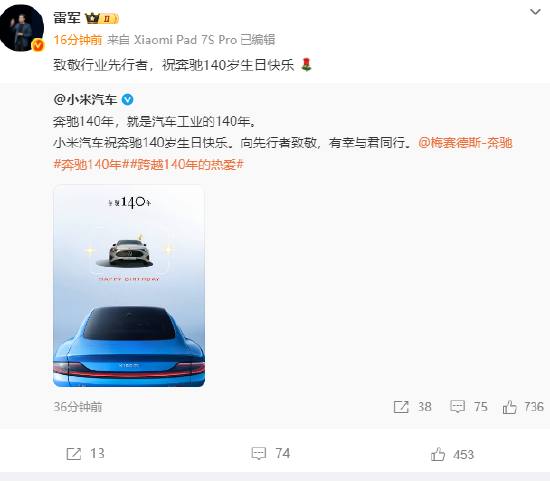
Core Viewpoint - Mercedes-Benz celebrates its 140th anniversary, marking a significant milestone in the automotive industry since the invention of the automobile by Karl Benz in 1886 [1][6]. Group 1: Historical Significance - The date January 29, 1886, is recognized as the day Karl Benz submitted the patent application for the first automobile, which is a pivotal moment in automotive history [6]. - The celebration emphasizes how transportation methods have evolved over the past 140 years, continuously reshaping global connectivity [5][6]. Group 2: Industry Recognition - Various automotive companies, including Xiaomi, Li Auto, NIO, Geely, and Cadillac, have extended their congratulations to Mercedes-Benz on this milestone, highlighting the collaborative spirit within the industry [1][6]. - Notable figures, such as Lei Jun from Xiaomi, expressed respect for industry pioneers and acknowledged the significance of Mercedes-Benz's contributions to automotive innovation [6][7]. Group 3: Future Aspirations - Mercedes-Benz's messaging reflects a commitment to innovation and a forward-looking vision, encouraging collaboration among industry peers to continue advancing automotive technology [9][10]. - The company aims to create the next iconic vehicle, reinforcing its role as a leader in the automotive sector [9].
港股开盘|恒指跌0.72% 蔚来跌逾3%
Di Yi Cai Jing· 2026-01-29 01:49
恒生指数低开0.72%,恒生科技指数跌0.79%。蔚来跌逾3%,京东集团跌逾2%,小鹏汽车、携程集团、 阿里巴巴等纷纷走低。 恒生指数低开0.72%,恒生科技指数跌0.79%。蔚来跌逾3%,京东集团跌逾2%,小鹏汽车、携程集团、 阿里巴巴等纷纷走低。 ...
蔚来济南首座“牛屋”停业
Xin Lang Cai Jing· 2026-01-29 01:49
文 | 导报财经组 继去年下半年广州多家蔚来汽车"牛屋"关闭后,近期,山东省会济南也传出了蔚来在该城的首座"牛 屋"已停业的消息。 文 | 导报财经组 近日,有读者反映,位于济南老城区核心商圈宽厚里的蔚来中心已闭店一段时间。1月28日,记者来到 位于该门店所在的宽厚里东南角,发现该门店原址外围已被围挡遮住,围挡均绘制有名创优品的图案, 显示这里未来不久将会变为名创优品门店。 据了解,蔚来中心也叫作"牛屋(NIO House)",是蔚来汽车打造的线下用户体验空间,定位于为用户 提供集展厅、办公、休闲、社交等功能于一体的"第三空间",该空间包含共享办公、阅读区、特饮吧等 功能区,与侧重销售功能的蔚来空间(NIO Space)形成互补。 公开报道显示,蔚来中心2022年8月6日在济南宽厚里开业,这也是蔚来在济南的首座牛屋,该门店位于 宽厚里东南角,与济南著名景点黑虎泉仅一街之隔,周边人流客流密集。另据公开信息,蔚来济南"牛 屋"还曾获得《Interior Design》2023年度最佳设计奖的最佳汽车展厅奖。 记者在蔚来中心官网搜索济南区域情况,显示这座"牛屋"目前已搜索不到,对于为何关闭,记者联系了 蔚来服务热线 ...
汽车早报|小米SU7 Ultra将正式入驻GT7 蔚来世界模型NWM新版本正式推送
Xin Lang Cai Jing· 2026-01-29 00:37
Group 1: Automotive Industry Developments - The first mandatory national standard for automotive driving assistance systems, titled "Technical Requirements and Testing Methods for Light Vehicle Automatic Emergency Braking Systems" (GB 39901—2025), will be implemented on January 1, 2028 [1] - Lantu Automotive has received approval from the China Securities Regulatory Commission for its introduction listing on the Hong Kong Stock Exchange [1] - NIO has officially launched a new version of its "NIO World Model" (NWM), which includes a city navigation battery swap feature, supporting over 2,000 battery swap stations nationwide [1] - Xiaomi's SU7 Ultra will officially enter the game "Gran Turismo 7" on January 29, marking the first Chinese brand model to be featured in the game [1] Group 2: Company Financials and Performance - Tesla reported fourth-quarter revenue of $24.9 billion, a year-on-year decrease of 3.1%, with operating profit at $1.41 billion, down 11%, and free cash flow at $1.42 billion, down 30% [5] - Kia Motors reported a fourth-quarter operating profit of 1.84 trillion KRW, net profit of 1.47 trillion KRW, and sales of 28.09 trillion KRW, all below market expectations [7] - Volvo Group's fourth-quarter adjusted operating profit was 12.77 billion SEK, with net sales of 123.8 billion SEK and an adjusted operating profit margin of 10.3% [7] Group 3: Strategic Initiatives and Collaborations - WeRide has launched its self-developed general simulation model, WeRide GENESIS, to accelerate the development and commercialization of autonomous vehicles [3] - Pony.ai and Aitb have formed a business partnership to build a fully autonomous driving service fleet, with the first batch of autonomous vehicles obtaining L4-level testing and demonstration application licenses [4] - Tesla plans to invest approximately $2 billion in xAI to deepen their collaborative relationship [6] - Tesla's CEO Elon Musk announced plans for significant capital expenditures in 2026, including the construction of a "Terafab" giant chip factory to address potential capacity bottlenecks [7] Group 4: Employment and Management Changes - German automotive supplier OMO has announced plans to lay off up to 4,000 employees globally, affecting operations in India, Singapore, Romania, Serbia, Germany, and Mexico [8] - Porsche announced that Tobias Sühlmann will succeed Michael Mauer as design director starting February 1, following Mauer's departure after over 20 years in the role [8]

Rivian vs. NIO: Which EV Manufacturer Stock Is Worth Buying?
ZACKS· 2026-01-28 16:41
Core Insights - Rivian Automotive, Inc. (RIVN) and NIO Inc. (NIO) are both electric vehicle (EV) manufacturers with different market strategies and geographic focuses [1] - Rivian operates primarily in the U.S. with a direct-to-consumer sales model, while NIO focuses on the Chinese market and is expanding into Europe and Asia [1] Rivian Overview - Rivian's vehicle deliveries decreased to 42,247 in 2025 from 51,579 in 2024, with production also down to 42,284 units from 49,476 [6] - The company is producing validation units of the R2 electric SUV, expected to start at around $45,000, aiming for customer deliveries in the first half of the year [7] - Rivian anticipates that the R2 launch will enhance profitability and reduce fixed costs per unit due to higher production volumes [10] - A significant investment from Volkswagen, up to $5.8 billion by 2027, is expected to bolster Rivian's financial outlook and support the R2 model development [11] - Rivian's material costs for the R2 are projected to be nearly 50% lower than the R1 models, contributing to improved profitability [12] - Rivian's cash balance decreased to $7.1 billion at the end of Q3 2025, with a high capital expenditure forecast of $1.8-$1.9 billion [13] NIO Overview - NIO delivered 326,028 vehicles in 2025, a 46.9% increase year-over-year, with Q4 deliveries reaching 124,807, up 71.7% [14] - A strategic partnership with Contemporary Amperex Technology Co., Ltd. aims to develop advanced long-life battery technologies, enhancing customer value [15] - NIO's vehicle margins improved to 14.7% in Q3 2025 from 13.1% in Q3 2024, with plans to launch three new large SUV models in 2026 [16] - NIO's SG&A expenses increased by 1.8% year-over-year, which may impact margins due to rising operational costs [17] - NIO's total debt-to-capitalization ratio stands at 79.8%, indicating higher leverage compared to Rivian's 46.6% [18] Valuation and Investment Outlook - NIO trades at a more attractive price-to-sales multiple than Rivian, suggesting a more reasonable stock price [19] - Despite cash burn and high capital spending, Rivian is viewed as a more compelling investment opportunity due to its upcoming R2 launch and stronger balance sheet [20] - NIO's strong growth is tempered by competitive pressures in the Chinese market and high operating expenses [21] - Both companies currently hold a Zacks Rank 3 (Hold), but Rivian is seen as the stronger choice for investors focused on financial resilience and long-term margin expansion [22]

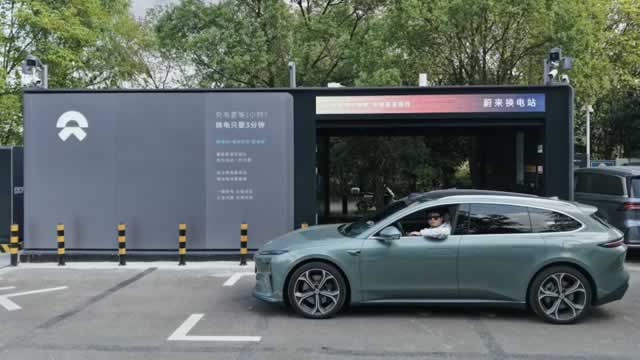
蔚来世界模型新版加速覆盖 马麟:Cedar系列1.4.0已送备即将推送
Feng Huang Wang· 2026-01-28 10:31
Core Viewpoint - NIO is advancing its smart driving technology with the release of the Cedar and Cedar S version 1.4.0, indicating a commitment to iterative upgrades across different vehicle platforms [1] Group 1: Smart Driving Technology Updates - NIO's smart driving R&D head announced that the Cedar and Cedar S version 1.4.0 has been submitted for approval, showcasing the company's focus on upgrading smart driving capabilities [1] - The new version of the "World Model" has been launched, covering over 460,000 vehicles equipped with the Banyan smart system, indicating a significant scale of deployment [1] - The upgrade features a "World Model + Closed-loop Reinforcement Learning" architecture, enhancing lane selection, dynamic game theory, and vehicle control to a more human-like level [1] Group 2: New Functionalities and Hardware - The upgrade introduces a new "Urban Navigation Battery Swap" function, which can automatically connect to over 2,000 battery swap stations nationwide [1] - NIO emphasizes its high-performance hardware, such as the Banyan platform with a computing power of 1016 TOPS, which supports ongoing software upgrades [1] - The Cedar series vehicles, equipped with the self-developed 5nm driving chip NX9031, are progressively receiving the latest technological enhancements [1]

港股汽车股午后持续走高,理想汽车(02015.HK)、比亚迪股份(01211.HK)涨超4%,蔚来汽车(09866.HK)涨近4%,小鹏汽车(09868...
Jin Rong Jie· 2026-01-28 06:57
本文源自:金融界AI电报 港股汽车股午后持续走高,理想汽车(02015.HK)、比亚迪股份(01211.HK)涨超4%,蔚来汽车(09866.HK) 涨近4%,小鹏汽车(09868.HK)、长城汽车(02333.HK)涨超2%。 ...

