BIDU(09888)

Search documents
百度集团-SW(09888.HK):AI收入展现强劲增长势头 无人驾驶业务维持全球扩张趋势
Ge Long Hui· 2025-11-28 05:20
Core Viewpoint - Baidu Group reported a decline in Q3 2025 revenue and profits, but showcased strong growth in AI-related business and autonomous driving services [1][2][3] Group 1: Financial Performance - In Q3 2025, Baidu Group achieved revenue of 31.174 billion yuan, a year-on-year decrease of 7.10% and a quarter-on-quarter decrease of 4.70% [1] - Non-GAAP operating profit was 2.205 billion yuan, down 69% year-on-year and 50% quarter-on-quarter [1] - Non-GAAP net profit attributable to shareholders was 3.770 billion yuan, a decline of 36% year-on-year and 21% quarter-on-quarter [1] - Baidu's core business generated revenue of 24.659 billion yuan, a year-on-year decrease of 7% [1] Group 2: AI Business Growth - Baidu Group disclosed AI-related business revenue for the first time, reporting over 50% year-on-year growth, reaching approximately 10 billion yuan in Q3 2025 [2] - AI cloud services revenue was 4.2 billion yuan, up 33% year-on-year, with high-performance computing subscription revenue increasing by 128% [2] - AI applications revenue reached 2.6 billion yuan, growing 6% year-on-year, while AI native marketing services revenue surged to 2.8 billion yuan, a 262% increase [2] - AI native marketing services accounted for 18% of Baidu's core online marketing revenue, up from 4% in Q3 2024 [2] Group 3: Autonomous Driving Expansion - Baidu's autonomous driving service, "Luobo Kuaipao," saw a 212% year-on-year increase in operational orders, reaching 3.1 million orders in Q3 2025 [3] - The service averaged over 250,000 fully autonomous driving operational orders per week as of late October 2025 [3] - The global expansion of "Luobo Kuaipao" increased its operational cities from 16 to 22, with significant progress in Europe, the Middle East, and Hong Kong [3] - The autonomous driving business is expected to maintain rapid growth in order volume and revenue, expand into new markets, and accelerate the application of new vehicle models [3] Group 4: Investment Outlook - The company is actively exploring commercialization of AI search, while maintaining high growth in smart cloud and autonomous driving businesses [4] - Revenue projections for 2025-2027 are 129.7 billion yuan, 135.5 billion yuan, and 143.9 billion yuan, respectively [4] - Adjusted net profit attributable to shareholders is expected to be 19.5 billion yuan, 19.8 billion yuan, and 23.4 billion yuan for the same period [4]
多家企业驰援香港大埔火灾救援,捐款捐物总额超6亿港元
Xin Lang Cai Jing· 2025-11-28 02:02
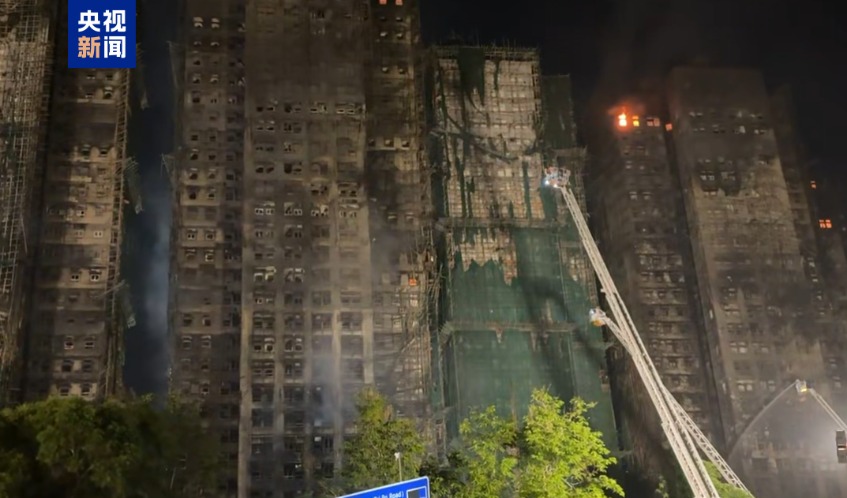
Group 1: Incident Overview - A major fire occurred in Hong Kong's Tai Po district, resulting in 94 fatalities, including one firefighter, and 76 injuries, with 11 being firefighters [1] - The Hong Kong government established a relief fund with an initial allocation of 300 million HKD to assist affected residents [1] Group 2: Corporate Donations - Alibaba Group announced a donation of 20 million HKD for immediate relief efforts and additional support for affected families [2] - Tencent Charity Foundation pledged a total of 30 million HKD, including an initial 10 million HKD and an additional 20 million HKD to the relief fund [2] - ByteDance (Hong Kong) and Baidu each committed 10 million HKD for emergency relief and community recovery efforts [2] Group 3: Additional Corporate Contributions - Various companies, including NetEase, Xiaomi, and Kuaishou, each donated 10 million HKD to support emergency relief and community recovery [3] - Anta Group and Bosideng Group each contributed 30 million HKD, while Li Ning Group and Xtep Group donated 20 million HKD each for disaster relief [4][5][6] - Other companies like 361°, Chow Tai Fook, and Nongfu Spring also made significant contributions, totaling millions in cash and supplies [7][8] Group 4: Broader Industry Response - Multiple sectors, including automotive, real estate, and finance, participated in the relief efforts, with companies like Chery Automobile and BYD each donating 10 million HKD [9][10] - Financial institutions and logistics companies, such as Didi and SF Express, also pledged substantial amounts for emergency aid and recovery efforts [15]



“北溪”爆炸案一嫌疑人至德国受审;香港大埔火灾致83人遇难;外交部:中方绝不接受日方的自说自话;阿维塔“递表”港股IPO;DeepSeek推出新模型丨每经早参
Mei Ri Jing Ji Xin Wen· 2025-11-27 22:00
Group 1 - The Hong Kong fire in Tai Po has resulted in 83 fatalities, prompting the government to provide emergency relief funds of 10,000 HKD per household and establish a 300 million HKD aid fund [6][13][14] - Over 40 companies and organizations have pledged donations exceeding 600 million HKD for rescue and recovery efforts following the fire [13][14][15][16][17] Group 2 - The Chinese Ministry of Commerce held a video conference with Germany's Federal Minister of Economics to discuss issues related to semiconductor supply chains, emphasizing the need for constructive solutions to stabilize the global semiconductor market [5][8] - The National Development and Reform Commission announced measures to enhance credit repair, including simplifying application processes and improving efficiency [9] Group 3 - Anta Sports has been rumored to consider bidding for Puma, with potential collaboration with a private equity firm, reflecting ongoing industry merger and acquisition dynamics [21] - The resignation of Zong Fuli as chairman of Wahaha Group may lead to strategic adjustments within the company, impacting the competitive landscape of the industry [22] Group 4 - Joy City Property officially delisted from the Hong Kong Stock Exchange after 12 years, as part of a privatization plan valued at approximately 2.932 billion HKD [24] - Avita Technology has submitted an IPO application to the Hong Kong Stock Exchange, marking a significant move for a state-owned enterprise in the new energy vehicle sector [28] Group 5 - The release of the white paper on China's military control and disarmament reflects the country's commitment to global security governance and multilateral arms control processes [7] - The recent increase in open-source AI model downloads from China surpassing that of the US indicates a significant advancement in China's AI technology capabilities [32]



【西街观察】AI洗牌,机会均等
Bei Jing Shang Bao· 2025-11-27 14:25
Core Insights - The AI industry is experiencing rapid changes, with major players like Google and Alibaba launching new models and technologies to compete in the market [1][2] - The emergence of new competitors, such as DeepSeek, demonstrates that established companies are not guaranteed dominance in the AI space [1][3] - The fast-paced technological advancements in AI are reshaping user expectations and competitive dynamics, making traditional advantages less relevant [3] Group 1: Market Dynamics - Google is pushing its market value close to $4 trillion with the introduction of its Gemini 3 pro model and self-developed TPU chips [1] - Alibaba is aggressively entering the AI to C market with multiple initiatives, while Baidu is establishing new model development departments [1] - The AI landscape is characterized by rapid iterations and unexpected shifts, as seen with the rise of DeepSeek and the challenges faced by established players like Nvidia [2] Group 2: Competitive Landscape - The AI sector allows for a level playing field, with decreasing computing costs and abundant open-source resources enabling new entrants [2] - Companies are facing diverse demands across industries, leading to a situation where specialized teams can outperform larger firms in niche areas [2] - The shift from closed development to open collaboration is changing the competitive landscape, allowing for faster innovation and shared technological advancements [2] Group 3: Future Outlook - The rapid pace of technological change means that traditional advantages such as user base and financial strength are becoming less secure [3] - Future competition will hinge on technological prowess and execution efficiency, with teams that can effectively integrate resources and optimize products having a better chance of success [3] - The AI industry is marked by a lack of permanent leaders, with new entrants continuously emerging to challenge established players [3]


香港大埔火灾已致65人遇难!蜜雪冰城:捐赠2000万港元!腾讯追加2000万港元 农夫山泉、百度、吉利等企业出手



Mei Ri Jing Ji Xin Wen· 2025-11-27 14:05
Group 1 - The fire in Hong Kong's Tai Po district resulted in 65 fatalities, including one firefighter, and 70 injuries, with 10 being firefighters [1] - The fire occurred on November 26, causing significant casualties and prompting widespread concern [3] Group 2 - Over 40 companies and organizations have pledged donations exceeding 600 million HKD for rescue and disaster recovery efforts [3] - Tencent Foundation announced an additional donation of 20 million HKD, bringing its total to 30 million HKD for fire relief efforts [3] - Other notable donations include 20 million HKD from SF Express, 10 million HKD from Nongfu Spring, and 30 million HKD from the Jack Ma Foundation [5][9][12] Group 3 - Alibaba Group initiated a donation of 20 million HKD and activated an emergency response mechanism to provide essential supplies to affected residents [14] - The Li Ka Shing Foundation allocated 30 million HKD for immediate aid and an additional 50 million HKD for community rebuilding [18] - Various companies, including Xiaomi, BYD, and Ctrip, also contributed 10 million HKD each to support disaster relief efforts [20][22][23]
净亏112亿、广告收入跌19%,百度交出史上最差季度报
Sou Hu Cai Jing· 2025-11-27 12:33
Core Insights - Baidu's third-quarter report revealed a significant revenue decline of 7% year-on-year, marking the largest single-quarter drop in its history, with a net loss of 11.2 billion yuan [2][3] - Despite a 50% increase in AI-related revenue to 10 billion yuan, this growth was insufficient to offset the decline in traditional business segments, particularly online marketing, which saw a 19% drop [2][3][6] - The company is facing intense competition from rivals like ByteDance and Alibaba, leading to a painful transition period for its AI strategy [2][4] Revenue Performance - Baidu's core search advertising revenue fell by 19%, indicating a fundamental challenge to its traditional business model [3] - In contrast, the overall Chinese internet advertising market grew by 6.4% during the same period, with competitors like Tencent and Bilibili experiencing revenue growth of 21% and 23% respectively [3][4] Market Position and User Behavior - Advertisers are shifting their budgets towards platforms that offer shorter conversion paths, such as e-commerce and short video platforms, which has led to Baidu's marginalization [4] - User search habits are changing, with more users opting for platforms like Xiaohongshu and Douyin for information, resulting in Baidu's media position index dropping to ninth place [5] Cost Structure and Profitability - Baidu's revenue costs increased by 12% year-on-year, with sales and administrative expenses rising by 14%, primarily due to investments in AI cloud infrastructure [5][6] - The rising costs are squeezing profit margins, as the company spends more to generate revenue, making it difficult for AI business growth to compensate for losses in traditional advertising [6] Strategic Execution Challenges - Baidu's historical tendency to lag behind competitors in execution, despite early recognition of AI's potential, has hindered its ability to capitalize on its technological advancements [7][9] - The company has struggled to transform its AI capabilities into competitive consumer products, with its AI applications showing slow growth and low user engagement compared to rivals [7][8] Future Directions - Baidu is attempting to pivot towards an "Orion AI Engine" to shift its search model from traditional link retrieval to task-oriented solutions, aiming to maintain relevance in the AI era [8] - The company must transition from an advertising-centric model to one focused on user value and product experience to avoid further marginalization [9]
智能眼镜,会否成为下一个智能音箱?
3 6 Ke· 2025-11-27 12:13
Core Insights - The article discusses the competitive landscape of smart glasses in China, highlighting the strategic moves of major players like Alibaba, Baidu, and Xiaomi in this emerging market [1][14][22] Group 1: Alibaba's Strategic Moves - Alibaba has entered the smart glasses market with its Quark brand, launching the Quark S1 smart glasses, which feature a differentiated design and technology support from its Tongyi large model [1][14] - The Quark smart glasses have made improvements in design, including a rear-weighted battery structure to reduce discomfort, a replaceable battery system, and enhanced video stability features [4][6][11] - The Quark team has taken over the role of leading Alibaba's consumer-facing hardware initiatives, replacing the Tmall Genie team, indicating a shift in focus towards smart glasses as a key product line [19][21] Group 2: Competitive Landscape - The smart glasses market is seeing participation from all three major players: Alibaba, Baidu, and Xiaomi, each bringing unique products and strategies to the table [22][29] - Xiaomi has introduced its AI glasses, which feature a unique design allowing for color-changing lenses, and aims for significant sales targets, indicating strong market ambitions [26][27] - Baidu is also entering the smart glasses arena with its AI glasses, focusing on voice assistant capabilities and competitive pricing, further intensifying the competition among these tech giants [29] Group 3: Market Dynamics and Challenges - The smart glasses market differs from the previous smart speaker market, with existing AR players already established before the entry of major tech companies, leading to a more complex competitive environment [30][32] - Technical challenges such as display technology, battery life, and lightweight design remain significant hurdles for the smart glasses industry, impacting product offerings and market readiness [35][36] - The article suggests that while the current smart glasses do not yet meet consumer expectations for functionality and design, the collective entry of major players could accelerate advancements in the industry [37]


霍启刚:家族捐赠3000万港元;京东、百度、红杉、滴滴、富途、小鹏等,火速驰援
Zhong Guo Ji Jin Bao· 2025-11-27 11:16
Core Points - A significant fire incident occurred in Hong Kong's Tai Po district, leading to substantial casualties and prompting immediate support from various sectors of society [1] Group 1: Donations and Support - The Ho family announced a donation of 30 million HKD to support the residents affected by the fire [2] - Baidu pledged 10 million HKD for emergency relief and reconstruction efforts for the affected community [7] - Sequoia Charity Foundation also committed 10 million HKD for emergency aid, medical assistance, and post-disaster recovery [8] - Didi donated 10 million HKD for emergency rescue and humanitarian assistance, coordinating with local authorities for effective support [11] - Futu announced a donation of 10 million HKD for urgent aid and basic living supplies for affected families [12] - XPeng Motors contributed 5 million HKD to assist affected families in overcoming the crisis [13] Group 2: Emergency Response Efforts - JD.com was the first company to deliver emergency supplies to the disaster site, providing essential items such as bottled water and snacks [4] - JD Logistics activated its emergency response plan, dispatching bedding, hygiene products, and food supplies to ensure timely delivery to affected areas [6] - The company established a green channel for the rapid transport of relief materials to Hong Kong [6]



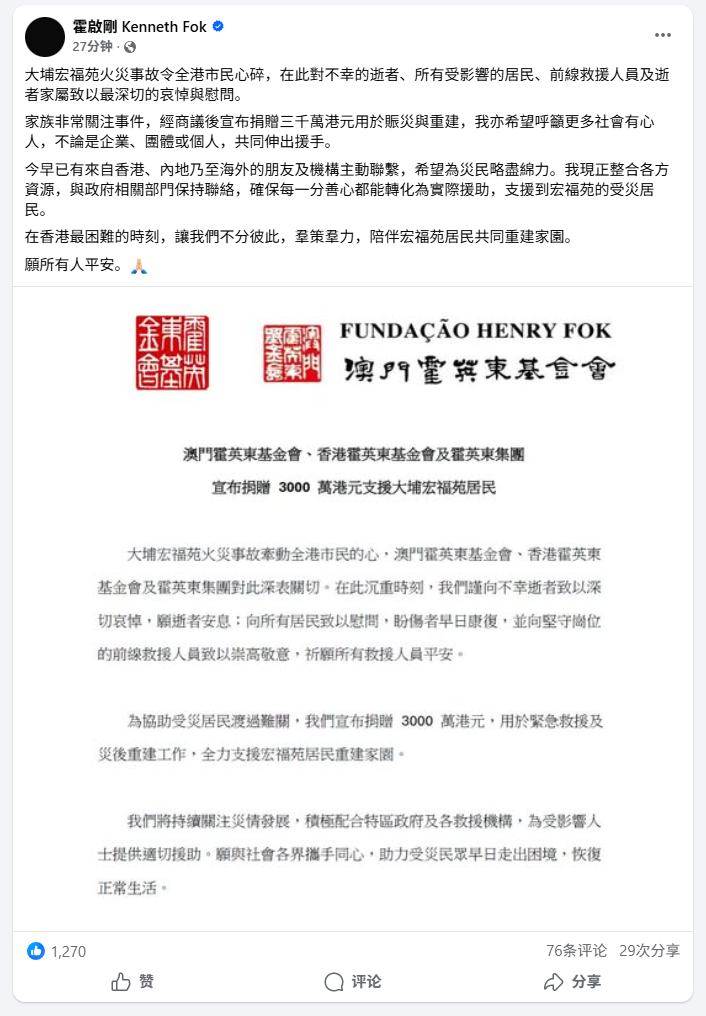
霍启刚:家族捐赠3000万港元;京东、百度、红杉、滴滴、富途、小鹏等,火速驰援
中国基金报· 2025-11-27 10:51
Core Viewpoint - The article highlights the significant support from various companies and individuals in response to a major fire incident in Hong Kong's Tai Po district, emphasizing the importance of community solidarity and corporate social responsibility in times of crisis. Group 1: Donations and Support - The Ho family announced a donation of 30 million HKD to support the residents affected by the fire [2][3] - Baidu pledged 10 million HKD for emergency relief and post-disaster reconstruction efforts [8][9] - Sequoia Charity Foundation committed 10 million HKD for emergency aid and recovery efforts for the affected residents [10][11] - Didi donated 10 million HKD for emergency rescue and humanitarian assistance, coordinating with local authorities for effective support [15][16] - Futu announced an immediate donation of 10 million HKD to assist affected families with urgent needs [17][19] - XPeng Motors contributed 5 million HKD to support the affected families in overcoming the crisis [20][21] Group 2: Emergency Response Actions - JD.com was the first company to deliver emergency supplies to the disaster site, providing essential items such as water and food [5][6] - JD Logistics activated an emergency response plan, ensuring timely delivery of necessary supplies to shelters and affected areas [7][12] - Baidu Maps implemented a dynamic response mechanism to provide real-time traffic updates and alternative routes for vehicles in the vicinity of the fire [9]

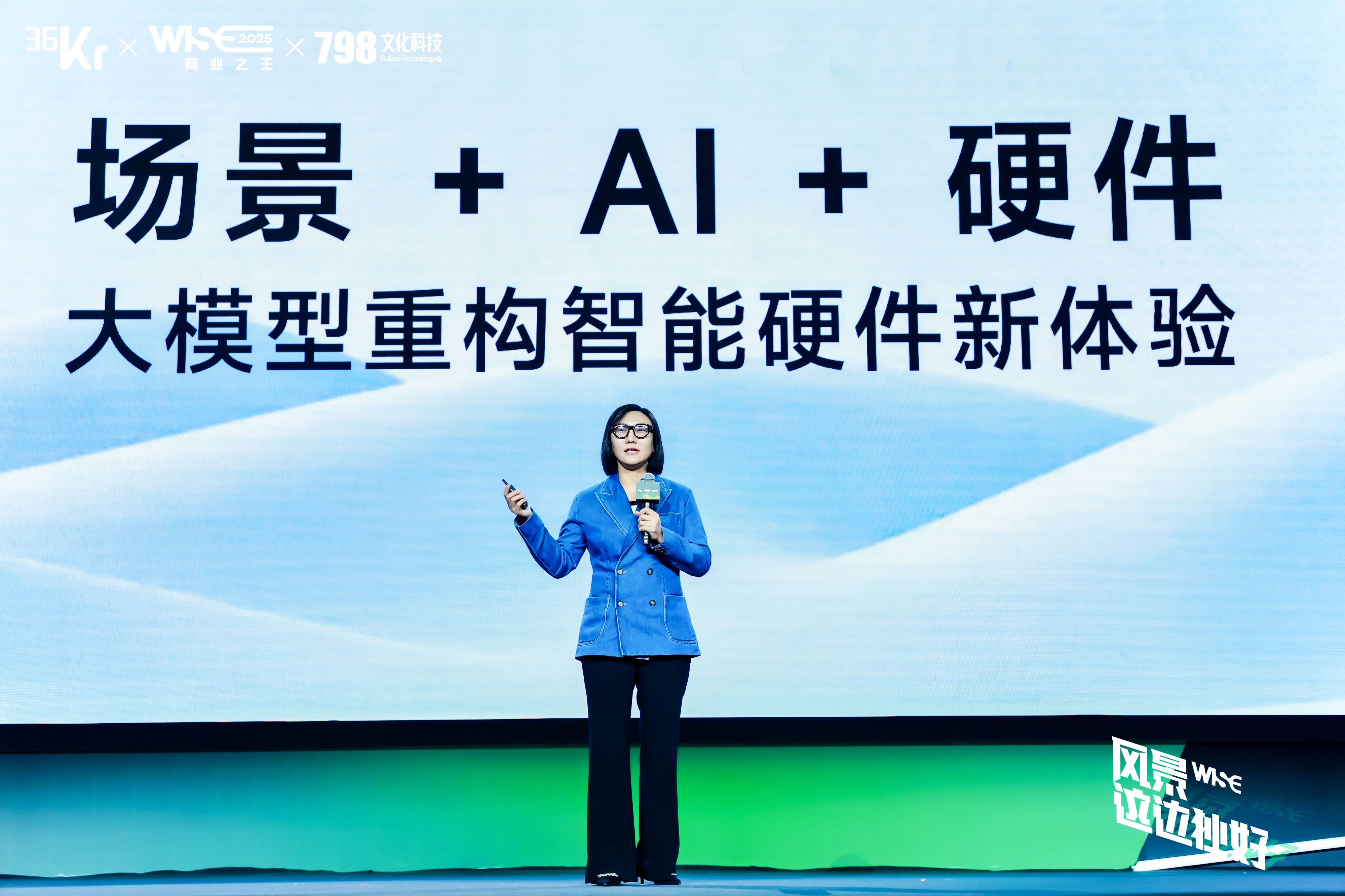
小度科技CEO、百度集团副总裁李莹:用“场景 + AI + 硬件”在同质化竞争中找到属于自己的蓝海|WISE 2025 商业之王
3 6 Ke· 2025-11-27 09:40
Core Insights - The WISE 2025 Business King Conference aims to anchor the future of Chinese business amidst uncertainty, emphasizing the integration of technology and business narratives [1] - The conference features immersive experiences showcasing the latest advancements in AI and smart hardware, highlighting the importance of understanding real-world applications [2] Company Innovations - Baidu's CEO introduced three new products: the Xiaodu AI Glasses Pro, a smart camera, and the Xiaodu Smart Speaker Fun, focusing on the integration of AI, hardware, and real-life scenarios [5][6] - The Xiaodu AI Glasses Pro is designed to assist users in obtaining information and enhancing capabilities without distraction, featuring a stylish design and advanced functionalities [6][10] - The smart camera utilizes multi-modal large model technology to not only capture images but also understand scenes and behaviors, offering proactive notifications and interventions [11][12] Product Features - The Xiaodu AI Glasses Pro includes a 12-megapixel wide-angle camera, AI noise reduction for clear audio, and real-time translation capabilities, achieving near-human translation accuracy [8][9] - The smart camera can recognize specific behaviors and send alerts, as well as interact with other smart home devices to enhance user experience [11][12] - The Xiaodu Smart Speaker Fun supports DIY customization and can pair with another speaker for a shared listening experience, appealing to younger consumers [15] Technological Advancements - The introduction of "Super Xiaodu," an AI-native operating system, allows devices to engage in multi-modal interactions, transforming them from mere tools to proactive partners [14] - The company plans to upgrade existing Xiaodu devices to the Super Xiaodu system at no cost to users, enhancing their functionality and user experience [14]