
BIDU(09888)

Search documents
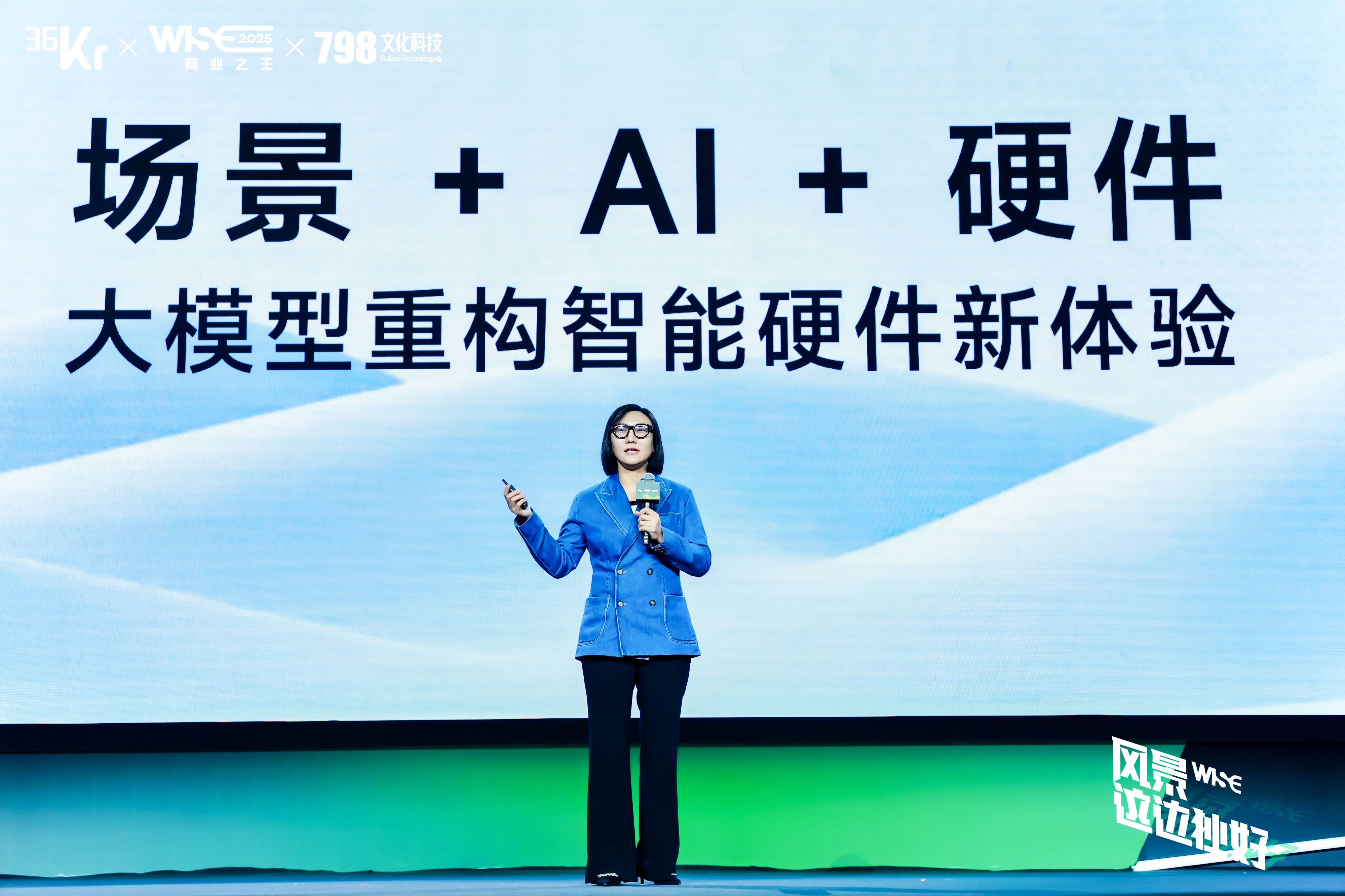
小度科技CEO、百度集团副总裁李莹:用“场景 + AI + 硬件”在同质化竞争中找到属于自己的蓝海|WISE 2025 商业之王
3 6 Ke· 2025-11-27 09:40
Core Insights - The WISE 2025 Business King Conference aims to anchor the future of Chinese business amidst uncertainty, emphasizing the integration of technology and business narratives [1] - The conference features immersive experiences showcasing the latest advancements in AI and smart hardware, highlighting the importance of understanding real-world applications [2] Company Innovations - Baidu's CEO introduced three new products: the Xiaodu AI Glasses Pro, a smart camera, and the Xiaodu Smart Speaker Fun, focusing on the integration of AI, hardware, and real-life scenarios [5][6] - The Xiaodu AI Glasses Pro is designed to assist users in obtaining information and enhancing capabilities without distraction, featuring a stylish design and advanced functionalities [6][10] - The smart camera utilizes multi-modal large model technology to not only capture images but also understand scenes and behaviors, offering proactive notifications and interventions [11][12] Product Features - The Xiaodu AI Glasses Pro includes a 12-megapixel wide-angle camera, AI noise reduction for clear audio, and real-time translation capabilities, achieving near-human translation accuracy [8][9] - The smart camera can recognize specific behaviors and send alerts, as well as interact with other smart home devices to enhance user experience [11][12] - The Xiaodu Smart Speaker Fun supports DIY customization and can pair with another speaker for a shared listening experience, appealing to younger consumers [15] Technological Advancements - The introduction of "Super Xiaodu," an AI-native operating system, allows devices to engage in multi-modal interactions, transforming them from mere tools to proactive partners [14] - The company plans to upgrade existing Xiaodu devices to the Super Xiaodu system at no cost to users, enhancing their functionality and user experience [14]


AI泡沫论升温,智能体为何迎来爆发元年?
Xin Lang Cai Jing· 2025-11-27 07:13
Core Viewpoint - The AI industry is experiencing a dual narrative in 2025, with a significant market correction in global tech stocks while the AI agent sector is witnessing explosive growth, particularly in China, where the market size is projected to increase from 4.75 billion yuan in 2024 to 7.84 billion yuan, representing over 60% growth [1][6]. Group 1: Evolution of AI Agents - AI agents are defined as software programs capable of autonomously understanding, planning, and executing complex tasks, fundamentally differing from traditional AI assistants [2]. - The emergence of AI agents is a result of technological advancements, transitioning from early models that were primarily for demonstration to sophisticated systems capable of logical reasoning and multi-modal understanding [3][4]. - The core value of this evolution is transforming intelligence from a cost into a productivity driver, as articulated by industry leaders [5]. Group 2: Major Investments and Market Dynamics - The growth of AI agents is fueled by strategic investments from global tech giants, which are based on clear commercial return expectations, creating a positive cycle of research, implementation, and profitability [6]. - Companies like Baidu and Tencent are leading the charge with innovative AI solutions, such as Baidu's self-evolving AI agent and Tencent's integration within its WeChat ecosystem [7]. - The commercial value of AI agents is evident across various sectors, including healthcare, retail, and finance, where they are significantly enhancing operational efficiency and reducing costs [8]. Group 3: Underlying Factors for Growth - The rapid growth of AI agents is attributed to the convergence of technological maturity, rising demand, and an improved ecosystem [9]. - Breakthroughs in technology have drastically reduced the cost of large model inference by 90% and increased speed by tenfold, addressing previous scalability issues [10]. - The pressing need for cost reduction and efficiency in businesses drives the adoption of AI agents, which offer non-intrusive solutions that integrate seamlessly with existing systems [11]. Group 4: Future Outlook - The future of AI agents is expected to shift from scaling to refinement, ushering in a new era of human-machine collaboration, with predictions indicating that 60% of enterprises will rely on AI agents for core operations by 2026 [12]. - Despite existing challenges such as communication delays and talent shortages, the evolution of AI agents is seen as a necessary phase in technological advancement, distinguishing them from past speculative bubbles [13].

恒生指数高开0.07% 恒生科技指数跌0.10%
Xin Lang Cai Jing· 2025-11-27 06:48
来源:上海证券报·中国证券网 上证报中国证券网讯 11月27日,恒生指数高开0.07%,恒生科技指数跌0.10%。蔚来跌超2%,百度集团 跌超1%。 ...

集邦咨询:预计2026年全球AI Server出货同比增长逾20% AI芯片液冷渗透率达47%
Zhi Tong Cai Jing· 2025-11-27 06:37
Core Insights - The global AI server shipments are expected to grow by over 20% year-on-year in 2026, driven by increased capital expenditure from North American CSPs and the rise of sovereign cloud initiatives [1][2] - The competition in the AI chip market is intensifying, with companies like AMD and various Chinese firms enhancing their self-developed ASIC capabilities, challenging NVIDIA's dominance [1][2] Group 1: AI Chip and Cooling Technologies - The thermal design power (TDP) of AI chips is projected to rise from 700W for NVIDIA's H100 and H200 to over 1,000W for upcoming models, necessitating liquid cooling systems in server cabinets, with a forecasted penetration rate of 47% for liquid cooling in AI chips by 2026 [2] - Microsoft is introducing new microfluidic cooling technologies for next-generation chip packaging, while the market is expected to transition from liquid-to-air (L2A) to liquid-to-liquid (L2L) cooling designs [2] Group 2: Memory and Data Transfer Innovations - HBM and optical communication technologies are becoming critical for overcoming bandwidth limitations in AI computing, with HBM4 expected to enhance I/O bandwidth and local bandwidth for AI chips [3][4] - The introduction of 800G/1.6T pluggable optical modules is underway, with expectations for higher bandwidth SiPh/CPO platforms to be integrated into AI switches starting in 2026 [4] Group 3: NAND Flash and Storage Solutions - NAND Flash suppliers are accelerating the development of specialized solutions to address the performance gap in AI training and inference workloads, including storage-class memory (SCM) SSDs and Nearline QLC SSDs [5][6] - QLC technology is anticipated to achieve a 30% market penetration in enterprise SSDs by 2026, significantly reducing the cost of storing large AI datasets [6] Group 4: Energy Storage Systems - AI data centers are evolving towards large-scale clusters, with energy storage systems transitioning from emergency backup to core energy solutions, expected to grow from 15.7 GWh in 2024 to 216.8 GWh by 2030, reflecting a CAGR of 46.1% [7] - North America is projected to become the largest market for AI data center energy storage, driven by major cloud providers [7] Group 5: Power Infrastructure and Semiconductor Demand - Data centers are shifting to 800V HVDC architectures to enhance efficiency and reliability, with third-generation semiconductors (SiC/GaN) expected to penetrate 17% of data center power supply by 2026 [8] Group 6: Advanced Semiconductor Technologies - The transition to 2nm GAAFET technology is underway, emphasizing higher transistor density and heterogeneous integration to meet the demands of AI applications [9] Group 7: Humanoid Robots and Market Growth - The global shipment of humanoid robots is projected to increase by over 700% in 2026, focusing on AI adaptability and application-specific designs [10][11] Group 8: Display Technology Advancements - OLED technology is set to accelerate in laptops, with Apple expected to introduce OLED panels in MacBook Pro by 2026, leading to a significant increase in OLED penetration in the laptop market [12][13] Group 9: Autonomous Driving and Robotaxi Expansion - The penetration rate of L2 and above advanced driver-assistance systems is expected to exceed 40% by 2026, with Robotaxi services expanding globally beyond just China and the US [15]



小摩:预期2026年底沪深300指数目标5200点,列出中资股首选股名单
Ge Long Hui· 2025-11-27 06:24
Core Viewpoint - Morgan Stanley expresses optimism for the Chinese capital market in 2026, expecting continued growth in the MSCI China Index and the CSI 300 Index, with target levels set at 100 points and 5200 points respectively by the end of 2026, indicating potential increases of 19% and 17% from November 24 [1] Group 1: Investment Themes - The acceleration of "anti-involution" policies is expected to structurally enhance profit margins and return on equity (ROE) for the MSCI China Index and CSI 300 Index, with current market estimates for net profit margins and ROE being relatively low [1] - Strong growth in global artificial intelligence infrastructure capital expenditure is anticipated to boost China's local AI ecosystem and related domestic industries, with emerging "world dynamic models" increasing demand for computing power [1] - The fiscal and monetary easing environment in developed markets is likely to stabilize China's export sales [1] - Consumption is showing a K-shaped recovery, with significant growth in high-end food and beverage and luxury goods sales, while mid-tier consumption recovery remains relatively weak [1] Group 2: Preferred Stocks - Morgan Stanley lists its preferred Chinese stocks for the first quarter of next year, including Baidu, NetEase, Midea Group, Mixue Group, Pinduoduo, Pop Mart, Trip.com, Master Kong, Futu Holdings, Sinopharm, CATL, and China Overseas Development [1] - Additionally, the bank identifies preferred stocks benefiting from the AI supercycle, including cloud service providers (CSP) like Alibaba and Tencent, AI data center companies (AIDC) such as Zhongji Xuchuang, Huqin Technology, and Northern Huachuang, as well as electrification and battery material firms like CATL, Yiwei Lithium Energy, and Ganfeng Lithium [2]
俄回应“和平计划”:绝无可能作出任何让步;香港大埔火灾已致44人遇难,警方拘捕3人



Sou Hu Cai Jing· 2025-11-27 04:26
Market Overview - US stock market continued its strong performance with major indices rising for four consecutive trading days, driven by a rebound in technology stocks and increased probability of a Federal Reserve rate cut in December [2][4] - The Dow Jones Industrial Average rose by 314.67 points (0.67%) to close at 47,427.12, the Nasdaq Composite increased by 0.82% to 23,214.69, and the S&P 500 climbed 0.69% to 6,812.61 [2] Stock Performance - Notable technology stocks showed mixed results: Tesla and Microsoft rose by 1.7%, Nvidia by 1.3%, while Amazon and Meta declined by 0.2% and 0.45% respectively [3] - Dell surged by 5.8% due to strong demand for AI data center servers, exceeding quarterly earnings expectations [3] - Oracle's stock increased by 4.0%, with Deutsche Bank projecting minimal impact on earnings despite the exclusion of OpenAI-related revenue [3] Economic Indicators - Initial jobless claims fell by 6,000 to 216,000, the lowest level since April, while continuing claims showed an upward trend, indicating a challenging labor market [4] - Durable goods orders rose by 0.5% in September, matching expectations but slowing from August's growth, with weak demand in the civilian aircraft sector offsetting gains in other categories [4] - Retail sales increased by 0.2% in September, a slowdown from the revised 0.6% growth in August [4] Federal Reserve Insights - The Federal Reserve's Beige Book indicated ongoing economic struggles, with low hiring intentions and persistent inflation concerns [4][5] - The CME FedWatch Tool shows an 84.9% probability of a 25 basis point rate cut in December, nearly doubling from the previous week [6] - Recent dovish comments from Fed officials have contributed to market optimism regarding potential rate cuts [6] Sector Highlights - Airline stocks experienced significant gains, with the S&P 1500 Airline Index rising by 3.4%, reflecting positive consumer health indicators ahead of the holiday shopping season [7] - Workday's stock fell over 8% after reporting third-quarter subscription revenue that met expectations [8] Commodity Performance - International oil prices saw slight increases, with WTI crude oil rising by 1.21% to $58.65 per barrel and Brent crude oil up by 1.04% to $63.13 per barrel [9] - Gold prices fluctuated upwards, with COMEX gold futures for November delivery increasing by 0.61% to $4,165.20 per ounce [10]

美国防部将中际旭创、新易盛、华虹半导体等8家中企计划列为涉军企业
是说芯语· 2025-11-27 03:49
Core Viewpoint - The article discusses the potential inclusion of eight Chinese companies in the 1260H list, which could impact their collaboration with the U.S. Department of Defense, although the immediate market reaction appears to be rational and unaffected by the news [2][3][4][7]. Group 1: News Context - The news regarding the 1260H list is not old; it was first reported despite the letter's date being October 7 [3]. - The Pentagon has identified Alibaba Group, Baidu, and BYD as companies that may assist the Chinese military, but no new developments have been reported since the initial claim [4]. - The Deputy Secretary of Defense, Stephen Feinberg, mentioned that five additional companies are also under consideration for inclusion, indicating that the list is not finalized [4]. Group 2: Impact on Companies - The core impact of the 1260H list is to restrict companies on the list from collaborating with the U.S. Department of Defense, but it does not directly prohibit partnerships with U.S. commercial firms, although it may create indirect obstacles [4]. - The market response to the news has been measured, as companies like Xuchuang and Xinyi Sheng did not show significant negative impact following the announcement [7]. Group 3: Industry Demand Forecast - According to GFHK's latest data, NVIDIA is expected to require 20 million 1.6T optical modules next year, while Google will need 12 million, raising questions about supply if companies like Zhongji Xuchuang and Xinyi Sheng are affected [4]. - The demand forecast for optical modules shows a significant increase, with shipments projected to rise from 2 million in 2023 to 43 million by 2026 for 800G modules [5].



超3300只个股上涨
第一财经· 2025-11-27 03:46
Core Viewpoint - The article discusses the performance of the A-share market, highlighting the fluctuations in major indices and sector performances, particularly in consumer electronics and HBM concepts, while noting the decline in AI applications and certain real estate stocks [3]. Market Performance - As of the midday session, the Shanghai Composite Index rose by 0.49%, the Shenzhen Component Index increased by 0.38%, and the ChiNext Index initially surged over 2% before settling at a 0.56% gain [3]. - The total trading volume in the Shanghai and Shenzhen markets reached 1.09 trillion yuan, a decrease of 466 billion yuan compared to the previous trading day, with over 3,300 stocks rising [4]. Sector Highlights - The consumer electronics sector saw a rise of 2.28%, while the HBM concept led the gains with a 2.62% increase [4]. - The solid-state battery concept also performed well, contributing to the overall positive sentiment in the market [3]. - The AI application sector continued to show weakness, indicating potential challenges in this area [3]. Notable Stocks - In the pork concept sector, stocks like Jin Xin Nong and Tian Yu Bio experienced significant gains, with Jin Xin Nong hitting the daily limit [5]. - Semiconductor stocks such as Huahong Semiconductor and SMIC saw increases of over 5% and 3%, respectively, reflecting strong performance in the tech sector [6]. - New Energy and AI concept stocks also showed strength, with New Yi Sheng rising by 7% and Yangguang Electric Power increasing by nearly 5% [7]. Additional Market Insights - The Hong Kong stock market opened with a slight increase, with the Hang Seng Technology Index expanding its gains [12]. - The People's Bank of China conducted a reverse repurchase operation of 356.4 billion yuan at an interest rate of 1.40%, indicating ongoing liquidity management [13]. - The Chinese yuan appreciated against the US dollar, reaching its highest level since October 2024 [14].



香港恒生指数开盘涨0.07%,恒生科技指数跌0.1%,蔚来跌超2%,百度集团、天齐锂业跌超1%
Mei Ri Jing Ji Xin Wen· 2025-11-27 01:37
Group 1 - The Hong Kong Hang Seng Index opened with a slight increase of 0.07% [1] - The Hang Seng Tech Index experienced a decline of 0.1% [1] - NIO saw a drop of over 2% [1] - Baidu Group and Tianqi Lithium both fell by more than 1% [1] - Guotai Junan International rose by over 1% [1]

港股开盘 | 恒指高开0.07% 万科企业跌超5%
智通财经网· 2025-11-27 01:36
Core Viewpoint - The Hong Kong stock market is experiencing adjustments, but the underlying bullish trend, particularly in technology stocks, is expected to continue over the next two to three years, with a potential shift to a broader bull market by 2026 [2][3][4]. Market Performance - The Hang Seng Index opened up by 0.07%, while the Hang Seng Tech Index fell by 0.1%. Notably, NIO dropped over 2%, and Baidu Group fell more than 1%, while the new stock Quantitative Party surged over 165% [1]. - Vanke Enterprises saw a decline of over 5% as the company plans to hold a meeting regarding the extension of its bond [1]. Investment Outlook - Analysts suggest that the current market volatility is primarily driven by liquidity, sentiment, and risk appetite, with a focus on core assets amid economic data concerns [3]. - Investment strategies should focus on three main areas: AI-driven industry trends, capacity cycle reversals, and sectors related to export and commodities influenced by external uncertainties [2]. - The Hong Kong market is viewed as a "valuation pit," with significant room for valuation recovery, especially in the context of low historical valuations compared to global indices [5][6]. Liquidity and Market Dynamics - The market's performance is largely influenced by liquidity conditions, with expectations of continued inflows from both domestic and foreign investors as the U.S. enters a rate-cutting phase [6]. - Historical data indicates that short-term market adjustments are normal, with average declines of 7% during minor corrections and 17% during significant liquidity tightening [2]. Sector-Specific Insights - The technology sector in Hong Kong is currently undergoing adjustments, but its long-term investment value is becoming increasingly apparent [4]. - The AI sector remains a focal point for investment, with expectations of continued growth despite recent market fluctuations [3][4].