TRIP.COM(09961)

Search documents
世界旅游联盟发布跨境游消费趋势研究报告 南京位列入境游客消费总额TOP10城市
Nan Jing Ri Bao· 2025-12-29 02:14
Core Insights - The report by the World Tourism Alliance, in collaboration with Mastercard and Ctrip, highlights Nanjing as one of the top 10 cities for inbound tourist spending [1] Group 1: Inbound Tourism Trends - Since the second half of last year, China's visa-free policies have been continuously optimized, leading to an expansion in coverage and longer stay durations for tourists [1] - The number of inbound tourists benefiting from visa-free policies has shown significant growth, with longer stay durations being a notable trend [1] Group 2: Tourist Preferences - "Cultural experience" tourism has emerged as a new favorite among inbound tourists, who are eager to engage with traditional Chinese culture [1] - Experiential travel remains a key driver for tourism development, with sports events and cultural performances having a particularly strong impact on tourism [1] Group 3: Spending Patterns - Inbound tourist spending is highly concentrated in first-tier and new first-tier cities, with Nanjing ranking among the top 10 cities for total inbound tourist spending [1] - There is a notable increase in spending on shopping, dining, and health-related services, indicating a trend towards diversified consumption in inbound tourism [1]
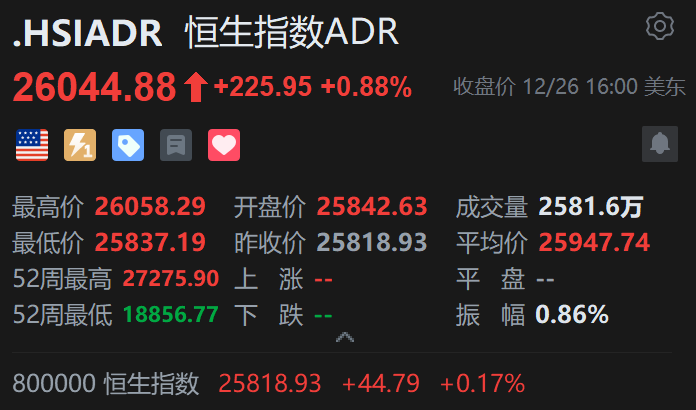
智通ADR统计 | 12月27日





智通财经网· 2025-12-26 23:56
Group 1 - Major blue-chip stocks showed mixed performance, with HSBC Holdings closing at HKD 124.291, up 0.40% from the previous close; Tencent Holdings closed at HKD 606.769, up 0.63% [1] Group 2 - Tencent Holdings reported a latest price of HKD 603.000, with an increase of HKD 1.000, representing a rise of 0.17% [2] - Ctrip Group saw a decrease of HKD 4.500, down 0.79%, closing at HKD 563.500 [2] - Meituan-W remained unchanged at HKD 103.200, with no price change [2] - BYD Company Limited increased by HKD 0.500, up 0.54%, closing at HKD 93.600 [2]

对话携程王韦:入境游红利,推动文旅市场三重“变革”
21世纪经济报道· 2025-12-26 14:24
Core Viewpoint - The article highlights the significant impact of visa facilitation policies on China's inbound tourism market, leading to a robust increase in foreign visitors and consumer spending, marking a transition from a "one-way flow" to a "two-way interaction" in the tourism industry [1][2]. Group 1: Inbound Tourism Growth - In 2025, the number of inbound foreign visitors reached 40.6 million, a year-on-year increase of 27.2%, with 240-hour visa-free transit visitors growing by 60.8% [1]. - In the first three quarters of 2025, visa-free inbound foreign visitors totaled 20.89 million, up over 50%, significantly boosting related project bookings by 300% [1]. - The optimization of the departure tax refund policy and the nationwide promotion of "buy and refund immediately" services have created a stimulating "golden combination" for consumer spending [1]. Group 2: Structural Changes in the Industry - Three structural "watersheds" have emerged in the tourism market: a shift in inbound tourism sources, a change in the role of platforms, and the integration of AI in demand creation [2][6]. - The engine of inbound tourism has shifted from primarily Asian markets to a rapid increase in visitors from Europe and America, indicating a broader global appeal of Chinese tourism [7]. - Platforms are evolving from mere sales channels to industry coordinators, utilizing technology to enhance operational efficiency and connect various stakeholders [8]. Group 3: Enhancing Visitor Experience - The focus has shifted from merely selling tickets and hotels to providing immersive experiences, reflecting a change in travelers' motivations [4]. - The introduction of AI in travel planning is transforming how itineraries are created, allowing for personalized and innovative travel experiences [8]. - The industry is addressing the "last mile" challenges by providing tools and support to local businesses, enabling them to better serve international tourists [9]. Group 4: Cultural and Product Innovation - The transformation of intangible cultural heritage into experiential products is crucial for attracting tourists and generating revenue [12]. - Innovative product offerings, such as immersive dining experiences that combine food, performance, and cultural elements, have proven effective in engaging global audiences [12]. - A tourism innovation fund has been established to reward successful cultural transformation cases, promoting the development of marketable cultural experiences [12]. Group 5: Global Service Integration - The trend of "Chinese tourism services going global" reflects the natural process of capability overflow, enhancing the global tourism experience for Chinese travelers [13]. - Chinese platforms are becoming co-builders of new global standards, promoting payment interoperability and service quality systems, which contribute to the overall upgrade of the tourism industry [13].

携程:与柬埔寨国家旅游局签署的营销合作未曾启动
Guan Cha Zhe Wang· 2025-12-26 09:01
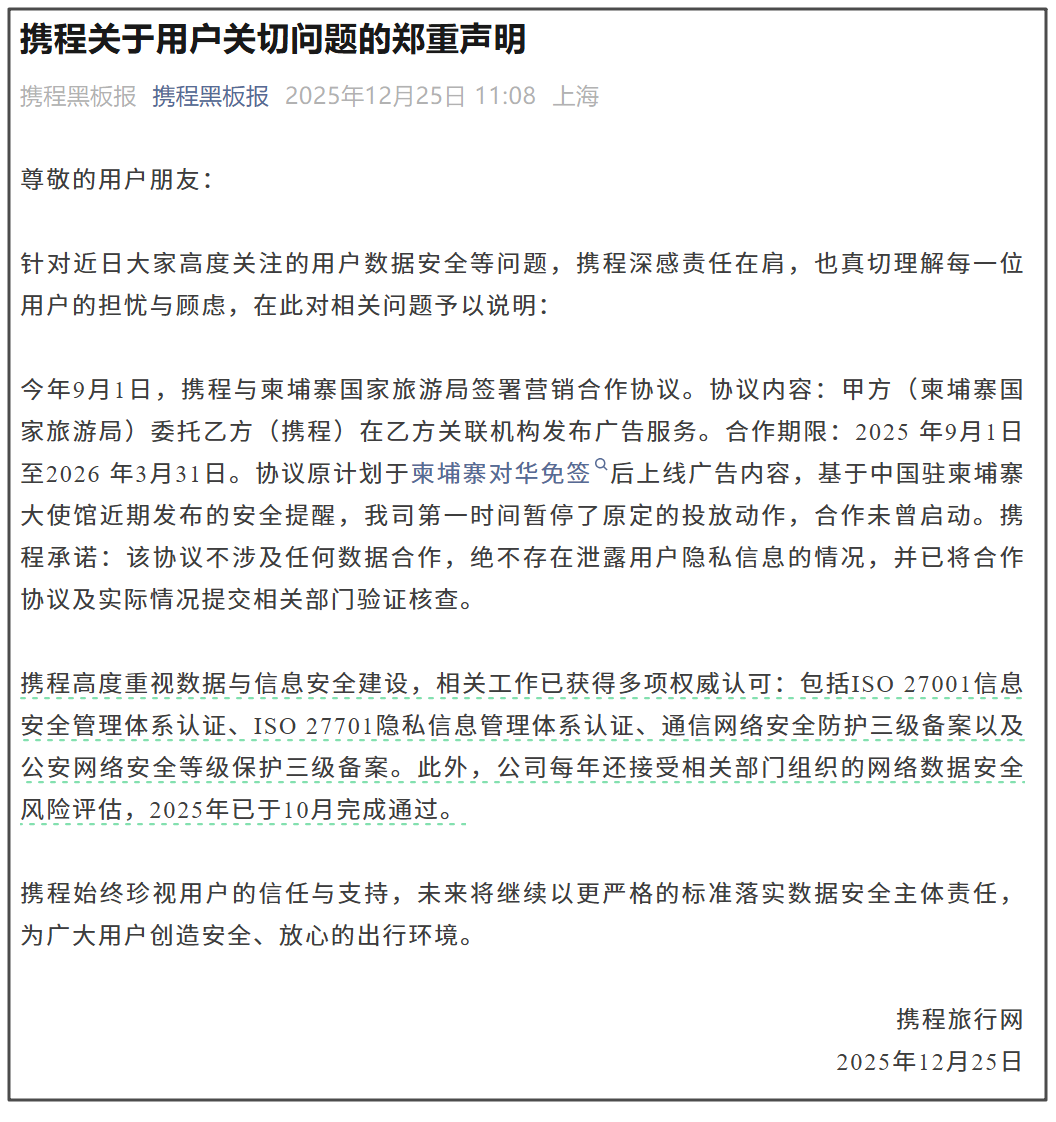
Core Viewpoint - Ctrip's partnership with the Cambodian National Tourism Board has sparked significant public concern regarding user data privacy, leading to a wave of account cancellations among users [1][5]. Group 1: Partnership Details - On September 1, Ctrip signed a marketing cooperation agreement with the Cambodian National Tourism Board, which is set to run from September 1, 2025, to March 31, 2026 [2][5]. - The agreement was intended to launch advertising content following Cambodia's visa exemption for Chinese citizens, but was suspended due to safety warnings issued by the Chinese Embassy in Cambodia [2]. Group 2: User Concerns and Reactions - Following the announcement of the partnership, many users expressed their concerns on social media, leading to a significant number of account deletions, including from high-tier users [5]. - The Chinese Embassy in Cambodia has issued multiple safety alerts due to recent armed conflicts between Thailand and Cambodia, further heightening user anxiety regarding travel safety [5]. Group 3: Data Security Assurance - Ctrip has emphasized that the partnership does not involve any data sharing and has committed to user privacy, submitting the agreement for verification by relevant authorities [2]. - The company has received multiple certifications for its data and information security practices, including ISO 27001 and ISO 27701, and undergoes annual security risk assessments [2].
对话携程王韦:入境游红利 推动文旅市场三重“变革”
2 1 Shi Ji Jing Ji Bao Dao· 2025-12-26 08:45
Core Insights - The implementation of visa facilitation policies in 2025 has significantly boosted China's inbound tourism market, with a 27.2% year-on-year increase in foreign visitors, totaling 40.6 million [1] - The growth in visa-free transit has led to a 60.8% increase in travelers benefiting from the 240-hour visa exemption, with major cities like Shanghai, Beijing, and Guangzhou seeing over 55% of inbound travelers enjoying this convenience [1] - The combination of optimized departure tax refund policies and "buy and refund immediately" services has created a stimulating effect on consumption, with a 285% increase in the number of foreign travelers processing tax refunds [1] Inbound Tourism Growth - In the first three quarters of 2025, the number of foreign visitors entering China visa-free reached 20.89 million, marking a growth of over 50% [1] - The surge in inbound tourism has led to a 300% increase in bookings for related projects, indicating a strong consumer demand [1] Structural Changes in the Industry - Three structural "watersheds" have emerged in the tourism market: changes in source markets, the evolving role of platforms, and the integration of AI in demand creation [6][7] - The source of inbound tourism has shifted from primarily Asian markets to a significant increase in visitors from Europe and America, indicating a broader global appeal [7] - Platforms are transitioning from mere sales channels to industry coordinators, enhancing operational efficiency through technology and connectivity [7] Service and Experience Enhancement - The dual flow of outbound and inbound tourism is fostering a mutual enhancement of service capabilities and quality standards, improving user experiences for both Chinese tourists abroad and foreign visitors in China [5] - The industry is now required to provide immersive experiences rather than just selling tickets and accommodations, reflecting a shift in consumer expectations [4] Addressing Industry Bottlenecks - Despite the explosive growth in visitor numbers, the tourism industry faces challenges in upgrading its service capabilities, particularly among small hotels and local businesses that lack the tools to serve international tourists [8] - Efforts are being made to empower these businesses through AI-driven solutions and partnerships with airports to enhance the overall travel experience [8] Cultural and Product Innovation - The transformation of intangible cultural heritage and local culture into marketable experiences is crucial, with innovative product offerings like immersive dining experiences attracting global tourists [10] - A tourism innovation fund has been established to reward successful cultural transformation cases, promoting the development of engaging and shareable cultural products [10] Global Service Integration - The trend of "Chinese tourism services going global" reflects the natural overflow of capabilities, with Chinese platforms becoming key players in establishing new global service standards [11] - This evolution allows Chinese tourists to receive seamless services in their native language worldwide, while also contributing to the global tourism industry's upgrade [11]
对话携程王韦:入境游红利,推动文旅市场三重“变革”
2 1 Shi Ji Jing Ji Bao Dao· 2025-12-26 08:21
Core Insights - The implementation of visa facilitation policies in 2025 has significantly boosted China's inbound tourism market, with a 27.2% year-on-year increase in foreign visitors, totaling 40.6 million [1] - The influx of visa-free travelers has led to a substantial increase in consumer spending, with a 300% rise in related project bookings and a 50% increase in the number of foreign visitors entering China in the first three quarters of 2025 [1] - The combination of optimized departure tax refund policies and "buy and refund immediately" services has created a stimulating effect on consumption [1] Group 1: Inbound Tourism Growth - The number of foreign visitors benefiting from 240-hour visa-free transit has increased by 60.8%, with major cities like Shanghai, Beijing, and Guangzhou seeing over 55% of inbound travelers enjoying this convenience [1] - By November 2025, over 12,000 departure tax refund stores were established, with a 285% increase in the number of foreign travelers processing refunds and nearly doubling the sales of tax refund products [1] Group 2: Structural Changes in the Industry - Three structural "watersheds" have emerged in the tourism market: a shift in inbound tourism sources, a change in the role of platforms, and the evolution of AI in demand creation [2][6] - The engine of inbound tourism has shifted from primarily Asian markets to a rapid increase in visitors from Europe and America, indicating a broader global appeal of Chinese tourism [6] - Platforms are evolving from mere sales channels to industry coordinators, utilizing technology to optimize operational efficiency across the tourism sector [6] Group 3: Service and Experience Enhancement - The dual flow of outbound and inbound tourism is enhancing service capabilities and quality standards, with a 15-point increase in user satisfaction for products adhering to new quality standards [5] - The industry is now required to provide immersive experiences rather than just selling tickets and accommodations, reflecting a shift in consumer expectations [4] Group 4: Addressing Industry Bottlenecks - The rapid growth in visitor numbers has outpaced the upgrade of the tourism supply chain, particularly affecting small hotels and local businesses that lack the tools to serve international tourists [8] - Initiatives are being implemented to empower local businesses, such as providing AI translation tools and optimizing transfer services at airports to enhance the overall travel experience [8] Group 5: Cultural and Product Innovation - The transformation of intangible cultural heritage into marketable experiences is crucial, with innovative product offerings like immersive dining experiences attracting global visitors [10] - A tourism innovation fund of 1 billion yuan has been established to reward successful cultural transformation cases, promoting the development of experiential and shareable cultural products [11] Group 6: Global Service Integration - The trend of "Chinese tourism services going global" reflects the natural process of capability overflow, enhancing the global experience for Chinese tourists and contributing to international tourism industry standards [11] - Chinese platforms are becoming co-builders of new global rules, promoting payment interoperability and service quality systems, which is essential for transitioning from a "tourism powerhouse" to a "service powerhouse" [11]
携程海外版 Tripcom 已开通稳定币支付功能,支持使用 USDT 和 USDC
Xin Lang Cai Jing· 2025-12-25 14:16
Core Insights - Tripcom, the overseas version of Ctrip, has launched a stablecoin payment feature that supports USDT and USDC for booking hotels and flights [1] Group 1 - The stablecoin payment functionality is supported by Triple-A, a licensed crypto payment institution based in Singapore [1] - The payment feature encompasses multiple public chains including Ethereum, Tron, Polygon, Solana, Arbitrum One, and TON [1]
他们为何急于注销携程?
Xin Lang Cai Jing· 2025-12-25 11:43
Core Viewpoint - The recent partnership between Ctrip and Cambodia has triggered a significant backlash from users, leading to a mass exodus from the platform due to concerns over data security and trust issues [4][6][12]. Group 1: User Reaction - Users have reportedly increased their uninstallation of the Ctrip app by 217% within 48 hours, with around 3 million users attempting to cancel their accounts [8][36]. - The rapid user response indicates a deep-seated fear regarding the potential misuse of personal data, particularly in light of recent news about scams in Cambodia [13][41]. Group 2: Trust Issues - The partnership with Cambodia has acted as a catalyst, exposing existing vulnerabilities related to data security and previous incidents of data mishandling by Ctrip [13][48]. - Users are not only concerned about data leaks but also about broader issues such as monopolistic practices and unfair pricing strategies, which have contributed to a growing distrust of the platform [20][48]. Group 3: Company Response - Ctrip has issued a formal statement asserting that the partnership is purely for advertising purposes and does not involve data sharing, while also emphasizing that advertising has been paused [6][34]. - Despite the company's assurances, the speed of user disengagement suggests that the trust has been significantly eroded, and the company may need to reassess its risk management and ethical practices [27][55].

携程,紧急声明!
Zheng Quan Shi Bao· 2025-12-25 08:29
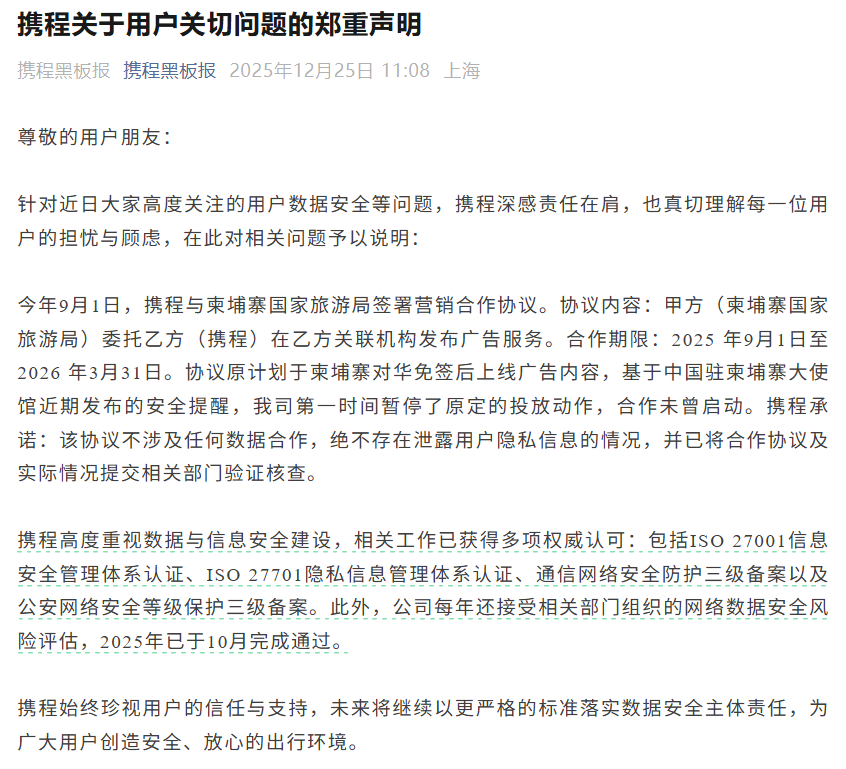
Core Viewpoint - Ctrip Group has signed a marketing cooperation agreement with the Cambodian National Tourism Board to enhance Cambodia's international appeal as a popular tourist destination and attract more Chinese tourists, but the cooperation has not yet started due to recent safety warnings from the Chinese Embassy in Cambodia [1][3]. Group 1: Cooperation Agreement Details - The marketing cooperation agreement was signed on September 1, 2023, and is set to run from September 1, 2025, to March 31, 2026, with the intention to launch advertising content after Cambodia's visa-free policy for Chinese tourists [3]. - Ctrip has stated that the cooperation does not involve any data collaboration and there is no risk of user privacy information leakage [3][4]. Group 2: Safety Concerns and Responses - The Chinese Embassy in Cambodia has issued multiple safety warnings since December 8, urging Chinese citizens near the Cambodia-Thailand border to enhance safety precautions due to recent incidents, including a Chinese citizen being injured by border conflict [3]. - Ctrip has paused the planned advertising actions in response to the embassy's safety reminders and has submitted the cooperation agreement for verification by relevant authorities [3]. Group 3: Data Security Measures - Ctrip emphasizes its commitment to data and information security, having received multiple authoritative recognitions, including ISO 27001 and ISO 27701 certifications, as well as other security assessments [4]. - The company undergoes annual network data security risk assessments, with the latest completed in October 2025 [4].
携程,紧急声明!
证券时报· 2025-12-25 08:16
Core Viewpoint - Ctrip Group has signed a marketing cooperation agreement with the Cambodian National Tourism Board to enhance Cambodia's international appeal as a popular tourist destination and attract more Chinese tourists, but the cooperation has not yet started due to recent safety warnings from the Chinese Embassy in Cambodia [2][5]. Group 1: Cooperation Agreement Details - The marketing cooperation agreement was signed on September 1, 2023, and is set to run from September 1, 2025, to March 31, 2026, with the aim of promoting Cambodia through advertising services [5]. - The agreement was originally planned to launch advertising content after Cambodia's visa exemption for Chinese tourists, but has been suspended in light of safety concerns [5]. Group 2: Safety Concerns and Responses - The Chinese Embassy in Cambodia has issued multiple safety warnings since December 8, urging Chinese citizens near the Cambodia-Thailand border to enhance safety precautions due to recent incidents [4]. - Ctrip has emphasized that the cooperation agreement does not involve any data collaboration and there is no risk of user privacy information leakage [5]. Group 3: Data Security Measures - Ctrip has highlighted its commitment to data and information security, having received multiple authoritative recognitions, including ISO 27001 and ISO 27701 certifications [5]. - The company undergoes annual network data security risk assessments, with the latest assessment completed in October 2025 [5].