BABA(09988)

Search documents
还有高手?千问新模型压轴亮相
Sou Hu Cai Jing· 2026-02-16 16:25
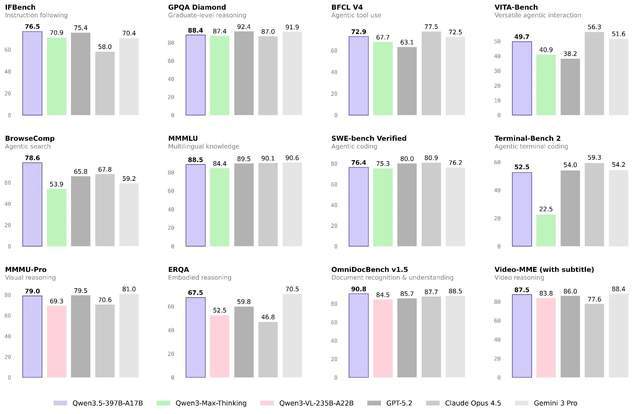
Core Insights - Alibaba has released its new model Qwen 3.5, which is noted for its significant advancements in architecture and performance, establishing itself as a leader in the open-source model space [1][2] - The Qwen 3.5-Plus model has 397 billion parameters, a decrease from the previous flagship model Qwen 3-Max, which had one trillion parameters, yet it achieves performance levels comparable to Gemini 3 Pro with less than 40% of the parameters [2] - The model utilizes only 5% of its computational resources for each response, resulting in a token cost that is 1/18th of that of Gemini 3 Pro, showcasing its efficiency [2] Model Advancements - Qwen 3.5-Plus incorporates a gating technology that has been recognized at a global AI conference, allowing other tech companies to benefit from its advancements [3] - The model has evolved through various architectural changes, including the introduction of a mixed attention mode that enhances its ability to process information selectively [2][3] - Alibaba's Qwen series is now positioned to compete directly with Google across all modalities, having integrated text and visual data learning from the outset [3] Industry Position - Chinese companies, including Alibaba, are leading the open-source model race, effectively surrounding closed-source models and setting the stage for significant advancements in the industry [3] - The rapid development of models like Qwen 3.5 suggests that the gap between domestic models and the strongest state-of-the-art (SOTA) models is narrowing, with potential for surpassing competitors in the near future [3]


阿里千问App:过去11天,用户一共说了50亿次“千问帮我”
Xin Lang Ke Ji· 2026-02-16 16:22
Core Insights - The "Qianwen Please Guest" Spring Festival campaign attracted over 130 million users engaging in various activities such as ordering milk tea, stocking up on New Year goods, purchasing movie tickets, and booking flights and hotels [1] - The feature "Qianwen Help Me" has become a habitual part of users' lives, with a total of 5 billion interactions recorded over the past 11 days [1] User Engagement - Following the launch of the second wave of the campaign on February 14, orders for movie tickets via AI increased by 372 times, with orders from third- and fourth-tier cities surging by 782 times [1] - In the last two days, AI orders for ticket purchases grew by 22 times, while AI bookings for flights and other transportation tickets increased by over 7 times [1] Demographics - Nearly half of the AI orders originated from county-level cities, indicating a significant reach into less urbanized areas [1] - Approximately 4 million users aged 60 and above experienced AI ordering for the first time, highlighting the feature's accessibility and appeal to older demographics [1]
千问 3.5 发布,四成参数超越万亿模型,大模型的竞赛逻辑变了
Sou Hu Cai Jing· 2026-02-16 16:07
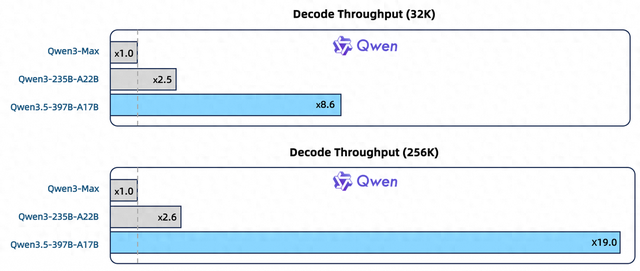
Core Insights - The main theme in the large model industry over the past two years has been "scaling up," but this has led to increased deployment costs, making it harder for companies to afford these models. The performance curve and adoption curve are diverging [1] - Alibaba's release of the Qwen 3.5-Plus model, with 397 billion total parameters and only 17 billion activated, demonstrates a shift in focus from merely increasing parameters to enhancing model efficiency and cost-effectiveness [1][3] Model Performance and Efficiency - Qwen 3.5-Plus surpasses the previous generation Qwen 3-Max and competes favorably with models like GPT-5.2 and Gemini 3 pro in various benchmarks, achieving scores such as 87.8 in MMLU-Pro and 88.4 in GPQA [1][3] - The model's API pricing is significantly lower, at 0.8 yuan per million tokens, which is 1/18 of Gemini 3 pro's price, indicating a new cost structure in the industry [1][8] Architectural Innovation - The industry is experiencing a shift from parameter accumulation to architectural innovation, similar to the transition in the chip industry from single-core to multi-core architectures [3] - Qwen 3.5 achieves efficiency by using only 17 billion parameters for inference, resulting in an 8.6 times increase in throughput for 32K context scenarios and up to 19 times for 256K context scenarios, while reducing deployment memory usage by 60% [3][4] Multi-Modal Capabilities - Qwen 3.5 represents a generational leap to a native multi-modal model, integrating text and visual data from the start, which enhances its capabilities compared to models that assemble components separately [4][7] - The model supports direct input of 2-hour videos and can convert hand-drawn sketches into executable front-end code, showcasing its advanced multi-modal functionalities [7] Strategic Implications - Alibaba's commitment to native multi-modal capabilities positions Qwen as a foundational model for enterprise applications, which inherently require multi-modal functionalities [8] - The collaboration between model architecture, chip optimization, and cloud infrastructure results in a sustainable cost structure, challenging closed-source competitors who rely on performance exclusivity [8][9] Market Position and Growth - Qwen is ranked first in the Chinese enterprise-level large model market, with Alibaba Cloud's market share reaching 35.8% in the AI cloud market, surpassing the combined share of the second to fourth competitors [11][12] - The open-source model ecosystem is rapidly expanding, with over 400 models released and more than 200,000 derivative models created, indicating strong developer engagement and market traction [12] Future Considerations - The competition in the large model industry is transitioning from a parameter race to an architecture race, where efficiency and cost become the core competitive dimensions [12][13] - Questions remain about the sustainability of closed-source models in light of open-source alternatives that match performance and cost, as well as the viability of current assembly methods in multi-modal training [13]
正面硬刚Gemini 3 Pro,阿里开源Qwen3.5-Plus|甲子光年
Sou Hu Cai Jing· 2026-02-16 15:57
Core Insights - Alibaba has officially open-sourced its new foundational model, Qwen3.5-Plus, which boasts 397 billion parameters but only activates 17 billion for inference, challenging existing models like Google's Gemini 3 Pro and OpenAI's GPT-5.2 [2][4] - The model represents a significant shift towards a more efficient architecture, moving away from traditional dense models to a sparse mixture of experts (MoE) approach, which drastically reduces computational resource requirements [5][6] Group 1: Architectural Innovations - Qwen3.5-Plus achieves a balance of performance and efficiency by integrating linear attention mechanisms with sparse MoE architecture, allowing for a significant reduction in memory usage and increased inference speed [6][8] - Compared to its predecessor, Qwen3-Max, Qwen3.5-Plus reduces deployment memory usage by 60% and increases inference throughput by up to 19 times in long-context scenarios [6][8] - The model's ability to dynamically allocate attention resources allows it to focus on important information while reducing computational complexity, enhancing its overall efficiency [8] Group 2: Native Multimodal Capabilities - Qwen3.5-Plus features a native multimodal design that integrates visual and textual data from the pre-training phase, enabling it to perform complex tasks without the typical losses associated with separate modality processing [9][10] - This capability allows the model to execute tasks such as converting sketches into runnable code or providing code fixes based on UI screenshots, marking a significant advancement in AI's practical applications [10][11] - The model's enhanced video understanding capabilities enable it to process long videos for analysis and summarization, showcasing its potential in embodied intelligence applications [12][13] Group 3: Market Impact and Strategy - The aggressive pricing strategy of Qwen3.5-Plus, with API call costs as low as 0.8 RMB per million tokens, positions it as a disruptive force in the global AI market, significantly undercutting competitors [16][17] - Alibaba's open-source model ecosystem has grown to over 400 models, with more than 20,000 derivative models developed by the community, establishing a robust and active foundation for AI development [17] - The model's support for 201 languages and dialects, with a vocabulary expansion from 150,000 to 250,000, enhances its accessibility and efficiency for low-resource languages, further embedding it in emerging markets [17][18] Group 4: Future Implications - Qwen3.5-Plus sets a new benchmark for open-source models, demonstrating that the path to AGI does not solely rely on closed-source solutions, but can also thrive in an open ecosystem [19][20] - The model's release signifies a shift from a parameter race to a competition based on architectural efficiency, emphasizing the importance of cost-effectiveness, transparency, and collaboration in AI development [18][19] - As the model continues to evolve, it is poised to become a preferred choice for enterprise-level localized deployments, marking a significant milestone in the journey towards AGI [21][24]
从米兰巨幅广告到快闪店,冬奥迎来史上最多中国顶级赞助商
第一财经· 2026-02-16 15:09
Core Viewpoint - The article highlights the significant presence and impact of Chinese brands as TOP sponsors at the Milan-Cortina Winter Olympics, showcasing the evolving landscape of sports marketing and sponsorship dynamics in the context of global events [5][15]. Group 1: Sponsorship Dynamics - The Milan-Cortina Winter Olympics features the highest number of Chinese TOP sponsors, including TCL, Alibaba, and Mengniu, marking a notable increase in Chinese brand representation compared to previous Olympics [5][15]. - The TOP sponsorship program is crucial for the financial support of the Olympics, with companies paying over $300 million per cycle, contributing significantly to the International Olympic Committee's revenue [12]. - The article notes that the TOP sponsorship program has seen a shift in participants, with traditional sponsors like Panasonic and Toyota exiting, while new entrants like TCL and Budweiser are filling the gaps, reflecting changes in commercial power [17][18]. Group 2: Marketing Strategies and Brand Visibility - TOP sponsors utilize various marketing strategies, including prominent outdoor advertising in Milan, to enhance brand visibility during the Olympics, with TCL securing a major outdoor advertising space [7][10]. - The presence of sponsors extends beyond advertising, as they provide services and products within the Olympic Village, enhancing the overall experience for athletes and staff [10][11]. - The article emphasizes the role of technology in enhancing viewer experience, with AI and cloud technologies being utilized for broadcasting and event management, showcasing the integration of new technologies in sports marketing [18][20]. Group 3: Market Expansion and Brand Recognition - Companies like TCL are leveraging the Olympic platform to expand their global business, with TCL reporting a 50% increase in market share in Italy, indicating successful brand recognition efforts [20]. - The article discusses the competitive landscape in the European market, where Chinese brands are gaining market share from traditional Japanese brands, highlighting a shift in consumer preferences [20]. - The need for companies to adapt their strategies to local market conditions in Italy is emphasized, as the market presents unique challenges and opportunities for growth [20].



千问3.5除夕开源!可通过千问APP免费体验
Xin Lang Cai Jing· 2026-02-16 13:00
Core Insights - Alibaba has launched its new generation large model Qwen3.5-Plus, which reportedly rivals Gemini 3 Pro in performance, featuring a total parameter count of 397 billion and an activation of only 17 billion, achieving superior performance with reduced memory usage and significantly enhanced inference efficiency [1][3] Group 1: Model Performance and Features - Qwen3.5-Plus has achieved a major leap in performance, surpassing the previous Qwen3-Max model, with a maximum inference throughput improvement of up to 19 times [1][3] - The model has transitioned from a pure text model to a native multimodal model, incorporating visual and text mixed tokens for pre-training, which enhances its reasoning logic and world knowledge [1][2] - In various authoritative evaluations, Qwen3.5 has demonstrated superior performance in multimodal reasoning, visual question answering, and video understanding, outperforming previous specialized models [2] Group 2: Technical Innovations - The performance improvements of Qwen3.5 are attributed to significant innovations in the classic Transformer architecture, including the integration of gating technology and a hybrid architecture that combines linear attention mechanisms with sparse mixture of experts (MoE) [3] - The model's training efficiency has been enhanced through advanced techniques, achieving a throughput increase of 8.6 times in common contexts and up to 19 times in ultra-long contexts [3][5] Group 3: Application and Market Impact - Qwen3.5's multimodal training has been efficiently executed on Alibaba Cloud's AI infrastructure, significantly lowering the difficulty threshold for native multimodal training [5] - The model has been integrated into the Qwen App and PC, enabling it to autonomously perform tasks on mobile and desktop platforms, thus enhancing operational efficiency [6] - The Qwen App has successfully executed 120 million orders in just six days during the Spring Festival, marking a significant milestone in real-world task execution and commercialization [6] Group 4: Future Developments - Alibaba plans to continue releasing various sizes and functionalities of the Qwen3.5 series models, with a more powerful flagship model, Qwen3.5-Max, set to be launched soon [7] - The Qwen model family has seen over 400 models open-sourced since 2023, with a global download count exceeding 1 billion, indicating strong developer interest and engagement [6][7]
除夕开源,阿里发布新一代基础模型千问3.5
Bei Jing Shang Bao· 2026-02-16 11:45
Core Insights - Alibaba has launched its new generation open-source model, Qwen3.5-Plus, which is claimed to rival Gemini 3 Pro, making it the strongest open-source model globally [1] Model Performance - The Qwen3.5-Plus version features a total of 397 billion parameters and 17 billion activated parameters, outperforming the trillion-parameter Qwen3-Max model [1] - The deployment memory usage has been reduced by 60%, and inference efficiency has significantly improved, with maximum inference throughput potentially increasing by up to 19 times [1] Pricing Strategy - The API pricing for Qwen3.5-Plus is set at 0.8 yuan per million tokens, which is only 1/18th of the price of Gemini 3 Pro [1]
2026年春晚AI公司成主角,阿里30亿元投入,腾讯推红包计划,千问冠名四大卫视……当红包散尽、晚会落幕,你的手机里会剩下哪个AI?
Mei Ri Jing Ji Xin Wen· 2026-02-16 11:44
Core Insights - The 2026 Spring Festival Gala has become a battleground for AI companies, with significant investments from major players like Alibaba, ByteDance, Tencent, and Baidu, marking a shift in traditional marketing strategies [1][3][4] Group 1: AI Companies' Investments - Alibaba's Qianwen invested 3 billion yuan in the Spring Festival Gala, securing exclusive sponsorships with four major regional TV stations [4] - ByteDance's Volcano Engine became the technical partner for the CCTV Spring Festival Gala, providing core support for live streaming and interactive features [4] - Tencent and Baidu launched 1 billion yuan and 500 million yuan red envelope initiatives, respectively, to enhance user engagement through their platforms [1][4] Group 2: AI Technology Integration - AI technology is being integrated into various aspects of the Spring Festival Gala, with regional stations utilizing AIGC technology for virtual stage backgrounds and interactive performances [4][6] - The use of AI is expected to improve production efficiency and reduce costs, as seen in the implementation of XR virtual stages by Shandong TV [7] - The Spring Festival Gala is evolving from a cultural event to a platform for showcasing technology and driving commercial transformation [7] Group 3: User Engagement Strategies - AI companies are leveraging the Spring Festival to promote their services, aiming to change user habits through integrated experiences like booking meals and movie tickets [8] - Qianwen's strategy includes bundling subsidies with various services, resulting in a significant increase in user engagement, with a reported 500% rise in movie ticket orders [8] - The competition among AI models is not just about immediate user acquisition but also about sustaining user engagement post-festival [9]



今日财经要闻TOP10|2026年2月16日
Xin Lang Cai Jing· 2026-02-16 11:41
Group 1: Israel-Iran Negotiations - Israeli Prime Minister Netanyahu sets a clear red line regarding Iran's nuclear facilities, stating that any agreement must include the complete dismantling of Iran's nuclear infrastructure, not just a halt to uranium enrichment [1] - Netanyahu expresses skepticism about the upcoming US-Iran negotiations, emphasizing that Iran must not retain any uranium enrichment capabilities [1] - He also demands the complete disarmament of Hamas, estimating that they still possess around 60,000 rifles, which must be surrendered [1] Group 2: Market Updates - The Hong Kong Hang Seng Index closed up by 0.52%, with notable gains in MINIMAX-WP, which rose by 24.56%, and other companies like Old Puhua Gold and Luoyang Molybdenum [4][12] - The adjustment to the Hang Seng Index will increase the number of constituent stocks from 88 to 90, with companies like CATL and Luoyang Molybdenum benefiting from this change [7][16] - The US stock market will be closed for Presidents' Day, affecting trading schedules for various futures and commodities [2][10] Group 3: Technology Developments - Alibaba has launched two new models, Qwen3.5-Plus and Qwen3.5-397B-A17B, with the former boasting 397 billion parameters and significantly improved performance compared to previous models [3][11] - The API pricing for Qwen3.5-Plus is set at 0.8 yuan per million tokens, which is only 1/18th of the price of Gemini 3 Pro, indicating a competitive edge in the market [3][11] Group 4: Warner Bros. Negotiations - Warner Bros. is considering restarting sale negotiations with Paramount after receiving a revised acquisition offer, which may lead to renewed competition with Netflix [8][17] - Paramount's revised terms include covering a $2.8 billion fee if Warner Bros. terminates its agreement with Netflix, highlighting its commitment to a swift regulatory approval process [8][17]


千问3.5,除夕开源!
Shang Hai Zheng Quan Bao· 2026-02-16 11:08
Core Insights - Alibaba has launched the new generation model Qwen3.5-Plus, which performs comparably to Gemini 3 Pro, with plans to release various sizes and functionalities of the Qwen3.5 series models soon [2][6] - The Qwen3.5 model represents a significant leap from previous versions, transitioning from a pure text model to a native multimodal model, enhancing its capabilities in reasoning and knowledge acquisition [4][8] Performance Metrics - Qwen3.5 achieved a score of 87.8 in the MMLU-Pro knowledge reasoning evaluation, surpassing GPT-5.2, and scored 88.4 in the GPQA assessment, exceeding Claude 4.5 [4] - In the IFBench instruction-following evaluation, Qwen3.5 set a record with a score of 76.5, outperforming all other models [4] - The model's performance in various benchmarks, including BFCL-V4 and Browsecomp, also exceeded that of Gemini 3 Pro and GPT-5.2 [4] Technical Innovations - The Qwen3.5 model features a total of 397 billion parameters, with only 17 billion activated, achieving high efficiency while reducing deployment memory usage by 60% [6][8] - Innovations in the Transformer architecture, including self-developed gating technology and a hybrid architecture combining linear attention and sparse mixture of experts (MoE), contribute to the model's efficiency [8][10] Multimodal Capabilities - Qwen3.5 has made significant advancements in visual capabilities, excelling in various evaluations such as MathVision, RealWorldQA, and CC_OCR [6] - The model supports direct input of videos up to 2 hours long, enhancing its ability to analyze and summarize long video content [6] Market Impact - The Qwen3.5-Plus model's API pricing is significantly lower, at 0.8 yuan per million tokens, which is only 1/18 of the cost of Gemini 3 Pro [6] - Since its open-source launch, Alibaba has released over 400 Qwen models, achieving over 1 billion downloads globally, with a monthly download volume surpassing that of the next seven competitors combined [12]