BABA(09988)

Search documents
智通港股通持股解析|2月17日
智通财经网· 2026-02-17 01:44
Group 1 - The top three companies by Hong Kong Stock Connect holding ratios are China Telecom (71.26%), Haotian International Investment (70.78%), and Green Power Environmental (68.78%) [1][2] - In the last five trading days, the companies with the largest increase in holding amounts are China National Offshore Oil (CNOOC) (+764 million), Meituan (+652 million), and Bilibili (+400 million) [1][2] - The companies with the largest decrease in holding amounts in the last five trading days are Tencent Holdings (-644 million), China Mobile (-377 million), and Alibaba-W (-351 million) [1][3] Group 2 - The latest holding ratios for the top 20 companies in Hong Kong Stock Connect show significant ownership, with China Telecom leading at 71.26% and others like Tianjin Chuangye Environmental and China Shenhua also above 66% [2] - The increase in holdings for the top 10 companies in the last five trading days indicates strong investor interest, particularly in CNOOC and Meituan, suggesting potential growth opportunities [2] - The decrease in holdings for Tencent, China Mobile, and Alibaba may indicate a shift in investor sentiment or profit-taking strategies [3]






阿里千问推出原生视觉-语言模型Qwen3.5-397B-A17B
智通财经网· 2026-02-17 00:49
Core Insights - Alibaba's Qwen3.5 has been officially launched, featuring the first model Qwen3.5-397B-A17B with open weights, showcasing superior performance in reasoning, programming, agent capabilities, and multimodal understanding [1] Group 1: Model Specifications - Qwen3.5-397B-A17B utilizes an innovative hybrid architecture combining Gated Delta Networks and Mixture of Experts (MoE), achieving a total parameter count of 397 billion, with only 17 billion parameters activated per forward pass, optimizing speed and cost while maintaining capability [1] - The language and dialect support has been expanded from 119 to 201 languages, enhancing global usability and support [1] Group 2: Performance Enhancements - The performance improvements of Qwen3.5 over the Qwen3 series are primarily attributed to the comprehensive expansion of various Reinforcement Learning (RL) tasks and environments, focusing on the difficulty and generalizability of RL environments rather than optimizing for specific metrics or narrow categories [1] - Qwen3.5 achieves efficient native multimodal training through heterogeneous infrastructure, decoupling visual and language components to avoid inefficiencies associated with unified solutions [2] - Sparse activation allows for overlapping computations across modules, achieving nearly 100% training throughput on mixed text-image-video data compared to pure text baselines [2] - The native FP8 pipeline employs low precision for activations, MoE routing, and GEMM operations, resulting in approximately 50% reduction in activation memory and over 10% acceleration, while maintaining stability for trillions of tokens [2]
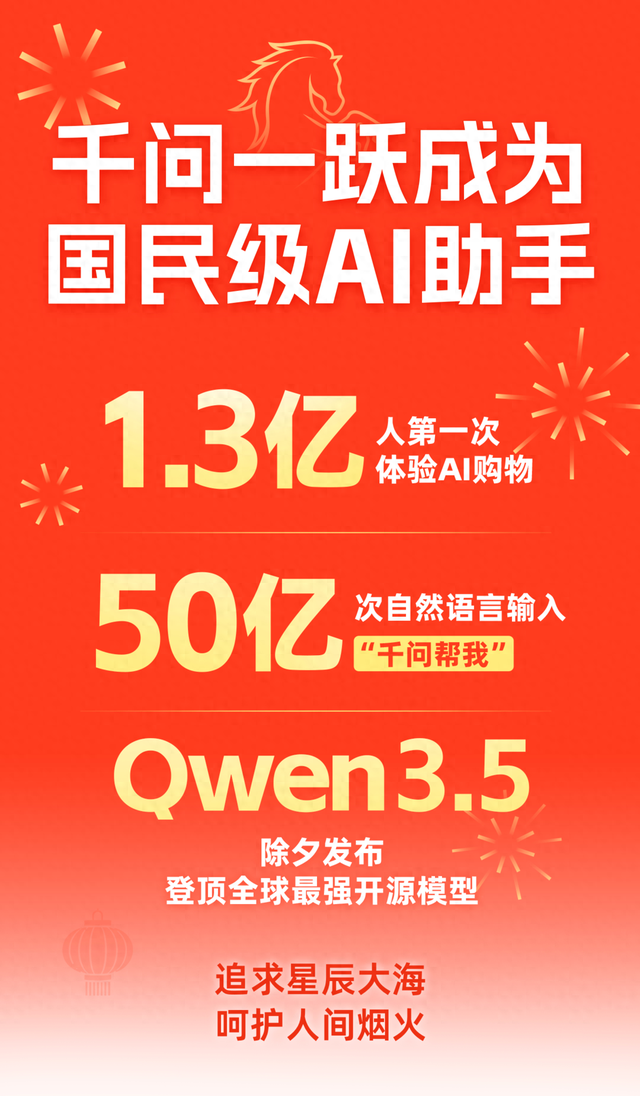
1.3亿人春节首次体验AI购物,千问一跃成为国民级AI助手
Xin Lang Cai Jing· 2026-02-17 00:46
Core Insights - During the Spring Festival period, over 130 million people experienced AI shopping for the first time, with "Qianwen help me" being invoked 5 billion times, establishing Qianwen as a national-level AI assistant [1] User Engagement and Growth - In the past two days, AI ticket purchasing orders increased by 22 times, while AI orders for flight tickets and other transportation tickets surged over 7 times [4] - The demand for AI movie ticket purchases saw a staggering 372-fold increase, with orders from third and fourth-tier cities skyrocketing by 782 times [4] - Nearly half of all AI orders originated from county-level cities, highlighting the accessibility of AI shopping [4] - Approximately 4 million users aged 60 and above engaged with AI shopping, indicating a broad demographic reach [4] Ecosystem Integration - Qianwen can leverage the entire Alibaba ecosystem to serve users, integrating platforms such as Taobao, Alipay, Taobao Flash Sale, Fliggy, Gaode, and Damai, with plans to introduce features like AI ride-hailing and mobile recharge [4] User Activity Metrics - On February 7, Qianwen's daily active users (DAU) reached 73.52 million, nearing Doubao's 78.71 million, achieving in three months what Doubao took three years to accomplish [4] - This shift signifies a change in user habits towards AI, moving from chat-based interactions to task execution through agents [4] Technological Advancements - On New Year's Eve, Alibaba released the new generation model Qianwen Qwen 3.5-Plus, which performs comparably to Gemini 3 Pro [4]

【财经早报】阿里巴巴,开源新一代大模型
Xin Lang Cai Jing· 2026-02-17 00:43
重要新闻提示 阿里巴巴开源全新一代大模型千问Qwen3.5-Plus 春运前15天我国交通出行人数预计超35亿人次 截至2月16日23时10分,2026年电影春节档(2月15日至2月23日)票房(含预售)已突破7亿元 ...
“问豆包认孙子” AI春晚秀出新高潮 大厂打响新年跑“马”圈地第一战
智通财经网· 2026-02-16 23:41
Core Viewpoint - The 2026 Spring Festival Gala showcased significant AI marketing efforts from major tech companies, highlighting the integration of AI into entertainment and user interaction, with a focus on enhancing audience engagement through innovative technologies [1][3][10]. Group 1: AI Integration in Spring Festival Gala - The gala featured AI elements prominently, with the "Doubao" application playing a central role in various performances and interactions, demonstrating the capabilities of AI in enhancing live events [1][3]. - Doubao's technology supported multiple aspects of the gala, including stage art creation, intelligent robot interactions, and real-time audience engagement through features like live subtitles [3][5][10]. - The gala's use of AI technologies, such as the Seedance 2.0 model, allowed for high-quality visual presentations and complex artistic expressions, showcasing the potential of generative AI in creative fields [4][5]. Group 2: Major Tech Companies' Marketing Strategies - Major companies like ByteDance, Tencent, Alibaba, Baidu, Meituan, and JD.com engaged in extensive marketing campaigns during the Spring Festival, utilizing AI to enhance user experiences and drive engagement [1][6][10]. - Tencent initiated a significant marketing campaign with a 1 billion yuan red envelope giveaway, aiming to replicate the success of previous promotional strategies [6][10]. - Alibaba's "one sentence to order milk tea" campaign achieved rapid success, reflecting the effectiveness of AI in facilitating consumer transactions during the festive season [7][10]. Group 3: Future of AI Applications - The competition among tech giants in the AI space is expected to accelerate, with a focus on applications that deliver clear business value and enhance user experiences [10][11]. - Companies are exploring long-term value in their marketing strategies, aiming to integrate AI into daily life and consumer habits [10][11]. - The ongoing AI flow battle is seen as a critical first step in establishing a competitive landscape for AI applications leading up to 2026 [11].

智通港股通资金流向统计(T+2)|2月17日
智通财经网· 2026-02-16 23:34
Group 1 - Tencent Holdings (00700), Yingfu Fund (02800), and Shandong Gold (01787) ranked the top three in net inflow of southbound funds, with net inflows of 736 million, 423 million, and 393 million respectively [1] - Alibaba-W (09988), SMIC (00981), and Hua Hong Semiconductor (01347) ranked the top three in net outflow of southbound funds, with net outflows of -524 million, -391 million, and -199 million respectively [1] - In terms of net inflow ratio, Nanhua Futures (02691), Southern East Select (03441), and Oculent (00501) led the market with ratios of 70.54%, 59.14%, and 56.33% respectively [1] Group 2 - The top ten stocks by net inflow included Tencent Holdings (00700) with 736 million and a closing price of 548.000, Yingfu Fund (02800) with 423 million and a closing price of 27.480, and Shandong Gold (01787) with 393 million and a closing price of 40.180 [2] - The top ten stocks by net outflow included Alibaba-W (09988) with -524 million and a closing price of 160.100, SMIC (00981) with -391 million and a closing price of 70.000, and Hua Hong Semiconductor (01347) with -199 million and a closing price of 99.600 [2] - The top three stocks by net inflow ratio were Nanhua Futures (02691) at 70.54% with a closing price of 11.230, Southern East Select (03441) at 59.14% with a closing price of 11.650, and Oculent (00501) at 56.33% with a closing price of 103.900 [3] Group 3 - The top three stocks by net outflow ratio included Zhengzhou Bank (06196) at -50.51% with a closing price of 1.150, China Energy Construction (03996) at -49.70% with a closing price of 1.180, and Hongye Futures (03678) at -48.03% with a closing price of 3.220 [3] - Other notable stocks with significant net inflow ratios included China Overseas Macro Yang Group (00081) at 55.30% and a closing price of 2.650, and Xinhua Wenhui (00811) at 50.59% with a closing price of 11.080 [3]

互联网巨头AI超级入口的第一战场
Sou Hu Cai Jing· 2026-02-16 20:06
Core Viewpoint - The article discusses the intense competition among major internet companies during the Spring Festival, particularly focusing on the rise of AI applications and the strategic battles for user engagement and market share in the AI sector [3][4][37]. Group 1: AI Competition Landscape - The Spring Festival has become a battleground for internet giants to compete for traffic, with significant events like the 2015 payment war and the 2020 short video competition [3][4]. - In 2025, a new player, DeepSeek, emerged, surpassing existing applications in daily active users, indicating a shift in the AI market landscape [4]. - By 2026, the competition intensified, with major companies preparing extensively for the Spring Festival, marking it as a critical moment for AI applications [4][5]. Group 2: Model Updates and Innovations - Major companies like Baidu, Alibaba, and ByteDance have updated their AI models recently, with Baidu's Wenxin 5.0 featuring 2.4 trillion parameters and advanced multi-modal capabilities [6][8]. - Alibaba's Qwen3-Max-Thinking model, with over a trillion parameters and 36 trillion tokens of pre-training data, enhances its tool-calling capabilities [8][10]. - ByteDance launched several models, including Seedance 2.0 and Seedream 5.0 Lite, which significantly improved video and image generation capabilities [10][14][15]. Group 3: AI Super Entry Points - Companies are focusing on creating AI super entry points that integrate their core business models, such as Baidu's AI+search and Alibaba's AI+e-commerce [21][25]. - Alibaba's launch of the Qwen APP aims to enhance the e-commerce experience by integrating various services into a single platform [25][28]. - Tencent's Yuanbao group chat feature incorporates AI to enhance user interaction and engagement, including a cash red envelope feature during the Spring Festival [30][32]. Group 4: Cash Incentives and User Engagement - Major companies are investing heavily in cash incentives to attract users, with Tencent announcing a 1 billion yuan cash giveaway and Baidu offering 500 million yuan in red envelopes [35][37]. - The competition for user attention and brand recognition is driving these cash distribution strategies, as companies aim to establish their AI super entry points [37].

Alibaba's New AI Model Runs 8x Faster While Sentiment Hits 60.6
247Wallst· 2026-02-16 19:00
Core Insights - Alibaba launched its new AI model Qwen3.5 on February 16, which operates 8 times faster and is 60% cheaper than its predecessor, enhancing its competitive position in the AI market [1] - The Qwen app achieved 10 million downloads in its first week, indicating strong user adoption and interest [1] - Retail investor sentiment around Alibaba has shifted from neutral to bullish, with a sentiment score of 60.6, reflecting increased discussions on platforms like Reddit [1] Group 1: Product and Market Position - Qwen3.5 outperforms competitors such as GPT-5.2, Claude Opus 4.5, and Gemini 3 Pro in benchmark tests, showcasing its advanced capabilities [1] - The model's enhanced "agentic capabilities" allow it to execute complex tasks independently across various applications, positioning Alibaba as a cost-effective alternative in the AI sector [1] - The Chinese government is directing Nvidia H200 chip orders to Alibaba, indicating state support for its AI initiatives [1] Group 2: Financial Performance and Investor Sentiment - Alibaba's shares fell 4.46% in the week leading up to the Q3 FY2026 earnings report, amidst fluctuating retail investor sentiment [1] - Analysts remain positive, with 14 rating the stock as "Strong Buy" and a 12-month price target of $188.69, representing a 21% upside [1] - The stock has gained over 32% in the past year, significantly outperforming the S&P 500, which has only gained approximately 11% [1]
这个春节后,中国AI进入千问豆包“双王时代”
Ge Long Hui· 2026-02-16 16:47
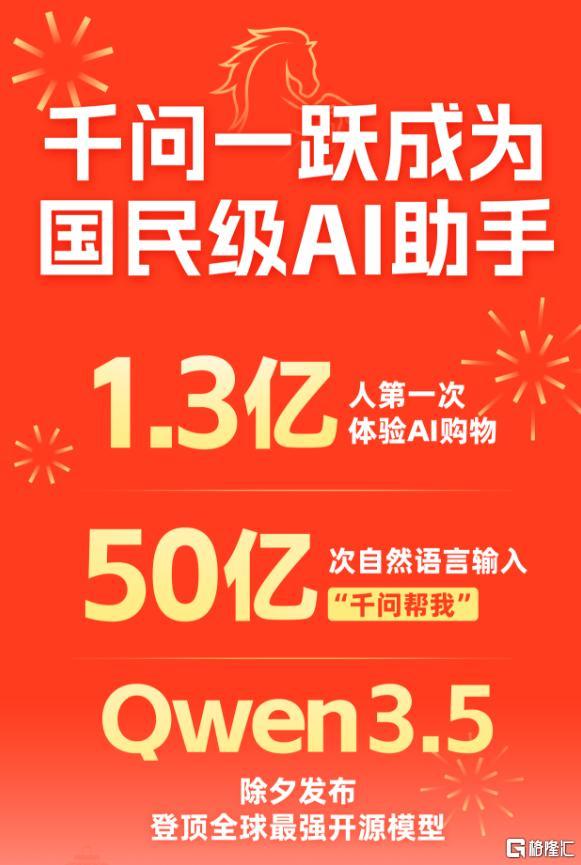
Core Insights - The 2026 Spring Festival marks a pivotal moment for China's AI industry, transitioning from technical experimentation to widespread public adoption [1][5] - Major tech companies like Alibaba and ByteDance have emerged as leaders in this competitive landscape, showcasing differentiated strategies and impressive operational metrics [1][5] Industry Overview - The Spring Festival AI competition has shifted from merely attracting users to cultivating habits and implementing practical applications, with Alibaba and ByteDance leading the way [5][6] - The competition has resulted in a dual development path for China's AI industry: Alibaba focuses on consumer-oriented applications, while ByteDance emphasizes content creation and innovation [6][18] Alibaba's Performance - Alibaba's Qwen 3.5-Plus model was released on New Year's Eve, achieving the status of the world's strongest open-source model, comparable to Gemini 3 Pro [1][8] - During the Spring Festival, over 1.3 billion AI-assisted transactions were completed, with users making 50 billion requests to the Qwen app, demonstrating its widespread adoption [1][5][12] Technological Breakthroughs - The Qwen 3.5-Plus model features a total of 397 billion parameters, with a significant performance improvement over previous models, achieving a 19-fold increase in inference throughput [10][11] - The model's API pricing is significantly lower than competitors, at 0.8 yuan per million tokens, making it more accessible for developers [10][11] Ecosystem Integration - Alibaba's extensive ecosystem, including platforms like Taobao and Alipay, enables seamless integration of AI into everyday tasks, enhancing user experience and driving rapid habit formation [11][15] - The Spring Festival saw a 372-fold increase in AI-assisted movie ticket purchases, highlighting the model's effectiveness in real-world applications [11][12] Competitive Landscape - The emergence of Alibaba and ByteDance as "dual kings" in the AI sector signifies a shift in China's AI industry towards original exploration, moving away from merely following Silicon Valley [18][19] - The competition between these two companies fosters a healthy industry environment, encouraging innovation and diverse development paths [18][19]
这个春节后,中国AI进入千问豆包“双王时代”
格隆汇APP· 2026-02-16 16:43
Core Viewpoint - The 2026 Spring Festival marks a pivotal moment for the AI industry in China, transitioning from technical experimentation to widespread public adoption, with major tech companies like Alibaba and ByteDance leading the charge through innovative strategies and significant user engagement [2][6][20]. Group 1: AI Competition Landscape - The Spring Festival AI competition has shifted from merely attracting users to cultivating habits and implementing AI in real-life scenarios, with Alibaba and ByteDance emerging as leaders [6][8]. - Tencent and Baidu launched substantial cash red envelope campaigns, with Tencent offering 1 billion yuan and Baidu 500 million yuan, to capture AI user engagement [6]. - ByteDance's Doubao achieved a daily model invocation of 63 trillion tokens, serving over 1 million enterprises and developers, while Alibaba's Qwen APP saw over 1.3 billion AI shopping transactions during the festival [7][10]. Group 2: Alibaba's AI Breakthroughs - Alibaba's Qwen 3.5-Plus model, released on New Year's Eve, is recognized as the strongest open-source model globally, outperforming competitors like Gemini 3 Pro, with an API price significantly lower at 0.8 yuan per million tokens [10][12]. - The Qwen APP's user engagement skyrocketed, achieving 73.52 million daily active users (DAU) within three months, nearing Doubao's 78.71 million DAU, demonstrating rapid growth [10][14]. - During the Spring Festival, Qwen facilitated over 1.3 billion orders, with users making 50 billion requests for assistance, showcasing its effectiveness as a practical AI assistant [7][15]. Group 3: Industry Development Insights - The competition between Alibaba and ByteDance highlights two core development directions in China's AI industry: consumer-oriented application by Alibaba and content innovation by ByteDance [8][20]. - The dual success of Alibaba and ByteDance signifies the emergence of a "dual king" era in China's AI landscape, moving from a follower to a leader position in the global AI industry [20][21]. - The integration of advanced AI technology with practical applications is essential for the realization of AI's value in everyday life, as demonstrated by Alibaba's comprehensive ecosystem supporting Qwen's capabilities [18][21].