
SPD BANK(600000)

Search documents
锚定重点领域加力服务实体经济
Jin Rong Shi Bao· 2025-09-08 02:03
Core Insights - Shanghai Pudong Development Bank (SPDB) reported a solid performance in the first half of 2025, with total assets reaching 9.65 trillion yuan, a 1.94% increase from the beginning of the year [1] - The bank's total loans (including bill discounting) amounted to 5.63 trillion yuan, reflecting a growth of 4.51% with an increase of 243.4 billion yuan [1] - The bank's loan increment for the first half of the year exceeded 65% of the total loan increment for the entire previous year, with the "five major tracks" accounting for 70% of new loans [1][2] Group 1: Loan Growth and Strategy - The significant growth in corporate loans is attributed to the bank's focus on key sectors and regions, particularly in technology finance, supply chain finance, inclusive finance, cross-border finance, and treasury finance [2] - SPDB aims to enhance its differentiated and specialized capabilities to provide high-quality financial services to the real economy while optimizing its asset structure [2] - The bank's loan portfolio in the Yangtze River Delta region reached nearly 2 trillion yuan, accounting for 35% of the total loans, with deposits exceeding 2.5 trillion yuan, marking a nearly 10% increase from the previous year [2] Group 2: Financial Performance - In the first half of 2025, SPDB achieved an operating income of 90.559 billion yuan, a year-on-year increase of 2.62%, and a net profit attributable to shareholders of 29.737 billion yuan, up 10.19% [3] - The continuous improvement in fundamentals validates the correctness of the bank's strategic path and the sustainability of its development model [3] - The bank plans to leverage its advantages in Shanghai's "five centers" construction to support economic stabilization and achieve high-quality development in the second half of the year [3]

A股上市公司及上市银行中报分析:上市公司中报的几点债市信号
Hua Yuan Zheng Quan· 2025-09-07 12:50
1. Report Industry Investment Rating - Currently, the report has a phased and clear bullish view on the bond market [1]. 2. Core Viewpoints of the Report - The revenue growth rate of the entire A-share market and the return on 10-year Treasury bonds are relatively consistent, and the economy may have stabilized at a low level in the first half of 2025, but there is still downward pressure [1][4]. - The loan growth rate continues to decline, the proportion of loans on the asset side of banks tends to decrease, and the financial investment proportion of large banks has increased since early 2023 [1]. - The cost rate of interest-bearing liabilities of listed banks has declined quarter by quarter, and it is expected to further decline in the next few years [1]. - The decline in bank liability costs will support the bond yield to oscillate downward, and it is recommended to increase the allocation of government bonds [1]. 3. Summary by Relevant Catalogues 3.1 From the Semi-annual Report of the Entire A-share Market to See the Economic and Bank Operating Pressures - **From the Performance of the Entire A-share Market to See the Economy** - The revenue growth rate of the entire A-share market can reflect the nominal GDP growth rate to a certain extent, and it is more consistent with the return on 10-year Treasury bonds than the nominal GDP growth rate [5][6]. - In the first half of 2025, the revenue growth rate of the entire A-share market was 0.0%, and the net profit growth rate attributable to the parent was 2.4%. The growth rate of the entire A-share market excluding finance, petroleum, and petrochemicals was under pressure, reflecting the large pressure on real - economy growth [4][10]. - **From the Performance of the Bank Sector to See the Economy** - The performance of the banking industry is closely related to the economy. In the past two years, the performance growth of the banking industry has been significantly under pressure, and the net interest margin of commercial banks has continued to decline [13][16]. - As of the second quarter of 2025, the net interest margin of commercial banks was 1.42%, a record low, and the average net interest margin of various types of listed banks has also decreased significantly [16][18]. - **From the Liabilities of the Entire A-share Market to See the Financing Demand** - Since the first quarter of 2024, the long - term borrowing of the entire A - share market (excluding finance, petroleum, and petrochemicals) has stagnated, reflecting the weak financing demand of market - oriented enterprises [20]. - The social financing growth rate generally leads the nominal GDP growth rate by 1 - 2 quarters, and the social financing growth rate may decline in the next few months [23]. 3.2 What Changes Have Occurred in the Bank's Assets and Liabilities? - **The Loan Growth Rates of Large and Small and Medium - Sized Banks Have Both Declined** - As of the end of July 2025, the balance of RMB loans of financial institutions was 268.5 trillion yuan, with a year - on - year growth rate of 6.9%, the lowest level since the beginning of 2011 [25]. - The growth rate of personal housing loans is under pressure of negative growth, and the loan growth rates of large and small and medium - sized banks have both declined. The proportion of loans of listed banks has tended to decline since the second quarter of 2024 [25][29]. - **The Proportion of Deposits on the Liability Side of Large Banks Has Decreased, and the Proportion of Deposits of Small and Medium - Sized Banks Has Remained Stable** - Since early 2023, the proportion of deposits of the six major banks has decreased from 81.4% in the first quarter of 2023 to 76.0% in the second quarter of 2025, while the average proportion of deposits of listed joint - stock banks has increased [25]. - The large - scale banks' corporate deposit growth has slowed down, and the large - scale banks' dependence on non - bank inter - bank deposits has increased [39][45]. 3.3 Which Banks Had More Financial Investment Growth in the First Half of 2025? - Since early 2023, the proportion of financial investment of large banks has rebounded. As of the end of June 2025, the overall financial investment of A - share listed banks reached 97.4 trillion yuan, accounting for 30.3% of assets [51]. - In the first half of 2025, ICBC and CCB had more financial investment growth, while a small number of joint - stock banks' financial investment decreased. The financial investment increments of large banks, joint - stock banks, and city and rural commercial banks were all significant [55][59]. - As of the end of July 2025, the year - on - year growth rate of the bond investment of the four major banks reached 21.2%, the highest since 2017, and that of small and medium - sized banks was 18.3% [60]. 3.4 How Much Has the Cost of Interest - Bearing Liabilities of Banks Decreased? - In 2025, the decline of the current deposit ratio has slowed down. Since early 2018, the current deposit ratio has dropped significantly, and it is expected to further decline in the future, but the decline rate may slow down [61]. - Since the beginning of 2024, the deposit interest - payment rate has decreased significantly. The overall deposit interest - payment rate of A - share listed banks in the first half of 2025 was 1.65%, a year - on - year decrease of 32BP [65]. - The cost rate of interest - bearing liabilities has declined quarter by quarter. It is expected to further decline in the next few years, and may drop below 1.65% in the fourth quarter of 2025 [67]. 3.5 Investment Suggestions - It is expected that the liability cost of commercial banks will decline year by year in the next five years, which will support the bond yield to oscillate downward, and the return on 10 - year Treasury bonds will follow the decline of bank interest - bearing liabilities [69]. - In the low - interest - rate era, it is recommended to reduce the return expectation of bond investment, and commercial bank self - operation should increase the allocation of government bonds [72][73].





银行业周报(20250901-20250907):1H25商业银行资产质量表现如何?-20250907
Huachuang Securities· 2025-09-07 12:45
Investment Rating - The report maintains a "Recommended" investment rating for the banking sector, expecting the sector index to outperform the benchmark index by over 5% in the next 3-6 months [4][24]. Core Insights - The overall asset quality of commercial banks has improved in the first half of 2025, with a slight decrease in the non-performing loan (NPL) ratio to 1.49% [7][8]. - Retail loan asset quality remains under pressure, particularly in specific areas such as credit cards and personal business loans, due to ongoing economic recovery challenges [8]. - The report emphasizes the importance of long-term capital inflows and public fund reforms, suggesting that banks with high dividend yields and solid asset quality present good investment opportunities [8][9]. Summary by Sections Corporate Sector - The corporate lending sector shows improved asset quality, driven by government policies aimed at stabilizing growth, with a focus on high-tech manufacturing and key policy-supported areas [3]. - The NPL ratio in the corporate real estate sector has increased by 10 basis points to 3.59%, but the peak risk exposure phase is considered to have passed [3][8]. Retail Sector - Retail loan quality is closely linked to employment, income expectations, and consumer confidence, with the NPL ratio for mortgages, credit cards, and consumer loans showing increases of 10bp, 9bp, and 6bp respectively [8]. - The report highlights that the recovery of household balance sheets may take longer, impacting the retail loan sector's performance [8]. Investment Recommendations - The report suggests a diversified investment strategy focusing on state-owned banks and robust regional banks with high provisioning coverage, such as China Merchants Bank and CITIC Bank [8][9]. - It also recommends attention to undervalued joint-stock banks with potential for return on equity (ROE) improvement, specifically mentioning浦发银行 (Shanghai Pudong Development Bank) [8]. Performance Metrics - The banking sector's absolute performance over the past month is reported at 5.0%, with a 17.3% increase over six months and 17.7% over twelve months [5]. - The report provides earnings per share (EPS) and price-to-earnings (PE) ratios for key banks, indicating a positive outlook for banks like 宁波银行 (Ningbo Bank) and 招商银行 (China Merchants Bank) [10].


本周聚焦:2025上半年银行确认了多少金融资产处置收益?OCI浮盈有多少?
GOLDEN SUN SECURITIES· 2025-09-07 08:20
Investment Rating - The report maintains an "Increase" rating for the banking sector, indicating a positive outlook for the industry [1]. Core Insights - In the first half of 2025, the contribution of financial asset disposal gains from AC and OCI accounts to revenue reached 5.2%, an increase of 2.9 percentage points compared to 2024 [1][2]. - The investment income growth rate for 42 listed banks was 23.6%, with AC, OCI, and TPL gains showing year-on-year growth rates of 134.7%, 79.0%, and -8.4% respectively [1]. - The report highlights that the increase in disposal gains does not necessarily indicate a significant increase in asset disposal scale, as market conditions and strategies vary among banks [2]. Financial Asset Disposal Gains - The contribution of AC and OCI financial asset disposal gains to revenue was 5.2%, up 2.9 percentage points from 2024, with AC asset disposal gains contributing 2.6% [2]. - Among different types of banks, rural commercial banks had the highest contribution from AC and OCI disposal gains, reaching 11.0%, an increase of 6.2 percentage points from 2024 [2]. - Specific banks such as Jiangyin Bank, Sunong Bank, and Zijin Bank had high disposal gain ratios relative to their revenue, at 28.9%, 26.7%, and 22.7% respectively [2]. OCI Floating Profit Situation - The overall OCI floating profit decreased compared to the end of the previous year, accounting for 12.6% of the estimated profit for 2025 [3]. - Major state-owned banks like CCB and ABC reported significant OCI floating profits, with balances exceeding 30 billion [3]. - The average contribution of OCI floating profits to profits for city and rural commercial banks was notably high, with Ningbo Bank's ratio reaching 35% [3][6]. Sector Trends - The banking sector is expected to benefit from expansionary policies aimed at stabilizing the economy, with a focus on real estate and consumer spending [7]. - The report suggests a focus on banks with improving fundamentals, such as Ningbo Bank, and those with dividend strategies like Jiangsu Bank and Chengdu Bank [7]. - Attention is also drawn to banks with potential convertible bond conversion expectations, including Shanghai Bank and Industrial Bank [7].



上半年狂买 险资重仓板块曝光
Jing Ji Guan Cha Wang· 2025-09-06 10:02
Core Insights - Insurance funds have significantly increased their presence in the A-share market, with nearly 800 companies listed among the top ten shareholders as of June 2025, and over 280 stocks being increased in the second quarter alone [2][3] - The total investment scale of insurance funds reached 36 trillion yuan by the end of the second quarter of 2025, with stock investments amounting to 3.07 trillion yuan, a net increase of approximately 640 billion yuan compared to the previous quarter [2][3] Group 1: Investment Trends - The seven major A+H listed insurance companies have a combined investment scale of 21.85 trillion yuan, accounting for 60.30% of the total industry [2] - The stock investment scale of these companies reached 2.05 trillion yuan, with a net increase of 431.3 billion yuan, representing 67.39% of the industry's net increase [3] - Insurance funds are increasingly allocating to equity assets due to declining risk-free returns, with different companies showing varied strategies in their asset allocation [4][5] Group 2: Company-Specific Actions - China Ping An saw the largest increase in stock investment, with a net increase of 211.9 billion yuan, raising its proportion by 2.9 percentage points [4] - China Life's stock investment increased by 119.1 billion yuan, with a 1.1 percentage point rise in proportion [4] - Sunshine Insurance has the highest stock investment proportion among the seven companies at 14.1%, with a 23.9% increase [4] Group 3: Sector Preferences - As of mid-2025, insurance funds have allocated nearly 1 trillion yuan to high-dividend other comprehensive income (OCI) stocks, with a significant increase in the proportion of OCI stocks in their portfolios [6] - The top five sectors for insurance fund holdings include banking, transportation, communication, real estate, and utilities, with the media, communication, and utilities sectors seeing the largest increases in holdings [6] Group 4: Market Dynamics - Insurance funds have engaged in 30 "block trades" since the beginning of 2025, with the banking sector being the most active [8] - The shift in accounting standards is expected to influence the stability of insurance companies' net profits, prompting a greater focus on OCI asset allocation [9] - Recent policy changes have encouraged insurance companies to invest more in the A-share market, with a target of 30% of new premiums allocated annually [10]




浦发银行南宁分行成功落地个人消费贷款贴息业务
Zhong Guo Jin Rong Xin Xi Wang· 2025-09-05 10:35
Group 1 - The core viewpoint of the news is that Shanghai Pudong Development Bank (SPDB) Nanning Branch has successfully implemented the first personal consumption loan under the interest subsidy policy, aimed at boosting consumer spending and supporting economic development [1][2]. - The interest subsidy policy, effective from September 1, 2025, to August 31, 2026, offers a 1% annual interest subsidy for personal consumption loans, with a maximum subsidy of 3,000 yuan per borrower [2]. - The policy covers two types of consumption: daily expenses under 50,000 yuan and key area expenditures over 50,000 yuan, including household vehicles, education, and healthcare [2]. Group 2 - SPDB Nanning Branch established a special task force to ensure the rapid and effective implementation of the subsidy policy, focusing on process optimization and staff training [1][2]. - The bank aims to provide a one-stop service model for personal consumption loans, enhancing customer experience and expanding credit coverage [4]. - The first loan under this policy was closely linked to household vehicle consumption, showcasing the bank's proactive approach in assisting customers with the subsidy details and loan application process [2][4].

浦发银行携手广西国控集团发行“碳资产+乡村振兴”中期票据
Zhong Guo Jin Rong Xin Xi Wang· 2025-09-05 10:35
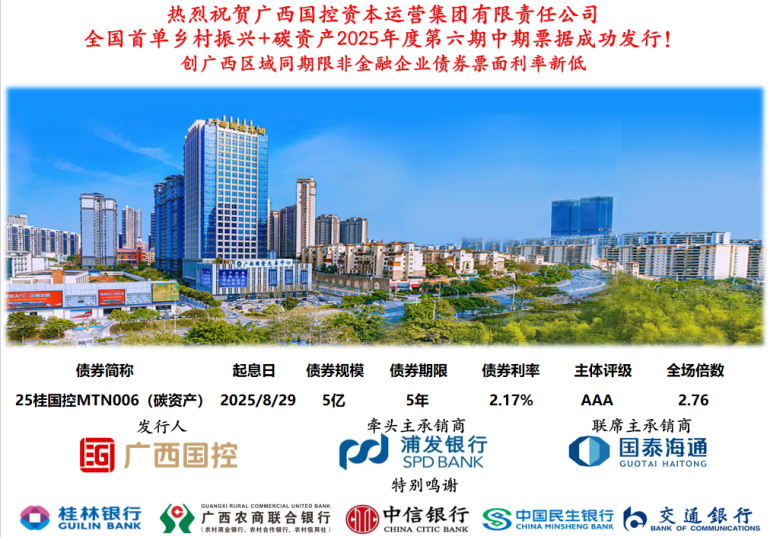
Core Viewpoint - The successful issuance of China's first "carbon asset + rural revitalization" dual-labeled medium-term note by Shanghai Pudong Development Bank and Guangxi Guokong Capital Operation Group represents an innovative financial product that aligns with national "dual carbon" goals and rural revitalization strategies, providing a replicable model for green financing and regional economic development [1][4][6] Group 1: Financial Innovation - The medium-term note has a total issuance scale of 500 million yuan and a five-year term, linking carbon assets to create new pathways for green financing [1][4] - The note's core innovation lies in its carbon asset yield as the underlying support, offering investors additional carbon asset yield distribution linked to the issuer's subsidiaries' carbon quotas [4] - The issuance attracted significant market interest, with a subscription multiple of nearly three times, reflecting confidence in Guangxi Guokong Group's capabilities and strategic positioning in the green low-carbon sector [4][5] Group 2: Fund Utilization - Proceeds from the medium-term note will primarily support the procurement of raw materials for sugar production, specifically purchasing sugarcane from local farms to ensure stable supply [5] - The funding is strategically directed towards rural revitalization and the real economy, transforming financial resources into drivers for rural development and industrial upgrades [5] - This initiative aims to enhance employment and income for sugarcane farmers, thereby activating the rural economy's self-sustaining capabilities [5][6] Group 3: Strategic Positioning - Guangxi Guokong Group, established in June 2025 with a registered capital of 11 billion yuan, integrates resources from various state-owned enterprises under the Guangxi State-owned Assets Supervision and Administration Commission [4] - The group focuses on leveraging Guangxi's policy advantages and unique industries, aiming to become a leading state-owned capital operation company and a top food industry enterprise in China [4]
上市银行1H25业绩总结:营收利润边际改善,看好板块配置价值有限
Dongxing Securities· 2025-09-05 09:38
Investment Rating - The report maintains a positive outlook on the banking sector's allocation value, suggesting continued investment interest in the sector [4][10]. Core Viewpoints - The performance of listed banks in the first half of 2025 shows a marginal improvement in revenue and profit margins, with year-on-year growth of 1.0% in revenue and 0.8% in net profit attributable to shareholders [4][5]. - The recovery in the bond market during the second quarter has alleviated some of the pressures on bond investment returns, contributing to the overall performance improvement [4][5]. - The report anticipates that the banking sector's revenue and net profit growth will remain around 1% year-on-year for 2025, despite ongoing pressures on the banking fundamentals [4][10]. Summary by Sections Performance Overview - In the first half of 2025, listed banks experienced a year-on-year revenue growth of 1.0% and a net profit growth of 0.8%, with quarter-on-quarter improvements of 2.8 percentage points and 2 percentage points respectively [4][5]. - The growth in interest-earning assets was 9.7% year-on-year, with a stable credit growth of 8% and a significant increase in financial investments by 14.9% [4][11]. - The net interest margin for the first half of 2025 was 1.33%, showing a year-on-year decline of 13 basis points, which is less than the decline seen in the same period last year [4][5]. Non-Interest Income - Non-interest income showed a positive trend, with a year-on-year increase of 10.8% in other non-interest income and a 3.1% increase in fee income [4][5][10]. - The report highlights that the recovery in the capital market has contributed to the improvement in non-interest income [4][10]. Asset Quality - The report notes that while the non-performing loan ratio remains stable, there is an increase in the generation rate of overdue and non-performing loans, particularly in retail banking [4][10]. - The provision coverage ratio remained stable, with an increase in provisioning efforts during the first half of 2025 [4][10]. Future Outlook - The banking sector is expected to face continued pressure in 2025, but signs of a potential turning point are emerging, with improved net interest margins and non-interest income [4][10]. - The report suggests that the demand for bank stocks will increase from long-term funds, driven by favorable policies encouraging investment in the banking sector [4][10].

浦发银行重庆分行:首笔消费贴息贷款落地
Sou Hu Cai Jing· 2025-09-05 09:16
Group 1 - The core viewpoint of the articles is that Shanghai Pudong Development Bank's Chongqing branch has successfully implemented a consumer loan interest subsidy policy to stimulate local consumption and support the economy [1][2] - On the first day of the policy implementation, the bank issued its first consumer loan interest subsidy, providing a financial boost to the local market [1] - The bank has launched targeted products such as "Pu Flash Loan" and "i Car Loan" to leverage the subsidy policy and stimulate demand in key consumption areas like automobiles [1] Group 2 - The Chongqing branch aims to uphold the "finance for the people" philosophy and enhance its services by integrating deeply into consumption scenarios and strengthening ecological collaboration [2] - The bank plans to monitor the effectiveness of the policy, gather customer feedback, and continuously optimize service processes to improve customer experience [2] - The goal is to ensure that national policies benefit more consumers and contribute to the recovery of the Chongqing consumption market [2]
浦发银行长沙分行落地分行首笔财政贴息消费贷款,精准助力消费市场回暖
Sou Hu Cai Jing· 2025-09-05 07:48
Core Viewpoint - The article highlights the implementation of a personal consumption loan policy with fiscal interest subsidies by SPD Bank's Changsha branch, aimed at boosting consumer spending and supporting economic growth in Hunan province [1] Group 1: Policy Implementation - SPD Bank's Changsha branch successfully issued its first personal consumption loan of 130,000 yuan under the fiscal interest subsidy policy on September 3 [1] - The bank established a special task force to quickly adapt to the new policy, completing system upgrades, process optimizations, and staff training [1] Group 2: Loan Features - The first subsidized loan focuses on household consumption, allowing customers to apply for the "Pu Flash Loan" product while benefiting from a 1% annual fiscal interest subsidy [1] - The loan processing is efficient, with the system automatically identifying eligible consumption behaviors, and the subsidy being directly deducted from interest payments, effectively reducing financing costs for consumers [1] Group 3: Future Plans - SPD Bank's Changsha branch plans to continue aligning with national policy directions, optimizing financial services, and expanding the coverage and beneficiary groups of the subsidy policy [1] - The bank aims to invigorate the consumer market in Hunan and contribute to high-quality economic development by providing financial support [1]