CMBC(600016)

Search documents
本周聚焦:多家银行下调存款挂牌利率
GOLDEN SUN SECURITIES· 2025-05-25 06:18
Investment Rating - The report indicates a positive outlook for the banking sector, suggesting that certain stocks may have alpha potential due to policy catalysts and a cyclical recovery [4]. Core Insights - Multiple banks have lowered their deposit rates, with the one-year and five-year Loan Prime Rate (LPR) reduced by 10 basis points on May 20, 2025. This trend reflects a broader market-driven decline in deposit costs [1][2]. - The average deposit cost rate for China Merchants Bank decreased significantly by 25 basis points to 1.29% in Q1 2025, indicating a trend of improving deposit costs across the sector [1]. - The report highlights that banks like Chongqing Bank, Minsheng Bank, and CITIC Bank have substantial room for further deposit cost reductions, suggesting a favorable environment for banks to optimize their funding costs [2]. Summary by Sections Section 1: Focus of the Week - Several banks have adjusted their deposit rates downward, with over half of listed banks participating in this trend by May 24, 2025 [1]. - The report notes that the average deposit cost rate for China Merchants Bank has shown improvement since Q2 2024, aligning with previous forecasts of enhanced cost reduction in liabilities [1]. Section 2: Sector Perspective - The banking sector is expected to benefit from expansionary policies aimed at stabilizing the economy, with specific banks like Ningbo Bank, Postal Savings Bank, and China Merchants Bank highlighted as potential investment opportunities [4]. - The report emphasizes that the cyclical recovery may take time, but the ongoing interest rate cuts could sustain the dividend strategy for banks like Shanghai Bank and Jiangsu Bank [4]. Section 3: Key Data Tracking - The report tracks various financial metrics, including the issuance of interbank certificates and the average rates for different types of bank notes, indicating a dynamic market environment [9][8]. - It also notes the increase in the proportion of deposits with a remaining maturity of less than one year, which rose by 3 percentage points to 37.4% by the end of 2024, suggesting a trend towards concentrated deposit maturities [2][16].






超百款理财产品业绩比较基准“缩水”
Zhong Guo Jing Ying Bao· 2025-05-23 18:37
Core Viewpoint - The recent adjustments in the Chinese banking wealth management market are primarily driven by the People's Bank of China's interest rate cuts, leading to a decline in market interest rates and subsequently affecting the performance benchmarks of various wealth management products [1][4]. Group 1: Market Impact - Since May, over a hundred wealth management products have announced reductions in their performance benchmarks, with some products' yield limits dropping below 2%, nearing the rates of fixed-term deposits [1][6]. - The decline in expected returns has prompted investors to reconsider their asset allocations, with conservative investors likely shifting towards cash management products or fixed-term deposits, while those with a higher risk appetite may focus more on "fixed income plus" products [2][4]. Group 2: Product Adjustments - Major wealth management firms, including Ping An Wealth Management and Bank of China Wealth Management, have adjusted their performance benchmarks in response to the declining policy interest rates, which have led to lower yields on underlying assets [3][5]. - The average performance benchmark for newly issued wealth management products in April 2025 was reported at 2.12%, reflecting a month-on-month decrease of 0.02 percentage points [7]. Group 3: Regulatory Environment - Regulatory bodies have been reinforcing the disclosure requirements for performance benchmarks of wealth management products, ensuring they accurately reflect market conditions and the risk-return characteristics of the products [4][5]. - The adjustments in performance benchmarks are aligned with regulatory expectations, aiming to provide a more transparent reference for investors regarding the expected returns of wealth management products [4][5]. Group 4: Future Trends - The low interest rate environment may lead to a reallocation of funds back to the deposit market, as many wealth management products' yields approach those of fixed-term deposits [6][10]. - Wealth management firms are encouraged to enhance their product offerings, particularly in "fixed income plus" products, to balance risk and return while adapting to the changing market landscape [11][12].





民生银行与民营火箭“六支箭”的星辰大海!
券商中国· 2025-05-23 15:16
Core Viewpoint - The article highlights the rapid development and commercialization of China's private space launch industry, emphasizing the role of Minsheng Bank in supporting these companies through tailored financial services and strategic partnerships [1][2][3]. Group 1: Industry Developments - On May 21, the Kuaizhou-1A rocket successfully launched six satellites, marking a significant milestone as it becomes the only Chinese commercial rocket capable of launching over six tons [1]. - The Tianqi constellation's first phase was completed with the successful launch of four satellites by Xinghe Power on May 19, indicating a major step towards global connectivity [1]. - Blue Arrow Aerospace's Zhuque-2 rocket achieved a significant milestone in the liquid oxygen-methane sector by successfully launching six satellites [1]. - Six private rocket companies in China have successfully launched orbital rockets, collectively referred to as the "six arrows" of China's private space sector [1]. Group 2: Minsheng Bank's Role - Minsheng Bank has proactively supported five of the six private rocket companies, providing not only credit but also comprehensive service packages tailored to the needs of enterprises and their employees [1][2]. - The bank has established 17 technology finance branches and six specialized institutions to cover high-tech industries and technology parks in Beijing [2]. - Minsheng Bank has shifted its credit approval process from traditional financial metrics to a more holistic view that includes talent, technology, and market potential [2][3]. Group 3: Financial Services and Support - Minsheng Bank has developed the "Minsheng Easy Innovation" service matrix, offering a one-stop solution that combines commercial banking and investment banking services [4]. - The bank plays a proactive role in equity financing for private rocket companies, leveraging its network to connect them with venture capital and private equity firms [4]. - Minsheng Bank provides high-level services to executives of technology companies, including wealth management and exclusive benefits [4]. Group 4: Comprehensive Ecosystem Support - Minsheng Bank has expanded its financial services to cover the entire commercial space industry chain, from upstream suppliers to downstream satellite manufacturing [5]. - The bank's "Minsheng E-Chain" product series offers customized financing solutions based on transaction data and supply chain dynamics, enhancing financial service efficiency [5]. - The bank aims to transform data assets of technology companies into financial assets, providing more precise and effective financial services [5].



民生银行与民营火箭“六支箭”的星辰大海——用金融温度陪伴中国商业航天迈入“万星时代”
经济观察报· 2025-05-23 14:00
Core Viewpoint - The commercial aerospace sector, particularly private rocket launch companies, is in the early stages of commercialization, facing challenges such as high R&D costs and difficulty in achieving profitability. Despite these challenges, Minsheng Bank has proactively engaged with this sector, providing tailored financial services to support innovation and growth [1][5][9]. Group 1: Industry Overview - The commercial aerospace industry, especially private rocket launch enterprises, has not yet established stable revenue streams and faces significant R&D investments [1][5]. - The industry has a high technical barrier and complex technological routes, making it difficult for traditional banks to provide credit loans [1][5]. - As of now, six private rocket companies in China have successfully launched operational rockets, marking a significant shift in the global aerospace landscape [2][5]. Group 2: Minsheng Bank's Strategy - Minsheng Bank has aligned its strategy with national innovation-driven development policies, establishing a strong presence in Beijing's "Rocket Street," which houses 75% of China's commercial rocket companies [5][6]. - The bank has developed a differentiated service strategy, shifting its credit approval focus from traditional financial statements to evaluating talent, technology, and market ecosystems [6][9]. - Minsheng Bank has cultivated a team of professionals who understand the unique needs of aerospace companies, enhancing credit support and expanding loan products to include long-term project financing [9][12]. Group 3: Comprehensive Support Services - The bank has created the "Minsheng Easy Innovation" service matrix, offering a one-stop solution that combines commercial banking and investment banking services [12]. - Minsheng Bank actively participates in equity financing for private rocket companies, leveraging its network to connect them with venture capital and private equity firms [12][14]. - The bank provides high-level services to executives of these companies, including wealth management and exclusive benefits, enhancing the overall client experience [12][14]. Group 4: Ecosystem Development - Minsheng Bank has expanded its financial services across the entire commercial aerospace supply chain, from upstream fuel storage to downstream satellite manufacturing [14][15]. - The bank's "Minsheng E-Link" product series addresses diverse financing needs for core enterprises and their supply chain clients, utilizing transaction data for risk assessment [14][15]. - The bank aims to transform data assets of innovative enterprises into financial assets, providing more precise and efficient financial services [15].

最低“2字头”,银行信用卡现金分期“暗战”再起
Jin Rong Shi Bao· 2025-05-23 12:50
Core Viewpoint - The competition in the credit card cash installment business has intensified, with banks offering significant interest rate discounts, leading to annualized rates dropping below 3% for some products [1][3]. Group 1: Market Dynamics - Following the regulatory crackdown on consumer loans, which set a minimum annualized interest rate of 3%, banks have turned to credit card cash installment services, which are not yet subject to the same restrictions [2]. - Major banks such as China Merchants Bank, Bank of China, and others have launched promotional activities, with some rates as low as 2.76% for 12-month installments [3][4]. - The cash installment service allows cardholders to convert their credit limits into cash, which can be repaid in installments along with fees [3]. Group 2: Strategic Implications - The current interest rate discounts are seen as a strategy to attract customers and expand retail loan volumes while managing credit risk through strict customer eligibility criteria [5]. - The credit card business is undergoing a strategic transformation, focusing on enhancing the value of existing customers and increasing the penetration of installment services [5]. - The low-interest strategy may stimulate short-term growth, but there are concerns about the potential accumulation of risks due to aggressive pricing [5][6]. Group 3: Industry Challenges - The credit card industry is moving away from rapid expansion, with several banks closing credit card branches and adjusting their operational strategies [7]. - The industry faces challenges such as difficulty in acquiring new users and pressure on product offerings, which test the strategic resilience of banks [7]. - Data indicates that among 14 listed banks reporting credit card non-performing loan rates for 2024, most have seen an increase, highlighting the pressure on retail banking [7].


股份行存款利率也下调:存款“搬家” 理财、保险接住溢出资金
Xin Jing Bao· 2025-05-22 09:14
Group 1 - Several joint-stock banks have followed state-owned banks in lowering deposit rates, with 10 banks reported to have adjusted their rates as of May 21 [1][2] - The one-year fixed deposit rate at China Merchants Bank has dropped to 0.95%, marking the first time it has fallen below 1%, while other banks have adjusted their one-year rates to 1.15% [2][4] - The adjustment in deposit rates is expected to lead to a decrease in the rates of various deposit products and large-denomination certificates of deposit [4][5] Group 2 - Customers are increasingly abandoning traditional deposits in favor of bank wealth management products and insurance, as current deposit rates are perceived as too low [5][6] - The phenomenon of "deposit migration" is anticipated to continue, with smaller banks also expected to lower their deposit rates in response to market conditions [7][8] - The decline in deposit rates may enhance market liquidity, as not all types of deposits are sensitive to interest rate changes, allowing banks to maintain stable customer relationships [8][9]


最新!又有多家银行宣布:下调!
天天基金网· 2025-05-22 05:26
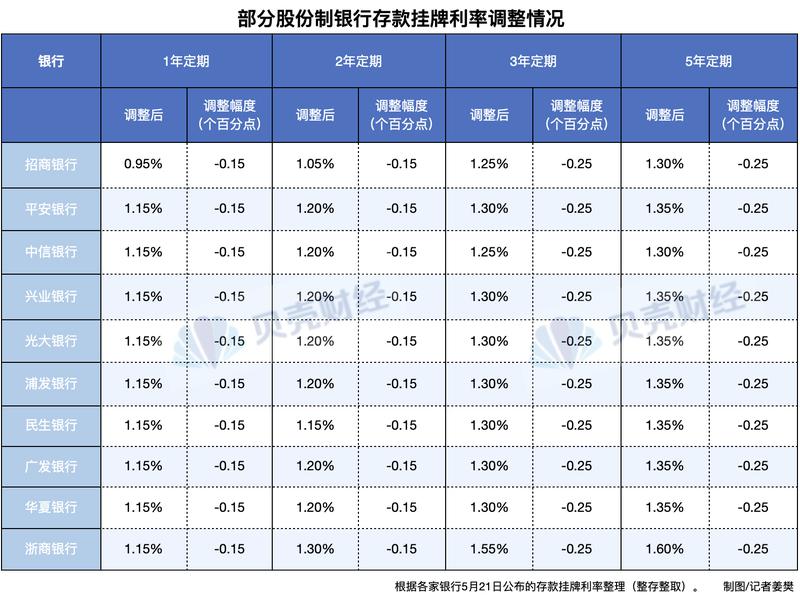
Core Viewpoint - The recent reduction in deposit rates by multiple banks, including state-owned and joint-stock banks, aligns with market expectations and aims to stabilize net interest margins while supporting the real economy [1][5][6]. Group 1: Deposit Rate Adjustments - Nine out of twelve joint-stock banks have announced reductions in deposit rates, with significant cuts in medium to long-term deposit rates, particularly a 25 basis points (BP) decrease for 3-year and 5-year fixed deposits [1][2][3]. - Specific banks like Ping An Bank and Minsheng Bank have adjusted their deposit rates, with Ping An Bank's rates for various terms now at 0.70%, 0.95%, 1.15%, 1.20%, and 1.30%, reflecting reductions of 15 BP for most terms and 25 BP for longer terms [2][3]. - The speed of these adjustments is seen as necessary for banks to manage their liabilities effectively and maintain competitiveness in the current economic environment [5][6]. Group 2: Market Reactions and Expectations - Investors have anticipated the decline in deposit rates, with no significant rush to lock in rates observed at bank branches, indicating a broader acceptance of a long-term downward trend in deposit rates [3][5]. - Experts believe that the synchronized reduction in deposit rates by banks is crucial for reducing financing costs for the real economy and stabilizing net interest margins [5][6]. Group 3: Implications for Banking Sector - The current trend of deposit rate reductions is expected to create more room for lowering financing costs in the future, which is essential for improving banks' profitability and sustainability in serving the real economy [6][7]. - The recent adjustments have seen deposit rate cuts that exceed the reductions in the Loan Prime Rate (LPR), indicating a strategic move by banks to manage their interest expenses more effectively [6][7].

又有多家银行宣布:下调!
新华网财经· 2025-05-22 02:41
Core Viewpoint - The recent reduction in deposit rates by nine joint-stock banks follows the lead of the six major state-owned banks, indicating a broader trend in the banking sector to lower interest rates in response to the central bank's monetary policy adjustments [1][4]. Group 1: Deposit Rate Adjustments - On May 21, seven joint-stock banks announced a reduction in their deposit rates, with a decrease of 15 basis points for 3-month, 6-month, 1-year, and 2-year fixed deposits, and a 25 basis points reduction for 3-year and 5-year fixed deposits [1][2]. - The new deposit rates for various terms at China Merchants Bank are set at 0.95% for 1-year, 1.05% for 2-year, 1.25% for 3-year, and 1.30% for 5-year deposits, while other banks have slightly different rates [1][2]. Group 2: LPR and Monetary Policy - The Loan Prime Rate (LPR) was also adjusted downwards, with the 5-year LPR at 3.5% and the 1-year LPR at 3%, both down by 10 basis points [4]. - Analysts suggest that the central bank is establishing a transmission mechanism from policy rates to LPR and deposit rates, indicating a coordinated approach to monetary policy [4][6]. Group 3: Implications for the Financial Market - The reduction in deposit rates is expected to lower the cost of liabilities for financial institutions and enhance the attractiveness of bond assets compared to loan assets, potentially leading to increased investment in the bond market [4][6]. - The average reduction in deposit rates is greater than that of the LPR, which reflects a strategy to protect bank interest margins while supporting the real economy [6].

活期存款利率已接近0 !7家银行同日发布公告下调存款利率
Guan Cha Zhe Wang· 2025-05-22 00:57
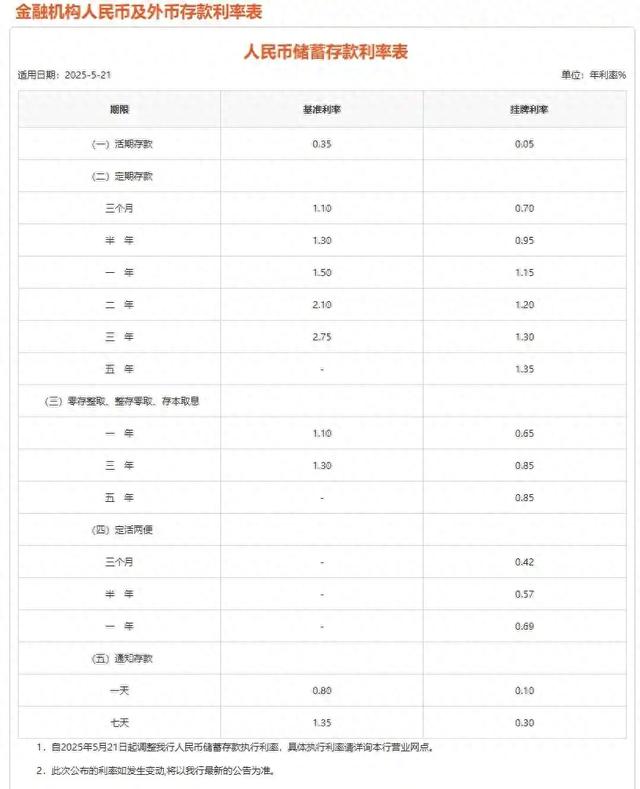
Group 1 - The core viewpoint of the article is that several banks in China have announced a reduction in RMB deposit rates, following a trend initiated by major state-owned banks, which is linked to the recent decrease in the Loan Prime Rate (LPR) [1][4][5] Group 2 - On May 20, six state-owned banks and several others, including China Merchants Bank and China Everbright Bank, announced a reduction in RMB deposit rates, with the adjustment range being 5 to 25 basis points [1] - Following this, on May 21, seven additional banks, including Ping An Bank and CITIC Bank, also announced similar reductions, with the new rates for demand deposits set at 0.05% and various fixed-term deposit rates adjusted accordingly [1][2] - The new fixed-term deposit rates for three months, six months, one year, two years, three years, and five years are 0.7%, 0.95%, 1.15%, 1.20%, 1.30%, and 1.35% respectively [1] - The recent LPR adjustments include a decrease in the 5-year LPR to 3.5% and the 1-year LPR to 3%, both down by 0.1% from the previous month [4] - The reduction in deposit rates is expected to lead to an overall decrease in deposit rates by approximately 0.11 to 0.13 percentage points, which may help stabilize banks' net interest margins [4][5] - As of the first quarter of 2025, the net interest margin for commercial banks was reported at 1.43%, a decrease of 0.09 percentage points, marking a historical low [5]
多家银行跟进,下调存款利率
新浪财经· 2025-05-22 00:43
Core Viewpoint - The recent reduction in deposit rates by nine joint-stock banks follows the earlier actions of the six major state-owned banks, indicating a broader trend in the banking sector to lower interest rates in response to the People's Bank of China's (PBOC) adjustments to the Loan Prime Rate (LPR) [1][3][6] Group 1: Deposit Rate Adjustments - On May 21, seven joint-stock banks announced a reduction in their deposit rates, with a decrease of 15 basis points for 3-month, 6-month, 1-year, and 2-year fixed deposits, and a reduction of 25 basis points for 3-year and 5-year fixed deposits [1][2] - Specific rates for China Merchants Bank were adjusted to 0.95% for 1-year, 1.05% for 2-year, 1.25% for 3-year, and 1.30% for 5-year deposits, while other banks set their rates at 1.15%, 1.20%, 1.30%, and 1.35% respectively for similar terms [1][2] Group 2: LPR and Monetary Policy - The PBOC announced a decrease in the LPR, with the 1-year LPR at 3% and the 5-year LPR at 3.5%, both down by 10 basis points [3] - Analysts suggest that the PBOC is establishing a transmission mechanism from policy rates to LPR and deposit rates, indicating a coordinated approach to monetary policy [3][4] Group 3: Market Implications - The reduction in deposit rates is expected to enhance the attractiveness of bond assets by lowering the yield advantage of loan assets, thereby improving the configuration value of bonds [3][4] - The larger reduction in deposit rates compared to LPR is seen as a measure to protect bank interest margins while encouraging credit growth [6]