
CITIC Securities Co., Ltd.(600030)

Search documents
中信证券:资金利率继续下探的空间有限
Xin Lang Cai Jing· 2025-12-29 00:22
Core Insights - The recent trend of DR001 gradually declining indicates that there is limited room for further decreases in funding rates before the next interest rate cut [1] - The central bank's statement from the fourth quarter monetary policy meeting in 2025 suggests that the emphasis on "preventing fund idling" is temporarily downplayed, indicating a low probability of funding rate increases [1] - It is expected that funding rates will maintain a low level in the future [1]

跨越2025 年终行情能否连涨收官?请看本周十大券商策略
智通财经网· 2025-12-28 23:37
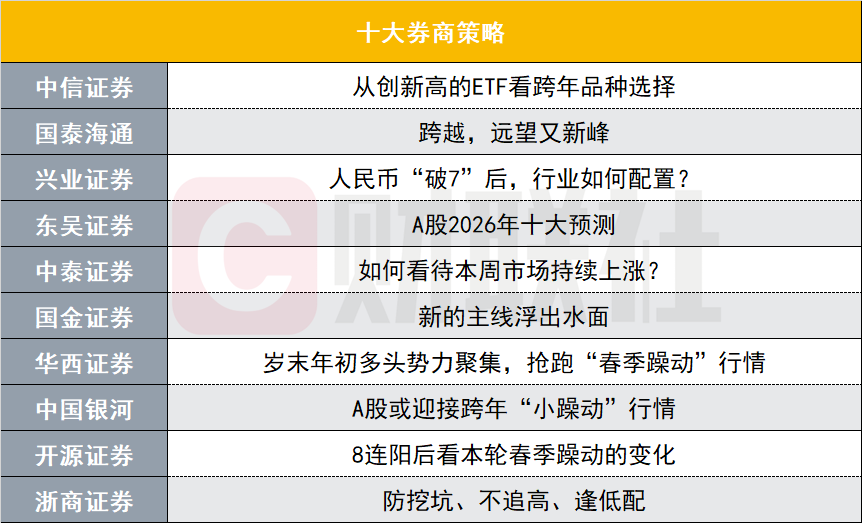
Core Viewpoint - The Chinese stock market is experiencing a positive trend as it approaches the end of 2025, with significant movements in various sectors and a focus on potential investment opportunities for 2026 [1][30]. Group 1: Market Trends and Predictions - The Shanghai Composite Index has achieved an "eight consecutive days of gains" [1]. - The total scale of Chinese ETFs has surpassed 6 trillion, setting a new historical high [1]. - Major brokerages have provided insights on market trends, with predictions for 2026 focusing on sectors that may dominate [2][5][13]. Group 2: Sector Analysis - Citic Securities highlights that 39 out of 360 industry/theme ETFs reached new highs in December, with a focus on telecommunications, non-ferrous metals, and commercial aerospace as key sectors [3]. - Industry sectors such as chemicals, engineering machinery, and new energy are expected to see increased attention and potential growth due to their long-term return on equity (ROE) improvement [4]. - Guotai Junan emphasizes the importance of capital markets in driving social confidence and investment, marking a shift from traditional investment methods to more capital-intensive approaches [5]. Group 3: Currency and Economic Factors - The recent appreciation of the Renminbi is attributed to a weaker US dollar and seasonal capital inflows, which may support the Chinese stock market [9][30]. - The potential for a significant influx of capital back into China is anticipated, driven by the reversal of previous trends in currency valuation and investment sentiment [9][10]. - The structural transformation of the Chinese economy is expected to reduce uncertainty and enhance investment opportunities, particularly in technology and manufacturing sectors [7][24]. Group 4: Investment Strategies - Investment strategies are shifting towards sectors that benefit from the current economic environment, including AI hardware, renewable energy, and consumer services [19][31]. - Brokers suggest focusing on thematic trading opportunities in sectors like robotics, commercial aerospace, and healthcare, which are expected to gain traction in the upcoming year [19][31]. - The market is advised to adopt a cautious approach, emphasizing low-cost entry points and avoiding high-risk positions as the market stabilizes [35][36].


【十大券商一周策略】A股跨年行情已经启动,新的主线浮出水面
Xin Lang Cai Jing· 2025-12-28 15:19
Core Viewpoint - The A-share market is expected to experience a spring rally driven by liquidity, policy expectations, and structural opportunities, with a focus on sectors like AI, commercial aerospace, and non-bank financials [5][10][12]. Group 1: Market Trends and Predictions - 39 out of 360 industry/theme ETFs reached new highs in December, with communication and non-ferrous metals being traditional favorites, while new themes like commercial aerospace are gaining traction [3]. - The A-share market is showing signs of a spring rally, supported by liquidity and positive policy expectations, with a focus on sectors such as technology and advanced manufacturing [5][10]. - The market is expected to maintain a high risk appetite due to favorable conditions, including a weak dollar and the upcoming Chinese New Year and Two Sessions [11][16]. Group 2: Sector Focus and Investment Opportunities - Key sectors to watch include AI, commercial aerospace, and non-ferrous metals, which are expected to benefit from structural changes and increased demand [10][12]. - The manufacturing sector, particularly in chemicals and engineering machinery, is showing signs of recovery and is expected to benefit from the shift in global competition [3][4]. - Non-bank financials, including insurance and brokerage firms, are positioned to benefit from the anticipated capital inflows and improved asset returns [9][12]. Group 3: Currency and Economic Factors - The appreciation of the RMB is expected to lower import costs and enhance domestic purchasing power, benefiting sectors reliant on imports and domestic consumption [7][9]. - The potential for significant capital inflows due to RMB appreciation could lead to a revaluation of Chinese assets, creating a favorable environment for investment [7][9]. - The overall economic environment is improving, with expectations of continued liquidity support and a stable policy backdrop, which is conducive to market growth [5][10].


中信证券2025年十大预测对了几个
Xin Lang Cai Jing· 2025-12-28 14:33
Economic Growth - The economy is expected to achieve a growth rate of around 5%, with nominal and real growth rates converging [2][20] - Actual growth is showing a "front high and back low" pattern rather than a "U-shaped" recovery [20] Fiscal Policy - The broad fiscal expenditure is better than last year, with the deficit rate raised to 4% and a debt relief plan of 10 trillion yuan to ease local fiscal pressure [3][4] - The government report confirms a deficit of 5.66 trillion yuan and a debt replacement scale of 10 trillion yuan, with significant increases in education and social security spending [4][21] Monetary Policy - The monetary policy remains moderately loose, with potential for more significant rate cuts and reserve requirement ratio reductions compared to 2024 [5][22] - A 0.5 percentage point reserve requirement cut in May released approximately 1 trillion yuan in liquidity, and the yuan appreciated instead of depreciating [5][22] Credit Cycle - M1 growth turned positive, reaching 4.9% in November, but the social financing growth did not follow the predicted "two ends low, middle high" pattern [7][24] - The actual social financing growth showed a "front high and steady" trend, with an 8.5% growth in November [24] International Relations - Economic disturbances primarily stem from U.S.-China relations, but macro policies have effectively mitigated impacts, with increasing pragmatism in China-Europe relations [8][25] - Cooperation among global southern countries is gaining momentum, evidenced by various agreements and initiatives [8][25] Exchange Rate - The prediction of the yuan remaining in a weak range of 7.3-7.5 was completely incorrect, as the yuan appreciated throughout the year due to strong economic resilience and unexpected export performance [10][27] Export Situation - External demand slowdown and tariff pressures led to a negative export growth in October, but overall performance was stronger than expected, with a 5.4% growth from January to November [12][29] Real Estate Market - Core areas in first-tier cities have stabilized, and new first-tier cities are expected to stop declining by mid-2025, although recent data shows some instability in housing prices [13][31] Domestic Demand Expansion - Policies aimed at boosting consumption and improving livelihoods are in place, but the actual growth in retail sales fell short of the 5% target, with a total growth of 4.0% from January to November [15][32] State-Owned Enterprise Reform - The implementation of market value assessments and increased mergers and acquisitions led by state-owned enterprises has been confirmed, with significant investments in traditional and emerging industries [16][33]
2026为何重视券商投行拐点及科创板跟投?
Changjiang Securities· 2025-12-28 11:45
Investment Rating - The report maintains a "Positive" investment rating for the industry [13] Core Insights - The brokerage investment banking business has experienced a contraction from 2022 to 2024, but is expected to see a recovery starting in 2025, with significant improvements in both business volume and revenue [2][7] - The recovery is influenced by the resurgence of the Sci-Tech Innovation Board (STAR Market), which is anticipated to enhance the profitability of brokerage firms through underwriting and follow-on investments [2][10] - Leading brokerage firms such as Guotai Junan, CITIC Securities, and CICC are expected to leverage their resource and scale advantages to maintain competitive edges in the market [2][10] Summary by Sections Investment Banking Business Recovery - The brokerage investment banking sector is projected to recover in 2025 after three years of contraction, with a notable increase in business volume and revenue [7][21] - A-share IPO and refinancing volumes for 2025 are expected to reach CNY 1,253 billion and CNY 9,347 billion, respectively, representing year-on-year increases of 86.1% and 318.9% [21][28] Market Concentration - The concentration of A-share IPOs has significantly increased, with the top five firms (CR5) accounting for 71.5% of the total IPO volume in 2025, up 15.9 percentage points from 2024 [28] - The concentration in bond underwriting has also risen, with CR5 at 52.3% [28] Sci-Tech Innovation Board Follow-On Investment - The follow-on investment returns from the Sci-Tech Innovation Board have improved significantly, with total follow-on investment amounting to CNY 11.2 billion in 2025 and first-day returns reaching 261% [9][30] - Major firms like CITIC, Huatai, and Guotai Junan have reported substantial first-day follow-on investment returns, contributing significantly to their annual profit growth [9][30] 2026 Outlook - The report anticipates a robust project pipeline for the Sci-Tech Innovation Board in 2026, with a total planned issuance of CNY 675 billion from 40 companies [36] - Under optimistic scenarios, follow-on investment returns could drive profit growth for leading brokerage firms by up to 10% in 2026 [10][42]

非银金融行业周报(2025/12/22-2025/12/26):IFRS17 切换后所得税处理方式进一步明确,为新准则全面落地奠定坚实基础-20251228
Shenwan Hongyuan Securities· 2025-12-28 11:09
Investment Rating - The report maintains a positive outlook on the insurance and brokerage sectors, indicating an "Overweight" rating for the industry [1]. Core Insights - The report highlights the expected improvement in the performance of the securities industry in December 2025, with a projected increase in investment returns and a significant rise in equity financing [3]. - The insurance sector is anticipated to undergo a systematic value reassessment, with specific recommendations for leading companies such as China Life, Ping An, and China Pacific Insurance [3]. - The report emphasizes the potential for cross-border investment opportunities due to the appreciation of the RMB against the USD, which could benefit brokerage firms [3]. Summary by Sections Market Review - The Shanghai Composite Index closed at 4,657.24, with a weekly increase of 1.95%. The non-bank index rose by 2.09%, while the brokerage, insurance, and diversified finance sectors reported increases of 1.58%, 2.97%, and 2.66%, respectively [6]. Non-Bank Industry Key Data - As of December 26, 2025, the average daily trading volume in the A-share market was 18,437.18 billion RMB, reflecting a month-on-month decrease of 5.10% [17]. - The margin financing and securities lending balance reached 25,454.30 billion RMB, up 36.5% from the end of 2024 [17]. - The report notes that the total equity financing in December 2025 was 508.4 billion RMB, a 72% increase month-on-month [3]. Non-Bank Industry News and Key Announcements - The Financial Regulatory Bureau released a plan for the high-quality development of digital finance in the banking and insurance sectors, outlining 33 tasks [18]. - The People's Bank of China published the "China Financial Stability Report (2025)," emphasizing the need for policies that support long-term investments in the A-share market [19]. - The National Development and Reform Commission initiated a venture capital guidance fund expected to reach a scale of one trillion RMB, aimed at supporting strategic emerging industries [21]. Individual Stock Highlights - In the insurance sector, notable A-share performances included Ping An (3.51%) and China Pacific Insurance (3.14%) [8]. - In the brokerage sector, the top performers included Zhongyin Securities (9.96%) and Industrial Securities (5.96%) [8].




非银金融行业跟踪周报:春季躁动行情启动,看好保险“开门红”表现-20251228
Soochow Securities· 2025-12-28 09:03
Investment Rating - Maintain "Overweight" rating for the non-bank financial sector [1] Core Views - The non-bank financial sector has shown resilience, with insurance and multi-financial sectors outperforming the CSI 300 index recently. The insurance sector is expected to perform well in the upcoming "opening red" period for 2026 [1][9] - The insurance industry has seen improvements in premium growth, with a year-to-date increase of 9.2% in original premiums for life insurance [20][27] - The securities sector is experiencing a decline in trading volume but is supported by new policies allowing foreign investors to engage in bond repurchase transactions [14][19] Summary by Sections Recent Performance of Non-Bank Financial Sub-Sectors - In the last five trading days (December 22-26, 2025), the multi-financial sector rose by 3.20%, and the insurance sector increased by 2.98%, while the overall non-bank financial sector rose by 1.97% [9] - Year-to-date, the insurance sector has increased by 35.78%, outperforming other sectors [10] Non-Bank Financial Sector Insights Securities - Trading volume has decreased, with an average daily trading amount of 21,509 billion CNY in December, a 22.49% increase year-on-year but a 4.02% decrease month-on-month [14] - The margin financing balance reached 25,454 billion CNY, a year-on-year increase of 35.40% [14] - The average PB valuation for the securities sector is 1.3x for 2025E, with recommendations for leading firms like CITIC Securities and Tonghuashun [19] Insurance - The insurance sector's original premium for the first 11 months of 2025 reached 44,206 billion CNY, with a year-on-year growth of 9.2% [20] - The asset-liability management regulations are being revised to strengthen oversight, which is expected to enhance risk management in the sector [23][27] - The insurance sector's valuation is currently at 0.69-1.02 times 2025E P/EV, indicating a historical low and maintaining an "Overweight" rating [27] Multi-Financial - The trust industry saw its asset scale reach 32.43 trillion CNY by mid-2025, with a year-on-year growth of 20.11% [30] - The futures market recorded a transaction volume of 7.70 billion contracts in November, with a transaction value of 66.61 trillion CNY, reflecting a year-on-year growth of 13.54% [34] Industry Ranking and Key Company Recommendations - The recommended ranking for the non-bank financial sector is insurance > securities > other multi-financial services, with key recommendations including China Life, Ping An, and CITIC Securities [45] - The sector is characterized by low average valuations, providing a safety margin and balanced risk-reward profile [45]





中信证券:以震荡市思维应对跨年行情
Xin Lang Cai Jing· 2025-12-28 08:45
Core Insights - In December, 39 out of 360 industry/theme ETFs reached new highs, primarily in the communication, non-ferrous metals, and military (aerospace) sectors, indicating strong market consensus on these areas [2][11] - Established sectors like communication and non-ferrous metals are seen as core investment themes, while emerging sectors such as commercial aerospace are gaining traction amid market volatility [1][3] Group 1: Performance of ETFs - The communication ETFs saw an average increase of 10% since October, with an annual average increase of 91.5% [2][12] - Non-ferrous metal ETFs experienced an average increase of 20.1% since October, with an annual average increase of 95.2% [2][12] - Military and aerospace ETFs had an average increase of 18.7% since October, with satellite ETFs rising by an average of 34.5% [2][12] Group 2: Emerging Investment Themes - Commercial aerospace is viewed as an active investment choice during market fluctuations, similar to previous low-altitude themes, driven by narratives around US-China space infrastructure competition [3][4] - The commercial aerospace sector, while promising, does not match the scale of humanoid robotics or low-altitude economies, indicating a more modest growth potential [4][14] Group 3: Under-the-Radar Sectors - Sectors like chemicals and engineering machinery are quietly rising and have reached new annual highs, reflecting China's manufacturing competitiveness and pricing power [5][15] - These sectors are characterized by low media attention and fragmented industry discussions, making them susceptible to being overlooked despite their potential for profit margin improvement [5][15] Group 4: Anti-Inflation Trends - Sectors related to anti-inflation, such as new energy and steel, are showing signs of recovery, with market sensitivity to supply dynamics increasing [6][16] - Recent supply chain disruptions in the new energy sector have led to positive stock price reactions, indicating market expectations for tangible supply reductions [6][16] Group 5: Investment Strategy - The current market strategy emphasizes structural opportunities in a volatile market, focusing on sectors with low heat and concentration but increasing attention and potential for long-term ROE improvement, such as chemicals, engineering machinery, and new energy [7][17] - The strategy also includes monitoring the trend of RMB appreciation, with sectors like brokerage and insurance being positioned as both offensive and defensive choices [7][17]
非银金融行业周报:IFRS17切换后所得税处理方式进一步明确,为新准则全面落地奠定坚实基础-20251228
Shenwan Hongyuan Securities· 2025-12-28 07:56
Investment Rating - The report maintains a "Positive" outlook on the non-bank financial industry [3] Core Insights - The report highlights the recovery in the securities sector, with a projected increase in December performance driven by improved investment returns and a rise in equity financing [4][7] - The insurance sector is expected to benefit from the clarification of income tax treatment under IFRS17, enhancing profit predictability for insurers [4][11] - The report emphasizes the growth of ETFs, which have surpassed 6 trillion yuan in total assets, indicating a strong trend in the investment landscape [4] Summary by Sections Market Performance - The Shanghai Composite Index closed at 4,657.24, with a weekly increase of 1.95%, while the non-bank index rose by 2.09% [7] - The securities, insurance, and diversified financial sectors reported increases of 1.58%, 2.97%, and 2.66% respectively [7] Securities Industry Insights - The average daily trading volume in the A-share market for December is estimated at 1.84 trillion yuan, with a 5% decrease month-on-month [4] - The margin financing balance reached 2.5 trillion yuan, reflecting a 3% increase [4] - Equity financing in December totaled 508.4 billion yuan, a 72% increase from the previous month [4] Insurance Industry Insights - The report notes that the implementation of IFRS17 will standardize income tax calculations for insurers starting in 2026, which is expected to improve profit visibility [4][11] - The insurance sector index rose by 2.97%, outperforming the Shanghai Composite Index by 1.02 percentage points [4] Investment Recommendations - For the securities sector, the report recommends focusing on leading firms with strong competitive positions, such as Guotai Junan and CITIC Securities, as well as firms with significant earnings elasticity like Huatai Securities [4] - In the insurance sector, the report suggests investing in major players like China Life and Ping An, highlighting their systemic value re-evaluation opportunities [4]
FOF嵌套烂尾项目,富安娜1.2亿元理财逾期超三年,中信证券一审判赔50%
Xin Lang Cai Jing· 2025-12-28 07:01
Core Viewpoint - The recent court ruling in favor of Fuanna against CITIC Securities highlights significant issues in the management and transparency of financial products, particularly in the context of asset management and investment risks associated with FOF (Fund of Funds) structures [1][2][3]. Group 1: Legal Proceedings and Court Ruling - Fuanna has received a court ruling that requires CITIC Securities to compensate 29.2863 million yuan for principal losses within ten days of the judgment [1]. - The court also stated that any subsequent recoveries from the asset management plan will be split 50/50 between Fuanna and CITIC Securities, indicating a substantial fault on the part of CITIC Securities [1][2]. - The case has drawn significant market attention due to its implications for asset management product disputes following regulatory changes [2][3]. Group 2: Investment Details and Product Structure - Fuanna began investing in CITIC Securities' "Fu An No. 1" product in April 2018, with a total investment of 120 million yuan in the fifth phase, which was supposed to yield returns but faced delays [2][3]. - The product was restructured into a FOF format, which has raised concerns about the underlying investments and the lack of transparency regarding the actual asset allocation [3][4]. - Investigations revealed that the investment funds were not directly allocated to the stated assets but were instead funneled through a trust plan, which involved a failed real estate project [3][4][5]. Group 3: Risk Management and Industry Implications - The case underscores the risks associated with FOF products, particularly regarding the concentration of investments and the potential for conflicts of interest within financial institutions [11][14]. - The rapid growth of private FOF products among securities firms has raised concerns about the adequacy of risk management practices and the potential for misalignment of interests between product managers and investors [13][14]. - The incident with Fuanna is not isolated, as other companies have also faced similar issues with CITIC Securities' products, indicating a broader industry challenge [11][15].

