
SAIC MOTOR(600104)

Search documents
智己汽车前11月销量仅完成目标70% 简化股权结构上汽集团直接持股59.5%
Chang Jiang Shang Bao· 2025-12-24 23:17
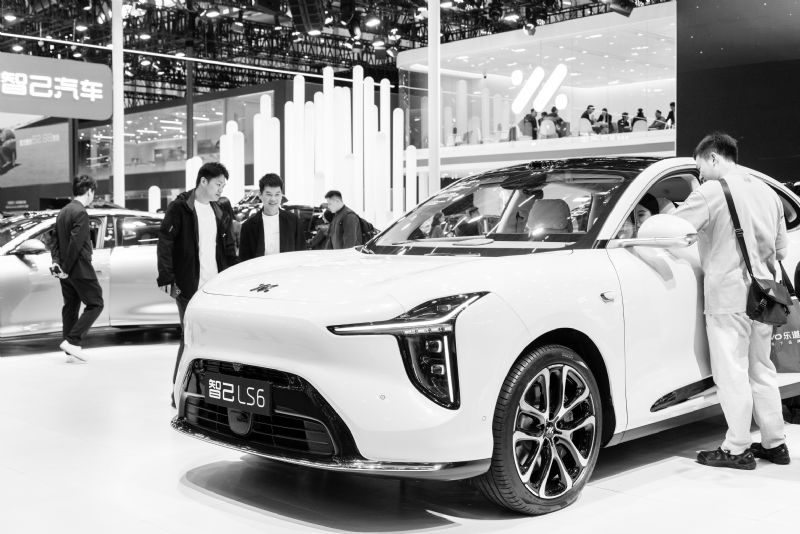
12月23日,上汽集团(600104.SH)发布公告称,为简化公司持股智己汽车的股权结构,对于原先通过元界基金 持有的智己汽车份额部分,拟变更为由公司直接持有智己汽车的股权,公司对智己汽车的持股比例没有变化。 2025年半年报显示,上汽集团直接持有智己汽车股份为7.19%,间接持有股份为52.34%,合计达59.53%。 然而,智己汽车当前销量虽在增长,但远低于公司的目标。 据公开信息显示,智己汽车高管曾宣布,公司2025年要实现国内外销量10万辆。 长江商报消息 ●长江商报记者 黄聪 智己汽车的股权结构将更加清晰明了。 近日,上汽集团发布的产销快报显示,2025年前11月,智己汽车销量达6.92万辆,同比增长20.35%。 这也意味着,前11月,智己汽车完成销量目标近70%,要在2025年最后一个月销量超3万辆才能完成年度目标,显 然难度很大。 虽然智己汽车销量不及预期,但上汽集团整体销量大幅回暖,公司前11月售车410.81万辆,同比增长16.38%。 上汽集团从元界基金中退出 12月23日,上汽集团发布公告称,为简化公司持股智己汽车的股权结构,对于原先通过元界基金持有的智己汽车 份额部分,拟变更为由公司 ...


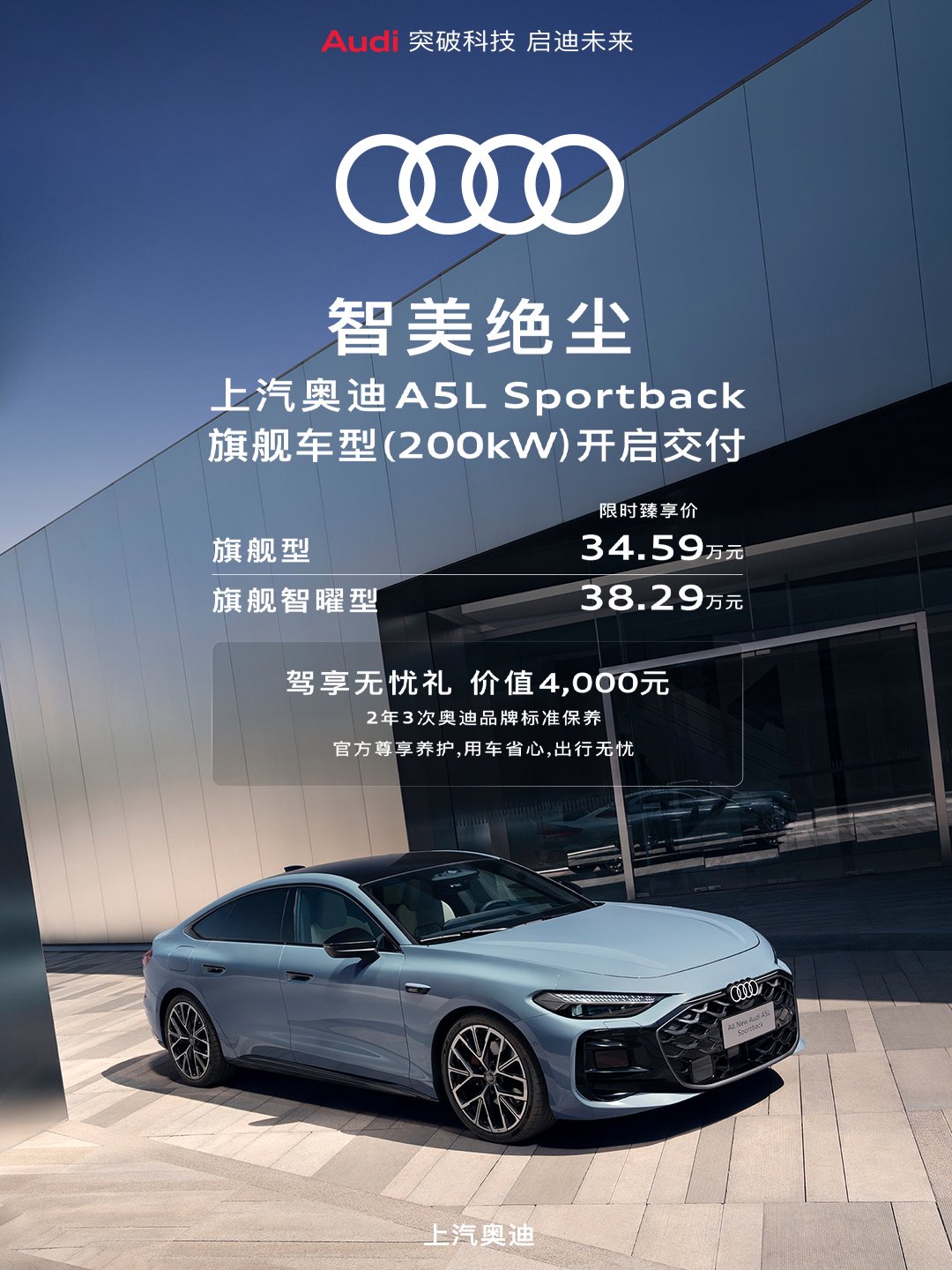
34.59 万元起上汽奥迪 A5L Sportback 旗舰版车型宣布交付,首款华为乾崑智驾燃油车
Xin Lang Cai Jing· 2025-12-24 09:52
Core Viewpoint - SAIC Audi officially announced the delivery of the Audi A5L Sportback flagship model (200kW), which is the world's first fuel vehicle equipped with Huawei's QianKun intelligent driving technology [1][10]. Pricing and Offers - The Audi A5L Sportback flagship model is available in two configurations, priced at 345,900 yuan and 382,900 yuan, making them the most expensive in the series. Additionally, a "Worry-Free Gift" worth 4,000 yuan is offered, which includes 2 years and 3 instances of Audi brand maintenance services [3][12]. Technology and Features - The vehicle utilizes Audi's new generation PPC intelligent platform and is equipped with 32 high-performance sensors, including 12 high-definition cameras, 6 millimeter-wave radars, and 12 ultrasonic sensors, along with 2 laser radars featuring a temperature-controlled self-cleaning system [5][14]. Powertrain and Performance - The car is powered by the fifth-generation EA888 engine, delivering a maximum output of 200kW and a peak torque of 400N·m. It features industry-leading 500bar direct injection, Porsche-sourced VTG variable turbocharging technology, and the new MHEV Plus super mild hybrid system, achieving a 0-100 km/h acceleration in just 5.6 seconds. It also includes an upgraded quattro intelligent all-wheel-drive system [6][15]. Suspension and Handling - The vehicle features a front and rear five-link independent suspension, complemented by a progressive steering system characteristic of luxury performance cars. All quattro models are equipped with Audi's track-level S-Sport suspension system, which integrates a lower vehicle height, high-stiffness spring settings, and the new ZF CDC adjustable damping system [9][17].
固态电池行情纵贯全年 主机厂“卡位”2026上车节点
Xin Lang Cai Jing· 2025-12-24 09:35
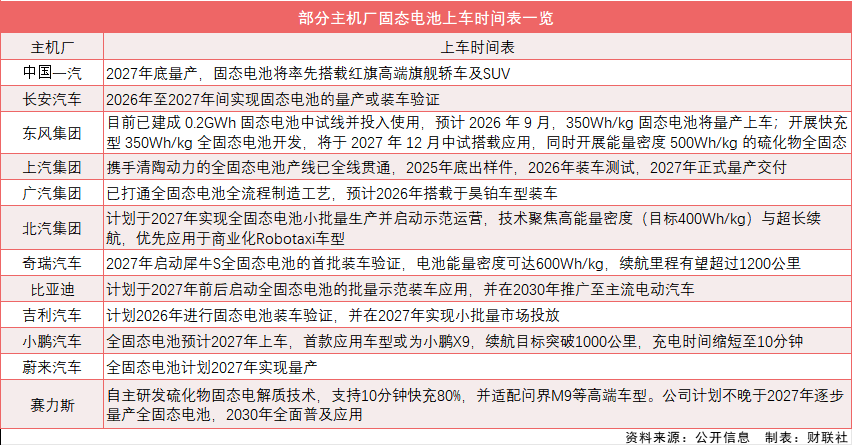
Core Viewpoint - The solid-state battery sector is gaining momentum in the electric vehicle industry, driven by the need to address range anxiety and enhance safety and efficiency. The market has seen a significant increase in solid-state battery stocks, with a 57.3% rise in the index over the past year, highlighting the growing interest and investment in this technology [1]. Group 1: Market Performance - The solid-state battery index rose from 696.24 in April 2025 to 1314.15 by the end of November 2025, reflecting a 57.3% increase [1]. - Companies such as Haike New Energy, Shanghai Xiba, and others have seen their stock prices increase by over 100% within the year [1]. Group 2: Manufacturer Plans - Twelve major automakers, including state-owned enterprises and companies like BYD and Geely, have disclosed their timelines for integrating solid-state batteries, targeting vehicle validation in 2026 and initial mass production in 2027 [1]. - Specific timelines include: - China FAW plans to mass-produce solid-state batteries by the end of 2027 for high-end vehicles [2]. - Changan Automobile aims for mass production or vehicle validation between 2026 and 2027 [2]. - Dongfeng Group has established a pilot line and expects to produce 350Wh/kg solid-state batteries by September 2026 [2]. - SAIC Group plans to deliver samples by the end of 2025 and conduct vehicle tests in 2026 [2]. - GAC Group has completed the manufacturing process for solid-state batteries and aims for vehicle integration in 2026 [2]. - BYD and Geely also have plans for solid-state battery applications around 2027 [2]. Group 3: Policy Support - The development of solid-state batteries is closely linked to government policies, with initiatives aimed at strengthening innovation in the electronic information manufacturing sector [3]. - The Ministry of Industry and Information Technology has emphasized the importance of technological innovation and the acceleration of new technology commercialization in the solid-state battery sector [3]. Group 4: Technical Innovations - The industry is focusing on replacing liquid electrolytes in lithium batteries with solid electrolytes to meet demands for higher energy density and faster charging [4]. - Experts suggest that achieving large-scale application of solid-state batteries will require three to five years of further development [4].




乘用车板块12月24日跌0.18%,海马汽车领跌,主力资金净流出7.87亿元
Zheng Xing Xing Ye Ri Bao· 2025-12-24 09:03
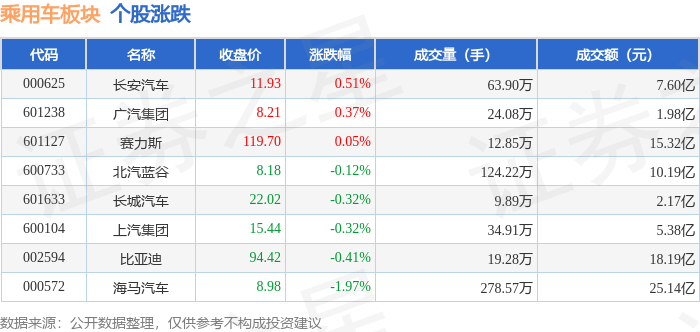
Core Viewpoint - The passenger car sector experienced a slight decline of 0.18% on December 24, with Haima Automobile leading the drop, while the overall stock market indices showed positive movements, with the Shanghai Composite Index rising by 0.53% and the Shenzhen Component Index increasing by 0.88% [1] Group 1: Market Performance - The Shanghai Composite Index closed at 3940.95, up 0.53% [1] - The Shenzhen Component Index closed at 13486.42, up 0.88% [1] - The passenger car sector saw a net outflow of 7.87 billion yuan from main funds, while retail investors contributed a net inflow of 6.13 billion yuan [1] Group 2: Individual Stock Performance - Changan Automobile (000625) closed at 11.93, with a slight increase of 0.51% and a trading volume of 639,000 shares, amounting to 760 million yuan [1] - GAC Group (601238) closed at 8.21, up 0.37%, with a trading volume of 240,800 shares, totaling 198 million yuan [1] - BYD (002594) closed at 94.42, down 0.41%, with a trading volume of 192,800 shares, amounting to 1.819 billion yuan [1] - Haima Automobile (000572) led the decline with a drop of 1.97%, closing at 8.98, with a trading volume of 2.7857 million shares, totaling 2.514 billion yuan [1] Group 3: Fund Flow Analysis - GAC Group saw a main fund net outflow of 2.9128 million yuan, with retail investors contributing a net inflow of 996.65 million yuan [2] - Great Wall Motors (601633) experienced a main fund net outflow of 14.755 million yuan, while retail investors had a net inflow of 1.91547 million yuan [2] - BYD faced a significant main fund net outflow of 199 million yuan, but retail investors contributed a net inflow of 82.7275 million yuan [2]






光庭信息:上汽集团受让3.16%股份
Xin Lang Cai Jing· 2025-12-24 08:50
Core Viewpoint - The company announced that its original shareholder, SAIC Venture Capital, signed a share transfer agreement with SAIC Group on September 22, 2025, to transfer 2.9301 million shares, representing 3.16% of the company's total shares, through a private agreement [1] Group 1 - The share transfer has been completed with the registration of the transfer, making SAIC Group a shareholder with a holding percentage of 3.16% [1] - The transfer does not involve any changes in the company's controlling shareholder or actual controller [1]
上海汽车集团股份有限公司 关于参与设立的上海元界智能科技股权投资基金合伙企业 (有限合伙)的变更公告
Zhong Guo Zheng Quan Bao - Zhong Zheng Wang· 2025-12-24 06:23
元界基金于2020年12月与底层投资标的智己汽车科技有限公司(以下简称为"智己汽车")签署了投资协 议。截至本公告日,元界基金已按照协议约定出资智己汽车72亿元,并持有智己汽车注册资本72亿元。 二、本次对外投资要素变更情况 为简化公司持股智己汽车的股权结构,对于原先通过元界基金持有的智己汽车份额部分,拟变更为由公 司直接持有智己汽车的股权。因此,元界基金拟将其持有智己汽车的注册资本人民币539,900万元对公 司进行定向的实物分配,实物分配基准日定于2025年1月31日。分配后,上述股权的所有权人变更为上 汽集团,附属于上述股权的所有权利和义务随本次股权权属转移而一并转移,上汽集团从元界基金中退 出,将通过元界基金间接持有智己汽车的份额调整为由上汽集团直接持有。 由于基金分配中,元界基金应向上汽集团分配的实物即为本次股权权属转移中智己汽车股权,因此上汽 集团无需就本次股权权属转移向元界基金支付价款。 本次变更后,元界基金出资额由720,000万元减少至180,100万元,基金合伙人恒旭资本将其所持有基金 全部的认缴份额、实缴份额及附带的所有权益和义务转让予有限合伙人张江高科指定的上海张江浩科科 技发展有限公 ...

上海张江高科技园区开发股份有限公司 关于参与设立的上海元界智能科技股权投资基金合伙企业 (有限合伙)的变更公告
Zhong Guo Zheng Quan Bao - Zhong Zheng Wang· 2025-12-24 06:16
Group 1 - The company, Shanghai Zhangjiang Hi-Tech Park Development Co., Ltd., has partnered with SAIC Motor Corporation and Hengxu Capital to establish the "Yuanjie Fund" with a total investment of RMB 7.2 billion, aimed at high-end smart electric vehicle projects [1][2] - The company holds a 25% stake in the Yuanjie Fund, contributing RMB 1.8 billion, while SAIC Motor holds 74.986% with an investment of RMB 5.399 billion [1] - The Yuanjie Fund has signed an investment agreement with Zhiji Motor Technology Co., Ltd., committing to invest RMB 7.2 billion, which corresponds to the registered capital of Zhiji Motor [2] Group 2 - SAIC Motor plans to simplify its shareholding structure in Zhiji Motor by directly holding shares instead of through the Yuanjie Fund, resulting in a distribution of RMB 5.399 billion in registered capital to SAIC Motor [3] - Following this change, the Yuanjie Fund's total investment will decrease from RMB 7.2 billion to RMB 1.801 billion, and Hengxu Capital will transfer its entire stake to a designated company [3][4] - The Yuanjie Fund will continue to operate as a limited partnership with a focus on equity investment, with a duration of nine years, including three years for investment and four years for management exit [4][6] Group 3 - The company will see an increase of RMB 1 million in its investment in Zhiji Motor following the adjustments to the Yuanjie Fund, with no significant impact on its financial or operational status [7] - The management of the Yuanjie Fund will be entrusted to Shanghai Zhangjiang Haokai Venture Capital Co., Ltd., which will oversee investment decisions and due diligence processes [6]
上汽集团调整智己汽车持股结构,元界基金完成多项要素变更
Ju Chao Zi Xun· 2025-12-24 03:12
Group 1 - The core point of the news is that SAIC Motor Corporation is simplifying its shareholding structure in Zhiji Motor by directly holding shares instead of through the Yuanjie Fund [2][3] - The Yuanjie Fund, established with a total subscription of 7.2 billion yuan, focuses on high-end smart electric vehicle projects, with SAIC contributing 5.399 billion yuan for a 74.986% stake [2] - The fund's capital will be reduced to 1.801 billion yuan after the changes, and the management structure will also be adjusted, with a new management company appointed [3] Group 2 - The share transfer will not require SAIC to pay any price to the Yuanjie Fund, and the ownership rights and obligations will be transferred to SAIC [3] - As of now, SAIC's only investment in funds managed by Hengxu Capital is the Yuanjie Fund, with an investment of 5.399 billion yuan [4]
157家公司获机构调研(附名单)
Zheng Quan Shi Bao Wang· 2025-12-24 02:18
近5日机构合计调研157家公司,领益智造、博盈特焊、光庭信息等被多家机构扎堆调研。 证券时报·数据宝统计,近5个交易日(12月17日至12月23日)约157家公司被机构调研,调研机构类型 显示,证券公司共对132家公司进行调研,即84.08%的上市公司调研活动有证券公司参与;基金公司调 研89家,位列其后;阳光私募机构调研64家,排名第三。 机构调研榜单中,共有20家公司获20家以上机构扎堆调研。领益智造最受关注,参与调研的机构达到 107家;博盈特焊被82家机构调研,榜单中排名第二;光庭信息、上汽集团等分别被67家、61家机构调 研。 机构调研次数来看,冰轮环境机构调研最为密集,共获机构5次调研。博盈特焊、本钢板材等机构调研 也较为密集,分别被机构调研4次、3次。 数据宝统计,20家以上机构扎堆调研股中,近5日资金净流入的有9只,中瓷电子近5日净流入资金2.02 亿元,主力资金净流入最多;净流入资金较多的还有钧达股份、领益智造等,净流入资金分别为1.32亿 元、1.18亿元。 | 证券代码 | 证券简称 | 机构调研次数 | 机构家数 | 最新收盘价(元) | 其间涨跌幅(%) | 行业 | | --- | ...

上海汽车集团股份有限公司关于参与设立的上海元界智能科技股权投资基金合伙企业(有限合伙)的变更公告
Shang Hai Zheng Quan Bao· 2025-12-23 19:40
Group 1 - The company has established the "Shanghai Yuanjie Intelligent Technology Equity Investment Fund Partnership (Limited Partnership)" to accelerate the development of its high-end intelligent electric vehicle brand, with a total investment of RMB 7.2 billion, where the company contributes RMB 5.399 billion, holding 74.986% of the fund [1][2] - The fund has signed an investment agreement with Zhiji Automotive Technology Co., Ltd., and has invested a total of RMB 7.2 billion, holding the same amount in registered capital of Zhiji Automotive [2] - The company plans to simplify its shareholding structure in Zhiji Automotive by directly holding the shares instead of through the fund, with a distribution of RMB 5.399 billion in registered capital from the fund to the company [2][3] Group 2 - After the changes, the fund's total investment will decrease from RMB 7.2 billion to RMB 1.801 billion, and the management relationship with Hengxu Capital will be terminated, transferring all rights and obligations to a new manager [3] - The change in the fund structure will not affect the company's operational activities or financial status, and there will be no new related transactions or competition issues arising from this change [3][4]