
CNRE(600111)

Search documents
今天杀的就是融资盘
表舅是养基大户· 2025-08-26 13:28
Core Viewpoint - The article discusses the recent trends in global risk assets, particularly focusing on the A-share market's performance and the dynamics of financing and ETF growth in China. Group 1: Market Performance - Global risk assets are experiencing a decline, with the U.S. stock market's downturn affecting other markets, particularly in France due to domestic political crises [1] - A-shares are characterized by high trading volumes, with over 2.7 trillion yuan traded, marking the 10th consecutive day above 2 trillion yuan [3] - The A-share index showed rapid movements, with the Wind All A index reaching a high of 6200 points within a single trading day [3] Group 2: Financing Dynamics - The financing buy-in amount reached a historical second-high of 374 billion yuan, with a net buy of 32.8 billion yuan, indicating a significant presence of leveraged funds in the market [7] - A notable trend is the increase in selling pressure among financing accounts, leading to a divergence in market sentiment [7] - Specific stocks with high financing buy-in amounts experienced significant declines, highlighting a "kill the financing" scenario where popular stocks faced sell-offs [8] Group 3: ETF Growth - The total scale of ETFs in China has surpassed 5 trillion yuan, with the last 1 trillion yuan added in just four months [9] - There is a structural change in ETF flows, with broad-based ETFs experiencing outflows of approximately 200 billion yuan, while industry and thematic ETFs saw inflows of around 900 billion yuan [17][20] - The article emphasizes the growing interest in chemical sector ETFs, with significant net subscriptions indicating strong institutional interest [24][25] Group 4: Investment Focus - Institutions are increasingly focusing on sectors with real profit generation, such as resources, innovative pharmaceuticals, gaming, and military industries [28] - The article suggests that ETFs related to rare metals and chemicals are suitable for expressing investment in these sectors [28]







半年报汇总丨这家公司上半年净利润同比增超5900%




Di Yi Cai Jing· 2025-08-26 13:16
Growth - Shudao Equipment reported a net profit of 10.15 million yuan in the first half of the year, a year-on-year increase of 5972.30% [1] - Aerospace Science and Technology achieved a net profit of 88.97 million yuan, up 2161.91% year-on-year [1] - Tianbao Infrastructure's net profit reached 118 million yuan, growing by 2106.58% year-on-year [1] - Northern Rare Earth reported a net profit of 931 million yuan, an increase of 1951.52% year-on-year [1] - Liugang Co., Ltd. posted a net profit of 36.8 million yuan, up 579.54% year-on-year [1] - Cheng Tian Wei Ye's net profit was 10.88 million yuan, increasing by 562.05% year-on-year [1] - Perfect World reported a net profit of 503 million yuan, a year-on-year increase of 384.52% [1] - Shenghong Technology achieved a net profit of 2.143 billion yuan, up 366.89% year-on-year [1] - Zhongke Magnetic Industry's net profit was 20.90 million yuan, increasing by 271.78% year-on-year [1] - Xinjiang Communications Construction reported a net profit of 255 million yuan, up 255.25% year-on-year [1] - Shennong Group achieved a net profit of 388 million yuan, a year-on-year increase of 212.65% [1] - Daikin Heavy Industries reported a net profit of 547 million yuan, up 214.32% year-on-year [1] - Fostar's net profit was 251 million yuan, increasing by 140.45% year-on-year [1] - Guohua Airlines achieved a net profit of 1.24 billion yuan, up 86.15% year-on-year [1] - China Electric Port reported a net profit of 181 million yuan, increasing by 64.98% year-on-year [1] - Ailisi's net profit was 1.051 billion yuan, up 60.22% year-on-year [1] - Zijin Mining reported a net profit of 23.292 billion yuan, a year-on-year increase of 54.41% [1] - Zhongke Chuangda achieved a net profit of 158 million yuan, up 51.84% year-on-year [1] - Sichuan Gold reported a net profit of 209 million yuan, increasing by 48.41% year-on-year [1] - Dongxing Securities achieved a net profit of 819 million yuan, up 42.12% year-on-year [1] - Fosun Pharma reported a net profit of 1.702 billion yuan, a year-on-year increase of 38.96% [1] - Kotec Power's net profit was 23.99 million yuan, increasing by 35.52% year-on-year [1] - Dongshan Precision reported a net profit of 758 million yuan, up 35.21% year-on-year [1] - Inspur Information achieved a net profit of 799 million yuan, a year-on-year increase of 34.87% [1] - Shenzhen Huaqiang reported a net profit of 236 million yuan, increasing by 33.45% year-on-year [1] - Conch Cement achieved a net profit of 4.368 billion yuan, up 31.34% year-on-year [1] - Jiuzhoutong reported a net profit of 1.446 billion yuan, increasing by 19.7% year-on-year [1] - Aofei Data achieved a net profit of 87.89 million yuan, a year-on-year increase of 16.09% [2] Decline and Loss - Huachang Chemical reported a net profit of 1.09 million yuan, a year-on-year decrease of 97.58% [2] - Meibang Apparel achieved a net profit of 993,030 yuan, down 87.07% year-on-year [2] - Toukeng Life reported a net profit of 275,930 yuan, a decrease of 58.41% year-on-year [2] - BlueFocus reported a net profit of 96.44 million yuan, down 47.33% year-on-year [2] - China Gold achieved a net profit of 31.9 million yuan, a decrease of 46.35% year-on-year [2] - Huaxi Biological reported a net profit of 22.1 million yuan, down 35.38% year-on-year [2] - Zhejiang New Energy achieved a net profit of 29.2 million yuan, down 34.65% year-on-year [2] - Hainan Mining reported a net profit of 28.1 million yuan, a decrease of 30.36% year-on-year [2] - Changying Precision achieved a net profit of 30.6 million yuan, down 29.37% year-on-year [2] - China Duty Free reported a net profit of 2.6 billion yuan, down 20.81% year-on-year [2] - Jiangling Motors achieved a net profit of 73.3 million yuan, down 18.17% year-on-year [2] - Donghua Software reported a net profit of 24.4 million yuan, down 15.78% year-on-year [2] - Hengda New Materials achieved a net profit of 3.4235 million yuan, down 12.68% year-on-year [2] - Yaoji Technology reported a net profit of 25.6 million yuan, down 9.98% year-on-year [2] - Ping An Insurance achieved a net profit of 68.047 billion yuan, down 8.8% year-on-year [2] - China Petroleum reported a net profit of 840.07 billion yuan, down 5.4% year-on-year [2] - 360 reported a net loss of 28.2 million yuan [2] - Electric Wind Power reported a net loss of 27.9 million yuan [2] Losses - Suzhou Keda reported a net loss of 21.7 million yuan [3] - Yuntian Lifa achieved a net loss of 20.6 million yuan [3] - Kosen Technology reported a net loss of 10.5 million yuan [3] - Xinyada reported a net loss of 5.2635 million yuan [3] - Chengfei Integration achieved a net loss of 1.49208 million yuan [3] - China Film reported a net loss of 11 million yuan, turning from profit to loss year-on-year [3]
必易微拟斥资近3亿元收购兴感半导体;北方稀土上半年净利润同比增长约1952%|公告精选
Mei Ri Jing Ji Xin Wen· 2025-08-26 13:01
Mergers and Acquisitions - Zhongqi Co., Ltd. plans to acquire 100% equity of Zhongqi Research Automotive Inspection Center (Hulunbuir) Co., Ltd. for a cash consideration of 111 million yuan [1] - Biyi Micro intends to invest 295 million yuan to acquire 100% equity of Shanghai Xingan Semiconductor Co., Ltd. [2] - Xintian Green Energy aims to acquire 49% equity of Chongli Wind Power and Zhangbei Wind Power through public bidding, with starting prices of 67.65 million yuan and 56.59 million yuan respectively [3] Earnings Disclosure - China Gold reported a net profit of 319 million yuan for the first half of 2025, a decrease of 46.35% year-on-year, with revenue of 31.098 billion yuan, down 11.54% [4] - Northern Rare Earth announced a net profit of 931 million yuan for the first half of 2025, an increase of 1951.52% year-on-year, with revenue of 18.866 billion yuan, up 45.24% [5] - Yonyou Network reported a net loss of 945 million yuan for the first half of 2025, with revenue of 3.581 billion yuan, down 5.9% year-on-year [6] Shareholding Changes - Shenma Power's major shareholder Chen Xiaoqin plans to reduce holdings by up to 3%, equivalent to 12.95 million shares, from September 17, 2025, to December 16, 2025 [7] - Weiming Environmental Protection's major shareholder and concerted actors plan to reduce holdings by up to 1.55% within three months from the announcement date [8] - Liande Co., Ltd.'s controlling shareholder's concerted actors plan to reduce holdings by up to 2.37%, totaling 5.688 million shares, within the next three months [9] Other News - Zhejiang Wen Film Industry announced that independent director Liu Jing has been detained by relevant supervisory authorities, but the matter is unrelated to the company [11]




中国最大市值稀土公司上半年净利润同比大增
Zhong Guo Xin Wen Wang· 2025-08-26 12:40
Core Viewpoint - China Northern Rare Earth Group High-Tech Co., Ltd. (Northern Rare Earth) reported significant growth in its financial performance for the first half of the year, indicating strong demand and operational efficiency in the rare earth sector [1] Financial Performance - The company achieved a net profit attributable to shareholders of approximately 931 million yuan, representing a year-on-year increase of 1951.52% [1] - The net profit excluding non-recurring gains and losses was about 897 million yuan, showing a remarkable year-on-year growth of 5644.93% [1] - Northern Rare Earth's operating revenue for the first half was approximately 18.866 billion yuan, reflecting a year-on-year growth of 45.24% [1] Asset and Equity Position - As of the end of June, the company's total assets were approximately 47.318 billion yuan, which is a year-on-year increase of 4.27% [1] - The net assets attributable to shareholders were about 23.265 billion yuan, marking a year-on-year growth of 3.71% [1] Product Offering and Market Position - Northern Rare Earth produces over 100 types of rare earth products across 11 major categories, including raw materials, functional materials, and end-use products [1] - The company is the largest listed company by market capitalization in the A-share rare earth permanent magnet sector, with a total market value exceeding 177.5 billion yuan as of the market close on the reporting date [1]
8月26日晚间公告 | 北方稀土上半年净利润增长近20倍;世运电路拟15亿投建新一代PCB项目
Xuan Gu Bao· 2025-08-26 12:06
一、停复牌 东珠生态:筹划收购凯睿星通控股权,股票停牌。 二、并购重组 2、工大科雅:拟以3000万元-5000万元回购股份。 四、投资合作、经营状况 五、业绩变动 1、必易微:拟以2.95亿元现金收购上海兴感半导体100%股权。通过整合双方资源,预计将形成涵盖电 流检测、运动感知、电源管理、电池管理、电机驱动的完整产品体系,提升技术领先地位和产品竞争 力。 2、南新制药:拟现金收购未来医药持有的标的资产组,预计构成重大资产重组。 3、中国石油:拟400亿元人民币收购储气库企业。 三、回购 1、长盈精密:拟以5000万元-1亿元回购股份。 1、鹏鼎控股:服务器及光模块等产品已通过部分客户的认证。 2、世运电路:拟投资建设"芯创智载"新一代PCB智造基地项目,投资金额15亿元。 3、泛亚微透:拟定增募资不超过6.99亿元,用于6G通讯的低介电损耗FCCL挠性覆铜板产业化项目等。 4、奥普特:目前东莞泰莱机器人关节模组产品已在送样过程中。 5、联影医疗:自研的中国首款光子计数能谱CT取得医疗器械注册证。 6、金龙机电:全资子公司兴科电子烟草专卖生产企业许可证续期。 7、海南发展:控股子公司中标约3.65亿元迪拜岛 ...
水牛不变 水温有点凉
Datayes· 2025-08-26 11:55
Core Viewpoint - The current A-share market sentiment is at a historically high level, indicating potential adjustments ahead, with various sectors showing signs of crowding and liquidity issues [4][7][31]. Market Overview - The A-share market experienced mixed performance, with the Shanghai Composite Index down by 0.39%, while the Shenzhen Component rose by 0.26% and the ChiNext Index fell by 0.75% [12]. - Total market turnover was 27,112.62 billion, a decrease of 4,664.29 billion from the previous day, with over 2,800 stocks rising [12][20]. Sector Performance - The consumer electronics sector saw gains, driven by the upcoming Q3 traditional peak season for new product launches, including AI smartphones and AR glasses [12]. - The pig farming sector became active again, with government initiatives to stabilize prices as demand increases with the school season [12]. - The gaming sector reacted positively to the approval of new domestic and imported games, leading to significant stock movements [12]. Investment Strategies - Morgan Stanley highlighted that the current market rally is liquidity-driven, with a focus on sectors like AI, innovative pharmaceuticals, and smart driving, which are less correlated with traditional deflationary sectors [7][8]. - The report emphasized the need for capital market reforms to convert liquidity into a sustainable bull market, suggesting adjustments to dividend policies and share buyback regulations [8]. Institutional Activity - Northbound capital saw a total transaction volume of 3,634.61 billion, with significant activity in stocks like Northern Rare Earth and Heng Rui Medicine [23][25]. - The net inflow of institutional funds was notable in sectors such as computing, basic chemicals, and electronics, while the pharmaceutical sector experienced the largest outflow [20][31]. Economic Policies - The State Council's initiative on "Artificial Intelligence+" aims for deep integration of AI across six key sectors by 2027, promoting smart products and technological innovation [16]. - Plans for urban renewal include the renovation of 25,000 old urban communities, with significant progress reported in several provinces [17]. Company Announcements - Northern Rare Earth reported a 45.24% increase in revenue for the first half of 2025, with net profit soaring by 1,951.52% [18]. - Aerospace Science and Technology announced a revenue decline of 11.04% for the same period, but a significant increase in net profit by 2,161.91% [18]. - Fuxing Pharmaceutical entered a licensing agreement with Sitala for the development of diagnostic and therapeutic products outside of China [17].


原料价格起飞,稀土龙头净利狂增近20倍
2 1 Shi Ji Jing Ji Bao Dao· 2025-08-26 11:41
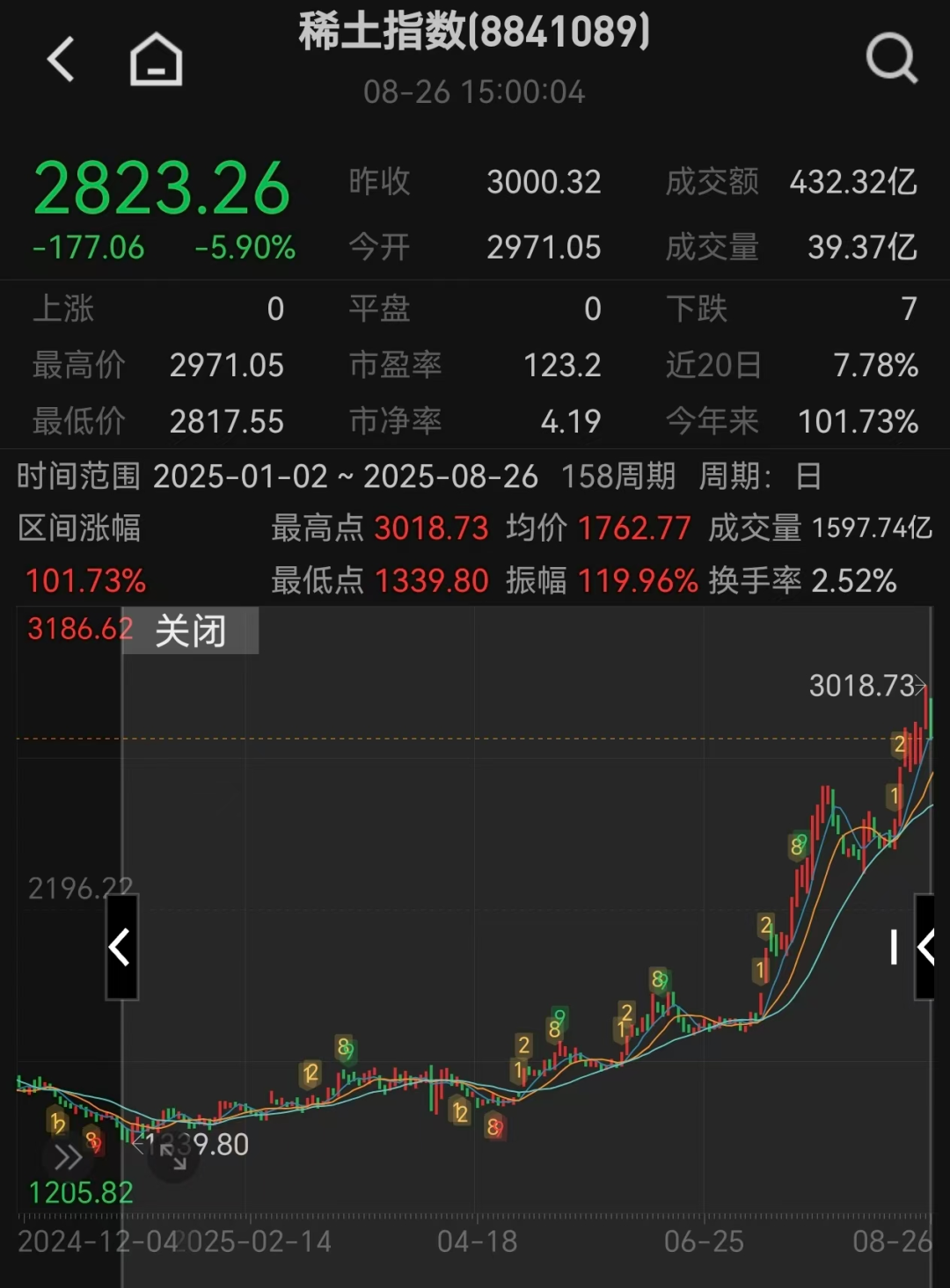
Group 1: Company Performance - Northern Rare Earth (600111) reported a revenue of 18.866 billion yuan for the first half of 2025, representing a year-on-year increase of 45.24% [1] - The net profit for Northern Rare Earth reached 931 million yuan, showing a remarkable year-on-year growth of 1951.52% [1] - The growth in performance is attributed to increased sales and average prices of key rare earth products, particularly praseodymium and neodymium [1] Group 2: Market Trends - The rare earth sector is experiencing a performance reversal, with multiple companies such as Yuyuan New Materials (600206) and Jieli Yongci (300748) reporting net profit increases exceeding 100% [2] - The rare earth index has seen a year-to-date increase of over 100%, with several stocks like Shenghe Resources and Ningbo Yunsheng doubling in price [2] - As of August 21, 2023, prices for key rare earth products have risen significantly, with praseodymium oxide increasing by over 58% year-to-date [6] Group 3: Price Dynamics - Rare earth prices have surged, with an average increase of over 100,000 yuan per ton since August [4] - The price of neodymium-iron-boron magnets has also risen, with N35 grade increasing by 51.3% year-to-date [6] - The demand for praseodymium and neodymium metals is being driven by multiple major magnet manufacturers conducting tender activities, leading to a strong demand support [6] Group 4: Regulatory Environment - The Ministry of Industry and Information Technology, along with two other departments, released interim measures for the total quantity control management of rare earth mining and separation [6] - This regulatory change marks the beginning of significant supply-side reforms in the rare earth industry, which is expected to further influence prices and market dynamics [6]
原料价格起飞,稀土龙头净利狂增近20倍
21世纪经济报道· 2025-08-26 11:36
Core Viewpoint - The rare earth sector is experiencing a significant performance turnaround, with leading companies like Northern Rare Earth reporting substantial revenue and profit growth driven by increased sales and rising prices of key rare earth products [1][3]. Group 1: Company Performance - Northern Rare Earth announced a revenue of 18.866 billion yuan for the first half of 2025, representing a year-on-year increase of 45.24%, and a net profit of 931 million yuan, up 1951.52% year-on-year [1]. - The company's performance is attributed to increased sales volumes and average prices of major rare earth products, while operating costs grew only by 38.43%, indicating strong cost control [1]. - Other rare earth companies, including Yuyuan New Materials, Jinli Permanent Magnet, and Ningbo Yunsheng, reported net profit increases exceeding 100% year-on-year, with several companies turning losses into profits [3]. Group 2: Market Trends - The rare earth index has seen a year-to-date increase of over 100%, with stocks like Shenghe Resources and Guangsheng Nonferrous doubling in price [4]. - Prices of major rare earth products have surged, with an average increase of over 100,000 yuan per ton since August [7]. - The price of neodymium iron boron N35 has risen by 51.3% year-to-date, while H35 has increased by 28% [7]. Group 3: Demand and Supply Dynamics - The demand for rare earth metals is being driven by multiple major magnet manufacturers simultaneously conducting procurement activities, leading to a strong demand for praseodymium and neodymium metals [7]. - Domestic orders are rapidly increasing due to significant price differences between domestic and international markets, resulting in a surge in replenishment orders [7]. - The Ministry of Industry and Information Technology has introduced new regulations for rare earth mining and separation, marking the beginning of significant supply-side reforms in the industry [7].
北方稀土上半年营收同比大增45%,归母净利暴增逾19倍,三大产品产销齐创新高 | 财报见闻
Hua Er Jie Jian Wen· 2025-08-26 11:33
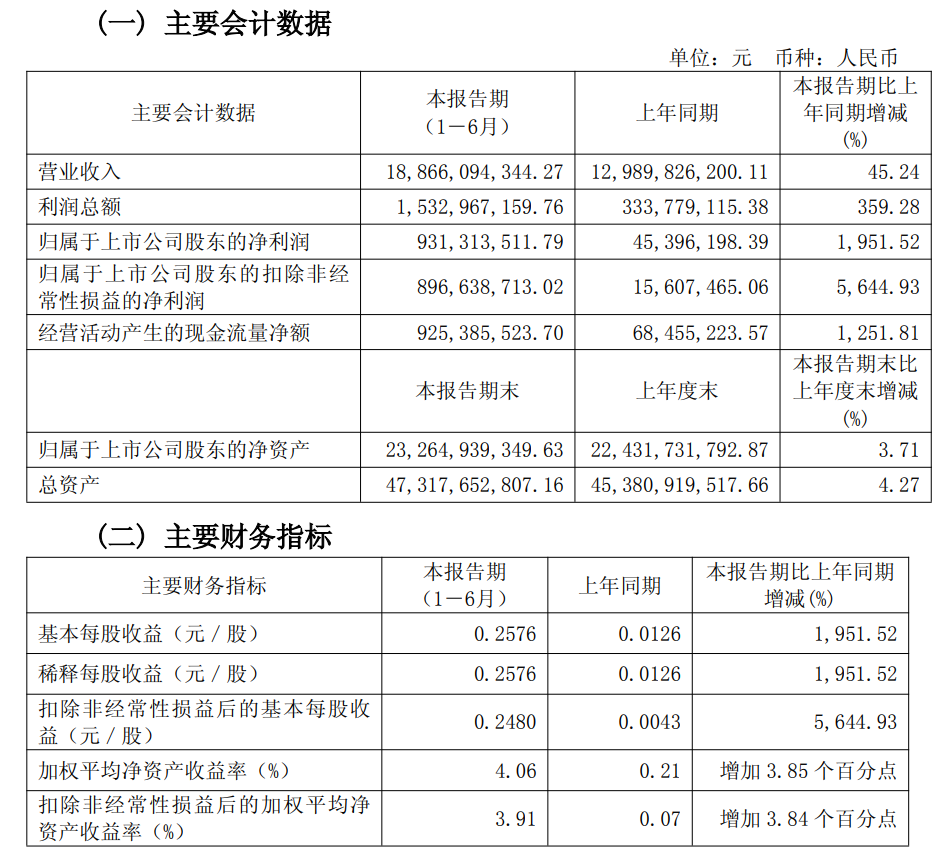
Core Viewpoint - The rare earth industry is experiencing a dual boost from favorable policies and increasing demand, leading to a significant surge in Northern Rare Earth's performance in the first half of the year, with revenue increasing by 45% and net profit soaring over 19 times [1][3]. Financial Performance - Revenue for the first half of the year reached 18.866 billion yuan, a year-on-year increase of 45.24% [1][5]. - Total profit amounted to 1.533 billion yuan, reflecting a 359.28% increase compared to the same period last year [1][5]. - Net profit attributable to shareholders was 931 million yuan, a staggering increase of 1,951.52% year-on-year [1][5]. - The net profit after deducting non-recurring gains and losses was 897 million yuan, up 5,644.93% year-on-year [1][5]. - Operating cash flow reached 925 million yuan, a year-on-year increase of 1,251.81% [1][5]. Key Product Lines - The company reported record-high production and sales across its three core product lines: rare earth smelting and separation products, rare earth metals, and rare earth functional materials, with production increases of 28.10% and 16.65% respectively [4][5]. Market Dynamics - The growth in revenue and profit is attributed to increased sales volume and a rebound in prices of rare earth products [3][5]. - Emerging applications in sectors such as electric vehicles, wind power, humanoid robots, and low-altitude economy are continuously injecting new momentum into rare earth demand [6]. Financial Structure - The financial condition has improved, with net cash flow from operating activities reaching 925 million yuan, a significant increase of 1,251.81% [7]. - The asset-liability ratio stands at 38.07%, remaining stable compared to the beginning of the year, indicating a solid financial structure [7]. - Inventory turnover is a point of concern, with ending inventory at 15.958 billion yuan, slightly down from the beginning of the year, but still substantial [7]. Investment Projects - The company is actively investing in key projects, with a net cash outflow from investing activities of 620 million yuan primarily for project construction [10]. - Significant projects include the new generation of rare earth green mining and smelting upgrades, with phase one nearing completion and phase two underway [10]. - The establishment of Northern Jinlong (Baotou) Rare Earth Co., Ltd. aims to enhance the company's supply chain stability and high-quality raw material provision for downstream industries [10].
北方稀土(600111.SH)上半年净利润9.31亿元,同比增长1951.52%
Ge Long Hui A P P· 2025-08-26 11:21
Group 1 - The company reported a revenue of 18.866 billion yuan for the first half of the year, representing a year-on-year increase of 45.24% [1] - The net profit attributable to shareholders reached 931 million yuan, showing a significant year-on-year growth of 1951.52% [1] - The basic earnings per share (EPS) was 0.2576 yuan [1]