TONGWEI CO.,LTD(600438)

Search documents
通威股份(600438):2025H1业绩符合预期 触底信号凸显
Xin Lang Cai Jing· 2025-09-05 06:24
Group 1 - The company reported a net profit attributable to shareholders of -5 billion yuan in the first half of 2025, with a revenue of 40.509 billion yuan, a year-on-year decline of 7.51% [1] - In Q2 2025, the company achieved a revenue of 24.575 billion yuan, a year-on-year increase of 1.44% and a quarter-on-quarter increase of 54.24% [1] - The company maintained its position as the industry leader in silicon material sales, with approximately 161,300 tons sold in the first half of 2025, capturing about 30% of the global market share [1] Group 2 - The average price of silicon material in Q2 2025 declined compared to Q1 2025, leading to an increase in per-ton losses despite stable costs [1] - The company sold 49.89 GW of battery cells in the first half of 2025, continuing to hold the global number one position, with cumulative shipments surpassing 300 GW [2] - The company achieved component sales of 24.52 GW, maintaining the top position in domestic distributed shipments, while overseas sales reached 5.08 GW, showing explosive growth in markets like Poland, Romania, and Hungary [2] Group 3 - Revenue projections for the company are estimated at 62.3 billion yuan, 69.1 billion yuan, and 75 billion yuan for 2025, 2026, and 2027 respectively, reflecting a year-on-year decline of 32.3% in 2025 [3] - The net profit forecast for 2025 has been revised down to -5.5 billion yuan, with subsequent years expected to show significant recovery [3] - The company maintains an "overweight" rating despite the downward adjustment in 2025 earnings expectations due to ongoing price declines in the industry chain and inventory impairment [3]

中银证券:给予通威股份增持评级
Zheng Quan Zhi Xing· 2025-09-05 05:24
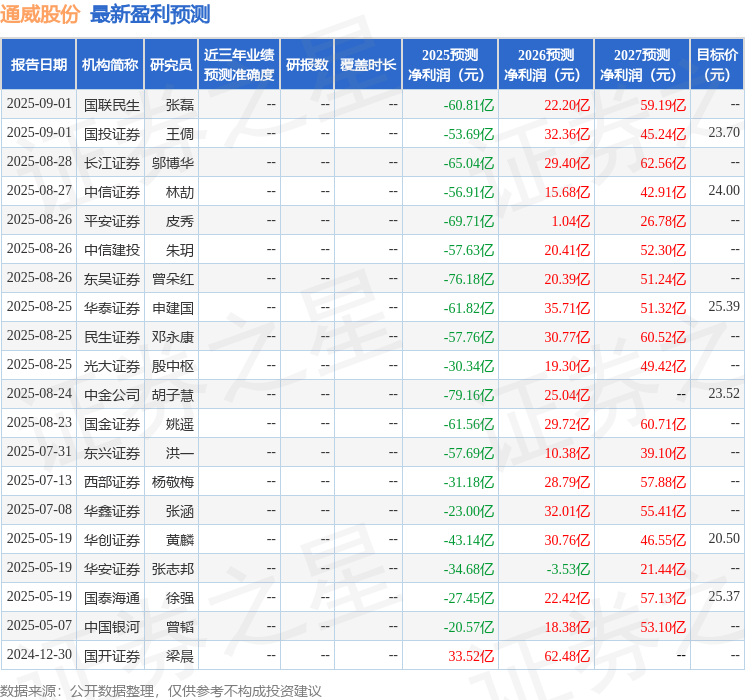
Core Viewpoint - The report highlights that Tongwei Co., Ltd. is expected to recover profits in the second half of 2025, driven by a significant increase in silicon material prices due to "anti-involution" measures in the industry, despite a year-on-year loss expansion in the first half of 2025 [1][4]. Financial Performance - In the first half of 2025, the company reported an operating income of 40.509 billion yuan, a decrease of 7.51% year-on-year, and a net profit attributable to shareholders of -4.955 billion yuan, indicating an expanded loss compared to the previous year [3]. - In Q2 2025, the net profit attributable to shareholders was -2.363 billion yuan, showing a reduction in losses compared to the previous quarter [3]. Business Operations - The photovoltaic segment of the company maintained steady shipments and actively prepared for new battery technologies, achieving a high-purity crystalline silicon production capacity of over 900,000 tons and a solar cell production capacity exceeding 150 GW by the end of June 2025 [3]. - The company sold 161,300 tons of polysilicon in the first half of 2025, holding a global market share of approximately 30%, and ranked first globally in solar cell sales with 49.89 GW shipped [3]. Market Trends - The "anti-involution" measures have led to a significant increase in silicon material prices, which rose to 46,000 yuan per ton by the end of August 2025, up from 35,000 yuan per ton at the end of June 2025 [4]. - The report anticipates that the company's profits may recover in the second half of 2025, supported by the upward trend in silicon material prices [4]. Valuation - The earnings per share forecasts for 2025-2027 have been adjusted to -1.30, 0.48, and 1.05 yuan respectively, with corresponding price-to-earnings ratios of 46.0 and 20.9 times for 2026 and 2027 [5]. - The company maintains a rating of "buy" based on its performance and market conditions [5].

光伏王者归来 资金大幅涌入
第一财经· 2025-09-05 04:53
2025.09. 05 微信编辑 | 夏木 作者 | 第一财经 图源 | 视觉中国 今日早盘,光伏板块强势爆发,多只龙头股冲击涨停!截至发稿,光伏指数大涨超4%,组件、逆变器、设备等细分领域全线拉升,多只龙头股创年内 股价新高,资金涌入迹象明显。 锦浪科技(300763.SZ)大涨逾13%,续创年内新高;科创50权重股大全能源(688303.SH)、创业板权重阳光电源(300274.SH)同步发力,阳光电 源创下历史新高,本月已涨近30%。一体化龙头通威股份(600438.SH)跟涨逾4%,亦创今年新高。 市场分析指出,本轮暴涨背后是利好叠加:一是,政策端持续发力,光伏减产效果持续落地;二是,产业链价格触底信号显现,龙头企业二季度减亏提 振市场信心。 第一财经持续追踪财经热点。若您掌握公司动态、行业趋势、金融事件等有价值的线索,欢迎提供。 专用邮箱: bianjibu@yicai.com 本文字数:385,阅读时长大约1分钟 (注:我们会对线索进行核实。您的隐私将严格保密。) 推荐阅读 "国家队"操作路线曝光 11 en review =15 0 生产队的驴 ...




通威股份(600438):25Q2环比减亏,“反内卷”有望提升硅料价格
Bank of China Securities· 2025-09-05 04:17
Investment Rating - The report maintains an "Accumulate" rating for the company [1][5] Core Views - The company experienced a year-on-year increase in losses in the first half of 2025, but a quarter-on-quarter reduction in losses in Q2 2025. The photovoltaic segment showed stable shipments, and the company is actively preparing new battery technologies. The "anti-involution" trend is expected to significantly boost silicon material prices, with attention on profit recovery in the second half of 2025 [3][8] - The report adjusts the earnings per share (EPS) forecasts for 2025-2027 to -1.30, 0.48, and 1.05 RMB, respectively, from previous estimates of 0.84 and 1.48 RMB for 2025-2026. The corresponding price-to-earnings ratios for 2026-2027 are projected at 46.0 and 20.9 times [5][8] Summary by Sections Financial Performance - In the first half of 2025, the company reported operating revenue of 40,509 million RMB, a decrease of 7.51% year-on-year. The net profit attributable to the parent company was -4,955 million RMB, reflecting an increase in losses compared to the previous year [9][8] - The company achieved a global market share of approximately 30% in polysilicon sales, maintaining the top position globally, with battery sales of 49.89 GW and module sales of 24.52 GW in the first half of 2025 [8][9] Market Trends - The "anti-involution" measures are expected to create a multi-layered governance system that promotes orderly development and healthy competition in the industry. As of late August 2025, silicon material prices rose to 46,000 RMB per ton, up from 35,000 RMB per ton at the end of June 2025, indicating a significant price increase [8][9] Valuation Metrics - The report provides a detailed financial forecast, including projected revenues of 106,193 million RMB for 2025, with a growth rate of 15.4%. The EBITDA is expected to be 4,819 million RMB, with a net profit forecast of -5,864 million RMB for the same year [7][8] - The report highlights a projected increase in net profit for 2026 to 2,151 million RMB, with a significant growth rate of 120.5% anticipated for 2027 [7][8]
光伏王者归来 资金大幅涌入
Di Yi Cai Jing· 2025-09-05 03:36
Group 1 - The photovoltaic index surged over 4%, with all sub-sectors including components, inverters, and equipment experiencing significant gains [1] - Leading stocks in the photovoltaic sector hit new highs for the year, with notable increases in share prices and evident capital inflow [1] - Jinlang Technology rose over 13%, reaching a new high for the year, while major stocks like Longi Green Energy and Sunshine Power also performed strongly, with Sunshine Power increasing nearly 30% this month [1] Group 2 - Market analysis indicates that the recent surge is driven by three main factors: ongoing supportive policies, the effective reduction in photovoltaic production, and signs of price stabilization in the industry chain [1] - Leading companies reported reduced losses in the second quarter, which has boosted market confidence [1]
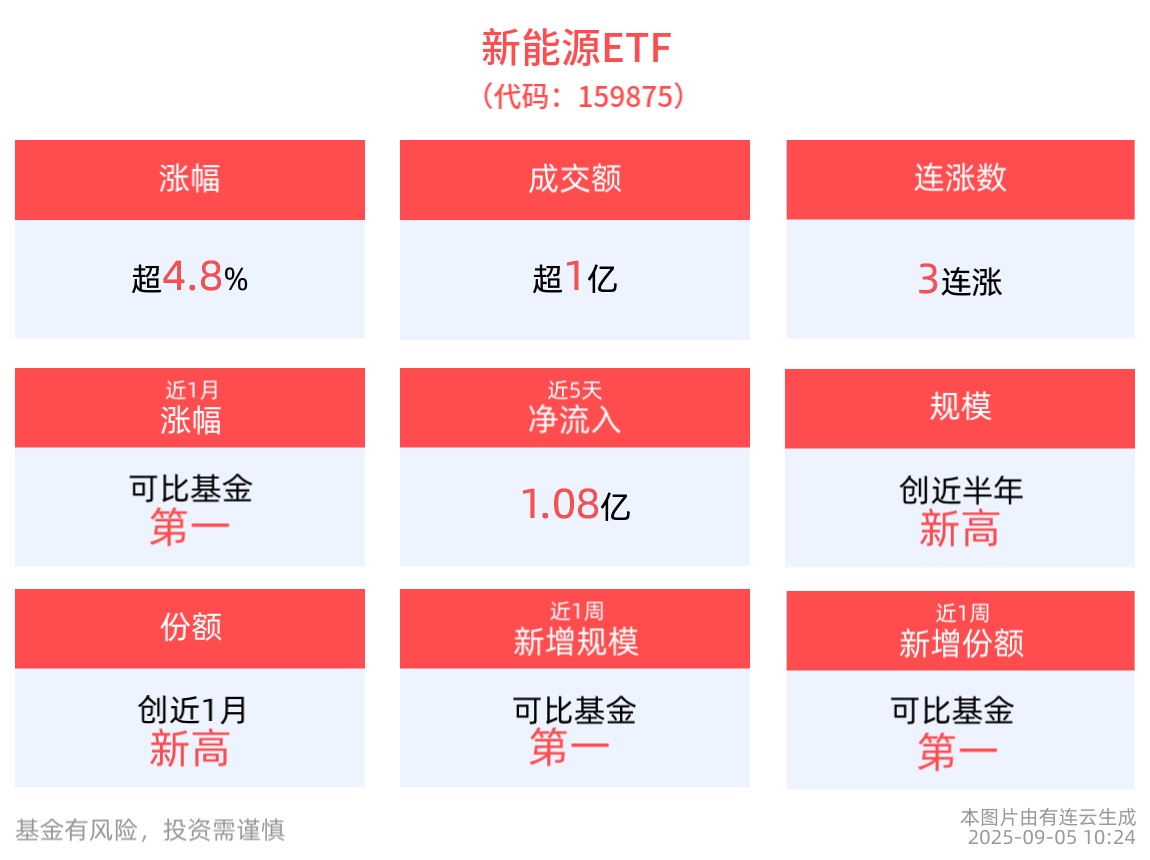
新能源ETF(159875)盘中涨近5%冲击3连涨!规模创近半年新高
Sou Hu Cai Jing· 2025-09-05 02:40
Group 1: Market Performance - The liquidity of the New Energy ETF showed an intraday turnover of 11.07%, with a transaction volume of 1.22 billion yuan, indicating active market trading [3] - As of September 4, the New Energy ETF reached a new high in scale at 10.55 billion yuan and a new high in shares at 1.907 billion [3] - The New Energy ETF experienced a net inflow of 52.8143 million yuan, with a total of 1.08 billion yuan net inflow over the last five trading days [3] Group 2: Historical Performance - The net value of the New Energy ETF increased by 17.43% over the past six months [3] - Since its inception, the New Energy ETF recorded a highest monthly return of 25.07%, with the longest consecutive monthly gains being four months and a maximum increase of 31.31% [3] - The average monthly return during the rising months was 8.03%, and the annualized return over the last three months exceeded the benchmark by 8.24% [3] Group 3: Industry Insights - Recent government initiatives aim for an average revenue growth rate of over 5% in lithium battery and related sectors by 2026 [6] - From January to July, China's renewable energy added 283 million kilowatts, accounting for nearly 60% of the total installed capacity [6] - The price of energy storage cells has slightly increased, with production schedules extending to October, benefiting leading storage manufacturers due to tight production [6] Group 4: Key Stocks - The top ten weighted stocks in the China Securities New Energy Index include CATL, Sungrow, Longi Green Energy, China Nuclear Power, and others, collectively accounting for 42.78% of the index [6]





沪市半年报看“反内卷”|光伏价格战降温 龙头企业聚焦技术突破
Zheng Quan Ri Bao Wang· 2025-09-04 14:05
Group 1: Industry Overview - The photovoltaic sector has been significantly impacted by "involution," leading companies to emphasize the importance of "de-pricing wars" in their half-year reports [1][3] - Major photovoltaic companies in the Shanghai market are focusing on technological upgrades and cash flow improvements as core strategies for the second half of the year [1] Group 2: Company Performance - Longi Green Energy reported a revenue of 32.813 billion yuan for the first half of 2025, a year-on-year decrease of 14.83%, with a net loss of 2.569 billion yuan, although the loss has narrowed compared to previous quarters [1] - Tongwei Co., Ltd. achieved a revenue of 40.509 billion yuan, down 7.51% year-on-year, with a net loss of 4.955 billion yuan; the company maintained a 30% global market share in high-purity silicon and reported a 31.33% increase in component sales [2] - JinkoSolar's revenue for the first half of 2025 was 31.831 billion yuan, a decline of 32.63%, with a net loss of 2.909 billion yuan; the company has focused on overseas markets, achieving over 60% of its shipments internationally [3] Group 3: Strategic Focus - Longi Green Energy aims to lead industry standards and improve product quality to promote industry progress and development, with a goal to achieve breakeven in gross profit and expenses by Q4 2025 [1] - Tongwei emphasizes the synergy between its "green energy" and "green agriculture" sectors to enhance operational efficiency amid industry challenges [2] - Industry experts suggest that the key to "de-involution" in the photovoltaic sector lies in technological iteration and self-discipline, with leading companies potentially stabilizing the industry by moving away from price competition [3]
数读A股光伏中报:13股过半收入来自境外,债务压力仍是挑战
Bei Jing Shang Bao· 2025-09-04 13:53
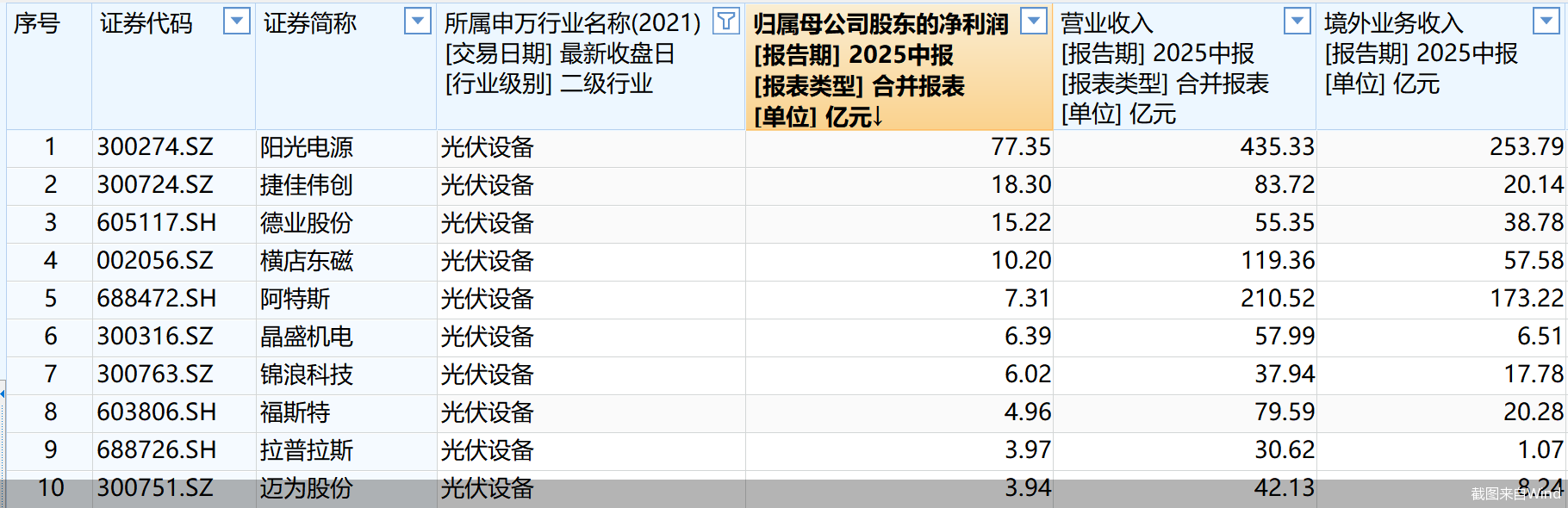
Core Viewpoint - The domestic photovoltaic industry is still facing challenges in the first half of 2025, with nearly half of the companies reporting net losses, indicating that the industry's "winter" has not yet ended [1][3]. Financial Performance - Among 70 photovoltaic companies, 34 reported net losses in the first half of 2025, accounting for approximately 48.57% [3][4]. - Notable losses include Tongwei Co. with approximately 4.96 billion yuan, TCL Zhonghuan with about 4.24 billion yuan, and Trina Solar with losses between 2.5 billion to 3 billion yuan [3][4]. - Conversely, 30 companies reported net profit growth, with MicroNano achieving the highest increase of 348.95% [3]. Debt Pressure - As of the end of the first half of 2025, 43 companies had asset-liability ratios exceeding 50%, representing about 61.43% of the total [5][6]. - Companies like *ST Jingang and ST Quan are in a precarious position with asset-liability ratios of 138.65% and 104.38%, respectively [6]. International Expansion - The trend of "going abroad" continues, with 13 companies reporting that over 50% of their revenue comes from international operations [8][9]. - Airo Energy leads with 97.14% of its revenue from overseas, focusing on markets in Europe, India, and Australia [9][10]. Market Capitalization - As of September 4, 2025, the market capitalization of leading companies includes Sunshine Power at 240.5 billion yuan, Longi Green Energy at 131.9 billion yuan, and Tongwei Co. at 103.4 billion yuan [7]. Capitalization Efforts - Several photovoltaic companies are pursuing dual listings, with Fulete and Junda already achieving "A+H" listings, while others like Sunshine Power and JA Solar are planning to list on the Hong Kong Stock Exchange [11].


预制菜概念涨2.36%,主力资金净流入45股
Zheng Quan Shi Bao Wang· 2025-09-04 10:39
Group 1 - The prepared food concept sector rose by 2.36%, ranking third among concept sectors, with 91 stocks increasing in value [1] - Notable gainers included Huijia Times, Guoguang Chain, and Huifa Food, which hit the daily limit, with respective increases of 10.05%, 10.00%, and 10.00% [1][3] - The sector saw a net inflow of 1.219 billion yuan from main funds, with 45 stocks receiving net inflows, and 7 stocks exceeding 50 million yuan in net inflow [2] Group 2 - The top net inflow stock was Bubu Gao, with a net inflow of 744.38 million yuan, followed by Tongwei Co. and Lingnan Holdings with net inflows of 453.21 million yuan and 126.47 million yuan respectively [2][3] - The net inflow ratios for Huijia Times, Bubu Gao, and Huifa Food were 40.73%, 34.85%, and 23.46% respectively, indicating strong investor interest [3] - The overall market performance showed a mixed trend, with the dairy industry leading with a 2.95% increase, while sectors like national big fund holdings and optical packaging saw declines [2]


大涨与大亏,硅料龙头们扭亏在即?
3 6 Ke· 2025-09-04 08:11
Core Viewpoint - The polysilicon market is experiencing significant price increases, yet leading companies in the sector are reporting substantial losses due to declining prices and market imbalances [1][2][4]. Group 1: Market Performance - On September 1, the futures prices for polysilicon surged, with the main contract PS2511 closing up by 6.03% and PS2510 up by 5.69% [1]. - Despite the price surge, major polysilicon producers, including Tongwei Co., GCL-Poly Energy, Daqo New Energy, Xinte Energy, and Hoshine Silicon Industry, reported a combined loss of 8.579 billion yuan in the first half of the year [2]. - Tongwei Co. recorded the largest loss among these companies, with a net loss of 4.955 billion yuan, a 58.35% increase in losses compared to the previous year [2]. Group 2: Company-Specific Insights - Hoshine Silicon Industry, a leading industrial silicon producer, is facing a tight cash flow situation due to ongoing construction projects and declining market demand [3]. - The company has invested 38 billion yuan in expanding its polysilicon production capacity, but is struggling with cash flow as it has not yet generated returns from these investments [3]. - GCL-Poly Energy indicated that its significant performance decline was primarily due to the imbalance in the polysilicon market and falling prices [4]. Group 3: Financial Health and Recovery Efforts - Some companies are managing to maintain financial stability; for instance, Tongwei Co. saw a 54% increase in revenue in Q2, reducing its net loss by 9.6% [5]. - GCL-Poly's EBITDA increased by 325.8% year-on-year, indicating a strong cash flow position despite the overall market downturn [5]. - As of June 30, Daqo New Energy reported a cash reserve of 12.09 billion yuan and a remarkably low debt ratio of 8.04%, with no interest-bearing debt [5]. Group 4: Industry Trends and Future Outlook - The polysilicon industry is undergoing a restructuring phase aimed at reducing overcapacity and stabilizing prices, with expectations of a gradual decrease in inventory and a potential price recovery [7][8]. - The Chinese government has initiated measures to combat low-price competition and promote orderly market conditions, which may lead to a more sustainable industry environment [9][10]. - Despite these efforts, the industry remains at a cyclical low, and the ability of polysilicon companies to navigate these challenges is still uncertain [10].