
HAIER SMART HOME(600690)

Search documents
瞄准5万亿美元市场:跨界布局机器人,时代的新共识
3 6 Ke· 2026-01-04 00:26
Core Insights - The Chinese robotics industry is poised for significant growth by the end of 2025, with humanoid robots transitioning from experimental concepts to practical applications, achieving over 50% growth and indicating a trillion-yuan industry on the horizon [1] - The entry of major players from various sectors such as automotive, electronics, and the internet into the robotics field marks a shift from niche exploration to widespread competition, creating a unique trend of "cross-industry integration" [1] Group 1: Market Dynamics - In the first eight months of 2025, the primary market financing in the robotics sector reached 38.624 billion yuan, 1.8 times the total for 2024, highlighting the blue ocean effect attracting significant investment [2] - The global industrial robot sales are projected to reach 542,000 units in 2024, with China accounting for 295,000 units, representing 54% of the global market [2] - By 2025, the Chinese robotics market is expected to exceed 150 billion yuan, capturing 35% of the global market share, with predictions suggesting the market for embodied intelligence could reach 400 billion yuan by 2030 and over a trillion yuan by 2035 [2] Group 2: Industry Trends - At least 20 automotive companies have entered the humanoid robot market by the end of 2025, with notable developments including Chery's humanoid robot Mocha and BYD's production line for core robot components [3] - The automotive industry's supply chain overlaps significantly with robotics, with a 60% compatibility rate, driving car manufacturers to invest in robotics as they view vehicles as "mobile intelligent robots" [3] - Home appliance manufacturers are transitioning from traditional manufacturing to smart ecosystems, with companies like Midea establishing dedicated innovation centers for humanoid robots and developing comprehensive R&D systems [7] Group 3: Strategic Shifts - The automotive sector is seen as a key player in the transition to robotics, with companies like Geely planning to invest 5 billion yuan over three years to develop critical components and establish an ecosystem covering all robotics applications [6] - Internet giants are leveraging their technological and capital advantages to enter the robotics space, with ByteDance and Huawei making significant investments in developing advanced robotic models and systems [8] - The competition in the robotics sector is viewed as a strategic restructuring driven by technological advancements, with companies aiming to activate existing technological capabilities and build new ecosystems [9] Group 4: Challenges Ahead - Despite the enthusiasm for entering the robotics market, cross-industry players face challenges such as adapting core competencies to the robotics field, where technology paths are still being defined [10] - The high precision and stability required for industrial applications pose significant challenges for companies transitioning from other sectors, as they may struggle to meet the diverse demands of various operational environments [11] - Cost remains a critical issue, with companies like BYD and GAC aiming to reduce the production cost of humanoid robots to below 200,000 yuan, which requires overcoming substantial supply chain and process optimization challenges [11]





美的、海尔、海信、TCL,一场决定未来十年命运的战争
虎嗅APP· 2026-01-02 09:36
Core Viewpoint - The Chinese home appliance industry is at a critical juncture, with the focus shifting towards international expansion as domestic markets reach saturation. The theme for 2026 is "going abroad," which represents a significant opportunity for companies like Haier, Midea, Hisense, and TCL to explore new markets and alleviate overcapacity issues [7]. Group 1: Overseas Market Potential - The global home appliance market is valued at nearly 4.5 trillion yuan, indicating substantial overseas market potential. In 2024, Midea and Haier are projected to generate approximately 270 billion yuan each in appliance revenue, translating to a global market share of only about 6% [9]. - Domestic brands have low market shares in most overseas regions, with Midea and Haier struggling to exceed 10% in many markets. In contrast, their competitors like Samsung and LG dominate the market [11]. - The growth strategy for domestic brands hinges on increasing their market share abroad, transitioning from competing with regional brands to facing established global giants [13]. Group 2: Challenges of Past Success - Historically, Chinese home appliance companies have relied on capacity expansion and brand acquisitions for international growth. However, this simplistic growth model is becoming unsustainable, as evidenced by the significant gap between global manufacturing share (over 45%) and retail share (less than 20%) [17]. - The stagnation in overseas revenue for leading companies like Haier and Midea, which has remained around 50% and 42% respectively for the past five years, highlights the need for a shift in strategy [18]. Group 3: Brand and Channel Development - The success of domestic brands in China was due to a strong competitive edge in product, brand, and channel management. However, these strengths have not yet translated effectively to international markets, where brand recognition and channel control remain challenges [23]. - Building brand recognition in mature markets is particularly difficult, as Chinese brands face trust issues despite offering lower prices compared to Japanese and Korean brands [25]. - The reliance on traditional retail channels in overseas markets poses significant barriers, as these channels are often fragmented and dominated by established players [30]. Group 4: Opportunities for Breakthrough - Technological innovation is seen as a key pathway to overcoming brand premium challenges and building core competitiveness. Chinese companies have increased R&D investments, achieving breakthroughs in areas like robotic vacuum navigation technology [33]. - Emerging markets such as Southeast Asia and Latin America present significant growth opportunities due to low penetration rates and a favorable demographic profile. These markets are less saturated, allowing for greater brand establishment potential [43]. - The rise of e-commerce in overseas markets offers a new avenue for brand penetration, enabling companies to reach consumers without the need for extensive physical retail investments [45].




家电股全线走高 26年家电以旧换新政策出台 有望提振家电消费景气
Zhi Tong Cai Jing· 2026-01-02 06:23
Group 1 - Home appliance stocks experienced a significant increase, with Skyworth Group rising by 10.45% to HKD 5.18, Midea Group increasing by 5% to HKD 89.2, Haier Smart Home up by 4.2% to HKD 25.3, and Hisense Home Appliances gaining 2.33% to HKD 23.72 [1] - The National Development and Reform Commission and the Ministry of Finance jointly issued a notice on December 30 regarding the implementation of large-scale equipment updates and the replacement of consumer goods by 2026, which is expected to positively impact the home appliance sector [1] - Dongfang Securities anticipates that the domestic sales pressure will improve in the first quarter of 2026 as national subsidy funds become available, and the industry will gradually enter a post-subsidy era [1] - Guotou Securities forecasts that the home appliance replacement policy will continue into 2026, with optimized support scope, subsidy standards, and implementation mechanisms, benefiting companies with R&D, channel, and brand advantages [1] - The easing of the US-China trade conflict is expected to reduce tariff pressures, allowing home appliance companies to gradually release global production capacity, with emerging markets contributing to incremental growth [1]
2026年家电以旧换新政策出台 家电消费景气有望提振(附概念股)
Zhi Tong Cai Jing· 2026-01-02 00:45
Group 1 - The 2026 appliance replacement policy will provide subsidies for consumers purchasing energy-efficient home appliances, with a subsidy of 15% of the product price, capped at 1,500 yuan per item [1] - The first batch of subsidies for the 2026 policy amounts to 62.5 billion yuan, which is lower than the 2025 plan, and the eligible appliance categories are fewer [1] - Citigroup believes the new policy will boost consumer sentiment despite the limited overall impact on e-commerce platforms due to high baseline effects and smaller subsidy scale [1] Group 2 - The 2026 policy is expected to stimulate domestic appliance sales and improve product structure, benefiting companies with R&D, channel, and brand advantages in the white and black goods sectors [2] - The easing of US-China trade tensions may reduce tariff pressures, allowing home appliance companies to gradually release global production capacity and gain incremental contributions from emerging markets [2] - The new policy is anticipated to drive the home appliance industry towards high-end, intelligent, and green upgrades, favoring large appliance companies with competitive advantages [2] Group 3 - Related Hong Kong-listed companies in the home appliance industry include Midea Group, Haier Smart Home, Hisense Home Appliances, TCL Electronics, Skyworth Group, and Xiaomi Group [3]
以原创科技重塑厨房健康新体验:卡萨帝厨电携手宝洁JOY定义“中国厨房新标配”
凤凰网财经· 2026-01-01 12:37
Core Viewpoint - The modern kitchen has evolved from a functional space to an important scene for family health and emotional connection, driven by technological innovation and aimed at redefining high-quality kitchen living standards [1] Group 1: User Pain Points and Innovations - The collaboration between Casarte and Procter & Gamble's JOY brand addresses common kitchen pain points in Chinese households, where the average kitchen size is only 6.1 square meters, with over 70% being small to medium-sized units [4] - Traditional dishwashers exacerbate ergonomic issues, leading users to bend over more than 7,300 times a year, accumulating a burden of 1,022 tons [4] - Casarte's innovative drawer-style dishwasher design alleviates these issues by allowing users to operate without bending, requiring only a 20 cm opening to access all dishes, saving nearly 30% in operational space compared to traditional designs [5][7] Group 2: User Experience and Market Feedback - The drawer-style dishwasher has achieved a user satisfaction rate of 98.2% for its "no bending" experience, indicating its human-centered design [7] - Casarte's drawer-style dishwasher has led the offline market in China for three consecutive years, becoming a new trend in quality kitchen configurations [7] - The collaboration with JOY has resulted in a complete kitchen ecosystem that integrates space optimization and cleanliness, moving from a focus on individual product functionality to a holistic solution [12][13] Group 3: Future Directions and Industry Impact - The partnership between Casarte and JOY signifies a shift in the home appliance industry from technical parameter competition to user experience delivery, emphasizing the importance of lifestyle solutions [13] - As consumer awareness of health and quality of life increases, the kitchen is becoming a central space reflecting family life quality, with technology seamlessly integrated into daily routines [15] - Future initiatives will include nationwide experiential activities to promote the innovative kitchen health solutions, aiming to enhance user experiences with "no bending, space-saving, and cleanliness" [15]


海尔智家(600690)重大事项点评:服务体系数字化获行业认可 经营表现延续稳健
Xin Lang Cai Jing· 2026-01-01 02:29
Core Viewpoint - Haier Smart Home has received multiple industry recognitions at the National After-Sales Service Conference, affirming its service capabilities and standardization through a digital platform that extends its offline service system online and overseas [1][2] Group 1: Service System and Operational Performance - The digitalization of the service system has been recognized by the industry, enhancing user engagement and service response efficiency, which supports channel operation quality and brand reputation [2] - In Q3 2025, the company achieved revenue of 77.56 billion yuan, a year-on-year increase of 9.51%, maintaining a growth rate of 10.2% from H1 2025 [2] - Domestic business revenue in Q3 2025 grew by 10.8%, with air conditioning revenue increasing by over 30% [2] - Market share for Haier's air conditioners, refrigerators, and washing machines increased by 3.7, -0.3, and 2.8 percentage points year-on-year, respectively [2] - The strong performance in air conditioning is attributed to high temperatures in northern China and the company's traditional market advantages, alongside operational model reforms and digital marketing efforts [2] Group 2: Profitability and Financial Performance - In Q3 2025, the net profit attributable to shareholders was 5.34 billion yuan, a year-on-year increase of 12.7% [3] - The improvement in product structure and operational efficiency in Europe positively impacted profitability [3] - The expense ratios for sales, management, R&D, and financial costs were stable, with slight year-on-year changes [3] - The gross margin for Q3 2025 was 27.9%, up by 0.1 percentage points, driven by product upgrades and supply chain optimization [3] - Operating cash flow for Q3 2025 was 6.352 billion yuan, a year-on-year increase of 0.295 billion yuan, representing 1.2 times the net profit attributable to shareholders [3] Group 3: Future Outlook and Investment Recommendations - Future growth momentum is expected to extend, with potential benefits from a recovery in the U.S. market due to anticipated interest rate cuts [3] - The company is projected to achieve double-digit profit growth in 2026, with high profitability quality supporting shareholder returns [3] - The EPS forecasts for 2025, 2026, and 2027 have been slightly adjusted to 2.29, 2.52, and 2.78 yuan, respectively, with corresponding PE ratios of 11.6, 10.5, and 9.5 times [4] - A target price of 33.8 yuan has been set, corresponding to a 13.4 times PE for 2026, maintaining a "strong buy" rating [4]
家电行业2026年度投资策略
2025-12-31 16:02
Summary of Key Points from the Conference Call on the Home Appliance Industry Industry Overview - The home appliance industry is expected to have a clear demand space in 2026, but growth momentum is limited, with marginal prosperity and structural changes being key influencing factors [1][3] - Categories with strong demand resilience or improved structures are likely to have higher performance certainty, particularly in the white goods and two-wheeler sectors [1] Core Insights and Arguments White Goods - The white goods sector is primarily driven by replacement demand, with structural growth opportunities in overseas markets. Leading companies are expected to achieve revenue growth of 5-10% [1][5] - Xiaomi's growth has slowed, and its high-end strategy has alleviated price competition, leading to an improved industry structure and increased performance certainty [1][5] - The overall valuation of the white goods sector is relatively low, with leading companies maintaining an upward trend, indicating potential for a strong rebound [3][12] Two-Wheeler Market - The two-wheeler market has essential demand characteristics, supported by inventory updates and structural growth opportunities in the mid-to-high-end market due to new national standards [1][9] - If domestic demand remains strong, the market could achieve single-digit growth [1][9] Black Goods - The black goods sector is experiencing a shrinking demand center but shows a trend of structural upgrades. However, external uncertainties and intense domestic competition may limit profit margin improvements [1][6] Kitchen Appliances and Lighting - Kitchen appliances and lighting are influenced by the real estate sector's post-cycle effects, with short-term demand potentially declining. However, the industry structure is improving, which could benefit leading companies in the medium term [1][7] Small Appliances and Cleaning Equipment - The small appliance sector is diverse and somewhat discretionary, with cleaning equipment being a focal point. Overseas demand is strong, but domestic risks exist due to subsidy factors [1][8] Additional Important Insights - The overall demand for the home appliance industry in 2025 was clear, but significant growth stories were lacking. Key factors include changes in marginal prosperity and industry structure [3] - Leading white goods companies are cash-rich and committed to increasing dividend payouts, with expectations of exceeding 70% [3][18] - The two-wheeler industry is expected to face a demand decline of 5-10% in 2026, but structural growth opportunities remain due to new standards and market dynamics [19][20] - The overseas market, particularly in Southeast Asia, presents significant potential for the two-wheeler industry, supported by favorable policies [21] - Brand expansion into international markets is crucial for future growth, with low penetration rates in emerging categories providing opportunities for Chinese brands [22] Investment Recommendations - Investment strategies for 2026 should focus on two main areas: dividend opportunities in white goods and two-wheelers, and overseas expansion potential in companies with reasonable valuations and strong brand/channel capabilities [29]

海尔智家(600690):重大事项点评:服务体系数字化获行业认可,经营表现延续稳健
Huachuang Securities· 2025-12-31 15:36
Investment Rating - The report maintains a "Strong Buy" rating for Haier Smart Home (600690) [1] Core Insights - Haier Smart Home has received multiple industry recognitions for its digital service system, which extends its offline service capabilities online and overseas, enhancing service efficiency and standardization [1] - The company reported a revenue of 77.56 billion yuan in Q3 2025, reflecting a year-on-year growth of 9.51%, consistent with the 10.2% growth in H1 2025 [8] - The domestic business revenue grew by 10.8% year-on-year, with the air conditioning segment seeing over 30% growth in Q3 [8] - The company’s profitability improved, with a net profit of 5.34 billion yuan in Q3 2025, up 12.7% year-on-year [8] - The operating cash flow for Q3 2025 was 6.352 billion yuan, which is 1.2 times the net profit [8] - Future growth is expected to continue, with a projected double-digit profit growth in 2026, supported by improving demand in domestic and international markets [8] Financial Summary - Total revenue projections for 2024A, 2025E, 2026E, and 2027E are 285.981 billion, 309.930 billion, 328.665 billion, and 347.024 billion yuan respectively, with year-on-year growth rates of 9.4%, 8.4%, 6.0%, and 5.6% [3] - Net profit projections for the same years are 18.741 billion, 21.432 billion, 23.605 billion, and 26.101 billion yuan, with growth rates of 12.9%, 14.4%, 10.1%, and 10.6% respectively [3] - The target price is set at 33.8 yuan, with the current price at 26.54 yuan, indicating significant upside potential [4]
年内1494家A股公司回购1392亿元,美的集团115亿元居首
Bei Ke Cai Jing· 2025-12-31 14:23
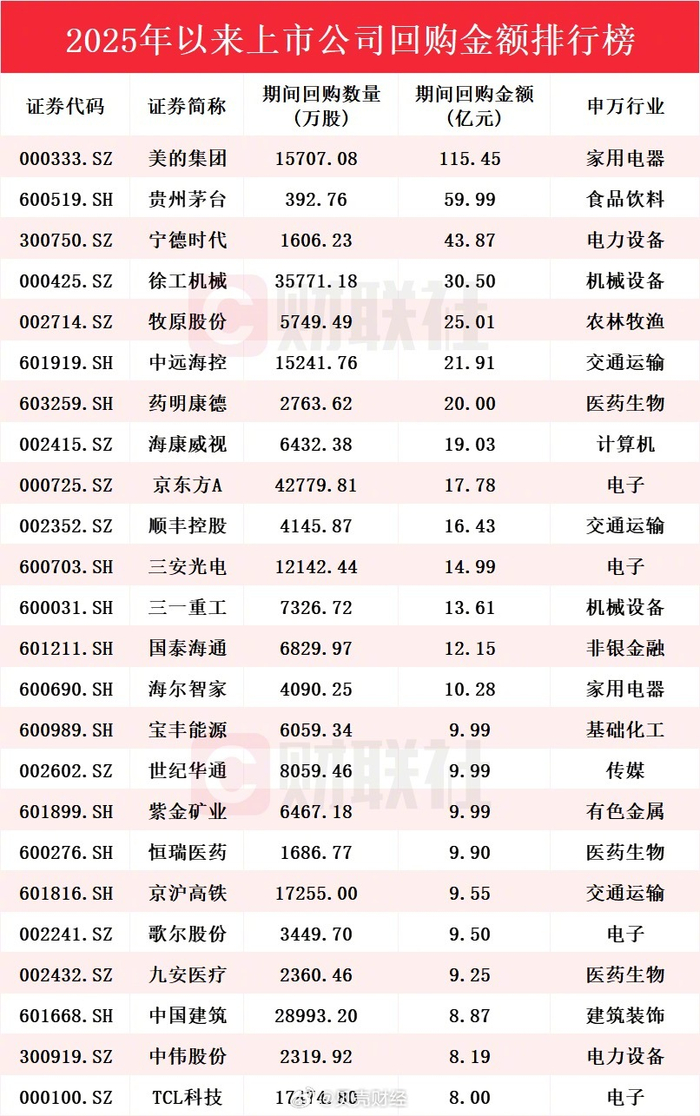
Group 1 - As of the report date, 1494 A-share companies have implemented share buybacks in 2025, with a total amount exceeding 1392.84 billion yuan [1] - Among these, 14 companies have repurchased more than 1 billion yuan, with Midea Group leading at 115.45 billion yuan [1] - Other notable companies include Kweichow Moutai with 59.99 billion yuan and CATL with 43.87 billion yuan in buybacks [1] Group 2 - The top companies by buyback amount include: - Midea Group: 15,707.08 thousand shares, 115.45 billion yuan [1] - Kweichow Moutai: 392.76 thousand shares, 59.99 billion yuan [1] - CATL: 1,606.23 thousand shares, 43.87 billion yuan [1] - XCMG Machinery: 35,771.18 thousand shares, 30.50 billion yuan [1] - Muyuan Foods: 5,749.49 thousand shares, 25.01 billion yuan [1]




海尔智家:李攀离任副总裁
Zhi Tong Cai Jing· 2025-12-31 12:07
Core Viewpoint - Haier Smart Home (600690)(06690) announced the resignation of Vice President Li Pan, effective December 30, 2025, after which he will no longer hold any senior management position within the company [1] Group 1 - The company’s board of directors received a written resignation report from Vice President Li Pan [1] - Li Pan's departure marks a significant change in the company's senior management team [1]