GDPD(600795)

Search documents
公用事业行业跟踪报告:北方火电释放弹性,水电业绩稳健增长
Haitong Securities International· 2025-06-03 09:34
Investment Rating - The report rates the industry as "Overweight" [1][4] Core Insights - Northern thermal power shows resilience with significant profit growth, while hydropower maintains stable performance. Green energy faces pressure on earnings due to dual impacts of wind conditions and electricity prices, while nuclear power's profitability is affected by electricity pricing [1][2][4] Summary by Sections Northern Thermal Power - The report highlights that the profitability of northern thermal power plants is growing faster than that of southern plants, with a median net profit growth rate of 8% for national thermal power companies in Q1 2025. The median PE ratios for thermal power companies have decreased from 15.7 in Q1 2023 to 10.4 in Q1 2025, indicating a declining market focus on this sector [8][10][9] - The report anticipates a recovery in thermal power performance in Q2 2025 following a significant drop in electricity generation in Q1 2025 due to a warm winter [10][14] Hydropower - Hydropower companies have shown strong earnings growth, with a median net profit growth rate of 26% in Q1 2025, driven by optimized water storage and scheduling. The median PE ratios for hydropower companies have fluctuated, reaching 18.8 in Q1 2024 before slightly declining to 18.1 in Q1 2025 [19][20][22] - The report notes that the El Niño phenomenon is expected to positively influence water inflow during the main flood season in 2024, while the situation for 2025 remains uncertain as the climate shifts to a La Niña phase [19][20] Green Energy - Green energy companies are experiencing a decline in net profit growth, with median growth rates of -12% in 2024 and -4% in Q1 2025. The sector is facing challenges from falling electricity prices and poor wind conditions, leading to a situation where revenue is increasing but profits are not [2][4] - The report predicts a recovery in green energy performance in 2025, with an expected median net profit growth rate of around 12% as wind utilization hours improve [2][4] Nuclear Power - The nuclear power sector is experiencing mixed performance, with major companies like China Nuclear Power and China General Nuclear Power facing different challenges. The report indicates that profitability for China Nuclear Power is expected to decline significantly in 2024 due to accounting policy changes and tax implications, while China General Nuclear Power's profits are only slightly increasing despite new capacity coming online [2][4][5]





未知机构:XZ公用136号文实施现货市场加速推进电力市场化产生裂变效应-20250603
未知机构· 2025-06-03 01:50
Summary of Conference Call Records Industry Overview - The conference call discusses the electricity market in China, particularly focusing on the implementation of the New Energy 136 Document and the acceleration of the spot market, which signifies a shift towards market-oriented electricity pricing [1][1]. Key Points and Arguments - The New Energy 136 Document, effective from June 1, marks a significant step in the marketization of the electricity sector, particularly for new energy sources, which now account for the second-largest share of electricity generation [1][1]. - Over ten provinces have begun long-cycle trial operations of the electricity spot market this year, enhancing the supply-demand relationship in electricity pricing [1][1]. - The introduction of the spot market has led to increased price volatility, with some pilot provinces like Shandong and Shanxi experiencing intraday price fluctuations exceeding 50% [2][2]. - As renewable energy capacity continues to grow, it is expected that more trading cycles will be dominated by renewable sources, which will lower overall price levels. However, traditional thermal power will still play a crucial role during periods of insufficient renewable output, maintaining higher prices during those times [3][3]. - The volatility in price curves is leading to a compression of trading cycles, pushing for weekly, multi-day, and even daily trading to become mainstream [4][4]. - The comprehensive electricity price for thermal power has risen during periods of declining coal prices, indicating a shift towards a model where thermal power is not just about generation but also about price regulation [4][4]. Recommendations - The report recommends focusing on national comprehensive power companies and northern thermal power companies with performance elasticity, such as: - Jintou Energy - Datang Power (H) - Huaneng International (H+A) - Huadian International (H+A) - Continued recommendations for Waneng Power, Sheneng Co., Huaneng Hydropower, and Guodian Power [4][4]. - For green energy, companies like Xintian Green Energy, Datang New Energy, and Longyuan Power (H) are highlighted. - In the hydropower sector, recommended companies include Yangtze Power, Chuan Investment Energy, Guotou Power, and Huaneng Hydropower [4][4]. Risks - The report outlines several risks associated with the marketization of electricity trading, including: - Price volatility risks due to market fluctuations - Risks from variations in wind and water resources - Significant increases in thermal coal prices - Delays in resource approval for new energy projects - Risks from macroeconomic downturns affecting electricity demand [4][4].


国家推广绿电直连项目,绿电机制竞价正式开启
Changjiang Securities· 2025-06-03 00:25
Investment Rating - The report maintains a "Positive" investment rating for the public utility sector [8]. Core Insights - The introduction of the "Green Electricity Direct Connection" model is expected to enhance demand certainty and consumption levels compared to traditional projects, particularly benefiting distributed commercial solar, offshore wind, and integrated projects in certain western regions [2][12]. - The green electricity pricing mechanism has transitioned to a competitive bidding phase, marking a shift from a supply-driven growth phase to a mature market regulated by demand [12]. - The report emphasizes that the "carbon neutrality" initiative and electricity market reforms will reshape the intrinsic value of power operators throughout the 14th Five-Year Plan period [12]. Summary by Sections Green Electricity Direct Connection - The National Development and Reform Commission and the National Energy Administration have established a framework for the "Green Electricity Direct Connection" model, allowing renewable energy sources to supply electricity directly to single users [12]. - Projects must have at least 60% of their generated electricity consumed on-site and a minimum of 30% of total electricity consumption from self-generated sources, with a gradual increase in self-consumption expected by 2030 [12]. - The model is anticipated to reduce price risks through long-term power purchase agreements (PPAs), enhancing project profitability [12]. Pricing Mechanism Transition - Starting June 1, new green electricity projects will no longer follow a benchmark pricing mechanism but will adopt a market-driven pricing model, with a competitive bidding process determining the final price [12]. - The report suggests that this transition may lead to a slowdown in new installations, which is viewed positively as it could alleviate pricing pressures and improve long-term growth prospects [12]. Investment Recommendations - The report recommends focusing on quality power operators such as Huadian International, China Resources Power, and Huaneng International, as well as hydropower companies like Yangtze Power and Guotou Power [12][16][17]. - For the renewable energy sector, it highlights companies like Longyuan Power and China Nuclear Power as key investment opportunities due to their strong market positions and growth potential [12][18].



【干货】2025年电力行业产业链全景梳理及区域热力地图
Qian Zhan Wang· 2025-05-29 03:08
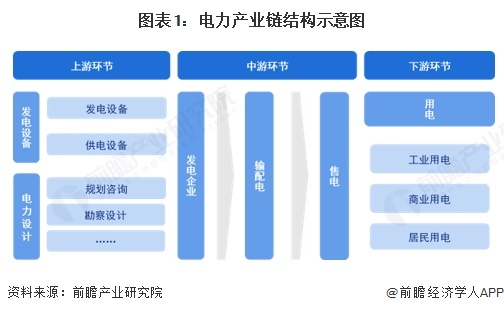
Group 1 - The core viewpoint of the article is a comprehensive analysis of the Chinese power industry, including its entire value chain, regional distribution, and representative companies' business layouts [1][4][6] - The power industry value chain consists of three main segments: upstream (generation), midstream (transmission and distribution), and downstream (end-users) [1][3] - Key players in the upstream generation segment include companies like China XD Group, XJ Electric, and Dongfang Cable, while major midstream players include Huaneng International, State Power Investment, and China Datang [3] Group 2 - The regional distribution of the power industry shows that provinces like Guangdong, Beijing, and Jiangsu have a high concentration of listed power companies, indicating a robust industry presence [4] - Huaneng International leads in several key performance indicators for 2024, including operating revenue of 245.55 billion, power business revenue of 237.55 billion, generation volume of 479.86 billion kWh, and total installed capacity of 145,125 MW [6][8] - Other notable companies include Datang Power with 123.47 billion in revenue and 28.52 million kWh in generation, and Huadian International with 112.99 billion in revenue and 22.26 million kWh in generation [8] Group 3 - Future investment trends indicate a shift towards renewable energy, with companies like Huaneng International planning to invest over 50 billion in renewable projects by 2025 [9] - Datang Power is set to invest approximately 5.969 billion in a coal power project, while Huadian International is undergoing a major asset restructuring to enhance its market share [9] - State Power Investment plans to invest around 19.2 billion in hydropower and photovoltaic projects, reflecting a broader industry trend towards integrating renewable energy sources [9]



助力合作共建“零碳岛” 国家电投江西核电棉船风电项目并网发电
Xin Hua Cai Jing· 2025-05-27 12:07
Core Viewpoint - The State Power Investment Corporation's 100 MW wind power project in Jiangxi's Mianchuan Island has achieved full-capacity grid connection, contributing to the establishment of a clean energy supply system and supporting the "zero-carbon island" initiative in Pengze, Jiangxi [1]. Group 1: Project Overview - The Mianchuan wind power project includes 18 wind turbines, a 35kV collection line, a 110kV booster station, and a 10MW/10MWh energy storage system, which will meet the electricity needs of 32,000 residents and supply over 200 million kWh of green electricity annually to the mainland [1]. - The project is a key energy construction initiative in Jiangxi and a demonstration project for carbon reduction during the 14th Five-Year Plan, with an annual power generation of 244 million kWh, equivalent to saving 96,000 tons of standard coal and reducing CO2 emissions by 240,000 tons [1]. Group 2: Community Impact - Residents of Mianchuan Island express increased confidence in electricity supply due to the wind power project, alleviating concerns about power outages caused by extreme weather affecting external transmission lines [1]. - The project has led to the installation of new infrastructure, such as charging stations and modern streetlights, enhancing the convenience of residents' daily lives [1][2]. Group 3: Future Development Plans - Mianchuan Island aims to develop a closed-loop system focusing on "zero-carbon energy, zero-carbon agriculture and tourism, zero-carbon buildings, zero-carbon waste, zero-carbon communication, and zero-carbon shipping," exploring diverse models for carbon reduction in inland islands [2].
【能源广角】电力企业跨界化工为哪般
Jing Ji Ri Bao· 2025-05-27 09:09
Group 1 - The boundaries between power companies and chemical companies are increasingly blurred, with major power enterprises like State Power Investment Corporation and China Energy Engineering accelerating their involvement in green ammonia and green methanol projects [2] - The rapid entry of power companies into the green chemical sector has outpaced many traditional chemical firms, driven by the need to convert renewable energy into usable products [3][4] - Significant projects have been initiated, including the State Power Investment's green hydrogen ammonia integration demonstration project, which aims to produce 180,000 tons of green ammonia annually, and China Energy Engineering's project with a total investment of 29.6 billion yuan, targeting 110,000 tons of green hydrogen and 600,000 tons of green ammonia/methanol [2][3] Group 2 - The push into hydrogen-based chemicals by power companies is a response to the global climate change agenda, as renewable energy sources like wind and solar are essential for low-carbon transitions [3] - Power companies face challenges in electricity grid planning and construction, leading to difficulties in absorbing increasing amounts of renewable energy, thus necessitating the conversion of green electricity into marketable products [3][4] - The market potential for green hydrogen-based chemicals is substantial, with international standards and policies promoting the use of zero-carbon fuels, and domestic carbon market expansions expected to enhance project profitability [5] Group 3 - Power companies possess unique advantages in the green hydrogen chemical sector, as they have extensive renewable energy installations and are more familiar with the characteristics of renewable energy compared to traditional chemical firms [4] - The production processes for green ammonia and green methanol have made progress but still face challenges such as high production costs and low efficiency, necessitating further research and optimization [5] - The development of green hydrogen-based chemicals is seen as a crucial pathway for high-quality energy development and an integral part of a new energy system [5]


国电电力:事件点评电价承压但成本改善,静待下游用电需求恢复-20250522
ZHESHANG SECURITIES· 2025-05-22 00:20
Investment Rating - The investment rating for the company is "Buy" (maintained) [5] Core Views - The company reported a revenue of 179.18 billion yuan in 2024, a decrease of 1.00% year-on-year, while the net profit attributable to shareholders increased by 75.28% to 9.83 billion yuan [17][11] - The first quarter of 2025 saw a revenue of 39.81 billion yuan, down 12.61% year-on-year, with a net profit of 1.81 billion yuan, up 1.45% [17] - The company is experiencing pressure on electricity prices but is seeing improvements in costs, awaiting recovery in downstream electricity demand [1] Summary by Sections Overall Performance - In 2024, the company achieved an operating income of 179.18 billion yuan, a decrease of 1.00% year-on-year, and a net profit attributable to shareholders of 9.83 billion yuan, an increase of 75.28% [17][11] - The basic earnings per share were 0.551 yuan, up 75.48% [17] Thermal Power Business - The average coal price for 2024 was 922.17 yuan per ton, down 1.37% year-on-year [20] - The thermal power segment contributed a net profit of 4.12 billion yuan, a year-on-year increase of 34.05% [27] - As of March 31, 2025, the company had a thermal power installed capacity of 75.63 million kilowatts, with 8.35 million kilowatts under construction [31] Hydropower Business - In 2024, hydropower generation was 59.47 billion kilowatt-hours, an increase of 7.93% year-on-year [32] - The hydropower segment contributed a net profit of 1.24 billion yuan, a decrease of 33.0% due to impairment provisions [37] - As of March 31, 2025, the hydropower installed capacity was 14.95 million kilowatts, with 4.92 million kilowatts under construction [41] New Energy Business - Wind power generation in 2024 was 20.18 billion kilowatt-hours, up 7.01%, while solar power generation was 11.28 billion kilowatt-hours, up 95.89% [4] - The new energy segment contributed a net profit of 1.38 billion yuan, down 21.1% year-on-year [48] - As of March 31, 2025, the installed capacity for wind power was 9.91 million kilowatts and for solar power was 15.90 million kilowatts [51] Profit Forecast and Valuation - The forecasted net profit for 2025 is 7.50 billion yuan, a decrease of 23.67% year-on-year, with expected earnings per share of 0.42 yuan [11][53] - The company is expected to maintain strong profitability due to sufficient long-term coal supply and overall robust performance as a leading power enterprise [53]
FOF系列研究之七十五:广发中证全指电力公用事业ETF投资价值分析
Orient Securities· 2025-05-21 00:30
Investment Rating - The report indicates a positive outlook for the electricity industry, suggesting it is entering a phase of high prosperity due to policy catalysts and fundamental improvements [2][11]. Core Insights - The implementation of the capacity price mechanism starting in 2024 is expected to restructure the revenue model for coal power companies, reducing reliance on energy sales and stabilizing income expectations [11][21]. - The auxiliary service market mechanism has been officially released, accelerating the construction of the spot market, which will support high-quality development in the electricity sector [12]. - Overall electricity demand is recovering, with a reported increase in national electricity consumption of 4.28% year-on-year as of March 2025, indicating a positive trend for the industry [13]. - Hydropower generation is expected to improve due to favorable water conditions, while coal-fired power plants are experiencing reduced fuel cost pressures, enhancing profitability [15][17]. Summary by Sections 1. Policy Catalysts and Fundamental Resonance - The capacity price mechanism will optimize the profit model for coal power, ensuring sustainable operation [11]. - The auxiliary service market will provide new revenue channels for electricity companies, enhancing income diversity [12]. - Electricity demand is on the rise, supporting industry prosperity [13]. 2. Investment Value Analysis of the CSI All-Share Power Index - The CSI All-Share Power Index consists mainly of stocks from the power utility sector, with 98.92% of its components in power generation and grid industries [3][29]. - As of April 30, 2025, the index's P/E ratio is 16.65 and P/B ratio is 1.69, indicating relatively suitable valuation levels [31]. - The index has shown strong profitability and a high willingness to distribute dividends, with a 12-month dividend yield of 2.80% [35]. 3. Analysis of the GF CSI All-Share Power Utility ETF - The GF CSI All-Share Power Utility ETF was established on December 29, 2021, and aims to closely track the CSI All-Share Power Utility Index [45]. - As of May 14, 2025, the ETF has a scale of 3.489 billion yuan and a daily average trading volume of 193 million yuan, indicating good market liquidity [45]. - The fund is managed by an experienced manager with over 25 years in the securities industry [46].


公用事业ETF(560190)联动指数上行,水电板块领涨效应显著
Xin Lang Cai Jing· 2025-05-20 02:33
Group 1 - The public utility ETF (560190.SH) increased by 0.71%, with its associated index, the All Public Utility Index (000995.CSI), rising by 0.80% [1] - Key constituent stocks such as Changjiang Electric Power, China Nuclear Power, and Guotou Power saw significant gains, with increases of 1.35%, 1.47%, and 2.97% respectively [1] - The Ministry of Water Resources anticipates continuous rainfall in the central and northern regions of the Pearl River Basin, potentially leading to flood conditions, which has triggered a level IV flood emergency response [1] Group 2 - The increase in rainfall is expected to boost hydropower generation and performance for water electricity companies like Changjiang Electric Power and Guotou Power, contributing to their stock price increases [1] - Guosen Securities highlighted supportive policies such as the Guangdong Document No. 136 and Zhejiang's encouragement for computing centers to participate in long-term electricity trading, which bolster the public utility sector [1] - The public utility index rose by 0.08% this week, with the water electricity sector performing particularly well, increasing by 0.87% [1]
储能收益改善措施有望出台,央企能源ETF(562850)逆市涨近1%
Sou Hu Cai Jing· 2025-05-19 03:17
Group 1 - The central enterprise energy ETF has a turnover rate of 2.38% and a transaction volume of 3.0688 million yuan, with an average daily transaction volume of 5.4144 million yuan over the past week as of May 16 [2] - The index tracked by the ETF, the China Securities National New Central Enterprise Modern Energy Index, is currently at a historical low valuation with a price-to-book ratio (PB) of 1.41, which is below 95.4% of the time over the past year, indicating a strong valuation cost-effectiveness [2] - The top ten weighted stocks in the index, including Changjiang Electric Power and China Nuclear Power, account for a total of 51.18% of the index as of April 30, 2025 [2] Group 2 - The A-share market has historically undervalued low-covariance assets due to insufficient risk awareness, but there is a growing recognition of the importance of the "return-risk ratio" amid increased market volatility, leading to a valuation uplift for utility and other low-covariance assets [2] - Huayuan Securities recommends selecting hydropower with strong risk resistance and undervalued quality thermal power benefiting from declining coal prices, while also suggesting a preference for undervalued quality wind power operators despite uncertainties in the new energy market under Document No. 136 [2]