
Shanxi Xinghuacun Fen Wine Factory (600809)

Search documents
穿透消费分化迷雾:CBI品牌榜中的“真增长”挖掘
格隆汇APP· 2026-01-15 11:15
Core Insights - The article highlights the steady recovery of China's consumer market since 2025, with a year-on-year growth of 6.8% in retail sales of consumer goods in the first three quarters, contributing 53.5% to economic growth [2] - However, the consumer sector faces challenges with increasing internal differentiation, where traditional brands struggle due to lack of innovation while new brands succeed through technological breakthroughs and innovative models [2][3] Group 1: Consumer Brand Landscape - The CBI500 ranking reflects a stable top tier of brands, emphasizing the "stronger get stronger" logic in the consumer market [7] - Leading brands like Apple, Xiaomi, Midea, Huawei, and Haier maintain competitive barriers through balanced performance across four dimensions: brand awareness, innovation, loyalty, and reputation [8][10] - DJI and Pop Mart have shown significant growth, with DJI entering the top ten for the first time, driven by continuous technological innovation and market expansion [11][16] Group 2: Brand Performance and Growth Strategies - DJI's growth is attributed to its focus on technology innovation and creating benchmark products, leading to a 66% market share in the global action camera market as of Q3 2025 [11][14] - Pop Mart's rise in the rankings is due to its strong loyalty metrics and effective IP matrix operation, which resonates with emotional consumer needs [19][20] - The brand's strategy includes a robust membership system that enhances customer loyalty through emotional engagement [19] Group 3: Market Differentiation and Opportunities - The differentiation in the consumer market presents challenges for traditional brands while creating opportunities for those that adapt to trends [21][22] - Brands like Fenjiu have successfully capitalized on changing consumer preferences, with a notable increase in their ranking due to a focus on younger consumers [26] - The article emphasizes the importance of aligning with policy support and consumer trends to identify quality brands that can thrive in a competitive landscape [27][28] Group 4: CBI Index and Its Value - The CBI index serves as a data-driven tool for observing the consumer market, helping investors identify brands that capture product innovation opportunities and possess resilience against economic cycles [30][31] - The index's multidimensional evaluation framework allows for a deeper understanding of consumer demand and brand performance, aiding in long-term investment decisions [32]








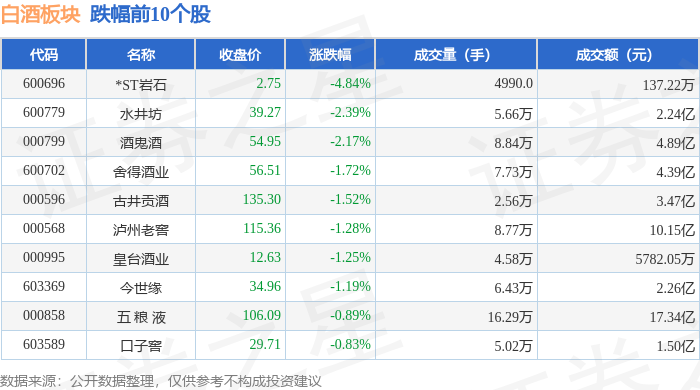
白酒板块1月15日跌0.77%,*ST岩石领跌,主力资金净流出11.52亿元
Zheng Xing Xing Ye Ri Bao· 2026-01-15 08:59
Group 1 - The liquor sector experienced a decline of 0.77% on January 15, with *ST Rock leading the drop [1] - The Shanghai Composite Index closed at 4112.6, down 0.33%, while the Shenzhen Component Index rose by 0.41% to 14306.73 [1] - Major liquor stocks showed varied performance, with *ST Rock down 4.84% to 2.75, and other notable declines including Shui Jing Fang down 2.39% and Moutai down 7.31% in net outflow [1][2] Group 2 - The liquor sector saw a net outflow of 1.152 billion yuan from main funds, while retail investors contributed a net inflow of 528 million yuan [1] - Specific stocks like Moutai and Wuliangye faced significant net outflows of 416 million yuan and 201 million yuan respectively, indicating a shift in investor sentiment [2] - The data indicates that retail investors are increasingly active, with a notable net inflow into stocks like Wuliangye, which saw 157 million yuan from retail investors [2]



中国消费板块 2026 展望:消费信心复苏是否已开启?-China Consumer Sector_ 2026 Outlook_ are we at the beginning of consumer confidence recovery_
2026-01-15 06:33
Summary of the Conference Call Transcript Industry Overview - **Industry**: China Consumer Sector - **Outlook**: The sector is believed to be in the early stage of a multi-year recovery cycle that began in Q3 2024, with expectations for gradual improvement in consumer sentiment and spending through 2026E [2][11][12] Key Insights - **Valuation**: MSCI China Consumer Discretionary and Staples are trading at 17x and 15x 12-month forward PE, approximately one standard deviation below the 10-year averages, indicating that current valuations do not reflect a potential consumption recovery [2][9] - **Consumer Confidence**: The China Consumer Confidence Index has been trending upwards since September 2024, suggesting a gradual restoration of consumer confidence despite ongoing challenges in the property market [12][19] - **K-shaped Recovery**: The recovery is characterized by a K-shaped trend, where mid- to high-income consumers in tier-1 cities are expected to lead spending, while lower-tier city consumers remain focused on value for money [3][48] Consumer Behavior Trends - **Shifting Preferences**: A UBS Evidence Lab survey indicates a divergence in consumer behavior, with over 50% of mid- to high-income consumers reporting investment gains and showing strong spending intentions, particularly in premium and experiential categories [3][37] - **Spending Intentions**: The strongest spending intentions are noted in beauty and skincare (41%) and tourism (37%), reflecting a shift towards experiential and premium spending [51] - **Investment Gains**: 64-74% of mid- to high-income consumers reported increased investment returns, with many planning to reinvest or spend on travel, health services, and consumer electronics [40][41] Stock Implications - **Company Ratings**: - Upgrades to Neutral for Fenjiu due to expected benefits from non-business baijiu consumption - Buy ratings maintained for companies like MIXUE, Guming, China Foods, CR Beer, and YUM China, among others [4] - **Dividend Payouts**: Premium baijiu companies are noted for their >75% dividend payout, which is expected to protect share prices from downside risks [4] Structural Growth Opportunities - **Emerging Themes**: Key investment themes for 2026E include changing consumer preferences, corporate restructuring, and industry consolidation, particularly in sectors like home appliances and mass-market consumption [14][50] - **Corporate Restructuring**: Companies are expected to adapt their business models to align with changing consumer behaviors, which may lead to sustainable long-term earnings growth [4][50] Risks and Challenges - **Property Market Downturn**: The ongoing downturn in the property market is anticipated to weigh on household balance sheets, potentially impacting consumer spending [13][48] - **Policy Support**: The pace of recovery is contingent on stabilizing the property market and effective policy implementation to boost consumption [13][48] Conclusion - The China consumer sector is poised for a recovery, driven by improving consumer confidence and shifting spending patterns. However, the recovery will be uneven across different income groups and city tiers, necessitating a nuanced investment approach to capture emerging opportunities while being mindful of potential risks associated with the property market downturn.



酒价内参1月15日价格发布 国窖1573上涨7元
Xin Lang Cai Jing· 2026-01-15 01:19
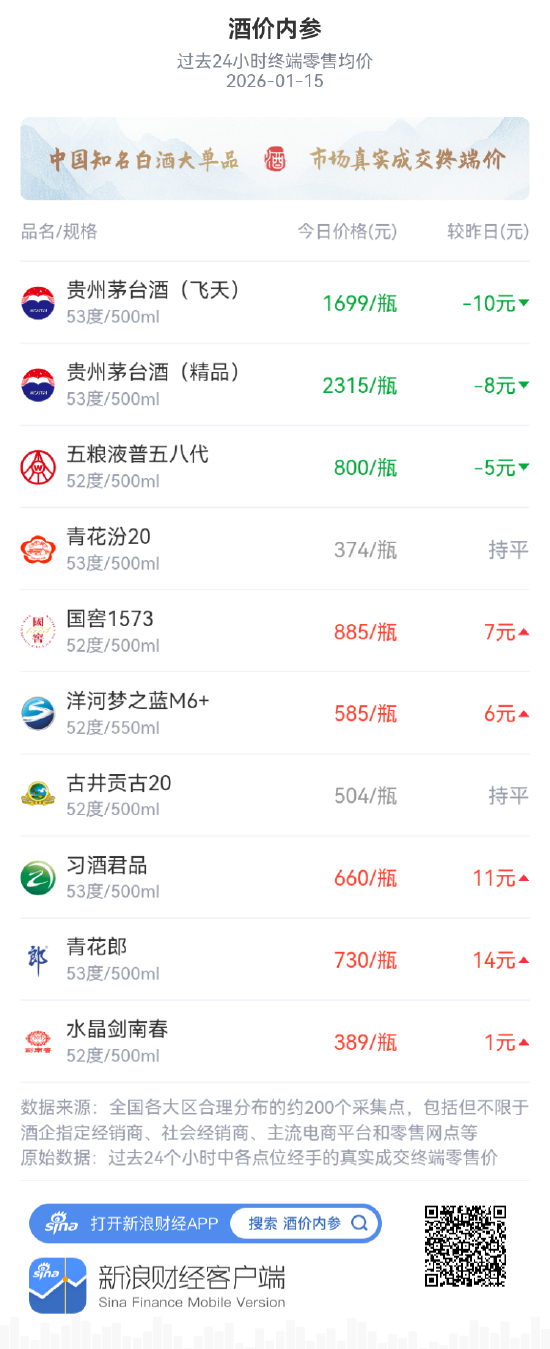
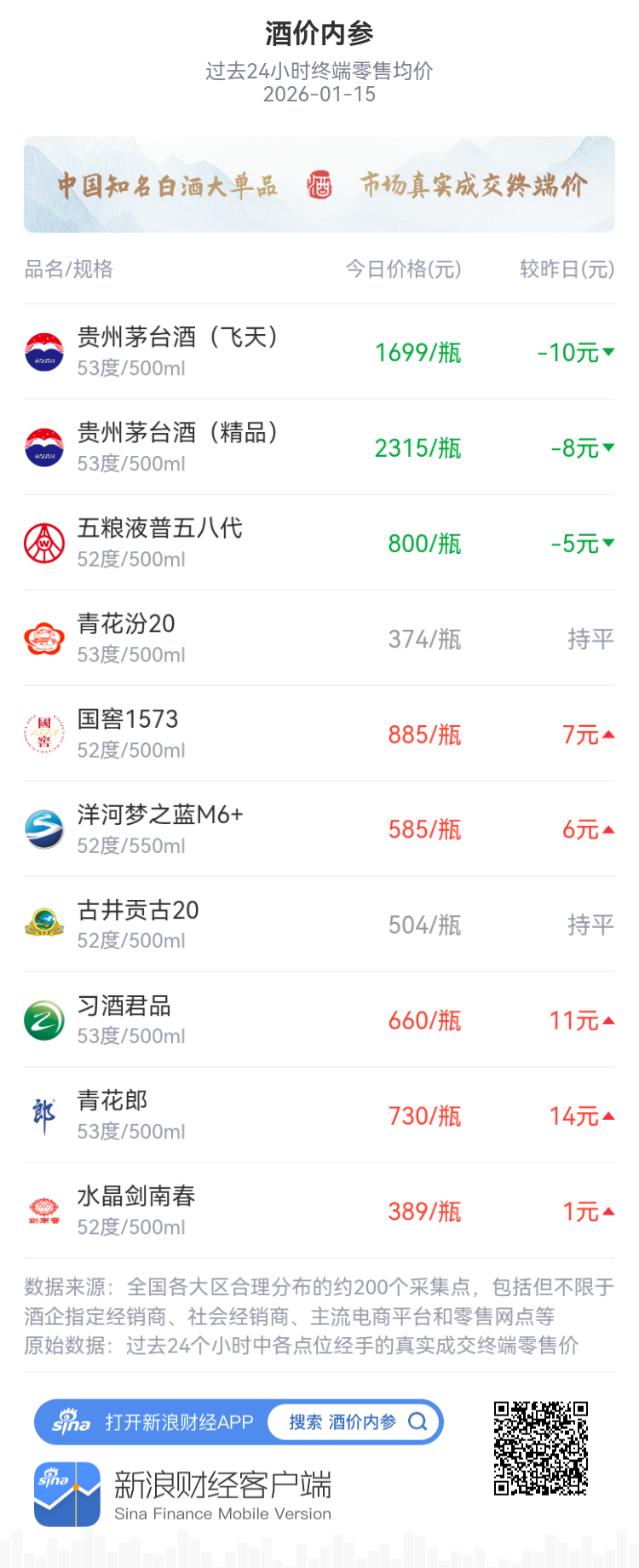
Core Insights - The article highlights the recent slight recovery in the retail prices of China's top ten liquor products, with an overall increase of 16 yuan, bringing the total price to 8941 yuan as of January 15 [1][6][7] - The market is experiencing structural volatility with five products increasing in price, three decreasing, and two remaining stable, reflecting the current industry adjustment phase [1][7] Price Movements - The leading price increase was observed in Qinghua Lang, which rose by 14 yuan per bottle, followed by Xijiu Junpin with an increase of 11 yuan per bottle [1][7] - Other notable price increases include Guojiao 1573 and Yanghe Dream Blue M6+, which rose by 7 yuan and 6 yuan per bottle, respectively [1][7] - Conversely, the prices of Feitian Moutai and Boutique Moutai decreased by 10 yuan and 8 yuan per bottle, respectively, attributed to the impact of the iMoutai platform's pricing strategy [1][7] Data Collection Methodology - The "Wine Price Reference" collects data from approximately 200 sampling points across various regions, including designated distributors, social distributors, e-commerce platforms, and retail outlets, ensuring a comprehensive and objective representation of market prices [2][8] - The data reflects real transaction prices from the past 24 hours, aiming to provide a reliable and traceable source of information for the liquor market [2][8] New Sales Initiatives - Moutai's digital marketing platform, iMoutai, announced a structured sales schedule for multiple core products starting January 15, 2026, including fixed monthly sales for various Moutai products [3][8] - This initiative is part of Moutai's strategy to enhance market supply through digital channels and align more closely with consumer demand, reinforcing its direct sales system [3][8]


酒价内参1月15日价格发布 青花郎上涨14元
Xin Lang Cai Jing· 2026-01-15 01:19
Core Viewpoint - The "Wine Price Reference" by Sina Finance has reported a slight recovery in the retail prices of China's top ten liquor products as of January 15, with an overall price increase of 16 yuan, bringing the total price for a package of these products to 8941 yuan [1][6]. Price Trends - The market shows a clear structural differentiation with five products increasing in price, three decreasing, and two remaining stable. Notably, the core products have experienced price adjustments [1][7]. - The leading price increase was observed in Qinghua Lang, which rose by 14 yuan per bottle, followed by Xijiu Junpin with an increase of 11 yuan per bottle. Other products like Guojiao 1573 and Yanghe Dream Blue M6+ saw increases of 7 yuan and 6 yuan per bottle, respectively. Crystal Jiananspring had a minor increase of 1 yuan per bottle [1][7]. - Conversely, Feitian Moutai and Boutique Moutai led the price declines, dropping by 10 yuan and 8 yuan per bottle, respectively. This decline is attributed to the introduction of the affordable 2026 Feitian Moutai and the pricing anchor effect of Boutique Moutai [1][7]. Data Collection Methodology - The daily data for "Wine Price Reference" is sourced from approximately 200 collection points across various regions, including designated distributors, social distributors, e-commerce platforms, and retail outlets. The data aims to provide an objective and traceable representation of the market prices for well-known liquor products [2][8]. - The recent launch of the iMoutai platform, which offers Feitian Moutai at 1499 yuan per bottle and Boutique Moutai at 2299 yuan per bottle, has begun to influence the market retail prices significantly [2][8]. Product Launches - Moutai's digital marketing platform, iMoutai, announced a structured sales schedule starting January 15, 2026, for several core products, including six vintage versions of Feitian Moutai. The platform will have fixed sales times for various products, enhancing its direct sales system and aligning with consumer demand [3][8].
酒价内参1月15日价格发布 价格小幅回升分化格局凸显
Xin Lang Cai Jing· 2026-01-15 01:16
Core Viewpoint - The Chinese white liquor market has shown a slight recovery in retail prices for the top ten products as of January 15, with an overall price increase of 16 yuan, bringing the total price for a packaged set to 8941 yuan, indicating a structural volatility in the market amidst ongoing industry adjustments [1]. Price Movements - The market displayed a clear differentiation today, with five products increasing in price, three decreasing, and two remaining stable. Notably, core product prices have seen a correction [1]. - Among the products that increased in price, Qinghua Lang led with a rise of 14 yuan per bottle, while Xijiu Junpin followed with an increase of 11 yuan per bottle. Other notable increases included Guojiao 1573 and Yanghe Dream Blue M6+, which rose by 7 yuan and 6 yuan per bottle, respectively. The price of Shuijing Jian'nan Chun saw a minor increase of 1 yuan per bottle [1][4]. - Conversely, Feitian Moutai and Jingpin Moutai experienced the largest declines, dropping by 10 yuan and 8 yuan per bottle, respectively. This decline is attributed to the pricing strategy of iMoutai, which has introduced a more affordable 2026 Feitian Moutai, affecting retail prices [1][3]. - Wuliangye Pu 58th generation also saw a decrease of 5 yuan per bottle, while Qinghua Fen 20 and Gujing Gong 20 remained unchanged from the previous day [1][4]. Market Data - The current retail prices for key products are as follows: - Feitian Moutai: 1699 yuan (down 10 yuan) - Jingpin Moutai: 2315 yuan (down 8 yuan) - Wuliangye Pu 58th generation: 800 yuan (down 570 yuan) - Qinghua Fen 20: 374 yuan (unchanged) - Guojiao 1573: 885 yuan (up 7 yuan) - Yanghe Dream Blue M6+: 585 yuan (up 6 yuan) - Xijiu Junpin: 660 yuan (up 11 yuan) - Qinghua Lang: 730 yuan (up 14 yuan) - Shuijing Jian'nan Chun: 389 yuan (up 1 yuan) [3][4].
16只白酒股下跌 贵州茅台微跌0.92%
Bei Jing Shang Bao· 2026-01-14 11:00
Core Viewpoint - The liquor sector, particularly the baijiu market, is currently experiencing a slight downturn, but there are signs of potential recovery as leading brands show an upward trend in sales ahead of the Spring Festival [1] Group 1: Market Performance - The Shanghai Composite Index closed at 4126.09 points, down 0.31% [1] - The baijiu sector index closed at 2237.49 points, with a minor decline of 0.03% [1] - Among individual stocks, Kweichow Moutai closed at 1398.01 yuan per share, down 0.92% [1] - Wuliangye closed at 107.04 yuan per share, down 0.89% [1] - Shanxi Fenjiu closed at 175.48 yuan per share, down 0.85% [1] - Luzhou Laojiao closed at 116.86 yuan per share, down 0.97% [1] - Yanghe Brewery closed at 63.30 yuan per share, down 0.39% [1] Group 2: Analyst Insights - Zheshang Securities noted that the baijiu sector is currently at a bottom range [1] - The report indicates that leading liquor companies are beginning to see an upward inflection point in sales [1] - There is an optimistic outlook for core products from brand liquor companies, with expectations for sales to exceed forecasts during the Spring Festival [1]
当政策红利遇上消费刚需 中证主要消费指数如何成为行业压舱石?
Sou Hu Cai Jing· 2026-01-14 06:27
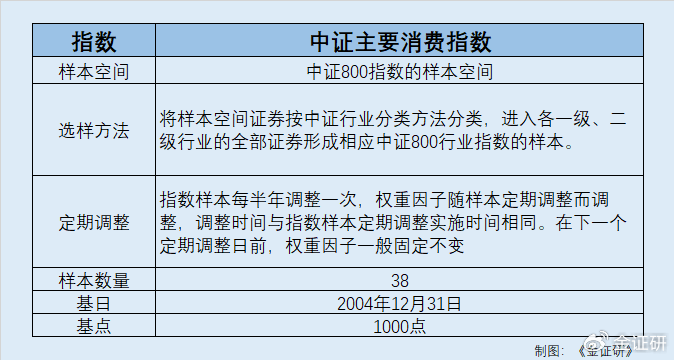
Group 1 - The core viewpoint of the article emphasizes the importance of policies aimed at boosting consumption, highlighting the collaboration between business and financial sectors to enhance consumer spending [1][2] - The China Securities Major Consumption Index, which focuses on the consumption sector, has an average free float market capitalization exceeding 600 billion yuan, reflecting the overall performance of major consumption stocks in the A-share market [2][3] - The index includes 38 sample stocks, with a free float market capitalization ranging from 36.47 billion yuan to 8,885.48 billion yuan, indicating significant growth potential in the consumption sector [2][4] Group 2 - The index is heavily concentrated in the food and beverage sector, with a weight of 67.62%, and agriculture, forestry, animal husbandry, and fishery at 28.42%, together covering over 96% of the index's weight [4][5] - The top ten stocks in the index are supported by leading companies such as Kweichow Moutai, Yili, and Wuliangye, which have strong brand recognition and stable cash flows [5][6] - The ongoing policy support for consumption is expected to enhance the long-term value and growth potential of the consumption sector, making the China Securities Major Consumption Index a quality benchmark for investing in core consumption assets [7]


A股白酒股普跌
Ge Long Hui· 2026-01-13 06:12
Group 1 - The core viewpoint of the article highlights a decline in A-share market for liquor stocks, particularly with major brands like Moutai planning to lower the prices of several products [1] - Major liquor stocks such as Shui Jing Fang, Gu Jing Gong Jiu, and others fell over 1%, while Moutai experienced a slight decline of 0.7% [1] - Moutai has reportedly confirmed a price reduction for certain products, including premium Moutai and Moutai 1935, affecting the contract prices for distributors [1]


山西汾酒入选“2025中国企业ESG百强”榜单
Xin Lang Cai Jing· 2026-01-13 05:41
Core Insights - The article emphasizes the growing importance of ESG (Environmental, Social, and Governance) as a key metric for high-quality corporate development and a vital link between corporate and social value [1][2] - The "2025 China ESG Top 100" list was released by Sina Finance, evaluating over 5,000 A-share listed companies and mainland enterprises listed in Hong Kong using 18 industry-specific ESG evaluation models and over 150 ESG indicators [1][2] - The list serves as a benchmark for industry development and provides valuable decision-making references for investors [1][2] Industry Overview - The ESG ecosystem in China is rapidly evolving, with tightening regulatory policies and increasing capital market focus on ESG performance, making sustainable development capabilities a core competitive advantage for companies [1] - ESG is no longer seen as an optional enhancement but as an essential requirement for businesses to meet global challenges and high-quality development demands [2] Company Highlights - Shanxi Fenjiu was recognized for its outstanding ESG performance, ranking 89th on the "2025 China ESG Top 100" list, showcasing its commitment to sustainable practices [2] - The recognition of companies in the ESG Top 100 is a significant endorsement of their sustainable development efforts and aims to inspire other companies to integrate ESG principles into their strategic planning and operations [2]
