Shanxi Xinghuacun Fen Wine Factory (600809)

Search documents
16只白酒股下跌 贵州茅台微跌0.92%
Bei Jing Shang Bao· 2026-01-14 11:00
Core Viewpoint - The liquor sector, particularly the baijiu market, is currently experiencing a slight downturn, but there are signs of potential recovery as leading brands show an upward trend in sales ahead of the Spring Festival [1] Group 1: Market Performance - The Shanghai Composite Index closed at 4126.09 points, down 0.31% [1] - The baijiu sector index closed at 2237.49 points, with a minor decline of 0.03% [1] - Among individual stocks, Kweichow Moutai closed at 1398.01 yuan per share, down 0.92% [1] - Wuliangye closed at 107.04 yuan per share, down 0.89% [1] - Shanxi Fenjiu closed at 175.48 yuan per share, down 0.85% [1] - Luzhou Laojiao closed at 116.86 yuan per share, down 0.97% [1] - Yanghe Brewery closed at 63.30 yuan per share, down 0.39% [1] Group 2: Analyst Insights - Zheshang Securities noted that the baijiu sector is currently at a bottom range [1] - The report indicates that leading liquor companies are beginning to see an upward inflection point in sales [1] - There is an optimistic outlook for core products from brand liquor companies, with expectations for sales to exceed forecasts during the Spring Festival [1]





当政策红利遇上消费刚需 中证主要消费指数如何成为行业压舱石?
Sou Hu Cai Jing· 2026-01-14 06:27
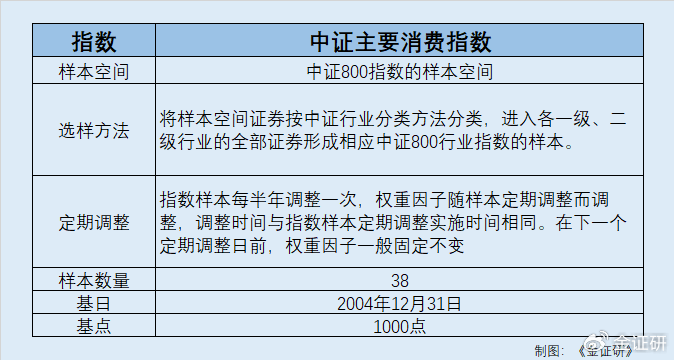
Group 1 - The core viewpoint of the article emphasizes the importance of policies aimed at boosting consumption, highlighting the collaboration between business and financial sectors to enhance consumer spending [1][2] - The China Securities Major Consumption Index, which focuses on the consumption sector, has an average free float market capitalization exceeding 600 billion yuan, reflecting the overall performance of major consumption stocks in the A-share market [2][3] - The index includes 38 sample stocks, with a free float market capitalization ranging from 36.47 billion yuan to 8,885.48 billion yuan, indicating significant growth potential in the consumption sector [2][4] Group 2 - The index is heavily concentrated in the food and beverage sector, with a weight of 67.62%, and agriculture, forestry, animal husbandry, and fishery at 28.42%, together covering over 96% of the index's weight [4][5] - The top ten stocks in the index are supported by leading companies such as Kweichow Moutai, Yili, and Wuliangye, which have strong brand recognition and stable cash flows [5][6] - The ongoing policy support for consumption is expected to enhance the long-term value and growth potential of the consumption sector, making the China Securities Major Consumption Index a quality benchmark for investing in core consumption assets [7]



A股白酒股普跌
Ge Long Hui· 2026-01-13 06:12
Group 1 - The core viewpoint of the article highlights a decline in A-share market for liquor stocks, particularly with major brands like Moutai planning to lower the prices of several products [1] - Major liquor stocks such as Shui Jing Fang, Gu Jing Gong Jiu, and others fell over 1%, while Moutai experienced a slight decline of 0.7% [1] - Moutai has reportedly confirmed a price reduction for certain products, including premium Moutai and Moutai 1935, affecting the contract prices for distributors [1]


山西汾酒入选“2025中国企业ESG百强”榜单
Xin Lang Cai Jing· 2026-01-13 05:41
Core Insights - The article emphasizes the growing importance of ESG (Environmental, Social, and Governance) as a key metric for high-quality corporate development and a vital link between corporate and social value [1][2] - The "2025 China ESG Top 100" list was released by Sina Finance, evaluating over 5,000 A-share listed companies and mainland enterprises listed in Hong Kong using 18 industry-specific ESG evaluation models and over 150 ESG indicators [1][2] - The list serves as a benchmark for industry development and provides valuable decision-making references for investors [1][2] Industry Overview - The ESG ecosystem in China is rapidly evolving, with tightening regulatory policies and increasing capital market focus on ESG performance, making sustainable development capabilities a core competitive advantage for companies [1] - ESG is no longer seen as an optional enhancement but as an essential requirement for businesses to meet global challenges and high-quality development demands [2] Company Highlights - Shanxi Fenjiu was recognized for its outstanding ESG performance, ranking 89th on the "2025 China ESG Top 100" list, showcasing its commitment to sustainable practices [2] - The recognition of companies in the ESG Top 100 is a significant endorsement of their sustainable development efforts and aims to inspire other companies to integrate ESG principles into their strategic planning and operations [2]

酒价内参1月13日价格发布 市场普涨反弹整体价格显著回升
Xin Lang Cai Jing· 2026-01-13 01:09
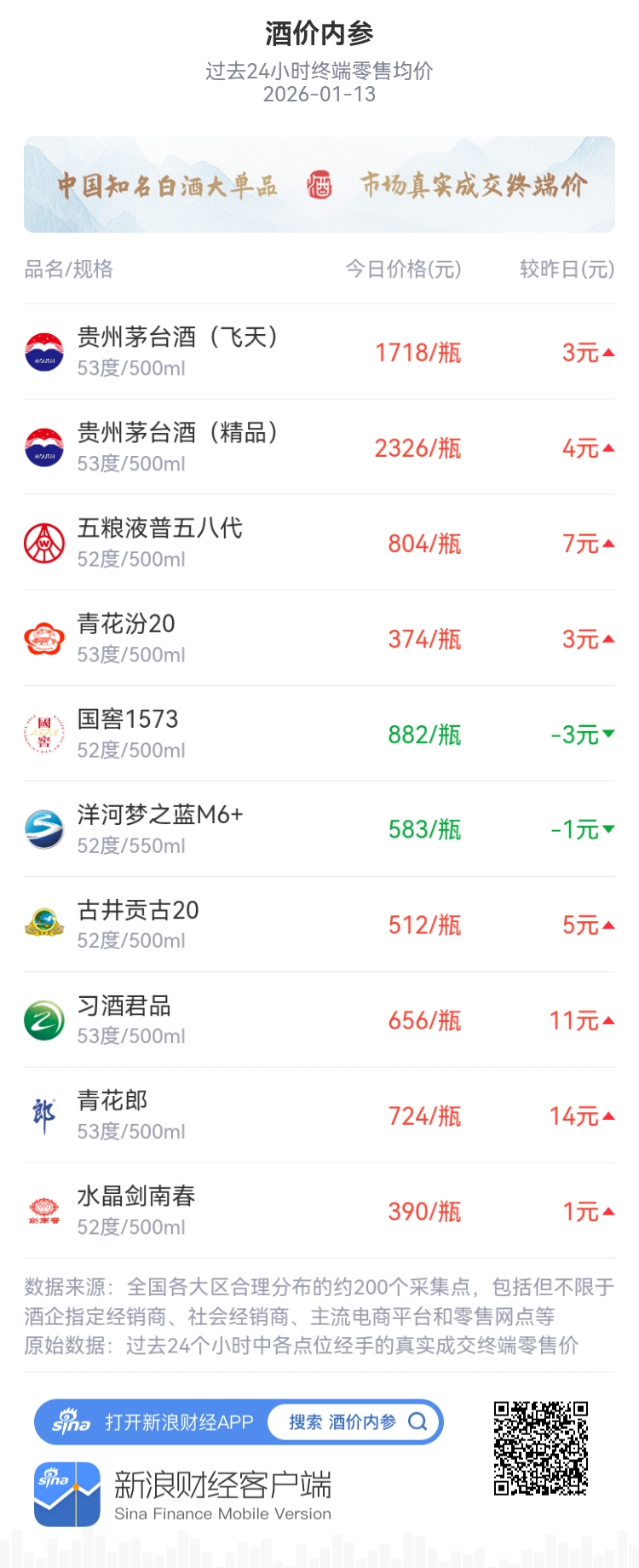
Core Viewpoint - The Chinese liquor market has experienced a significant rebound in retail prices for the top ten products, indicating a recovery in market sentiment after a period of decline [1]. Price Trends - The overall retail price for the top ten liquor products reached 8969 yuan, an increase of 44 yuan from the previous day [1]. - The market showed a broad upward trend, with most core products experiencing price increases, reflecting restored market confidence [1]. Individual Product Performance - Qinghua Lang saw the most substantial increase, rising by 14 yuan per bottle [1]. - Xijiu Junpin increased by 11 yuan per bottle, showing a strong rebound [1]. - Wuliangye Pu 58th generation ended its decline with a price increase of 7 yuan per bottle [1]. - Gujing Gonggu 20 rose by 5 yuan per bottle, while Jingpin Moutai increased by 4 yuan per bottle [1]. - Feitian Moutai and Qinghua Fen 20 both saw a rise of 3 yuan per bottle [1]. - The only products that experienced price declines were Guojiao 1573, which fell by 3 yuan, and Yanghe Dream Blue M6+, which decreased by 1 yuan [1][4]. Market Data Sources - The data was collected from approximately 200 points across major regions, including designated distributors, social distributors, mainstream e-commerce platforms, and retail outlets [4].
食品饮料行业周度更新:如何把握春节旺季备货行情?-20260112
Changjiang Securities· 2026-01-12 14:10
Investment Rating - The industry investment rating is "Positive" and is maintained [8] Core Viewpoints - The liquor sector is currently experiencing a phase of "supply optimization and weak demand recovery," with inventory destocking ongoing in Q4. Short-term price recovery is expected due to controlled supply from Moutai, with attention on Spring Festival sales and inventory movement [2][5] - The demand for mass-market products is expected to show marginal improvement, with January anticipated to see a strong start due to delayed Spring Festival stocking [2][5] - The report recommends focusing on products with strong seasonal effects and high performance realization, particularly in sectors like leisure snacks, restaurant supply chains, condiments, soft drinks, and dairy products [4][26] Summary by Sections Spring Festival Stocking Strategy - The Spring Festival stocking strategy should focus on products with strong seasonal effects and high performance realization. The timing of the Spring Festival can impact the performance of listed companies, especially in years when it falls later in the calendar [4][15] - Products with clear gifting scenarios and positive market sentiment in specific segments are prioritized for opportunity selection. The continuation of the post-Spring Festival market will depend on actual sales and positive Q1 performance feedback [4][26] CPI Trends - The food CPI has been strengthening since December, surpassing service and overall CPI. This trend is supported by supply clearing in certain items and seasonal demand recovery, which together bolster price improvements [32][34] - The CPI-PPI differential remains positive, supporting the continued improvement in profitability for food manufacturing companies [37] Market Performance Review - Since the beginning of 2026, the food and beverage index has increased by 2.21%, lagging behind the CSI 300, which rose by 2.79%. The performance of the liquor sector has remained stable, while the dairy sector has seen declines [6][40] - Soft drinks and leisure snacks have led the market in terms of growth related to Spring Festival stocking, while dairy and meat products have experienced declines [6][40] Industry Dynamics - The industry is increasingly focused on value deepening and structural optimization. Companies are prioritizing supply-demand balance, healthy pricing systems, and profit structure improvements rather than merely pursuing sales growth [7][46] - Food safety and supply chain resilience remain foundational to brand trust, highlighted by recent global recalls and supply chain disruptions [7][46]





酱酒品牌剩者为王,大众品重视春节催化:食品饮料行业周报(20260105-20260111)-20260112
Huachuang Securities· 2026-01-12 11:12
Investment Rating - The report maintains a "Recommendation" rating for the food and beverage industry, indicating an expected increase in the industry index exceeding the benchmark index by more than 5% in the next 3-6 months [26]. Core Insights - The report emphasizes that the remaining brands in the sauce liquor sector will thrive, while mass-market products are expected to benefit from the upcoming Spring Festival [2][8]. - The dairy sector is showing signs of improvement, with a potential rebound in raw milk prices and a narrowing supply-demand gap, which could lead to increased demand for processed dairy products [6]. - The beverage and snack categories are experiencing sustained growth, with specific segments like energy drinks and konjac snacks showing remarkable sales increases despite overall declines in the snack market [6]. - The report highlights a significant shift in the sauce liquor industry, where pricing strategies are becoming more pragmatic, with a new growth level emerging around the 200 yuan price point as lower-tier brands face market exit pressures [6][8]. - The report suggests that leading liquor companies should maintain operational stability during this industry downturn, focusing on balanced investments in base liquor to prepare for future market recovery [8]. Summary by Sections Industry Overview - The food and beverage sector consists of 126 listed companies with a total market capitalization of 44,935.30 billion yuan, representing 3.54% of the market [3]. - The circulating market value stands at 43,859.19 billion yuan, accounting for 4.28% of the total market [3]. Performance Metrics - The absolute performance of the industry over the past month is 1.3%, with a relative performance decline of 2.2% compared to the benchmark [4]. - Over the past 12 months, the industry has seen a relative performance decline of 25.2% [4]. Sector-Specific Insights - Dairy products are expected to benefit from a favorable pricing environment and improved supply dynamics, with major companies actively preparing for the Spring Festival [6]. - The beverage sector is witnessing growth in specific categories, with leading brands launching targeted marketing campaigns for the holiday season [6]. - The sauce liquor market is undergoing a consolidation phase, with a focus on brand strength and market share recovery among leading companies [6][8].

白酒板块1月12日涨0.79%,*ST岩石领涨,主力资金净流入4.03亿元
Zheng Xing Xing Ye Ri Bao· 2026-01-12 09:04
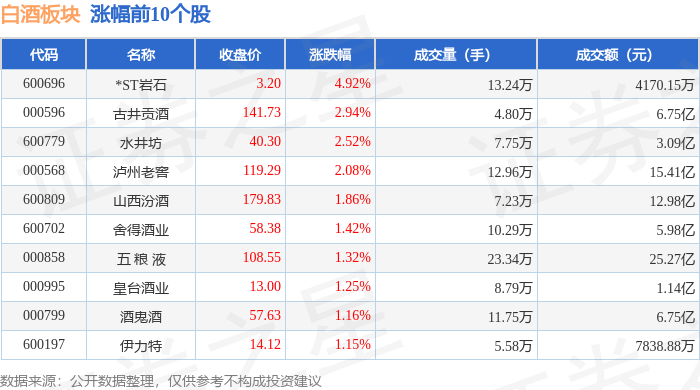
Core Viewpoint - The liquor sector experienced a rise of 0.79% on January 12, with *ST Rock leading the gains, while the Shanghai Composite Index rose by 1.09% and the Shenzhen Component Index increased by 1.75% [1] Group 1: Market Performance - The closing price of *ST Rock was 3.20, with a gain of 4.92% and a trading volume of 132,400 shares, amounting to 41.70 million yuan [1] - Gujing Gongjiu closed at 141.73, up 2.94%, with a trading volume of 48,000 shares and a transaction value of 675 million yuan [1] - Luzhou Laojiao closed at 119.29, increasing by 2.08%, with a trading volume of 129,600 shares and a transaction value of 1.54 billion yuan [1] Group 2: Capital Flow - The liquor sector saw a net inflow of 403 million yuan from main funds, while retail investors experienced a net outflow of 29.32 million yuan [1] - Wuliangye had a main fund net inflow of 267 million yuan, but retail funds saw a net outflow of 87.06 million yuan [2] - Luzhou Laojiao recorded a main fund net inflow of 85.62 million yuan, with retail funds experiencing a net outflow of 34.07 million yuan [2]


ETF盘中资讯|“i茅台”成交用户超40万!“茅五泸汾洋”集体上攻,机构喊话白酒配置机会!
Sou Hu Cai Jing· 2026-01-12 02:33
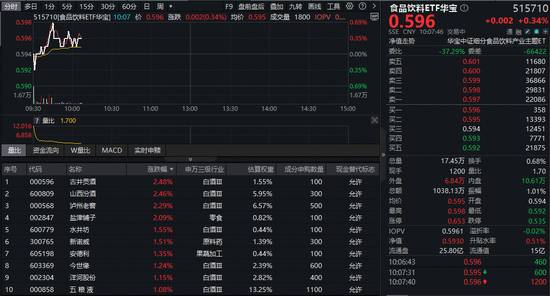
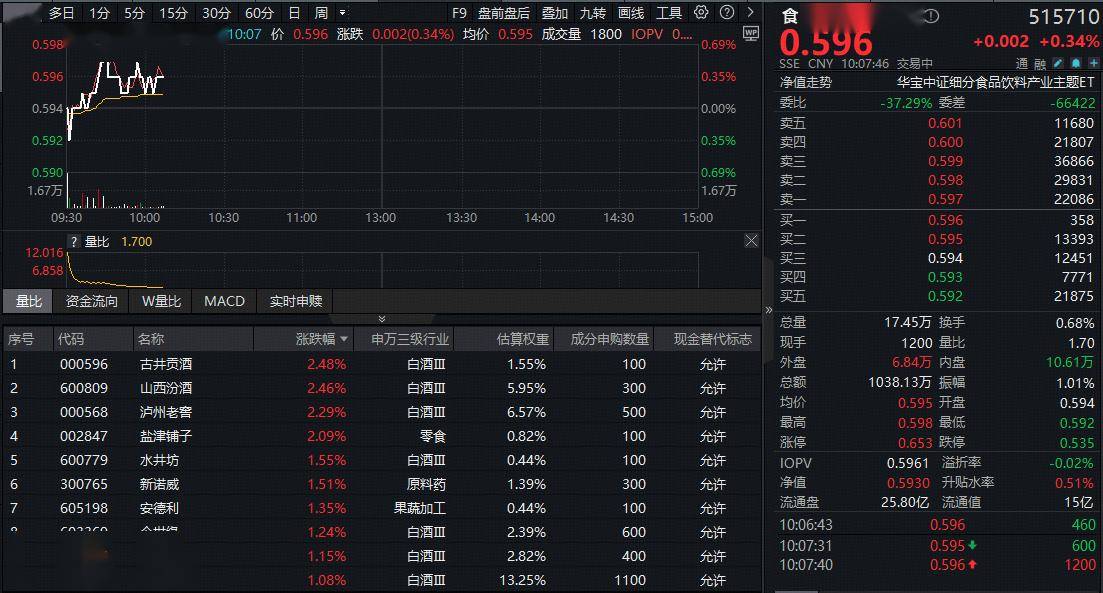
Group 1 - The food and beverage sector is experiencing an upward trend, with the Huabao Food and Beverage ETF (515710) showing a price increase of 0.34% as of the report time [1] - Major liquor stocks such as Shanxi Fenjiu, Luzhou Laojiao, and Gujing Gongjiu have surged over 2%, while Wuliangye and Yanghe have increased by more than 1% [1] - Kweichow Moutai has implemented a strategy to stabilize the market by directly reaching consumers through its iMoutai platform, which has gained over 2.7 million new users [1] Group 2 - Guizhou Moutai's recent dealer communication emphasized three principles: preventing speculation, adapting supply and demand, and stabilizing the market [2] - The current valuation of the food and beverage sector is at a historical low, with the PE ratio of the Huabao ETF at 20.16, indicating a favorable entry point for investors [2] - The white liquor industry is expected to reach a turning point as major companies like Moutai and Wuliangye implement market strategies ahead of the Spring Festival [3] Group 3 - The iMoutai platform's launch of the full range of Moutai products is expected to stabilize prices and improve market management [3] - The Huabao Food and Beverage ETF primarily invests in leading high-end and mid-range liquor stocks, with significant allocations to brands like Moutai, Wuliangye, and Luzhou Laojiao [3] - Investors can also consider the Huabao Food and Beverage ETF linked fund for exposure to core assets in the food and beverage sector [3]
“i茅台”成交用户超40万!“茅五泸汾洋”集体上攻,机构喊话白酒配置机会!
Xin Lang Ji Jin· 2026-01-12 02:30
Group 1 - The food and beverage sector is experiencing an upward trend, with the Huabao Food and Beverage ETF (515710) showing a price increase of 0.34% as of the latest update [1] - Major liquor stocks such as Shanxi Fenjiu, Luzhou Laojiao, and Gujing Gongjiu have surged over 2%, while Wuliangye and Yanghe have increased by more than 1% [1] - The recent communication from Kweichow Moutai to its distributors emphasizes a strategy to stabilize the market by ensuring product availability directly to consumers, with over 2.7 million new users on the iMoutai platform [2][4] Group 2 - Guojin Securities notes that the market's expectations for the liquor industry are at an absolute low, and the clear volume and price planning from leading companies will alleviate concerns about price competition [3] - The valuation of the food and beverage sector is at a historical low, making it a favorable time for investment, with the food and beverage ETF's price-to-earnings ratio at 20.16, which is in the bottom 5.88% of the last decade [3] - CITIC Securities suggests that the current adjustments in the liquor industry may signal a turning point, with the upcoming Spring Festival being a critical observation period for market recovery [4] Group 3 - The Huabao Food and Beverage ETF (515710) primarily invests in leading high-end and mid-range liquor stocks, with about 60% of its portfolio allocated to these sectors [5] - The top ten weighted stocks in the ETF include major brands like Moutai, Wuliangye, and Luzhou Laojiao, indicating a strong focus on established players in the market [5]