
CYPC(600900)

Search documents
A500ETF基金(512050)成交额超32亿居同类第一,机构称“活钱”的持续提升或助推市场上行
Xin Lang Cai Jing· 2025-10-17 03:30
Group 1 - The A500 index components showed mixed performance, with Huatian Technology leading the gains at 10.02%, followed by Wentai Technology at 5.96% and Shandong Gold at 3.29%, while Desay SV fell [1] - The A500 ETF fund's latest price is 1.15 yuan, with a turnover rate of 19.72% and a trading volume of 3.248 billion yuan, indicating active market trading [1] - As of October 16, the A500 ETF fund had an average daily trading volume of 5.003 billion yuan over the past month, ranking first among comparable funds [1] Group 2 - The A500 index consists of 500 securities selected from various industries based on market capitalization and liquidity, reflecting the overall performance of representative listed companies [2] - As of September 30, 2025, the top ten weighted stocks in the A500 index accounted for 19% of the index, including Ningde Times, Kweichow Moutai, and China Ping An [2] - The A500 ETF fund and its enhanced version closely track the A500 index, with various related index funds available for investment [2]






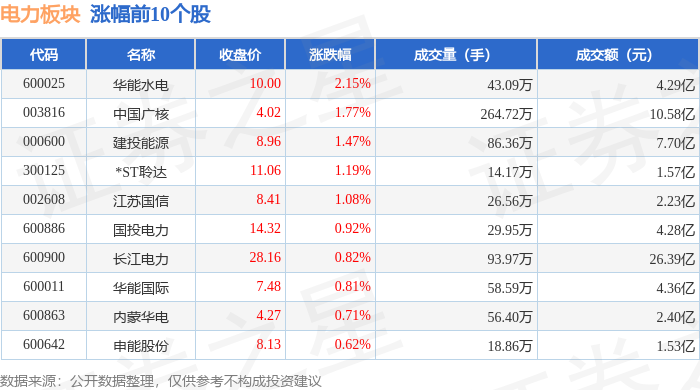
电力板块10月16日涨0.19%,华能水电领涨,主力资金净流出13.32亿元
Zheng Xing Xing Ye Ri Bao· 2025-10-16 08:20
Core Insights - The electricity sector experienced a slight increase of 0.19% on the previous trading day, with Huaneng Water Power leading the gains [1] - The Shanghai Composite Index closed at 3916.23, up 0.1%, while the Shenzhen Component Index closed at 13086.41, down 0.25% [1] Electricity Sector Performance - Huaneng Water Power (600025) closed at 10.00, up 2.15%, with a trading volume of 430,900 shares and a transaction value of 429 million [1] - China General Nuclear Power (003816) closed at 4.02, up 1.77%, with a trading volume of 2,647,200 shares and a transaction value of 1.058 billion [1] - Other notable performers include: - Jiantou Energy (000600) at 8.96, up 1.47%, with a transaction value of 770 million [1] - ST Lingda (300125) at 11.06, up 1.19%, with a transaction value of 157 million [1] - Jiangsu Guoxin (002608) at 8.41, up 1.08%, with a transaction value of 223 million [1] Capital Flow Analysis - The electricity sector saw a net outflow of 1.332 billion from institutional investors and 258 million from retail investors, while retail investors had a net inflow of 1.591 billion [2][3] - Key stocks with significant capital flow include: - Changjiang Electric (600900) with a net inflow of 299 million from institutional investors [3] - China Nuclear Power (601985) with a net inflow of 132 million from institutional investors [3] - Huaneng Water Power (600025) with a net inflow of 13 million from institutional investors [3]





今日19只股长线走稳 站上年线
Zheng Quan Shi Bao Wang· 2025-10-16 07:46
Core Viewpoint - The Shanghai Composite Index closed at 3916.23 points, above the annual line, with a slight increase of 0.10% on the day, and the total trading volume of A-shares reached 1,948.66 billion yuan [1][2] Group 1: Market Performance - As of the latest close, 19 A-shares have surpassed the annual line, indicating positive market sentiment [1] - The stocks with the largest deviation rates include Shenglong Co., Changshan Beiming, and Youlide, with deviation rates of 9.96%, 3.76%, and 2.52% respectively [1] - The total trading volume for A-shares today was 1,948.66 billion yuan, reflecting active market participation [1] Group 2: Individual Stock Highlights - Shenglong Co. (603178) saw a daily increase of 10.00% with a turnover rate of 9.13% and a latest price of 21.45 yuan, resulting in a deviation rate of 9.96% [1] - Changshan Beiming (000158) increased by 9.98% with a turnover rate of 9.68%, latest price at 24.57 yuan, and a deviation rate of 3.76% [1] - Youlide (688628) experienced a 4.23% increase, with a turnover rate of 2.91%, latest price of 36.22 yuan, and a deviation rate of 2.52% [1]


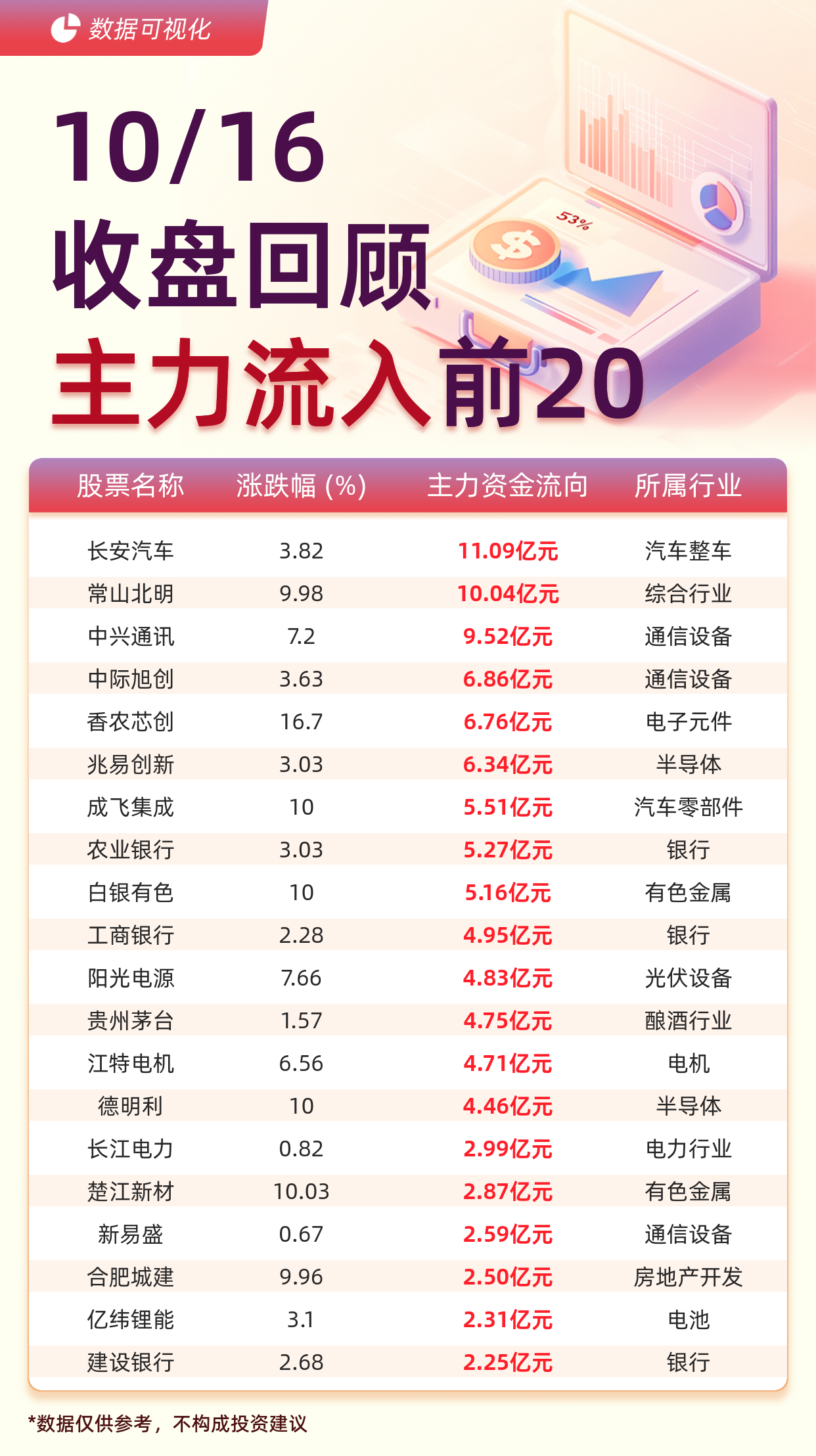
主力资金流入前20:长安汽车流入11.09亿元、常山北明流入10.04亿元
Jin Rong Jie· 2025-10-16 07:15
Core Insights - The main focus of the articles is on the significant inflow of capital into specific stocks as of October 16, with notable amounts recorded for various companies across different sectors [1][2][3] Group 1: Capital Inflows - The top stocks by capital inflow include Chang'an Automobile (¥1.109 billion), Changshan Beiming (¥1.004 billion), and ZTE Corporation (¥0.952 billion) [1] - Other notable inflows were seen in companies such as Zhongji Xuchuang (¥0.686 billion), Shannon Chip (¥0.676 billion), and Zhaoyi Innovation (¥0.634 billion) [1][2] - The banking sector also saw significant inflows, with Agricultural Bank of China receiving ¥0.527 billion and Industrial and Commercial Bank of China receiving ¥0.495 billion [1][3] Group 2: Stock Performance - Chang'an Automobile experienced a price increase of 3.82%, while Changshan Beiming saw a rise of 9.98% [2] - ZTE Corporation's stock rose by 7.2%, and Zhongji Xuchuang's increased by 3.63% [2] - Shannon Chip had the highest increase at 16.7%, indicating strong market interest [2] Group 3: Sector Analysis - The automotive sector is represented by companies like Chang'an Automobile and Chengfei Integration, both showing positive capital inflows and stock performance [1][2] - The banking sector, including Agricultural Bank and Industrial and Commercial Bank, also demonstrated resilience with steady inflows [1][3] - The electronics and communication sectors, represented by companies like ZTE Corporation and Shannon Chip, are attracting significant investment, reflecting a growing interest in technology stocks [1][2]



【盘中播报】20只股长线走稳 站上年线
Zheng Quan Shi Bao Wang· 2025-10-16 03:19
Market Overview - The Shanghai Composite Index is at 3916.86 points, above the annual line, with a change of 0.12% [1] - The total trading volume of A-shares is 909.4 billion yuan [1] Stocks Breaking Annual Line - A total of 20 A-shares have surpassed the annual line today, with notable stocks including: - Shenglong Co., Ltd. (603178) with a deviation rate of 9.96% - Lege Co., Ltd. (300729) with a deviation rate of 2.14% - Jinguang Co., Ltd. (300510) with a deviation rate of 1.75% [1] Deviation Rate Rankings - The following stocks have the highest deviation rates after breaking the annual line: - Shenglong Co., Ltd. (603178): Today's change of 10.00%, turnover rate of 4.72%, latest price at 21.45 yuan [1] - Lege Co., Ltd. (300729): Today's change of 4.01%, turnover rate of 4.10%, latest price at 15.58 yuan [1] - Jinguang Co., Ltd. (300510): Today's change of 2.00%, turnover rate of 5.62%, latest price at 4.60 yuan [1] Stocks with Smaller Deviation Rates - Stocks with smaller deviation rates that have just crossed the annual line include: - Changjiang Electric Power (600900): Today's change of 0.36%, latest price at 28.03 yuan, deviation rate of 0.01% [2] - Beiqi Blue Valley (600733): Today's change of 3.05%, latest price at 8.11 yuan, deviation rate of 0.03% [2] - Hongcheng Environment (600461): Today's change of 0.22%, latest price at 9.10 yuan, deviation rate of 0.05% [2]




自带杠铃策略的上证180ETF指数基金(530280)涨超0.3%,本月以来涨幅排名可比基金首位
Sou Hu Cai Jing· 2025-10-16 02:35
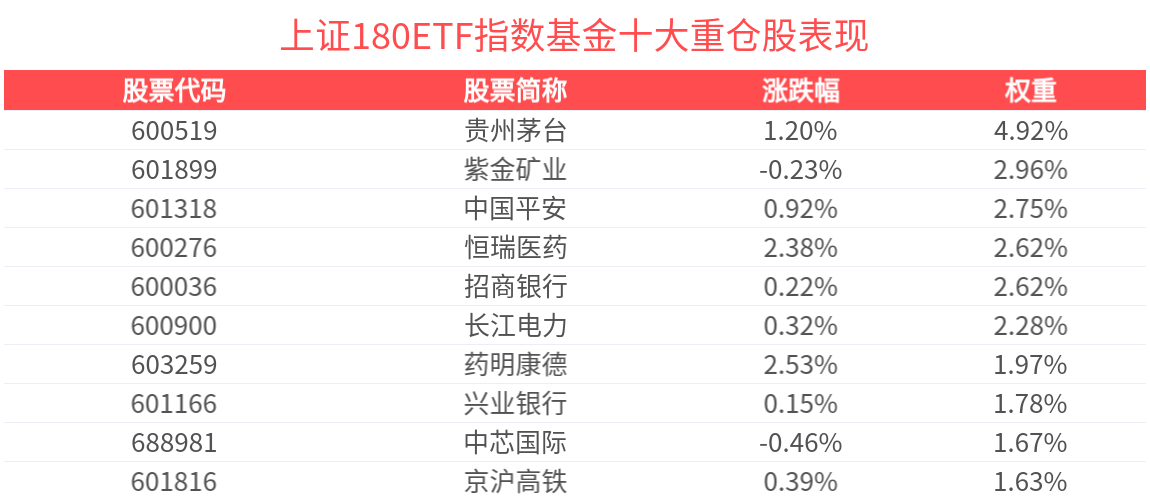
Core Viewpoint - The recent short-term market fluctuations do not alter the long-term bullish trend of the stock market, with dividend and technology assets expected to yield excess returns over time [1] Group 1: Market Trends - The long-term investment strategy emphasizes a barbell approach, combining dividend and technology assets, which are anticipated to benefit from increased equity market allocation by residents [1] - The Shanghai Stock Exchange 180 Index (000010) is structured with a 90% allocation to dividend assets and 10% to technology assets, making it a suitable choice for equity market investment [1] Group 2: Performance Data - As of October 16, 2025, the Shanghai Stock Exchange 180 Index rose by 0.45%, with notable increases in constituent stocks such as China Life (601628) up 4.37% and Zhaoyi Innovation (603986) up 4.17% [1] - The Shanghai 180 ETF Index Fund (530280) increased by 0.33%, with a current price of 1.23 yuan, and has shown a cumulative increase of 1.57% for the month as of October 15, 2025, ranking 1st among comparable funds [1] Group 3: Index Composition - The Shanghai 180 Index includes 180 large-cap, liquid stocks from the Shanghai market, with the top ten weighted stocks accounting for 26.75% of the index [2] - The top ten stocks by weight include Kweichow Moutai (600519), Zijin Mining (601899), and China Ping An (601318), among others [2][4]



北向资金三季度持续加仓A股 科技制造板块获重点配置
Huan Qiu Wang· 2025-10-16 02:08
Group 1 - As of the end of Q3, the northbound capital's holdings in A-shares reached 2.58 trillion yuan, marking a growth of 12.9% and 15.59% compared to the end of Q2 and Q1 respectively, with a total increase of over 340 billion yuan in the first three quarters of this year [1][3] - The trend of increasing northbound capital strengthened further at the end of September, with ETF funds and northbound capital becoming the main sources of incremental market funds before the National Day holiday, while margin trading funds showed a seasonal net selling characteristic [3] - By the end of Q3, the top three industries in terms of northbound capital holdings were power equipment (443.803 billion yuan), electronics (391.523 billion yuan), and biomedicine (183.941 billion yuan), with banking and food & beverage industries dropping out of the top three compared to the end of Q2 [3] Group 2 - In Q3, northbound capital significantly flowed into the technology manufacturing sector, particularly in semiconductor equipment and AI computing-related segments, with the electronics industry seeing an increase of over 150 billion yuan in holdings and an increase of 1.821 billion shares [3] - The proportion of the electronics industry's holdings in total industry market value reached 15.17%, a substantial increase of 4.96 percentage points compared to the end of Q2, making it the highest growth among all industries [3] - As of the end of Q3, the top ten heavy stocks held by northbound capital included CATL, Kweichow Moutai, Midea Group, China Merchants Bank, Northern Huachuang, Huichuan Technology, Zijin Mining, Heng Rui Medicine, Yangtze Power, and Fuyao Glass, with Northern Huachuang, Heng Rui Medicine, and Fuyao Glass entering the top ten, while BYD, Ping An Insurance, and Mindray Medical exited [3]




研报掘金丨长江证券:维持长江电力“买入”评级,全年业绩展望依然积极
Ge Long Hui A P P· 2025-10-15 07:12
Core Viewpoint - Changjiang Power's electricity generation in Q3 2025 reached 108.47 billion kWh, a year-on-year decrease of 5.84% due to alternating water levels impacting seasonal performance [1] Group 1: Water Supply Impact - The total water supply for the Wudongde Reservoir in the first three quarters was approximately 83.49 billion cubic meters, a decrease of 6.04% compared to the same period last year [1] - The total water supply for the Three Gorges Reservoir was about 298.88 billion cubic meters, down 4.54% year-on-year [1] Group 2: Overall Performance - The total electricity generation from the company's six domestic cascade power stations in the first three quarters was approximately 235.13 billion kWh, remaining stable compared to the previous year [1] - With the onset of autumn floods and considering the current abundant water supply, the company's annual performance outlook remains positive despite a significant decline of 17.60% in Q4 of the previous year [1] Group 3: Investment Outlook - The company is viewed as a stable dividend investment, maintaining a "Buy" rating due to its long-term investment value [1]
人工智能赋能电力行业新未来
Zhong Guo Dian Li Bao· 2025-10-15 06:44
Core Insights - The integration of AI technology in the power industry is a significant trend, enhancing network security through intelligent analysis, decision-making, and operational efficiency [1] - AI applications in the power system focus on classification and prediction, enabling fault diagnosis and proactive protection against anomalies [2][3] - The collaboration between Huaneng Lancangjiang Company and Deepin Technology has led to the establishment of a cybersecurity maturity model, improving overall network security management [3] Group 1: AI Technology in Power Industry - AI technology enhances network security by providing high-value support for intelligent analysis, decision-making, and operational efficiency [1] - The application of AI in the power system includes machine vision for fault diagnosis and neural networks for anomaly detection [2][3] - AI enables a comprehensive approach to fault management, including prevention, real-time identification, and post-incident analysis [3] Group 2: Cybersecurity Practices - Huaneng Lancangjiang Company has implemented a unified security monitoring platform covering 39 units, improving overall situational awareness and reducing management pressure [4] - The company's cybersecurity strategy emphasizes minimizing exposure, concealing network asset information, detailed asset management, and talent development [5] - Yunnan Electric Power Company utilizes the Cloud Shield platform for comprehensive network security awareness, characterized by rapid perception and accurate alerts [5] Group 3: Future Prospects - Experts agree on the broad prospects of AI technology in the industry, emphasizing the need for deep integration with industry network structures and asset characteristics [6]
A股水电板块直线拉升,梅雁吉祥触及涨停,华能水电、闽东电力、川投能源、国投电力、长江电力等纷纷走高
Ge Long Hui· 2025-10-15 01:54
Group 1 - The hydropower sector experienced a significant surge, with Meiyan Jixiang (600868) hitting the daily limit up, indicating strong market interest [1] - Other companies in the hydropower sector, such as Huaneng Hydropower (600025), Mindong Electric Power (000993), Chuan Investment Energy (600674), Guotou Electric Power (600886), and Yangtze Power (600900), also saw notable increases in their stock prices [1]


