Bank Of Jiangsu(600919)

Search documents
本周聚焦:黄金波动下的机遇与挑战:银行贵金属业务有望成重要增长极
GOLDEN SUN SECURITIES· 2025-10-27 00:58
Investment Rating - The report maintains an "Accumulate" rating for the banking sector, indicating a positive outlook despite challenges in the gold market in 2025 [1]. Core Insights - The gold market is expected to present both opportunities and challenges for banks, with a trend towards deepening precious metal business driven by central bank purchases [1][2]. - The demand for gold bars and coins has increased significantly, reflecting a growing need for gold as a hedge and store of value among residents [4]. - The establishment of a market-making system for gold trading is anticipated to enhance market liquidity and stability, positioning listed banks as key players [3][4]. Summary by Sections 1. Policy and Market Environment - As of September 2025, China's official gold reserves reached 74.06 million ounces, marking an increase for 11 consecutive months [2]. - In Q2 2025, global central banks added 166 tons of gold to their reserves, with 95% of surveyed central banks expecting further increases in the next 12 months [2]. - New policies allowing insurance funds to invest in gold are expected to create new opportunities for banks to provide services to insurance institutions, enhancing their intermediary income [2]. 2. Business Dynamics and Revenue Contribution - In the first half of 2025, China's gold consumption was 505.205 tons, a year-on-year decrease of 3.54%, with significant growth in gold bar and coin consumption by 23.69% [4]. - The decline in gold jewelry consumption is prompting banks to shift focus from traditional jewelry sales to investment-oriented precious metal businesses [4]. - The growth in investment demand for gold bars and coins is expected to stabilize income from investment-related businesses, enhancing the profitability of the precious metals segment for banks [4]. 3. Industry Trends - The report highlights a structural shift in gold consumption, with investment demand rising while jewelry demand declines, indicating a need for banks to adapt their business strategies [4]. - The performance of the banking sector is expected to benefit from expansionary policies aimed at stabilizing the economy, with specific banks like Ningbo Bank and Jiangsu Bank recommended for investment due to positive fundamental changes [8]. 4. Key Data Tracking - The report includes various financial metrics, such as average daily trading volume and margin financing balances, which are essential for assessing market conditions [9][10].






招商基金王平旗下招商中证红利ETF三季报最新持仓,重仓宁波华翔
Sou Hu Cai Jing· 2025-10-26 21:39
Core Viewpoint - The report from the招商中证红利交易型开放式指数基金 indicates a net value growth rate of 9.21% over the past year, with significant changes in the top ten holdings compared to the previous quarter [1]. Group 1: Fund Performance - The fund achieved a net value growth rate of 9.21% over the last year [1]. - The report highlights the addition of new stocks to the top ten holdings, including 潞安环能, 中谷物流, 农业银行, 南钢股份, and 建设银行 [1]. Group 2: Changes in Top Holdings - New entries in the top ten holdings include: - 潞安环能 (669709): 7.7764 million shares valued at 1.11 billion - 中谷物流 (603560): 10.0744 million shares valued at 1.1 billion - 农业银行 (601288): 161.424 million shares valued at 1.08 billion - 南钢股份 (600282): 199.957 million shares valued at 1.05 billion - 建设银行 (601939): 117.632 million shares valued at 1.01 billion [2]. - 宁波华翔 (002048) saw an increase in holdings by 56.7 thousand shares, making it the largest holding at 2.73 billion [1][2]. - Other stocks that exited the top ten holdings include 成都银行, 兴业银行, 大秦铁路, 江苏银行, and 交通银行 [1][2].







关注信贷需求修复:银行业周报-20251026
Xiangcai Securities· 2025-10-26 14:50
Investment Rating - The industry investment rating is maintained at "Overweight" [4][7]. Core Insights - The new policy financial tools have been implemented to boost credit demand, with over 330 billion yuan allocated by three policy banks [3][27]. - A total of 500 billion yuan in new policy financial tools has been initiated, with 250 billion yuan already invested in 12 major economic provinces, focusing on infrastructure, foreign trade, and emerging sectors like digital economy and AI [4][5]. - The expected leverage effect of the 500 billion yuan policy financial tools could generate approximately 5 trillion yuan in investments and 4 trillion yuan in loans [4][29]. - The rapid deployment of these financial tools is anticipated to enhance credit demand in the fourth quarter, particularly benefiting regional banks due to the demonstration effect from major economic provinces [5][29]. Summary by Sections Market Review - The banking index increased by 1.40% during the period from October 20 to October 26, 2025, underperforming the CSI 300 index by 1.84 percentage points [9]. - The performance of major banks was relatively strong, with Agricultural Bank of China leading with a 4.86% increase [9]. Financial Market - The central bank's net injection in the open market was 198.1 billion yuan, maintaining a loose monetary environment [18]. - The average issuance rates for one-year interbank certificates of deposit were 1.68% for state-owned banks and 1.74% for regional banks, with a notable increase in net financing of 425.3 billion yuan in October [22][26]. Industry Dynamics - The policy financial tools are expected to support long-term public loans and improve loan term structures, with a focus on sustainable credit demand release during project operation cycles [29]. - Investment in emerging industries, particularly AI, is projected to maintain strong financing demand, with technology innovation loans expected to grow rapidly [5][29]. Investment Recommendations - The report suggests focusing on state-owned banks for their stable high dividend yields and potential valuation recovery opportunities for joint-stock and regional banks amid improving economic expectations [7][30].

\十五五\规划背景下,银行如何进行战略升级?:银行业周报(20251020-20251026)-20251026
Huachuang Securities· 2025-10-26 11:16
Investment Rating - The report maintains a "Recommendation" rating for the banking sector, expecting the industry index to outperform the benchmark index by over 5% in the next 3-6 months [24]. Core Insights - The banking sector is transitioning from a "deposit-loan intermediary" to a key executor of national strategies and resource allocation hubs, focusing on five major areas: technology finance, green finance, inclusive finance, pension finance, and digital finance [2]. - The "14th Five-Year Plan" emphasizes the importance of financial system security, urging banks to balance profit-making with risk management while enhancing operational efficiency and service quality [3]. - The report highlights the need for banks to adapt to a more complex international competitive environment while prioritizing financial security and risk management in cross-border capital flows [3]. - The overall market performance shows a 1.40% weekly increase in the banking index, lagging behind the Shanghai Composite Index by 1.84 percentage points [7]. Summary by Sections Industry Overview - The banking sector's total market capitalization is approximately 1.15 trillion yuan, with a circulating market value of about 790 billion yuan [4]. - The report notes a 3.24% increase in the Shanghai Composite Index and a 2.88% increase in the Shanghai A-share market during the week [7]. Performance Metrics - The banking sector's absolute performance over the last month is 5.0%, with a relative performance of 2.8% compared to the benchmark [5]. - The report indicates a significant increase in the banking index over the past 12 months, with a relative performance of 24.4% [5]. Investment Recommendations - The report suggests a diversified investment strategy focusing on state-owned banks and stable joint-stock banks, highlighting the ongoing dividend plans and valuation improvement initiatives [8]. - Specific banks recommended for investment include China Merchants Bank, CITIC Bank, and Jiangsu Bank, among others, due to their solid fundamentals and growth potential [8][9].

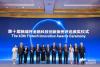
第十届融城杯金融科技创新十佳案例揭晓 农行邮储上榜
Xin Hua Cai Jing· 2025-10-25 11:35
Core Viewpoint - The "10th Rongcheng Cup Financial Technology Innovation Case Selection Award Ceremony" was held, recognizing ten institutions for their innovative contributions in various financial technology areas, showcasing significant advancements in inclusive finance, green finance, and intelligent risk control [1][3][5]. Group 1: Awarded Institutions and Innovations - The awarded institutions include Agricultural Bank of China, Postal Savings Bank of China, Industrial Bank, Shanghai Pudong Development Bank, Zhejiang Commercial Bank, Jiangsu Bank, Hangzhou Bank Wealth Management, Ant Group, Volcano Engine, and Sangfor Technologies [1][3]. - Agricultural Bank of China's AI + Smart Remote Sensing Financial Service Platform developed over ten AI remote sensing interpretation models, enhancing the quality of inclusive and green finance [3][4]. - Postal Savings Bank of China's enterprise-level model management practice established a governance framework covering the entire model lifecycle, creating a low-code intelligent platform for efficient decision-making [3][4]. - Industrial Bank's consumer rights protection intelligent review platform utilizes a compliance knowledge base to automatically identify potential violations, representing a significant application of intelligent technology in consumer protection [3][4]. - Shanghai Pudong Development Bank's digital financial supply chain project integrates blockchain, AI, and IoT technologies, establishing a comprehensive intelligent service system for supply chain finance [3][4]. Group 2: Additional Recognitions and Trends - The "Excellent Case" award was also given to nine other institutions, including Tianjin Bank and East Asia Bank, recognizing their contributions to financial technology exploration [5]. - The evaluation committee identified five new trends in digital finance development: technology integration, practical AI advancements, data value release, innovation in business models focusing on ecological collaboration, and lightweight digital transformation paths for small financial institutions [5].


江苏银行荣膺第十届“融城杯金融科技创新十佳案例”
Xin Lang Cai Jing· 2025-10-25 07:39
Core Insights - Jiangsu Bank's "Su Yin Green Finance Intelligent Service Platform" was recognized as one of the "Top Ten Financial Technology Innovation Cases" at the 10th "Rongcheng Cup" awards, highlighting the industry's acknowledgment of the bank's technological innovation capabilities [1][2] Group 1: Event Overview - The "Rongcheng Cup" financial technology case evaluation was co-hosted by the New Financial Alliance (NFA) and Financial City, with academic support from the China Financial Forty Forum (CF40) and Peking University's Digital Finance Research Center [2] - The evaluation process began on June 19 and included a rigorous selection and review, resulting in ten exemplary cases across various important fields such as inclusive finance, green finance, consumer protection, supply chain finance, and risk management [2] Group 2: Platform Development - Jiangsu Bank has been committed to the concept of green development and has integrated "greening" with "digitalization" as a key path for high-quality transformation in green finance [3] - The "Su Yin Green Finance Intelligent Service Platform" was developed over five years, employing a gradual development strategy to create a comprehensive decision management platform that integrates technological breakthroughs, model innovation, and ecological construction [3] Group 3: Core Functions - The platform addresses industry challenges such as the identification of diverse green business, analysis of vast green asset data, ESG risk management, and high-standard environmental information disclosure [4] - It features five core functions: green business identification, ESG risk management, environmental information disclosure, specialty product management, and green asset management, with several functions being industry firsts [4] Group 4: Technological Empowerment - The platform utilizes three core technologies to enhance its functionalities, including a large language model based on the DeepSeek architecture for building a green industry knowledge base, machine learning algorithms for optimizing important green finance models, and a domestic distributed big data platform for secure data integration [5] Group 5: Achievements and Impact - As of now, Jiangsu Bank has managed a green financing scale exceeding 750 billion yuan, achieving a reduction of 5.62 million tons of carbon dioxide emissions, saving 2 million tons of standard coal, and conserving 4.09 million tons of water [6] - The bank's achievements in the digitalization of green finance have received high praise from regulatory bodies and internal user groups, demonstrating a leading role in providing replicable and promotable advanced experiences for the integration of "greening" and "digitalization" in the financial industry [6]
城商行板块10月24日跌0.76%,厦门银行领跌,主力资金净流出1.42亿元
Zheng Xing Xing Ye Ri Bao· 2025-10-24 08:27
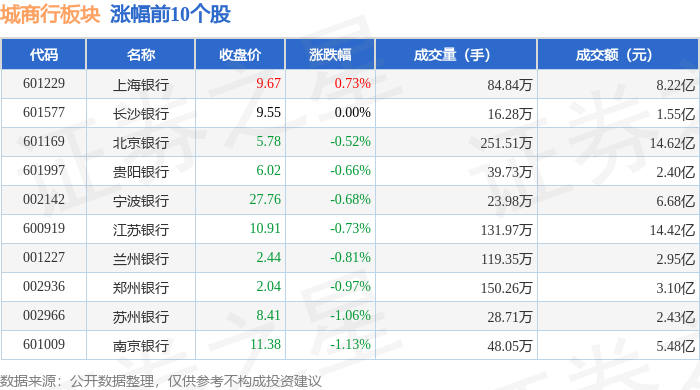
Core Insights - The city commercial bank sector experienced a decline of 0.77% on October 24, with Xiamen Bank leading the drop [1] - The Shanghai Composite Index closed at 3950.31, up 0.71%, while the Shenzhen Component Index closed at 13289.18, up 2.02% [1] Stock Performance - Shanghai Bank closed at 9.67, up 0.73% with a trading volume of 848,400 shares and a transaction value of 822 million [1] - Xiamen Bank closed at 6.68, down 1.76% with a trading volume of 153,100 shares and a transaction value of 103 million [2] - The majority of city commercial bank stocks showed negative performance, with notable declines in Beijing Bank (-0.52%) and Guizhou Bank (-0.66%) [1][2] Capital Flow - The city commercial bank sector saw a net outflow of 142 million from institutional investors, while retail investors contributed a net inflow of 55.9 million [2] - Jiangsu Bank had a net inflow of 70.84 million from institutional investors, while Shanghai Bank experienced a net outflow of 78.96 million from retail investors [3] Individual Stock Analysis - Chengdu Bank had a slight negative net flow from institutional investors of 19.75 million, but a positive inflow from retail investors of 596.99 million [3] - Lanzhou Bank saw a net inflow of 13.36 million from institutional investors, while it faced a net outflow of 1.48 million from retail investors [3]


银行股逆市向上,银行ETF南方(512700)拉升涨超1%,冲击四连阳,银行板块防御属性持续彰显
Xin Lang Cai Jing· 2025-10-23 02:22
Core Viewpoint - The banking sector is showing strong defensive characteristics amid market adjustments, with expectations of seasonal performance improvements due to high dividends and low valuations [2] Group 1: Market Performance - As of October 23, 2025, the Bank ETF Southern (512700) rose by 1.13%, marking a four-day winning streak with a transaction volume of 33.92 million yuan [1] - The CSI Bank Index increased by 1.18%, with notable gains from Postal Savings Bank (up 4.36%), Industrial Bank (up 1.91%), and Agricultural Bank (up 1.85%) [1] - Over the past five trading days, the Bank ETF Southern (512700) experienced net inflows on four occasions [1] Group 2: Interest Rate Policy - Tianfeng Securities suggests that the likelihood of lowering the Loan Prime Rate (LPR) this year is low, as the primary goal of such a move is to stimulate credit demand, which may not be significant in Q4 [1] - The report indicates that the focus will likely shift towards fiscal subsidies and structural monetary policy tools as a form of "indirect interest rate reduction" [1] - The main challenge for banks in asset-liability management is the pressure of asset reallocation [1] Group 3: Investment Outlook - According to Everbright Securities, the banking sector's defensive attributes are highlighted by rising risk aversion due to renewed trade tensions, making it an attractive investment option [2] - Historical data shows that the banking sector has a 70% and 80% probability of generating absolute returns in November-December and January of the following year, respectively [2] - The upcoming Central Economic Work Conference is expected to reinforce policies aimed at stabilizing growth, further supporting the banking stocks' seasonal performance [2] Group 4: Index Composition - The Bank ETF Southern (512700) closely tracks the CSI Bank Index, which categorizes companies into various industry levels for comprehensive performance analysis [2] - The top ten weighted stocks in the index include China Merchants Bank, Industrial Bank, and Agricultural Bank among others [2]


银行ETF指数(512730)涨超1.1%,农行15连阳累涨近25%
Xin Lang Cai Jing· 2025-10-23 02:16
Group 1 - The China Securities Banking Index (399986) has shown a strong increase of 1.17%, with notable gains from Postal Savings Bank (4.19%), Industrial Bank (2.06%), and Minsheng Bank (1.98%) [1] - Agricultural Bank has experienced a significant rally, achieving a 25% increase since September 25, with a total market capitalization approaching 2.9 trillion [1] - According to Everbright Securities, the banking sector's "high dividend, low valuation" characteristics are becoming more prominent, suggesting a potential reallocation opportunity in the sector [1] Group 2 - As of September 30, 2025, the top ten weighted stocks in the China Securities Banking Index account for 64.6% of the index, including major banks such as China Merchants Bank and Industrial Bank [2]
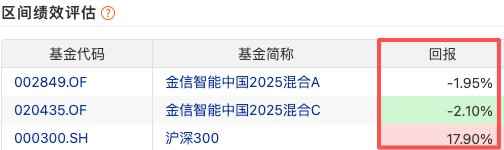
金信智能中国2025跑输大盘20%:“智能主题”基金却重仓银行,三季度踏空行情
Feng Huang Wang Cai Jing· 2025-10-22 12:58
Core Viewpoint - The phenomenon of investment style drift is evident in the third-quarter report of the Jinxin Fund's Intelligent China 2025 Flexible Allocation Mixed Fund, which, despite its stated investment goal of focusing on intelligent enterprises, has heavily invested in traditional financial stocks, leading to poor performance and significant underperformance compared to peers [1][10]. Fund Performance - Jinxin Intelligent China 2025 Mixed Fund reported returns of -1.95% for Class A and -2.10% for Class C in the third quarter, while the benchmark return was 12.19%, and the CSI 300 index rose by 17.90%, indicating a nearly 20% underperformance against the index [2][3]. - Year-to-date performance as of October 21 shows Class A with a return of 14.90%, ranking 1417 out of 2303 similar products, and a six-month return of 11.87%, lagging the CSI 300 by nearly 10 percentage points [4][5]. Investment Strategy and Holdings - The fund's investment objective is to focus on enterprises providing intelligent production, design, and services, including sectors like smart machinery and smart healthcare [6]. - However, the top ten holdings for the third quarter were entirely traditional financial stocks, including major banks such as Industrial and Commercial Bank of China and China Construction Bank, indicating a significant deviation from its stated investment strategy [8][10]. Investor Sentiment - Investors have expressed concerns regarding the fund's strategy, questioning the rationale behind its heavy allocation to traditional financial stocks instead of intelligent enterprises, leading to skepticism about the fund's alignment with its stated goals [11][13]. Regulatory and Market Implications - The drift in investment style raises compliance concerns, as frequent style changes can mislead investors regarding the product's risk profile, potentially leading to greater scrutiny and pressure on the fund's future performance [14].