CHIFENG GOLD(600988)

Search documents
赤峰黄金涨0.08%,成交额21.33亿元,近3日主力净流入1.23亿
Xin Lang Cai Jing· 2026-02-12 08:00
Core Viewpoint - The company, Chifeng Jilong Gold Mining Co., Ltd., is experiencing growth in revenue and profit, driven by its main business in gold and non-ferrous metal mining, with significant overseas revenue contributions due to the depreciation of the RMB [4][9]. Company Overview - Chifeng Jilong Gold Mining Co., Ltd. is located in Inner Mongolia and was established on June 22, 1998. It was listed on April 14, 2004. The company's main business includes gold and non-ferrous metal mining and resource recycling [8]. - The revenue composition of the company is as follows: gold accounts for 90.03%, electrolytic copper 3.76%, and other products including zinc concentrate, rare earth products, and molybdenum concentrate make up the remainder [8]. Financial Performance - For the period from January to September 2025, the company achieved a revenue of 8.644 billion yuan, representing a year-on-year growth of 38.91%. The net profit attributable to shareholders was 2.058 billion yuan, with a year-on-year increase of 86.21% [9]. - The company has distributed a total of 387 million yuan in dividends since its A-share listing, with the same amount distributed over the past three years [9]. Market Activity - On February 12, the stock price of Chifeng Gold increased by 0.08%, with a trading volume of 2.133 billion yuan and a turnover rate of 3.34%. The total market capitalization is 72.691 billion yuan [1]. - The stock has shown no significant trend in net inflow from major investors, with a net outflow of 2.1359 million yuan on the day of analysis [5][6]. Business Operations - The company operates a multi-metal mine in Laos, primarily engaged in copper mining and smelting [3]. - The overseas revenue accounted for 69.11% of total revenue, benefiting from the depreciation of the RMB [4]. Strategic Developments - The company is collaborating with Xiamen Tungsten Co., Ltd. to develop rare earth resources in Laos, with a project that has an estimated resource of 101 million tons of ore and 25,500 tons of rare earth oxides [4].

全球抢稀土!美国建战略储备、缅甸停矿、我国强化出口管制,稀土永磁迎来量价齐升+业绩高增双击时刻!
Xin Lang Cai Jing· 2026-02-11 10:16
Group 1 - North Mining Technology (600980) is a state-owned enterprise under the State-owned Assets Supervision and Administration Commission, focusing on mining equipment and magnetic materials, with a leading position in the global market for intelligent flotation machines and a 12% share in domestic sintered permanent magnetic ferrite production [1][25][26] - Greenme (002340) is a leader in the recycling of rare metals and new energy materials, with a dual business model of "urban mining + new energy materials," supplying major companies like CATL and BYD [1][27] - Xiamen Tungsten (600549) is a leader in tungsten, molybdenum, and rare earth permanent magnetic materials, with a complete industrial chain from mining to high-end magnetic material production [2][28] Group 2 - Jiyuan Wanfang (000612) is a significant player in aluminum smelting and rare earth permanent magnetic materials, leveraging local resources to form a dual business model of "aluminum + rare earth" [3][29] - Wanlong Magnetic Plastic (603150) is a leader in refrigerator door seals and magnetic materials, producing ferrite magnets for major appliance manufacturers [4][30] - Northern Rare Earth (600111) is the largest rare earth producer globally, controlling over 40% of the world's rare earth oxide production and holding significant pricing power [5][30] Group 3 - Chifeng Gold (600988) is involved in gold mining and rare earth resource development, with a strong position in the domestic rare earth market [6][31] - Zhongmin Resources (002738) is a leader in lithium mining and rare earth resources, with significant overseas rare earth mining rights [7][33] - Galaxy Magnet (300127) specializes in sintered and bonded neodymium-iron-boron magnets, serving major clients like BYD and CATL [8][34] Group 4 - Zhong Rare Metals (600259) focuses on rare earth mining and functional materials, with a strong position in the medium and heavy rare earth sectors [9][35] - Tianhe Magnetic Materials (603072) is a leader in high-end neodymium-iron-boron magnets, supplying major automotive and industrial clients [10][36] - Oriental Zirconium (002167) produces zirconium products and rare earth functional materials, with a focus on the electronics and new energy sectors [11][37] Group 5 - Jinli Permanent Magnet (300748) is a leading producer of rare earth permanent magnetic materials, with a strong presence in the automotive sector [12][38] - Huaxin Environmental (301265) focuses on environmental equipment and rare earth recycling, leveraging a dual business model [13][40] - China Rare Earth (000831) is a key player in rare earth mining and processing, with a focus on high-value applications in new energy and military sectors [14][49]


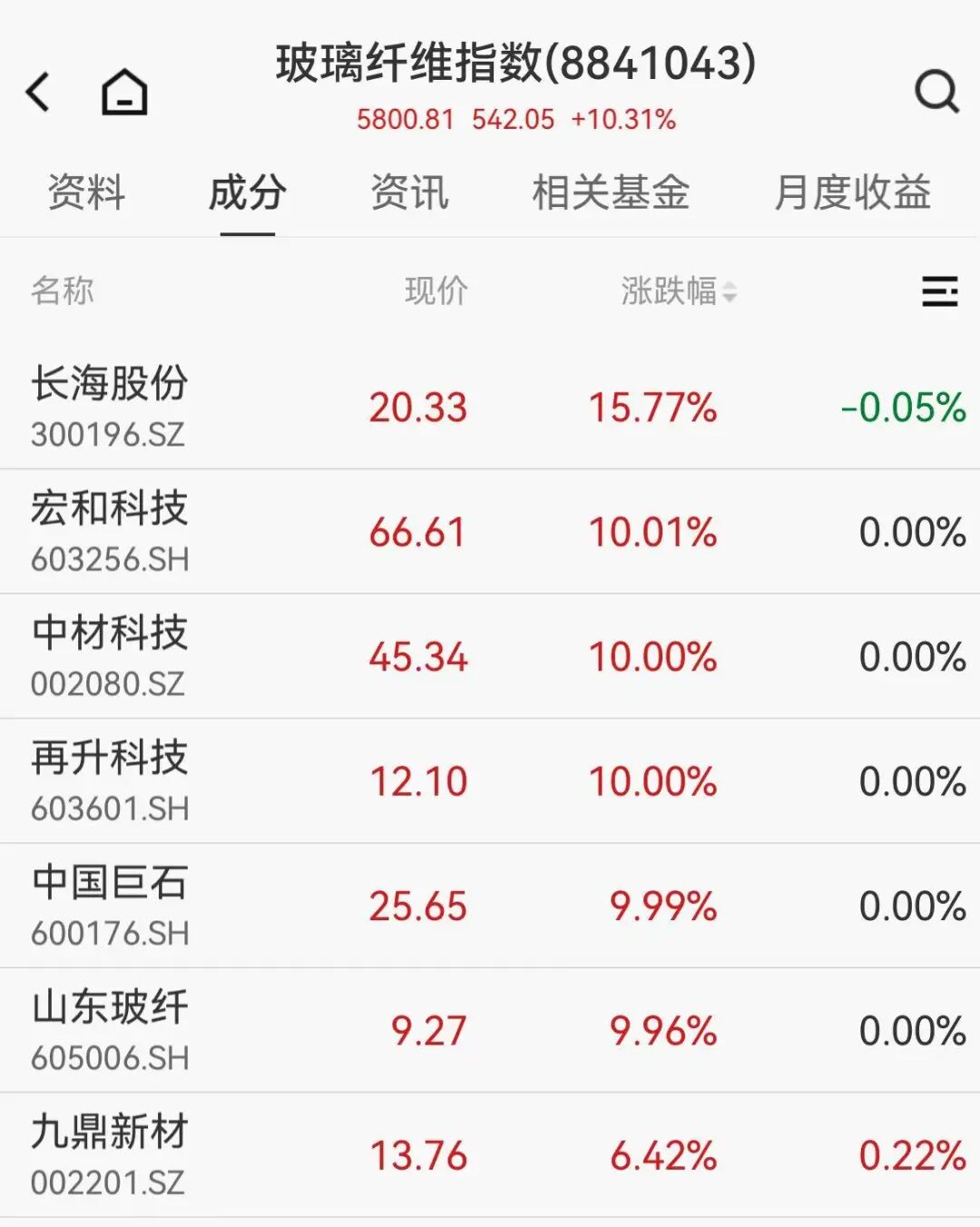
玻纤板块集体涨停,化工牛股5天4板,白银急升4%,加密货币超10万人爆仓
2 1 Shi Ji Jing Ji Bao Dao· 2026-02-11 08:11
Group 1: Market Overview - The A-share market showed mixed performance on February 11, with the ChiNext Index falling over 1% and total trading volume in the Shanghai and Shenzhen markets reaching 2 trillion yuan, a decrease of 123.7 billion yuan from the previous trading day [1] - Over 3,200 stocks in the market experienced declines, indicating a broad-based sell-off [1] Group 2: Chemical Industry Insights - UBS recently released a report raising expectations for the Chinese chemical industry, predicting a new upward cycle from 2026 to 2028 due to multiple positive factors, with expectations for profit recovery and valuation increases [1] - The chemical sector has shown resilience, with companies like Jihua Group and Taihe New Materials experiencing significant stock price increases [1] Group 3: Fiberglass Sector Performance - The fiberglass manufacturing sector saw a collective surge, with nearly all stocks hitting the daily limit, a rare occurrence in the market [1] - Notable stocks included International Composite Materials, which hit a 20% limit up shortly after market open, and others like Changhai Co., Honghe Technology, and China Jushi also saw significant gains [1][2] - The fiberglass sector's revaluation is linked to price increases and demand driven by AI, with major manufacturers indicating price hikes and low inventory levels [3] Group 4: Lithium Battery and Precious Metals - Lithium battery stocks were active, with Zhongcai Technology hitting the limit up and reaching a historical high [4] - The domestic commodity futures market saw most prices rise, with lithium carbonate increasing over 9% [4] - Precious metals also experienced volatility, with silver futures rising over 4% and gold prices recovering above $5,050 per ounce [5]


现货黄金日内收复5050美元,黄金股票ETF基金(159322)涨超3.1%
Xin Lang Cai Jing· 2026-02-11 06:09
Group 1 - The core viewpoint of the news is that the gold industry stocks are experiencing a strong rebound, with significant increases in the stock prices of major companies in the sector, indicating a positive market sentiment towards gold investments [1][2]. - As of February 11, 2026, the CSI Hong Kong-Shenzhen Gold Industry Stock Index (931238) rose by 2.97%, with key stocks such as Zijin Mining International and WanGuo Gold Group increasing by 8.48% and 8.45% respectively [1]. - The gold stocks ETF (159322) also saw a rise of 3.16%, closing at 2.09 yuan, reflecting the overall positive trend in the gold market [1]. Group 2 - The CSI Hong Kong-Shenzhen Gold Industry Stock Index comprises 50 large-cap companies involved in gold mining, refining, and sales, which collectively represent the performance of the gold industry in the mainland and Hong Kong markets [1]. - The top ten weighted stocks in the index account for 61.69% of the total index, indicating a concentration of investment in a few key players within the gold sector [2].



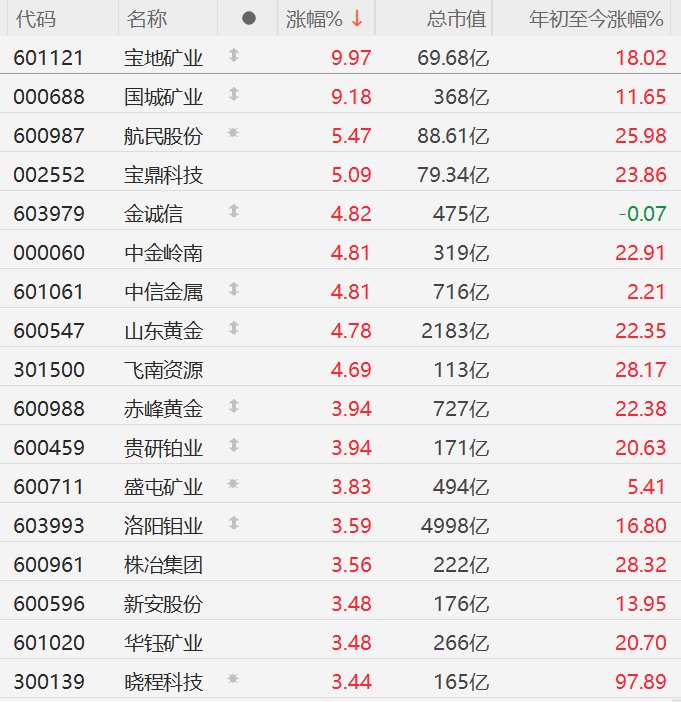
黄金概念股走强,山东黄金涨超4%
Ge Long Hui· 2026-02-11 06:02
Core Viewpoint - The A-share market saw a strong performance in gold-related stocks, with several companies experiencing significant price increases on February 11 [1] Group 1: Stock Performance - Baodi Mining reached the daily limit with a rise of 9.97%, bringing its total market value to 6.968 billion [2] - Guocheng Mining increased by 9.18%, with a total market capitalization of 36.8 billion [2] - Hangmin Co. and Baoding Technology both rose over 5%, with market values of 8.861 billion and 7.934 billion respectively [2] - Other notable performers included Zhongjin Metal, Shandong Gold, and Feinan Resources, all of which saw increases of over 4% [1][2] Group 2: Year-to-Date Performance - Baodi Mining has a year-to-date increase of 18.02% [2] - Guocheng Mining's year-to-date rise stands at 11.65% [2] - Hangmin Co. and Baoding Technology have year-to-date increases of 25.98% and 23.86% respectively [2] - Shandong Gold and Feinan Resources also reported strong year-to-date performances of 22.35% and 28.17% [2]


国际金价盘中走强,同标的费率最低的黄金股ETF(159562)涨超3%
2 1 Shi Ji Jing Ji Bao Dao· 2026-02-11 04:29
Group 1 - The core viewpoint of the articles highlights the strong performance of gold prices and related stocks, with COMEX gold futures trading around $5,080 and London gold at approximately $5,060 [1] - Gold-related ETFs have shown significant gains, with the 华夏 Gold ETF (518850) up 0.61%, the Non-ferrous Metals ETF (516650) up 3.16%, and the Gold Stocks ETF (159562) up 3.41%, indicating a positive market sentiment towards gold investments [1] - Six gold-listed companies, including Zijin Mining and Zhongjin Gold, have released earnings forecasts for 2025, with Zijin Mining expecting a net profit increase of 59%-62% year-on-year, and Zhongjin Gold projecting a Q4 net profit growth of 14%-75% quarter-on-quarter [1] Group 2 - The 华夏 Gold ETF (518850) and Gold Stocks ETF (159562) have a combined management and custody fee of 0.2%, which is among the lowest in their category, making it more cost-effective for investors to participate in the gold market [2]
有色板块爆发,南方基金旗下有色金属ETF(512400)劲升涨超3%,北方稀土涨超6%
Xin Lang Cai Jing· 2026-02-11 03:36
Group 1 - The core viewpoint is that the non-ferrous metals sector is experiencing short-term pressure due to pre-holiday sentiment, but there are structural opportunities in specific sub-sectors [2] - The global non-ferrous metals industry is expected to enter a "recovery cycle with supply constraints" from 2026 to 2027, with copper and aluminum prices shifting from supply constraints and loose liquidity in 2026 to demand recovery in 2027 [2] - The supply growth of electrolytic aluminum is projected to be only 1.7% in 2026, with a supply gap of over 800,000 tons; electrolytic copper supply growth is 2.4% while demand growth is 3.3%, indicating a shift from surplus to shortage [2] Group 2 - Tungsten is expected to see a continued supply-demand shortage due to China's mining control policies, leading to sustained price increases from 2026 to 2027 [3] - Rare earth permanent magnets are experiencing tightening supply-side integration, with improving demand expectations for exports, indicating a fundamental improvement [3] - Cobalt is projected to face a global shortage due to supply reduction policies in the Democratic Republic of Congo, with strong upward momentum in the short term [3] Group 3 - Lithium is benefiting from the rising demand for energy storage batteries and domestic supply disruptions, potentially at the bottom of its cycle [3] - Nickel is expected to clear supply issues from the second half of 2026 to 2027 due to Indonesia's quota policies, with prices likely to rise if economic recovery boosts stainless steel demand [3] - Magnesium is gaining traction in the lightweighting sector of new energy vehicles due to its higher cost-effectiveness compared to aluminum, indicating improved industry sentiment [3] Group 4 - The non-ferrous metals ETF (512400) closely tracks the CSI Shenyin Wanguo Non-Ferrous Metals Index, which selects 50 listed companies to reflect the overall performance of the non-ferrous metals sector in the Shanghai and Shenzhen markets [3] - The top ten weighted stocks in the index include Zijin Mining, Luoyang Molybdenum, Northern Rare Earth, China Aluminum, and Huayou Cobalt, among others [3]


赤峰黄金涨2.07%,成交额4.22亿元,主力资金净流入3498.39万元
Xin Lang Cai Jing· 2026-02-11 02:01
Core Viewpoint - Chifeng Gold's stock price has shown significant fluctuations, with a year-to-date increase of 20.17% and a recent decline of 2.57% over the past five trading days, indicating volatility in the market [1]. Group 1: Stock Performance - As of February 11, Chifeng Gold's stock price rose by 2.07% to 37.54 CNY per share, with a trading volume of 422 million CNY and a turnover rate of 0.68%, resulting in a total market capitalization of 71.34 billion CNY [1]. - The stock has experienced a 20.17% increase year-to-date, a 2.57% decline over the last five trading days, a 16.15% increase over the last 20 days, and a 25.30% increase over the last 60 days [1]. Group 2: Financial Performance - For the period from January to September 2025, Chifeng Gold reported a revenue of 8.644 billion CNY, representing a year-on-year growth of 38.91%, and a net profit attributable to shareholders of 2.058 billion CNY, reflecting an 86.21% increase [2]. - The company has distributed a total of 387 million CNY in dividends since its A-share listing, with the same amount distributed over the past three years [3]. Group 3: Shareholder Information - As of September 30, 2025, Chifeng Gold had 104,000 shareholders, a decrease of 14.13% from the previous period, with an average of 0 shares per shareholder, unchanged from the previous period [2]. - The top ten circulating shareholders include Hong Kong Central Clearing Limited, which holds 49.81 million shares, a decrease of 36.05 million shares from the previous period [3].
临近春节假期致需求走弱,铜铝价格以稳为主
Zhong Guo Neng Yuan Wang· 2026-02-10 12:54
Core Viewpoint - Precious metals, particularly gold and silver, have seen further declines in prices, but the Federal Reserve's anticipated interest rate cuts this year are expected to support precious metal prices moving forward [2][3]. Precious Metals - Gold price this week was $4,948.00 per ounce, down $33.85 from January 30, a decrease of -0.68% [2]. - Silver price this week was $74.94 per ounce, down $28.25 from January 30, a decrease of -27.38% [2]. - The Federal Reserve officials have expressed views on the need for interest rate cuts this year, with expectations of multiple cuts [2]. Copper and Aluminum - Demand weakened as the Chinese New Year approaches, leading to stable prices for copper and aluminum [4][6]. - LME copper closed at $12,900 per ton, down $540 from January 30, a decrease of -4.02% [4]. - SHFE copper closed at ¥99,810 per ton, down ¥3,360 from January 30, a decrease of -3.26% [4]. - Domestic aluminum price was ¥23,110 per ton, down ¥1,530 from January 30 [5]. Tin - Domestic refined tin price was ¥356,660 per ton, down ¥66,970 from January 30, a decrease of -15.81% [7]. - Inventory levels indicate a tightening supply situation, but short-term demand remains weak [7]. Antimony - Domestic antimony ingot price was ¥160,000 per ton, unchanged from January 30 [8]. - Demand feedback is average, and prices are expected to remain stable [8]. Industry Ratings and Investment Strategy - Gold industry maintains a "recommended" investment rating due to the Fed's rate cut cycle [9]. - Copper industry also maintains a "recommended" investment rating due to ongoing tight supply [10]. - Aluminum, tin, and antimony industries maintain "recommended" investment ratings based on supply dynamics [11]. Recommended Stocks - Gold industry recommendations include Zhongjin Gold, Shandong Gold, and China National Gold [12]. - Copper industry recommendations include Zijin Mining and Western Mining [12]. - Aluminum industry recommendations include Shenhuo Co. and Yunnan Aluminum [12]. - Tin industry recommendations include Tin Industry Co. and Huaxi Nonferrous [12].

全球资产去美元化+央行购金,构筑贵金属长期投资逻辑
Sou Hu Cai Jing· 2026-02-10 03:03
Group 1 - The core viewpoint is that the long-term logic of the precious metals bull market remains solid, with gold's role shifting from an inflation hedge to a geopolitical risk and dollar credit weakening hedge [1][22]. - As of the end of January, China's official gold reserves reached 74.19 million ounces, an increase of 40,000 ounces compared to December 2025, marking the 15th consecutive month of gold accumulation by the People's Bank of China [1][17]. - The precious metals market is influenced by factors such as global central bank gold purchases, a weakening dollar, and the restructuring of the global monetary system [1][22]. Group 2 - The non-ferrous mining ETF tracks the upstream mining segment of the non-ferrous metal industry, showing strong price elasticity and higher beta values, particularly in commodity bull markets or inflationary environments [2]. - The non-ferrous mining index has achieved a cumulative increase of 279.71% over the past decade, outperforming mainstream non-ferrous indices [2][12]. - The index's annualized return over the past decade is 14.71%, with a volatility of 30.04% and a Sharpe ratio of 0.63, indicating a favorable risk-adjusted return [15]. Group 3 - The non-ferrous mining index is heavily weighted towards copper, gold, and aluminum, which together account for over 58% of the index [7]. - Key components of the index include Zijin Mining (9.44% weight), Luoyang Molybdenum (9.25% weight), and Northern Rare Earth (5.69% weight) [10]. - The index's performance is characterized by higher elasticity compared to similar indices, reflecting its strategic significance in both industrial development and financial markets [12][15].